
Ad-network economics guideName the paid eventRecord whether the contract charges measured impressions, clicks, views, conversions or another defined event, including the reporting cutoff and adjustment rule. Separate the ledgersAdvertiser charges and publisher compensation can follow different agreements. Reconcile each side with its own event, period, currency and deductions. Judge buyer valueRead CPC or CPM beside qualified visits, approved conversions, reversals and accepted value by source. Scale the marginal cohort only when its complete economics remain useful.
How do ad networks make money across CPC and CPM buying?
Ad networks generally earn through a disclosed fee, a margin between advertiser spend and publisher compensation, or an agreed managed-service charge. CPC makes a recorded click the buyer's billable event; CPM uses measured impressions. Those labels do not reveal the network's entire commercial arrangement. Compare counted delivery, filtering, adjustments, currency, reporting access and mature cost per accepted outcome before you allocate more budget.

Revenue model overview
Ad network revenue models at a glance
An ad network connects advertiser demand with publisher inventory, records eligible delivery and applies the commercial terms agreed with each side. Its revenue may be a stated platform or service fee, a margin retained between buyer spend and supply compensation, or a managed-buying charge. Contracts differ, which is why a buyer should read the actual billing and reporting definitions rather than infer the model from one rate.
Under CPM, measured impressions are the billable unit. Under CPC, recorded clicks are the billable unit. A network can still compensate supply under a different agreement, so advertiser pricing and publisher payment do not have to use the same event. Auction clearing, invalid-traffic filtering, adjustments, currency conversion and service scope can all affect the final reconciled amounts.
For advertisers, the practical question is whether total spend produces accepted outcomes at sustainable economics. For publishers, it is whether eligible delivery, deductions and payment terms are transparent enough to forecast revenue. OpenRTB explains how bid requests and responses move through programmatic trading; it does not prescribe a network's commercial margin. See the IAB Tech Lab OpenRTB standard for the transaction protocol context.
Buyer decision
Build the decision before buying more delivery
Write the paid event and accepted business outcome before comparing networks. A CPC proposal answers what one recorded click costs, while a CPM proposal answers what one thousand measured impressions cost. Neither alone tells you what an approved lead, sale, signup or install will cost.
List every amount that can change the comparison: media spend, platform or managed-service fees, taxes where applicable, currency conversion, minimum commitments, credits, adjustments and refunds. Mark each item as included, separate, conditional or unknown. If a term is unclear, treat it as a question for the provider rather than filling the gap with an assumption.
Then define the evidence required for a decision: delivery by source, accepted outcomes, maturity window, value or margin rule and a budget ceiling. This converts a general question about how networks earn money into a testable buying decision.
Commercial brief
What how do ad networks make money requires before media starts
Ask for the billing definition in writing. For CPM, confirm what counts as an impression, how the platform handles invalid or filtered delivery and which timezone closes the report. For CPC, confirm what qualifies as a click, how repeated or invalid clicks are treated and whether the displayed amount is a bid, average cost or final charge.
Separate the advertiser ledger from the publisher ledger. The buyer may pay for one event while the network compensates a publisher under another formula or commercial agreement. That difference can fund technology, traffic-quality controls, account service and business operations, but the exact allocation is provider-specific and should not be invented.
Map who owns each reconciliation step. The media buyer should verify spend and source delivery; analytics should confirm qualified visits; the backend should approve commercial outcomes; finance should confirm currency and invoice totals. Set the date when cohorts are mature enough to judge, and record the condition that pauses spend.
Connect the guide to live testing
Connect How do ad networks make money across CPC to a controlled audience test
Turn the commercial model into one controlled media cell. Keep format, market, audience and destination fixed, preserve source identifiers, and compare the billed event with mature accepted outcomes before expanding spend.
Create My Free Account
Inventory context
Build the campaign around user context, not channel labels
The same CPC or CPM label can cover very different user moments. A native placement inside editorial content, a display impression, a push notification and a pop experience create different attention, message space and landing-page expectations. Compare inventory by context and downstream behavior, not by billing acronym alone.
Match the creative promise to the destination and the accepted outcome. A broad-awareness impression may need a longer path before conversion, while an offer shown to an already interested visitor may support a direct response. Keep campaign, creative, source and landing identifiers so the economics can be traced to the exact journey.
Use separate campaign cells when format, market, device or audience intent changes materially. A blended account average can make an inexpensive source look profitable because a stronger source carries the result. Source-level evidence lets you retain valuable supply, cap uncertain supply and exclude only what fails the written rule.
Effective economics
Measure quality at the level where action is possible
Reconcile the commercial chain from spend to accepted value. Record measured impressions or clicks, qualified visits, conversion events, approved outcomes, reversals and revenue or another approved value measure. Each stage answers a different question; collapsing them into one conversion rate hides where the economics changed.
Calculate effective CPM as spend divided by measured impressions multiplied by one thousand. Calculate effective CPC as spend divided by recorded clicks. Calculate cost per accepted outcome as spend divided by approved outcomes after the maturity window. When order or lead values differ, compare accepted value and contribution after media cost using the business's approved formula.
Segment by source, placement, device, market, creative and landing path where the sample permits. Mark low-volume cells as inconclusive instead of treating random movement as proof. The useful output is a source-level action with a reason: keep, cap, investigate, exclude or retest.
Controlled scale
Scale only the part of the system that earned confidence
A network's revenue rises when more eligible media is purchased, but an advertiser should increase spend only when the next unit still supports the business outcome. Preserve the audience, creative, destination and measurement configuration that produced the evidence, then change one major lever at a time.
Track marginal economics separately from the original average. New sources, broader audiences or higher bids can change the mix of inventory and user intent. Compare the added spend cohort with the stable baseline using the same maturity window, currency and acceptance rule.
If accepted cost worsens, identify whether the cause is price, delivery quality, landing behavior, approval rate or delayed value. Roll back the changed lever when the written stop condition is reached. Controlled scale protects the advertiser's budget while giving useful sources a fair test.
Choose the execution format
Choose a paid-media format that supports How do ad networks make money across CPC
Choose push, native, display, pop, video or interstitial according to the user context and message. Keep the billing event separate from the business outcome, and evaluate each source under the same maturity and currency rules.
Create My Free Account
Commercial verification
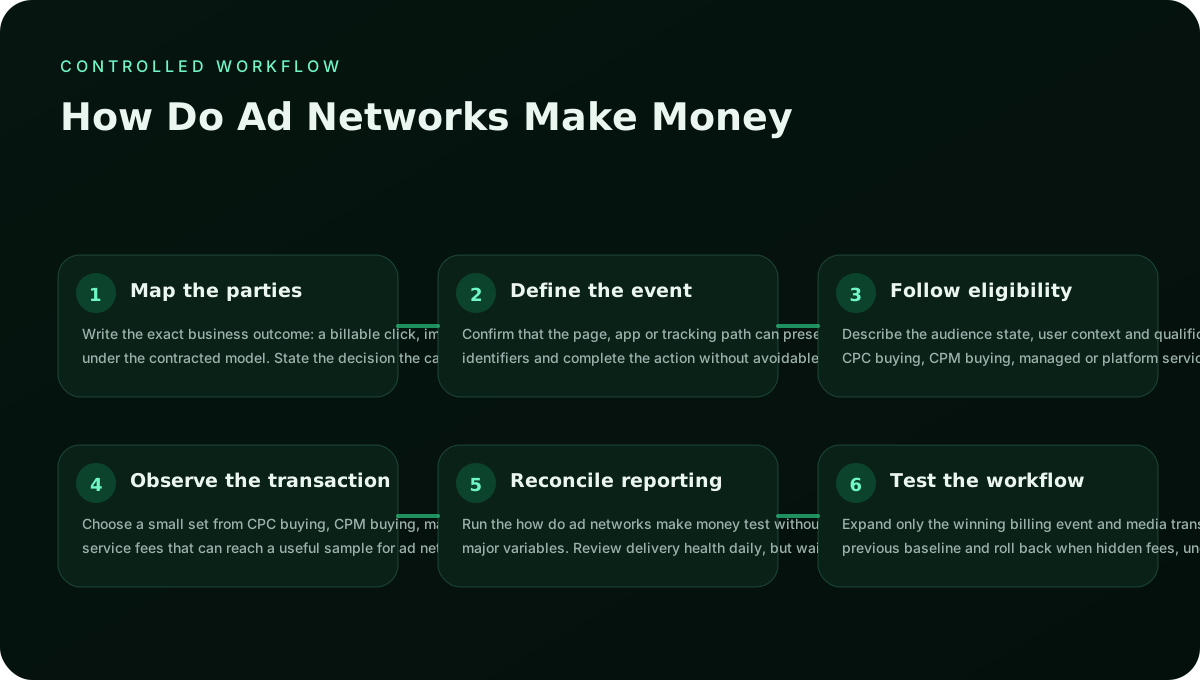
A six-step workflow for how do ad networks make money
- Name the parties. Record advertiser, network, exchange or intermediary where disclosed, publisher or supply partner, and any managed-service provider.
- Define the billable event. State whether the buyer pays for impressions, clicks, views, conversions or another contracted event and how invalid activity is filtered.
- Map money and reporting. List bid, cleared or charged amount, stated fees, adjustments, currency and invoice period without assuming an undisclosed margin.
- Define accepted value. Choose the approved sale, lead, signup or install, its maturity delay, reversal rule and business owner.
- Run one bounded cell. Hold format, audience, creative and destination stable; cap spend and preserve source identifiers.
- Reconcile and decide. Compare media delivery, qualified visits, accepted outcomes and value by source, then keep, cap, investigate, exclude or retest.
This workflow answers the buyer's real question: whether the network's commercial model and traffic can be evaluated transparently enough to support the next budget decision.
Decision table
Read the outcome, quality and guardrail together
Use the billed event for invoice reconciliation, the accepted outcome for campaign economics and source-level evidence for optimization. None of these measures should silently replace another.
A low CPM can be useful when the creative and landing path convert the additional reach. A higher CPM can still be viable when the inventory produces more accepted value. A low CPC can fail when visits are unqualified; a higher CPC can earn budget when approved outcomes remain economical. Compare mature cohorts under one attribution and currency rule.
Check transaction definitions against primary references. OpenRTB describes programmatic bid communication, while the IAB Tech Lab supply-chain resources provide transparency context. Google's guidance on cost reporting illustrates why the reported cost and billing basis must be read in the platform's own definitions.
Set guardrails for invalid or filtered delivery, missing source IDs, currency mismatch, reporting delay, duplicate conversions and outcome rejection. Pause the affected cell when a guardrail fails; do not use an attractive headline rate to excuse an unresolved evidence gap.
Put the guide into practice
Turn How do ad networks make money across CPC into a bounded campaign test
Set a spending limit, reporting cutoff and accepted-outcome rule. Launch one FroggyAds campaign cell, reconcile delivery and backend value by source, then scale only the part of the test that earned confidence.
Create My Free Account
Readiness check
Confirm the campaign can support a real decision
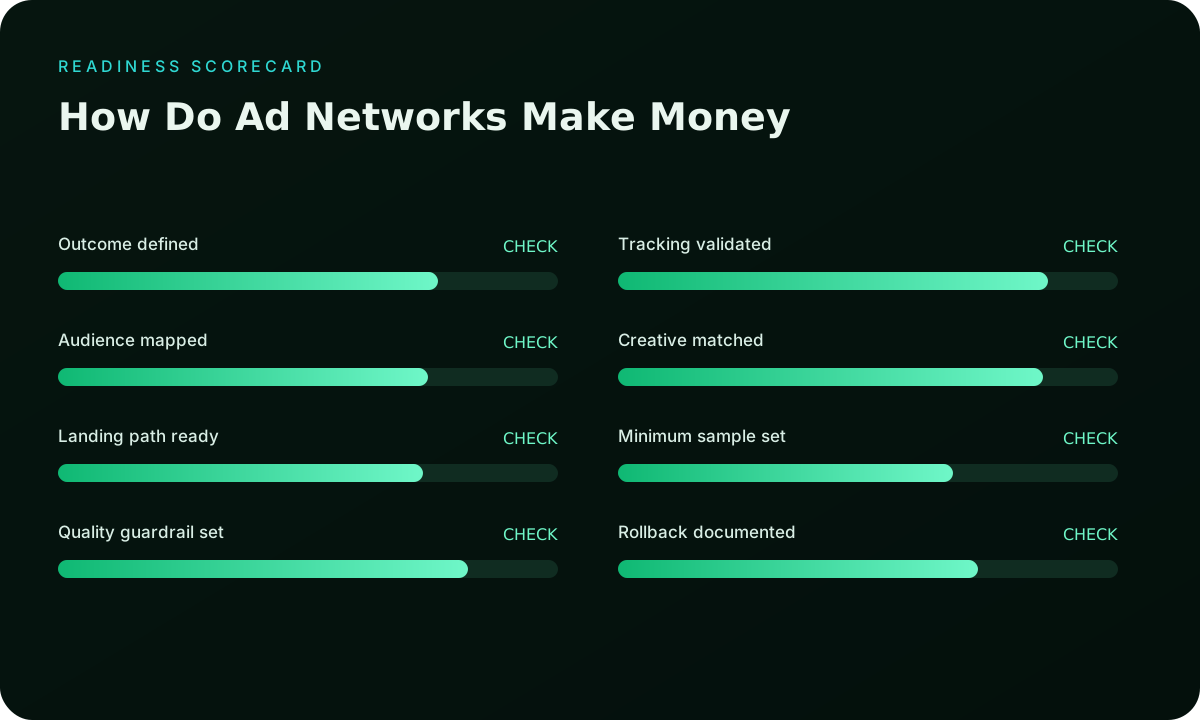
The test is ready when the billed event is defined, source IDs survive the journey, accepted outcomes have an owner, the maturity window is recorded and spend has a ceiling. The checklist does not guarantee performance; it prevents an undefined fee, delayed approval or blended total from dictating the budget.
Scenario response
How the next action changes when the evidence changes
| Observed pattern | Likely question | Next action |
|---|---|---|
| Delivery reconciles and accepted cost is stable | Can the result survive more volume? | Raise one budget or targeting control and compare the next cohort with the baseline. |
| Headline rate falls but approved outcomes weaken | Did cheaper supply change intent or quality? | Split by source and placement; cap the weak cell and keep the stronger evidence intact. |
| Clicks or impressions disagree with the invoice | Are filters, timezones or adjustments aligned? | Reconcile the contracted event and reporting period before optimizing traffic. |
| Media data matches but backend value does not | Is conversion tracking or approval status incomplete? | Hold spend, trace identifiers and wait for the maturity window. |
| One market changes after currency conversion | Is the comparison using the same currency date? | Normalize the financial view and record the conversion rule. |
Questions and answers
How Do Ad Networks Make Money: FAQ
Use these answers to separate billed media, network economics, publisher compensation and advertiser outcomes.
Where does an ad network earn its revenue?
An ad network may retain a disclosed margin between advertiser spend and publisher compensation, charge a stated platform or service fee, or provide managed buying under agreed terms. The exact arrangement varies by provider and contract.
How does CPM generate revenue for an ad network?
With CPM, the advertiser is billed for measured impressions. The network applies its supply and service agreements to that delivery. Confirm counted impressions, filtering, adjustments, currency and any separate fees before comparing offers.
How does CPC change the payment flow?
CPC makes a recorded click the advertiser's billable event. Publisher compensation can still follow a different agreement, so the buyer should not assume that the displayed CPC reveals the network's exact margin.
Is an advertiser's bid the same as the network's revenue?
No. A bid can be a maximum or auction input rather than the final charged amount. Clearing, delivery, adjustments, commercial agreements and service scope determine the reconciled economics.
Why can advertiser spend and publisher revenue differ?
The two sides can use different commercial terms, reporting periods, eligible-event rules, deductions and currency handling. Compare each ledger with its own contract rather than subtracting unmatched dashboard totals.
Which fees should an advertiser check?
Ask about disclosed platform or service fees, managed-service charges, currency conversion, minimum commitments, taxes where applicable, credits, refunds and adjustment timing. Record unknowns instead of estimating them.
Should a buyer choose the lowest CPC or CPM?
Choose the option that produces sustainable accepted outcomes after the cohort matures. A lower media rate can be valuable, but it can also hide weak intent or poor downstream quality when read alone.
How should source quality be compared?
Preserve source and placement identifiers, then compare delivery, qualified visits, approved outcomes, reversals and value under one attribution, currency and maturity rule. Mark low-volume cells as inconclusive.
What should publishers review in a network agreement?
Review eligible delivery, traffic-quality deductions, reporting access, revenue calculation, currency, payment timing, thresholds, adjustments and dispute procedures. Use the network's current written terms.
How can an advertiser test FroggyAds responsibly?
Create one bounded campaign with a defined audience, format, destination, accepted outcome and budget ceiling. Reconcile source-level spend with mature backend results, then expand one proven control at a time.
Related FroggyAds guides
Continue from planning into campaign execution
Ad network guide
Review the buyer and publisher roles before comparing commercial terms.
Programmatic advertising platform
Understand the controls used to buy and measure programmatic media.
Demand-side platform
See how buyers organize bids, targeting and campaign decisions.
Ad exchange platform
Connect inventory access with supply-path and reporting questions.
Run a controlled test
Turn the framework into a measurable campaign
Choose one format, audience, market and destination. Define the billed event, accepted outcome, maturity date and budget ceiling, then review source-level economics before changing another major control.
Direct answers
How Do Ad Networks Make Money: definition, decision and proof
Direct answer: A network can retain an agreed spread between demand and supply payments, charge a disclosed technology or service fee, or operate a managed buying arrangement. The parties, eligible event, deductions and settlement terms determine the actual economics. Do not infer a provider's margin by subtracting totals from dashboards that use different events or reporting periods.
Decision focus: trace the buyer's billable event, the publisher's eligible delivery and the advertiser's accepted outcome as three separate records.
What the advertiser buys
Write the precise chargeable event. For CPM, capture measured impressions, the thousand-impression denominator, filtering and adjustment window. For CPC, capture the recorded click, repeated-click treatment and any invalid-activity review. Mark whether a displayed number is a maximum bid, clearing amount, average cost or final charge. This prevents a rate label from being mistaken for an invoice definition.
What the publisher earns from
Document eligible inventory, measured delivery, traffic-quality deductions, revenue calculation, currency, payment timing and later adjustments. The supply agreement may not mirror the advertiser's billing event. Compare publisher revenue with the corresponding eligible records and settlement period, rather than with an unmatched buyer dashboard.
What the network provides
Networks can aggregate inventory, connect demand with supply, operate buying and reporting technology, apply traffic-quality controls and provide account services. Which activities are included, separately charged or funded through a margin is contract-specific. Ask for current written terms and avoid claiming an undisclosed allocation.
What the media buyer decides
The buyer's decision is whether source-level traffic produces accepted outcomes at viable marginal economics. Hold format, audience, creative and destination steady through the first cohort. Preserve campaign and source identifiers, wait for approval or reversal delays, and compare the next unit of spend with the saved baseline.
| Ledger | Evidence to reconcile | Decision it supports |
|---|---|---|
| Advertiser charge | Billable event, count, price, currency, filters and adjustments | Confirms the media invoice and effective CPC or CPM. |
| Publisher settlement | Eligible delivery, deductions, revenue calculation and payment period | Explains supply-side revenue under the publisher agreement. |
| Traffic quality | Source, placement, device, market, qualified visits and invalid events | Separates useful supply from cheap but weak delivery. |
| Business outcome | Approved conversions, value, reversals and maturity date | Shows whether the campaign earns another unit of budget. |
| Change record | Bid, budget, source set, creative, destination and rollback point | Makes the marginal result attributable and reversible. |
Eight checks before comparing networks
- Define the buyer's charged event.
- Confirm whether the displayed amount is bid, average or final cost.
- List disclosed service, platform, managed-buying and currency charges.
- Record filtering, adjustment and invoice windows.
- Preserve campaign, source, placement and conversion identifiers.
- Set the accepted-outcome rule and maturity delay.
- Compare equal cohorts under one currency and attribution method.
- Save the decision owner, spend ceiling and rollback condition.
Worked comparison
Suppose one cell spends 600 currency units for 300 recorded clicks and later produces 12 approved outcomes. Its effective CPC is 2 and its mature cost per approved outcome is 50. A second cell may show a lower CPC yet produce fewer approved outcomes. The lower media rate wins only when its accepted economics also meet the written ceiling. The example is hypothetical; use your own spend, status and value data.
Reconciliation stop rule
Pause the affected cell when billed-event totals cannot be reconciled, source identifiers disappear, currency handling changes, approval delays exceed the declared window or accepted cost crosses the ceiling. Restore the last stable settings before testing another hypothesis. An unresolved ledger difference is a measurement problem, not evidence that more volume will repair the campaign.
What this page can establish
The method can show whether a specific commercial model is transparent enough for a controlled campaign and whether the observed traffic deserves more budget. It cannot reveal confidential provider margins, promise a universal CPC or CPM, guarantee traffic quality or predict profit. Record the contract and campaign evidence that actually applies to your account.
Primary reference set: IAB Tech Lab OpenRTB overview, OpenRTB 2.6 specification, Google Ad Manager Programmatic Direct overview, Google Ads display purchase options, Google Ads CPM definition, and Google Ads average CPC definition. Verify active platform settings and commercial terms again before launch.
Search intent and buyer decision
The buyer task this ad-network revenue URL owns
This page owns the commercial-mechanics question: which event the advertiser buys, how the network may earn a fee or margin, why buyer and publisher agreements can differ, and how to reconcile headline media rates with accepted business outcomes. The nearby How websites make money from ads guide answers the publisher monetization question; use this page when the buying decision depends on CPC, CPM, fees, reporting and source-level economics.
Evidence to request before comparing offers
- The contracted billable event and invalid-activity treatment.
- Whether the displayed rate is a bid, clearing price, average or final charge.
- Any disclosed platform, service, managed-buying or currency charges.
- Reporting timezone, adjustment period and invoice reconciliation process.
- Source or placement detail available for optimization.
- The advertiser's own accepted-outcome and value definition.
Why use FroggyAds for the controlled media test?
We give advertisers, affiliate marketers, media buyers and agencies a self-serve path to configure campaigns and evaluate traffic against their own conversion and acceptance data. Use a bounded first campaign to compare source-level delivery with accepted outcomes. Increase spend only where the complete economics support the next decision.
Direct answer
What matters first in a CPC or CPM revenue model?
First identify the billable event and the disclosed commercial arrangement. Then reconcile spend, measured delivery, source quality and mature accepted outcomes under one currency and attribution rule. A lower CPC or CPM deserves more budget only when the complete result remains commercially useful.