
Growth Marketing Campaign: How to Plan, Launch, Measure and Improve
Turn one growth question into a campaign your team can launch and learn from. Choose a customer problem, prepare a testable change and use FroggyAds for the paid introduction. We help advertisers, agencies, ecommerce and SaaS teams control available formats, targeting, bids, budgets and sources while their own customer or product records establish the useful outcome.
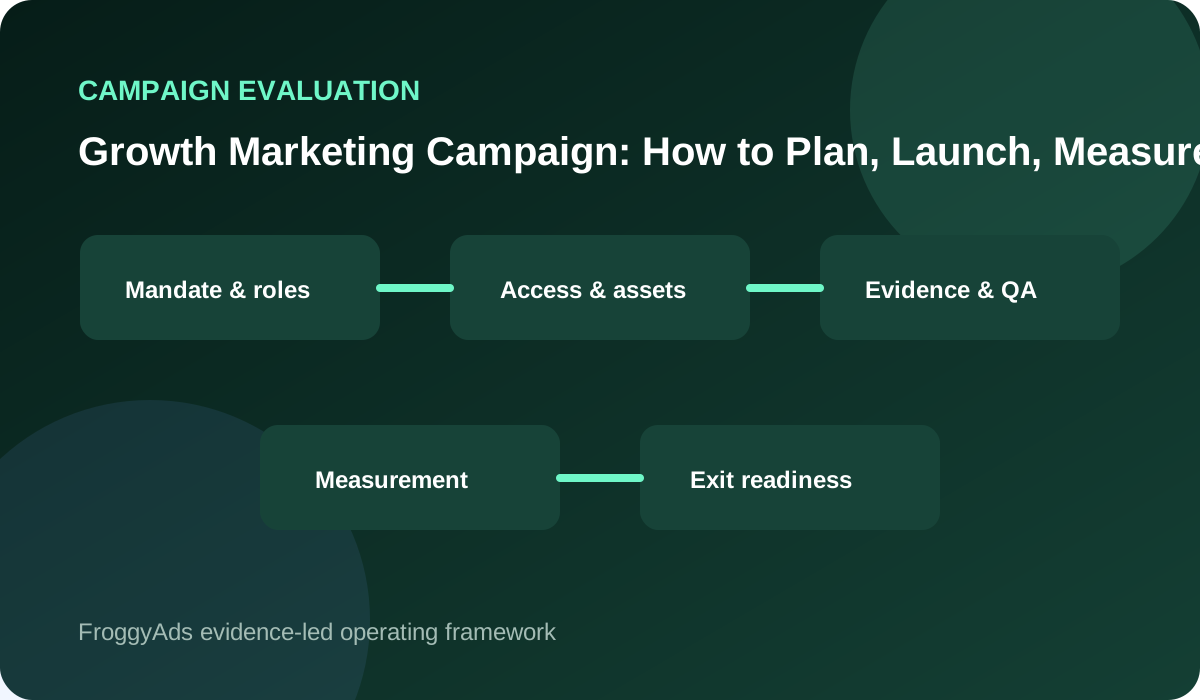
How do you run a growth marketing campaign?
Run a growth marketing campaign by choosing one lifecycle problem, writing a hypothesis and preparing the buying, destination and measurement needed to examine it. Use FroggyAds to purchase a controlled introduction, then review the intended customer outcome alongside spend and limitations. A campaign can test acquisition messaging or support a wider activation question; it does not automatically prove retention, profit or causal improvement simply because traffic arrived.
| Starting decision | Question to answer | Record before launch |
|---|---|---|
| Customer problem | Which observable interruption should this campaign address? | Customer evidence, affected journey stage and one priority question. |
| Proposed change | What message, offer or buying choice will change? | Named hypothesis and the approved version being tested. |
| Paid introduction | Which eligible visitors and interaction fit the test? | Selected FroggyAds format, available targeting and destination. |
| Useful outcome | Which action will show progress beyond delivery? | Event definition, receiving record and observation period. |
| Next purchase | What evidence would continue, revise or pause the campaign? | Affordable allowance, review question and responsible buyer. |
Choose the lifecycle stage your campaign serves
Growth marketing campaigns can address different stages: attracting a suitable visitor, helping a trial user reach first value or understanding whether a customer returns. Give this campaign one primary job. FroggyAds supplies paid distribution when the experiment needs an introduction; your destination, product or sales process supplies the experience being examined. A campaign brief should explain how those parts connect without treating every lifecycle measure as the same conversion.
Assign the hypothesis and campaign owner
Name the person who can explain the growth hypothesis and the buyer who implements its paid campaign. A small team may combine these responsibilities; an agency engagement may divide them. Identify who prepares the destination and who verifies customer outcomes so a missing response has someone able to investigate it.
Keep the responsibility attached to the work. We provide FroggyAds campaign controls for the traffic purchase. Your team supplies the offer, creative, destination and subsequent customer experience. If the hypothesis concerns onboarding or retention, name the product or customer-service owner needed to change that experience; buying more visits cannot implement the product change itself.
Select one customer problem and useful outcome
Choose the lifecycle interruption before selecting a campaign tactic. A SaaS team may observe trials that never complete a useful first action; an ecommerce team may find that eligible visitors cannot understand a product benefit. Explain the observed problem in customer terms, then decide which part a paid introduction can usefully test.
Make the primary outcome specific enough to count. A trial registration, activated account, valid first order and returning customer answer different questions. Choose the event that matches the campaign objective and keep intermediate responses available as diagnostics. Avoid changing the success definition after delivery merely because another available metric looks stronger.
Build a baseline the test can explain
Record the existing customer journey before changing it. Keep the offer, destination version, traffic context and observation period with the relevant counts. If historical records cannot connect visits to activation or acceptance, name that gap. The first campaign may need to establish a descriptive baseline rather than promise an improvement against an unreliable one.
Use comparable denominators. A signup rate needs the eligible visitor count behind it; an activation rate needs the matching signup group. Preserve pending outcomes and the time available to complete the action. A different traffic mix or a longer observation period can change the ratio without demonstrating that your new message caused the change.
| Baseline stage | Count to retain | Boundary to document |
|---|---|---|
| Eligible arrival | Visitors who could use the offer and destination. | Market, device journey and measured arrival definition. |
| Initial response | The matching registrations, enquiries or checkout actions. | Duplicate rule, test-record exclusion and acquisition period. |
| Useful activation | Customers completing the stated first-value action. | Event owner, receiving record and time to observe it. |
| Later behavior | The same customer group returning or remaining active. | Equal observation age; unfinished retention stays provisional. |
Write a campaign experiment brief
Write the proposed explanation, change and expected observation together. For example, a trial offer may attract people who misunderstand the first task; clearer creative and destination wording could attract better-prepared users. That is a hypothesis to examine, not an established reason for weak activation. Specify what would make you revise the explanation.
Keep the experiment brief practical: approved message, chosen audience, destination, primary event, campaign allowance and review responsibility. Record the current version before adding a variation. When several teams contribute, settle which changes belong in this test and which should wait; otherwise the resulting customer group cannot explain which idea was actually tried.
Translate the audience brief into buying choices
Translate the audience brief into available FroggyAds settings and record the actual selection. Confirm the market can be served and the chosen device can complete the destination. Keep the offer and useful outcome clear so the purchase examines the intended customer question. Audience research can guide the message without implying that every need, behavior or lifecycle state is a selectable targeting field.
Build My Traffic Test
Prepare the people and customer capacity
Prepare the team to operate the campaign and receive its response. The buyer handles the actual FroggyAds settings; the creative owner supplies the approved asset; the destination owner checks the journey; the customer or product owner reviews the useful outcome. Confirm these tasks before live buying instead of discovering an unowned handoff after delivery.
Capacity affects what you should launch. A trial campaign needs a working start experience; a sales campaign needs someone available to respond; a product offer needs fulfillment. Choose a buying pace the receiving team can support, and arrange coverage for material campaign issues so a growth test does not create avoidable customer disappointment.
Keep access and campaign versions usable
Retain a usable record of the campaign configuration, approved creative and destination version. Confirm who can access the buying account and receiving records, with the business maintaining the authority it needs. Your campaign should remain understandable when another operator takes over, rather than depending on the original creator's memory.
Verify required access and recovery arrangements with each selected provider. Do not assume that permissions in a project or analytics tool automatically apply in the buying account. Give operators the access their actual tasks require and document handover; this guide does not assert a particular FroggyAds role system or single-sign-on feature.
| Campaign responsibility | Practical access question | Record to keep |
|---|---|---|
| Buying operation | Can the authorized buyer inspect and adjust the configured campaign? | Campaign ID, current settings and responsible operator. |
| Creative preparation | Can the next operator identify the approved asset and destination? | Version reference, source asset owner and launch approval. |
| Outcome review | Can the receiving team verify the intended customer action? | Event definition, permitted identifier route and record owner. |
| Handover | Can another responsible operator continue or pause the purchase? | Current configuration, unresolved issues and recovery contact. |
Define the campaign events and customer record
Define the useful customer event before interpreting a conversion count. If the campaign concerns activation, explain the action that represents first value and who records it. A registration can remain an intermediate step. Use permitted identifiers only where your implementation can connect the campaign response to that customer action.
Keep the records in their proper roles. FroggyAds reports delivery and available sources; your analytics describes measured behavior; your product, sales or order records establish the accepted event. Document how those records connect and where they do not. Attribution assigns credit under a rule and should not be presented as proof of incremental growth.
Verify the response handoff before delivery
Verify the tracking route your campaign actually uses. Available FroggyAds methods include supported conversion signals through pixels, macros or server-to-server reporting where applicable. Confirm the method's requirements and receiving record with your implementation. These methods do not imply a native CRM connection, product SDK or automated experiment-assignment system.
Use labelled test actions to check the event and duplicate rule before buying. Inspect a missing or invalid record as well as a successful one, then keep those tests outside the real outcome count. If the journey cannot produce a usable response record, repair it before funding a campaign that depends on that observation.
Turn the hypothesis into creative choices
Creative should express the customer problem and the specific idea being tested. A clearer benefit, stronger explanation of the first task or more direct next action can each be a useful variation. Choose one material idea where practical and preserve the approved offer so the comparison answers a recognizable campaign question.
Keep message changes traceable through the destination. Record which asset and page version the customer encountered and what the business promised next. A higher response rate can be unhelpful when the creative attracts people who cannot use the offer. Review the useful customer event alongside attention and initial response.
| Message hypothesis | Change to prepare | Observation that matters |
|---|---|---|
| Benefit clarity | Explain the useful result the customer can reasonably expect from the offer. | Whether eligible visitors understand and complete the intended next step. |
| Claim credibility | Choose approved proof that answers a real customer doubt about the advertised benefit. | Inspect useful customer actions while ensuring the supporting claim remains accurate. |
| First-task clarity | Describe the action needed after registration or arrival. | Whether the matching customer group completes the defined first-value action. |
| Eligibility clarity | Make material limits and conditions understandable before commitment. | Whether responses fit the serviceable customer group rather than merely increasing volume. |
Choose the format that fits the campaign interaction
Choose a supported FroggyAds format that can introduce your hypothesis clearly. Native or banner creative may explain a benefit before the visit; push and pop interactions need a destination prepared for that context. Confirm the actual creative requirements and use available reporting to inspect response. The preserved illustration is not a rate quote or a complete inventory of current features.
Choose My Campaign Format
Keep audience and lifecycle groups identifiable
Separate the customer state relevant to the question. New prospects, recent trial users and existing customers bring different histories to an offer. Apply available GEO, device, operating-system or category choices in FroggyAds where they fit. Do not assume that a detailed lifecycle description means the platform supplies a native customer-list or retention-targeting feature.
Record other channels that could affect the observation. Product changes, email follow-up or sales contact may influence activation after the paid introduction. Keep those conditions visible and avoid crediting each channel with the same customer independently. A simple campaign comparison describes what happened under those conditions; a causal claim requires an appropriate study design.
Measure the chosen growth outcome consistently
Keep the primary outcome's definition, acquisition group and review cutoff together. Confirm the time zone, counting rule and treatment of duplicates or reversals. Compare campaign cost with the same customer group rather than a convenient total from another period. When a record remains pending, retain that status instead of silently treating it as a failure or success.
Review delivery, initial response and the useful outcome as a sequence. A missing arrival suggests a different repair from a trial user who never reaches value. Inspect the earliest inconsistent stage before changing the buying. Reconcile differences through the actual implementation and avoid inventing a universal percentage of reporting discrepancy that the team should accept.
Design the comparison before running the experiment
Write the comparison you can actually run. Record the proposed change, exposure conditions, primary measure and observation logic before launch. FroggyAds supplies traffic-buying controls; it does not establish random assignment or an independent control group by default. If your test needs those methods, verify that the surrounding experiment implementation provides them.
Plan how to report negative and inconclusive findings. A broken event route is an implementation problem; a complete but small customer group may leave the hypothesis unresolved. A clear result should state what the campaign observed, what remains uncertain and which next question follows, without turning every completed test into a success claim.
| Experiment element | Decision before launch | Interpretation limit |
|---|---|---|
| Hypothesis | Name the customer problem and the change expected to address it. | A plausible explanation remains unproven until suitable evidence supports it. |
| Exposure conditions | Keep campaign, audience and destination versions identifiable. | Uncontrolled mix changes can weaken attribution to the proposed change. |
| Primary observation | Select the event, denominator and time available for completion. | An earlier proxy cannot silently replace the intended growth outcome. |
| Review rule | Decide what would continue, revise, pause or leave the test unresolved. | A spending or calendar limit can end a test without producing a final answer. |
Authorize an affordable campaign allowance
Authorize the purchase around one useful question and exposure you can afford. Record the actual FroggyAds bid and budget settings, then inspect delivered spend. A higher allowance can produce more observations but cannot repair unclear measurement or guarantee a reliable outcome. Define which problem would justify reducing or pausing the purchase.
Our USD 50 minimum deposit funds the account. Your test allowance is a separate buying decision, and the wider campaign may also require creative, destination or analysis work. Keep those costs visible when deciding whether the experiment is worthwhile. The funding minimum is neither a recommended universal test budget nor a promised cost per customer.
Compare campaign costs under a stated scope
Include the resources needed for this campaign question: media, creative preparation, destination changes and relevant measurement or analysis work. Distinguish reusable preparation from repeated campaign spending. A low media cost per response can still accompany substantial operating effort, so label which costs your comparison includes rather than calling every ratio fully allocated acquisition cost.
If you commission outside work, define the deliverable and how its fee is determined with that provider. Keep service fees separate from traffic spend. An outcome-linked agreement needs its own accepted-event rules; it does not turn a measured campaign CPA into a FroggyAds billing model or imply that we sell a managed growth program.
Launch the paid part of the experiment
Launch after the hypothesis, customer journey, measurement and affordable allowance are ready. Retain the current configuration and inspect actual delivery through FroggyAds reporting. Follow the defined response into its receiving record before deciding what the next purchase should change. A spending limit can contain the test while the resulting customer evidence remains uncertain.
Create My Free Account
Check campaign readiness through the customer journey
Check the approved creative, destination, material terms, available audience settings and response route before launch. Walk through the intended customer task on the selected devices. Known broken functionality should be repaired before buying visits. Paid traffic can reveal real response to a prepared experience; it should not be used as a substitute for basic destination preparation.
Review the actual configured campaign against the brief and confirm its submission status. Your internal authorization to spend and FroggyAds campaign review are different steps. Record the approved version and any open issue so a launch decision reflects the configuration that will run, rather than an earlier presentation or a task marked complete.
| Launch check | Task to complete | Reason to pause preparation |
|---|---|---|
| Creative and offer | Match the approved claim, asset and material terms to the destination. | A visitor would receive a different or unsupported promise. |
| Customer path | Complete the intended form, checkout or first task on eligible devices. | The useful action is broken, unclear or has no receiving owner. |
| Measurement | Verify labelled test events and the accepted counting rule. | The outcome needed for the experiment cannot be observed reliably. |
| Buying setup | Verify campaign settings, authorized allowance and review status. | The submitted configuration differs materially from the approved brief. |
Keep campaign claims and information use appropriate
Support the advertising claims you make and explain material terms before commitment. Review requirements for the actual market and offer, using the relevant specialists when needed. A growth experiment does not make misleading creative acceptable merely because the message is being tested. Keep the approved promise with the campaign version.
Use only the customer information needed for a permitted measurement task and verify who receives it. Consent and data-handling requirements belong in the implementation review. Google's linked consent-mode guide describes Google's tags; it does not establish a native FroggyAds consent integration, grant permission to collect information or certify the campaign's legal compliance.
Review the experiment as a buying decision
Bring the observed sequence to review: actual purchase, arrivals, intermediate responses and the chosen customer outcome. Show the acquisition group, observation period and unresolved records. Explain whether the proposed change was implemented as intended before discussing its result; a configuration error and an unsupported hypothesis need different next actions.
Record one useful decision after the review. Continue a coherent observation, revise the idea, repair the implementation or close the test as unresolved. Keep the reason and responsible person with the campaign record. A clean report is valuable when it changes the next purchase or customer experience, not merely because it contains more charts.
Use a pilot to verify the complete campaign
Use one representative campaign to verify the proposed launch and review process before adding more concurrent experiments. Inspect actual settings, destination behavior and receiving events, then let the relevant customer group develop. This pilot tests whether the team can operate the campaign and interpret its evidence; it does not promise a growth result.
Match the review to the event's timing. A first-value action may be observable before long-term retention or contribution. Record the early finding under that limited scope and schedule the later observation separately. Neither a completed pilot nor a fixed review date makes an unfinished customer outcome mature.
| Observed situation | Useful next action | Evidence before further buying |
|---|---|---|
| Delivery works, outcome unfinished | Continue only the observation the business can afford. | Pending cases, normal completion timing and the remaining question. |
| Message attracts unsuitable responses | Revise the supported offer explanation or eligibility message. | Affected creative version and the observed customer mismatch. |
| Journey or measurement is broken | Pause the affected purchase while the interruption is repaired. | A verified working customer path and receiving event. |
| Result supports another test | Expand one identifiable purchase with capacity in view. | Useful outcomes, included cost and limits of the current comparison. |
Hand over campaign learning and configuration
Hand over the campaign's current settings, approved assets, destination version and open questions when an operator changes. Include the receiving team's follow-up responsibilities and any customer observations still pending. Confirm actual access with the relevant providers so the next person can continue the campaign without reconstructing its history from a report headline.
Close a campaign with its learning intact. Retain what ran, what was observed and what future work remains justified. Explain whether the idea was unsupported, the implementation failed or the evidence stayed inconclusive. Those distinctions prevent the team from repeating the same unresolved experiment under a new campaign name.
Decide what to change after the campaign
Choose the next change from the observed customer problem and the test's limits. A useful outcome at acceptable included cost may justify another controlled purchase. A weak response may call for a clearer offer or a different eligible audience. State why the next action follows instead of treating a finished campaign as automatic authority to increase spend.
Keep later lifecycle evidence with the original campaign group. Activation, repeat use and contribution can change the interpretation of an initially attractive acquisition result. Observe those outcomes through the business or product records that actually own them. FroggyAds provides the traffic purchase; it does not guarantee that customers remain active or profitable.
A final growth campaign review card
| Review area | Question to answer | Decision it informs |
|---|---|---|
| Customer problem | Did the campaign address the interruption originally selected? | Retain the hypothesis or choose a better explanation. |
| Offer and audience | Did suitable people receive an understandable, serviceable offer? | Repair the message or available audience choices where evidence supports it. |
| Implementation | Did the approved campaign, destination and event route actually run? | Separate execution repair from interpretation of the idea. |
| Customer outcome | What useful actions occurred at the stated observation age? | Report the event achieved and keep later outcomes provisional. |
| Next allocation | Do included cost, capacity and unresolved limits support another purchase? | Continue, revise or pause one identifiable part of the campaign. |
Growth marketing campaign FAQ
What makes a campaign a growth marketing campaign?
A growth marketing campaign examines a customer or lifecycle problem through a defined hypothesis, change and review decision. It can concern acquisition, activation or later behavior. A paid campaign supplies an introduction when needed; the useful result comes from connecting that purchase to the customer action the experiment was designed to observe.
What should the first campaign experiment test?
Start with an observed interruption the team can act on, such as an unclear offer or a missing response handoff. Choose one primary outcome and a change that plausibly addresses the problem. Avoid launching several unrelated ideas together when the resulting customer group would not explain which action deserves another test.
How much should we budget for the campaign?
Choose an affordable allowance for the question, format, market and observation you need. Include relevant preparation work separately from media spend. Our USD 50 minimum deposit funds the FroggyAds account; it is not a universal experiment budget, guaranteed sample size or promised price for an activated customer.
How should we choose the audience for a growth test?
Audience selection starts with a customer group that can use the offer and destination. Apply available FroggyAds GEO, device, operating-system or category settings where relevant, and keep the lifecycle state and traffic context identifiable in your records. A research profile does not make every described characteristic a native targeting option.
What should change between creative variations?
Change a meaningful explanation of the customer benefit, supporting evidence, first task or eligibility condition. Keep the approved offer and destination consistent with that change. Review suitable responses and the primary customer outcome alongside clicks, so an attention-grabbing variation is not rewarded merely for attracting people the business cannot serve.
When is the destination ready for paid traffic?
The destination is ready when its offer, material terms and intended customer action work for the eligible visitors you plan to buy. Verify the receiving record and follow-up owner with labelled tests. Repair known functional gaps before launch, then use paid traffic to observe real response to the prepared experience.
How do we measure the campaign beyond clicks?
Define the useful event, matching customer group, denominator and review period before launch. Connect FroggyAds delivery with analytics and receiving records only through verified measurement. Keep initial responses, accepted outcomes and pending records separate. Attribution credit is useful reporting context and does not by itself establish causal growth.
How should we diagnose a weak campaign result?
Locate the earliest inconsistent stage: purchase, arrival, response or useful customer action. Inspect actual settings and the change timeline, then review source mix, offer clarity, destination behavior and receiving records. Test the repair supported by that evidence instead of changing targeting, creative and the customer experience together without a clear question.
What conditions should pause the campaign?
Pause or reduce the affected purchase when the intended journey is broken, required measurement is unusable, the configuration exceeds authorization or the business cannot serve the response. Repair and verify the specific interruption before continuing. A disappointing result under a working setup can instead require an idea revision or an honest inconclusive review.
When should we expand a growth marketing campaign?
Expand one identifiable purchase when useful customer evidence, included costs and service capacity support another allocation. Keep the earlier configuration and pending lifecycle observations visible. A favorable comparison can justify a further test without guaranteeing that a larger audience, new source or higher allowance will behave the same way.
Related operating guides
Use these related growth marketing guides when the campaign raises a broader decision. Strategy sets priorities, solutions compare the work needed around the buying, and tools support particular tasks. Keep this campaign's hypothesis and result together while you investigate those wider choices; an additional tool or channel is not automatically the right next step.
Primary references and product boundaries
The Google references explain Google's bidding, analytics, attribution and tagging products. The FTC resources support truthful advertising preparation. We use verified FroggyAds facts for our own buying guidance; a linked Google feature or implementation method is not automatically available in FroggyAds, and these references do not certify a campaign or promise results.
- Budget terminology: Google Ads: Choose your bid and budget
- Goal-based bidding: Google Ads: Determine a bid strategy based on goals
- Session reporting: Google Analytics: Traffic acquisition report
- Attribution concepts: Google Analytics: Get started with attribution
- Consent implementation: Google Tag Platform: Consent mode
- Server-side architecture: Google Tag Manager: Introduction to server-side tagging
- Claim support: Federal Trade Commission: Advertising and marketing basics
- Online advertising guidance: Federal Trade Commission: Online advertising and marketing
Choose FroggyAds for the paid introduction
Prepare one campaign hypothesis and a working destination, then use FroggyAds to control the traffic purchase. Select supported formats and available targeting, set bids and budgets, inspect reported sources and follow the response through your verified measurement. Create your free account when the next growth question is ready for a controlled campaign.
Turn one growth hypothesis into an executable campaign
Use this page to prepare, launch and review one growth marketing campaign. The related How To Do Growth Marketing guide covers the broader operating process. Here, the practical output is the specific hypothesis, configured purchase, customer observation and next action needed to run one useful campaign experiment.
Keep the campaign objective, audience and market fit, ad format, and budget and bid choices together in the brief. Explain how each serves the customer question rather than treating the settings as a checklist detached from the offer. Use the observed outcome to decide what the next traffic purchase should change.
| Campaign checkpoint | Action before continuing | Record for the next operator |
|---|---|---|
| Prepare | Choose the lifecycle problem, proposed change and useful customer event. | Hypothesis, baseline, approved offer and affordable campaign allowance. |
| Launch | Verify destination, event route and the actual FroggyAds configuration. | Campaign ID, asset version, selected settings and acquisition period. |
| Review | Compare the observed customer group with the question and stated limitations. | Outcome counts, pending cases, included cost and next buying decision. |
Hypothetical calculation: suppose campaign A spends USD 240 and records 8 activated users, while campaign B spends USD 300 and records 9. Media cost per activation is USD 30 for A and about USD 33.33 for B. B's larger activation count alone does not make its media cost more efficient. These invented figures exclude other campaign costs and do not establish causal lift, statistical reliability, customer retention or a FroggyAds rate or expected result.
Choose FroggyAds to put the paid part of your growth campaign into action. Our available formats, targeting, bids, budgets and source controls help you make a defined purchase and inspect its response. Bring a clear hypothesis and customer outcome. Create your free FroggyAds account.
Growth Marketing Campaign: How to Plan, Launch, Measure and Improve — what matters first
Start with one customer problem and a change your team can implement. Use FroggyAds for the controlled introduction, verify what actually ran and review the useful outcome under its stated limits. The next campaign should build on that learning, whether the right action is another purchase, a clearer offer or a repaired customer journey.