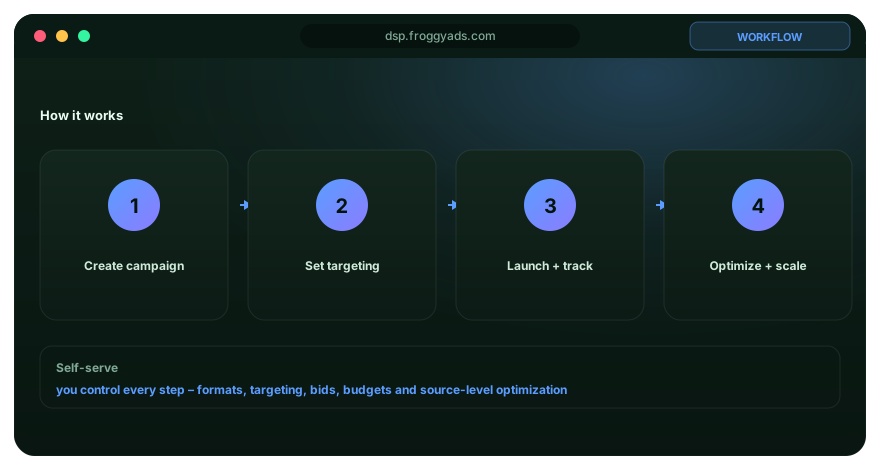
The media-buyer glossary.
New to programmatic, or just want a quick reference? These are the core terms behind FroggyAds – DSPs, SSPs, bidding models, ad formats, targeting and traffic quality – in plain language.
Programmatic advertising terms, explained
A plain-language reference for the formats, pricing models and controls you will use on FroggyAds.
DSP (Demand-Side Platform)
Software that lets advertisers buy programmatic ad inventory across many sources from one dashboard. FroggyAds is a self-serve DSP.
Learn moreSSP (Supply-Side Platform)
A platform publishers use to sell their ad inventory. FroggyAds connects to 750+ SSP integrations for global supply.
Learn moreRTB (Real-Time Bidding)
An auction that decides which ad is shown in the milliseconds a page loads. Advertisers bid programmatically per impression.
Learn moreCPC (Cost Per Click)
A pricing model where you pay per click. Push and Native start from $0.003 CPC on FroggyAds.
Learn moreCPM (Cost Per Mille)
Cost per thousand impressions. Display starts from $0.10 CPM on FroggyAds.
Learn moreCPV (Cost Per Visit)
A pricing model used for Pop traffic, where you pay per visit. Pop starts from $0.0001 on FroggyAds.
Learn morePush Ads
Clickable notification-style ads delivered to opted-in users on desktop and mobile.
Learn moreNative Ads
Ads that match the look and feel of the content feed they appear in, reading like recommended content.
Learn moreDisplay Ads
Banner and rich-media placements shown across websites and apps in standard ad sizes.
Learn morePop Ads
Full-page placements (pop / popunder) that open in a new window or tab for high-volume reach.
Learn moreInterstitial Ads
Full-screen ads shown at natural transition points, capturing full attention before continuing.
Learn moreAudience Targeting
Reaching users by interest, intent and behavior, including retargeting of warm visitors.
Learn moreSmartCPC
FroggyAds automatic bid-optimization engine that steers spend toward the sources and segments most likely to convert.
Learn moreAdscore
The traffic-quality layer that screens every impression for bots, proxies and fraud before it reaches your budget.
Learn moreSource ID
An identifier for an individual traffic source or zone, used to analyze and control performance at a granular level.
Learn moreWhitelist
A list of approved sources you want to keep buying from, so spend concentrates on what performs.
Learn moreBlacklist
A list of blocked sources you want to exclude, so budget stops going to weak or low-quality zones.
Learn moreConversion tracking
Measuring the actions that matter (sign-ups, sales, installs) with a pixel or postback so you can optimize to results.
Learn moreAd fraud / IVT
Invalid traffic such as bots, click farms and proxies that wastes budget. FroggyAds filters it with Adscore.
Learn moreBot filtering
Automatically detecting and removing non-human traffic before it is charged to your campaign.
Learn moreGEO targeting
Choosing the countries, regions or cities your campaign serves in, down to the city level.
Learn morePut it into practice
Open your FroggyAds account and launch your first campaign from $50.
Start buying traffic on FroggyAds
Create your account and reach 20B+ daily impressions across 750+ SSP integrations.
Core media-buying terms, defined
Programmatic media buying has its own vocabulary, and using it precisely makes you a sharper buyer. The terms below come up constantly on FroggyAds and across the wider industry – understanding them helps you read reporting correctly, set bids sensibly and optimize with intent rather than guesswork.
Pricing models are the foundation. CPC (cost per click) charges per click and suits direct-response push and native; CPM (cost per mille) charges per thousand impressions and suits display and branding; CPV (cost per view) charges per view and makes pop traffic extremely cheap to test. CPA (cost per acquisition) is the outcome metric you ultimately optimize toward – what it costs to win a conversion.
Supply and quality terms matter just as much. An SSP (supply-side platform) is where inventory comes from; a DSP (demand-side platform) like FroggyAds is what you buy with. A source ID identifies an individual traffic source so you can whitelist (allow) or blacklist (block) it. Bot traffic is automated, non-human traffic that Adscore screens out. Knowing these lets you run the core optimization loop – read by source, cut waste, scale winners – with confidence.
| Term | Meaning |
|---|---|
| CPC / CPM / CPV | Cost per click / per 1,000 impressions / per view |
| CPA | Cost per acquisition (the outcome metric) |
| DSP / SSP | Demand-side platform / supply-side platform |
| Source ID | Identifier for a single traffic source |
| Whitelist / Blacklist | Allow / block specific sources |
| Bot traffic | Automated non-human traffic (screened by Adscore) |
A DSP is what advertisers buy with; an SSP is where supply comes from. FroggyAds is a DSP connected to 750+ SSPs.
Pop CPV is extremely low (from $0.0001); push/native CPC from $0.003 is also cheap for direct response.
See it inside the platform
Everything runs from one self-serve dashboard – launch, target precisely, then watch results by source and optimize in real time.
- Launch and target in minutes
- Read performance by source ID
- SmartCPC and Adscore in the background