
France Website Traffic
Build a France website traffic test around French customer information, EUR pricing, metropolitan and overseas service boundaries, measurable source quality and a destination that completes the transaction without surprises.
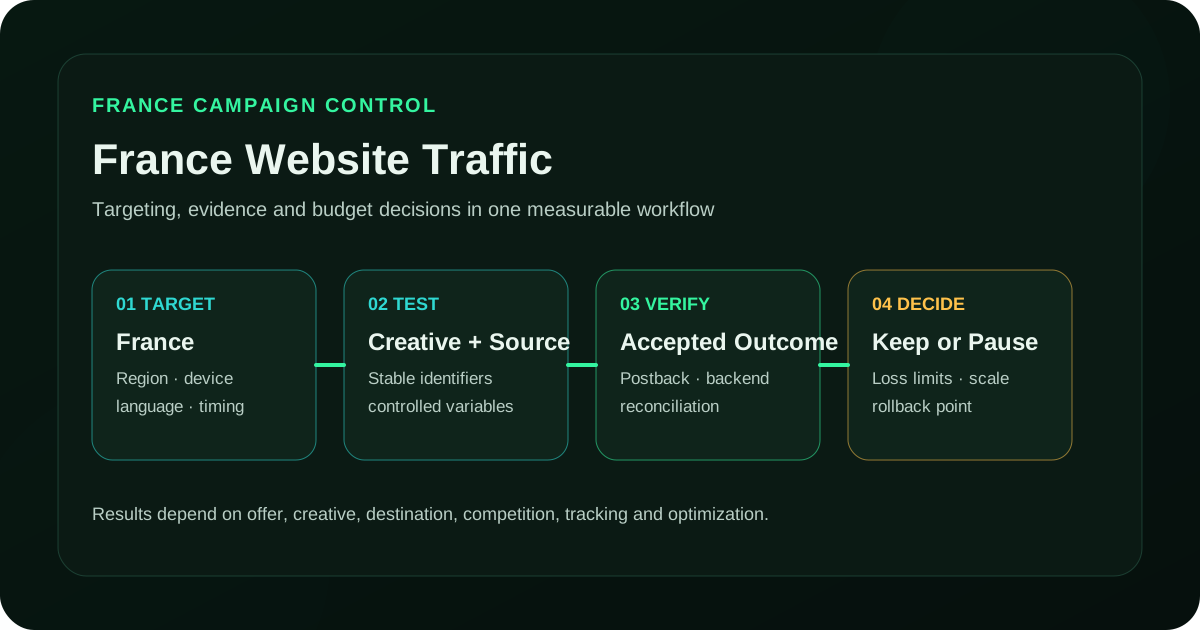
What is covered by this France website traffic guide?
France website traffic is paid delivery directed to an eligible audience in France and evaluated against an outcome the advertiser accepts. A defensible campaign does more than select a country. It records where the offer can actually be served, which French information a visitor receives, whether the payable price is clear in euros and includes taxes, which clock controls delivery, how consent and measurement work, and which source produced the accepted result. Start with a capped cell, preserve source and creative identifiers, compare platform events with the advertiser's backend, and expand only the cells that remain within the approved acquisition limit.
This page is a planning guide, not a promise of impressions, customers or revenue. FroggyAds can provide self-serve traffic access, targeting and reporting controls, while availability and results vary with inventory, bid, format, region, device, creative, destination, competition and measurement. The advertiser owns the offer, customer information, legal assessment, fulfilment, consent configuration and acceptance rules.
Why should France be planned as a market dossier?
A market dossier is the signed operating record behind a France campaign. It joins the media plan to the experience after the click. The dossier identifies the eligible geography, excluded areas, offer language, price basis, delivery promise, accepted outcome, measurement method, privacy roles and person able to stop spend. It also records the evidence date. That matters because a campaign can look French at the ad level while the checkout, support path or delivery policy contradicts the message.
Use one dossier for one materially consistent customer journey. A metropolitan France ecommerce offer priced in EUR, dispatched only to mainland addresses and measured after a completed payment should not share a decision row with a lead form serving Réunion or a Pacific checkout priced in XPF. Those cells can exist, but each needs its own scope, clock, currency, service promise and evidence. The purpose is not paperwork for its own sake. It is to prevent a national average from hiding a broken local transaction.
The dossier gives every team the same question: did this source deliver an eligible visitor who could understand the offer, complete the intended action and receive the promised service? If the answer cannot be reconstructed, the cell is not ready to scale.
Does one France setting cover metropolitan and overseas demand?
No. A country selector is not proof that an offer, price, payment route or delivery promise works in every French territory. Build operational lanes from verified serviceability rather than assuming that national identity creates one commercial environment. Metropolitan France, Corsica, overseas departments and regions, and Pacific collectivities can require different logistics, support, clock and currency checks.
| Planning lane | What the dossier must prove | Launch treatment |
|---|---|---|
| Metropolitan mainland | French offer, EUR and TTC price, delivery coverage, Europe/Paris schedule, payment completion | Open only verified departments and postcode rules |
| Corsica | Shipping eligibility, delivery time, surcharges, returns and support are accurate | Separate when the fulfilment promise differs |
| Overseas departments and regions | Territory-specific availability, local clock, taxes or charges, payment and support path | Use a distinct cell and destination evidence |
| Pacific collectivities | Local serviceability and IANA zone; New Caledonia, French Polynesia and Wallis-et-Futuna use XPF, not EUR | Do not inherit a metropolitan price or schedule |
| Excluded locations | The ad and landing page do not imply fulfilment where the advertiser cannot serve | Exclude before budget is released |
FroggyAds targeting should be configured to the approved lane and then tested against observed delivery. The platform setting controls media eligibility; the advertiser's checkout and fulfilment systems control commercial eligibility. Both must agree.
What must the French-language customer path contain?
France is not a market where translation can be treated as optional decoration. Article 2 of Law 94-665 requires French for the designation, offer and presentation of goods, products and services, instructions for use, warranty scope and conditions, invoices and receipts, and advertising. Other languages may supplement the French version. Where the law's covered statements are translated, the French presentation should remain at least as legible, audible or intelligible. A professional should obtain advice for the exact product, audience and exception rather than infer a universal rule from this summary.
For a campaign, the practical test is continuity. The promise in the placement, the landing-page explanation, the payable price, the order button, the delivery terms, the withdrawal route and support messages should not force the visitor to guess the commercial meaning. Machine translation is not evidence that regulated or safety-sensitive wording is accurate.
| Customer moment | French evidence to approve | Failure to prevent |
|---|---|---|
| Ad impression | Product identity, qualification and material condition are understandable | An English slogan carrying the only important limitation |
| Landing page | Offer, characteristics, price basis and seller identity remain consistent | A creative promise that disappears after the click |
| Decision | Delivery, subscription, renewal, warranty and withdrawal information is clear | Essential terms hidden in another language or late step |
| Payment | Total payable amount and optional charges are explicit before commitment | Preselected extras or unexplained charges |
| After purchase | Confirmation, invoice, support and return instructions preserve meaning | A French acquisition path followed by unusable service |
Connect the guide to live testing
Connect France Website Traffic to a controlled audience test
Use the choices established in “What must the French-language customer path contain?” to define one audience, budget and source set in FroggyAds. Keep the surrounding offer and measurement rule stable so the test adds evidence to france website traffic instead of mixing several changes at once.
Create My Free Account
How do we activate a France traffic dossier?
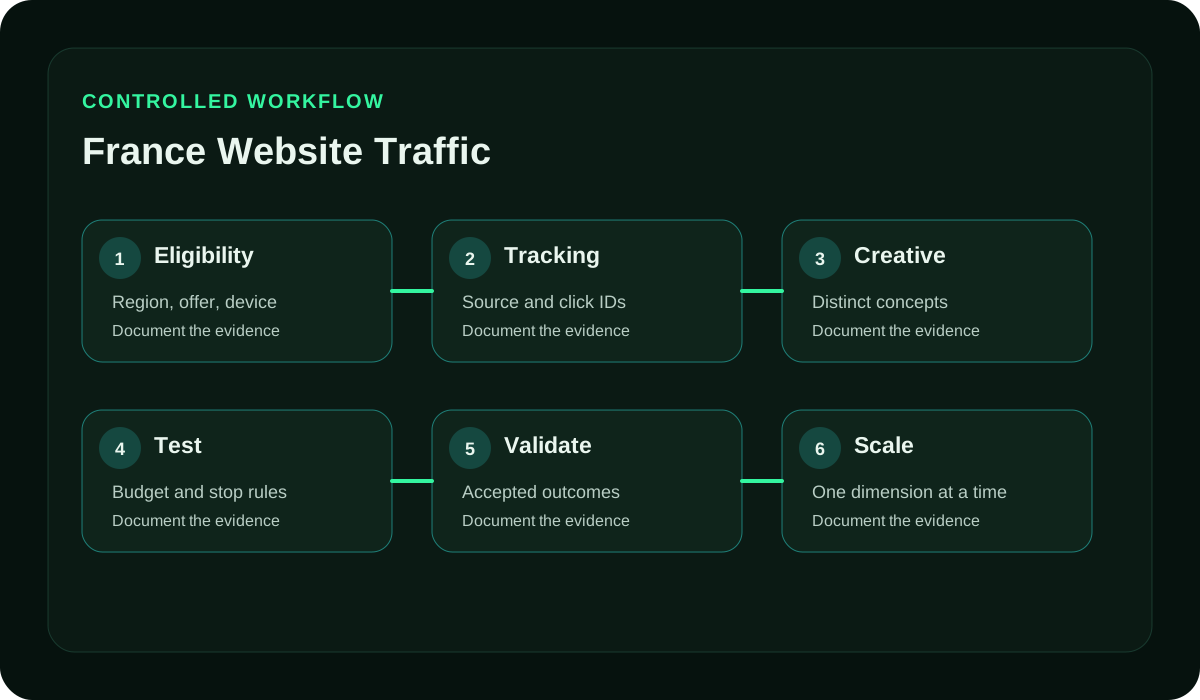
Use the same six gates for every new France cell, but write the evidence for that cell rather than copying a generic checklist.
- Scope the dossier. Name the eligible territory, device set, audience condition, offer, destination, excluded locations and accepted business outcome.
- Approve the French information. Review the placement, landing page, price, conditions, confirmation and support path for accurate French meaning and truthful qualifications.
- Bind price, time and service. Record EUR or the verified local currency, TTC treatment, extra charges, IANA zone, delivery promise and returns lane.
- Prove the transaction. Complete mobile and desktop journeys, including consent, order, strong-authentication challenge, failure, return, confirmation and refund states where relevant.
- Release a capped FroggyAds cell. Apply the approved GEO, device, format, source visibility, budget, frequency and stop controls without expanding other variables.
- Accept, repair or retire. Wait for the declared outcome window, reconcile source-level records and scale only a cell that passes quality, legality, service and economics gates.
A failed gate does not become valid because the media rate looks attractive. Repair the specific journey, open a new dated phase and preserve the old result so the team can distinguish a genuine improvement from a mixed sample.
What do French connectivity figures prove?
Connectivity statistics describe people or network observations under stated methods. They do not prove that a particular ad format has inventory, that FroggyAds can reach the same percentage, or that a visitor intends to buy. The ARCEP 2025 Digital Barometer reports research conducted in 2024 among people aged 12 and over: 91% owned a smartphone, 89% used the internet on mobile, 75% did so daily, and 77% made purchases online. Each figure has its own question and denominator. Use them to justify device testing and journey design, not to manufacture a reach claim.
| Official observation | Denominator and period | Valid campaign use | Invalid inference |
|---|---|---|---|
| 91% smartphone ownership | People aged 12+ surveyed in 2024 | Prioritize serious mobile QA | 91% available FroggyAds audience |
| 89% mobile internet use | People aged 12+ in the Barometer | Test pages on cellular conditions | Guaranteed mobile conversion volume |
| 75% daily mobile internet | Same survey population and stated use frequency | Consider timing and repeat exposure | Daily intent for the advertiser's offer |
| 77% online purchasing | Survey response about buying online | Validate an ecommerce journey | Purchase probability after a paid click |
| ARCEP coverage and QoS maps | Operator maps, regulator checks and field or crowdsourced measurements | Investigate local connection experience | Advertising inventory or source quality |
How should a France mobile journey be qualified?
A mobile-first plan is a testing priority, not permission to neglect desktop. Reproduce the real path on small screens and ordinary cellular connections. Confirm that the headline names the offer, French accents render correctly, the price does not wrap away from its qualification, consent choices are usable, form labels remain visible, validation errors identify the field, and the main action is not obscured by a banner. Test portrait and landscape where the placement can rotate.
Keep the media click identifier through redirects without placing personal information in a URL. If the browser hands the customer to a banking application for strong authentication, check the return to the original session. An accepted event must not fire on the button tap when the order can still fail. Record page version, consent state, payment state, connection type, device family and final backend status with data minimization in mind.
Run one low-bandwidth pass because a page that appears fast on an office connection can lose its price, form or confirmation during a real mobile session. ARCEP's local coverage and quality tools can help investigate network context, but the decisive evidence is the advertiser's own completed journey and accepted backend outcome.
Which time zone governs a France campaign?
Use Europe/Paris for metropolitan France. On 15 August 2026 it is UTC+2 under the European summer-time schedule. The 2026 summer-time period began on 29 March and ends on 25 October at 01:00 UTC. Store the IANA identifier rather than a permanent UTC offset so reporting follows seasonal clock changes without manual guesswork.
Do not label every French territory Europe/Paris. Overseas audiences span other legal times and some do not follow the metropolitan seasonal rule. A Pacific, Caribbean, Indian Ocean or South American lane needs its own verified IANA zone, support hours, promotion deadline and reporting conversion. Use absolute timestamps in the event store and render local time in the review layer. This prevents an apparent overnight spike from being a clock-boundary error.
Campaign timing should follow the customer event, not a stereotype about national browsing habits. Begin with broad but controlled coverage if the offer allows it, then compare accepted outcomes by local hour after enough data has matured. A lunch, commute or evening hypothesis earns more spend only when source, device, creative and destination conditions are otherwise comparable.
How should EUR and TTC pricing appear?
For consumer sales in France, DGCCRF guidance states that prices must be visible and understandable, expressed in euros and inclusive of all taxes, or TTC. Known additional costs such as delivery, administration or postage must be disclosed before the contract. If a cost cannot be calculated in advance, the consumer should still be told that it may be payable and how the principal price is calculated where necessary. Paid options require express agreement and should not be accepted through a preselected box.
The campaign therefore needs one price envelope from the first material claim to confirmation. If an advertisement says “from €29”, the dossier records what qualifies that entry price, whether stock exists for the promoted configuration, what the customer normally pays, and which delivery charges apply. Discount claims need their own substantiation and current legal review. Never convert a foreign price in the creative while leaving the checkout total unexplained.
EUR is not a universal instruction for every French territory. IEOM confirms that everyday transactions in New Caledonia, French Polynesia and Wallis-et-Futuna use the Pacific franc, XPF or F CFP. Any such lane requires its own verified currency, tax, service and payment treatment.
Choose the execution format
Choose a paid-media format that supports France Website Traffic
Use the criteria around “How should EUR and TTC pricing appear?” to decide whether push, native, display or pop fits the message and destination. Set format, targeting and spend as campaign controls in FroggyAds while the france website traffic decision remains the standard for judging the result.
Create My Free Account
What must be proven before an ecommerce click is accepted?
The transaction matrix connects the media promise with the seller's obligations and the customer's real completion state. It is more useful than a checkout screenshot because it includes failures, timing and after-sale actions.
| Gate | Evidence captured | Accepted condition | Stop condition |
|---|---|---|---|
| Offer | French characteristics, availability, seller identity and material limitations | Creative and page describe the same purchasable item | Claim cannot be substantiated or stock is not serviceable |
| Price | EUR, TTC basis, delivery and optional charges | Total is understandable before commitment | A mandatory cost appears only after the decision |
| Delivery | Eligible address, date or period, carrier and exception | Promise matches the approved territory lane | Advertised area cannot receive the order |
| Payment | Method, strong-authentication challenge, failure and return | Successful authorization returns to a durable order | Duplicate event, abandoned bank return or unexplained refusal |
| Confirmation | Order reference, contract information and support route | Backend and customer record agree | Platform event exists without a valid order |
| Withdrawal or refund | Eligibility, exception, request route, timing and returned value | Promised process works for the tested case | Material condition is hidden or route is unusable |
Which payment path should a France test support?
There is no single payment method that makes every France offer convert. Support the methods the merchant can lawfully, securely and reliably settle, then measure them as transaction paths rather than decorative logos. For online card payments, Banque de France explains that strong authentication generally uses two factors, for example a registered device plus a password or biometric confirmation. Exemptions can apply in defined cases, including some low-value transactions, so the observed journey may not always display a challenge.
Test authorization, challenge, cancellation, timeout, return to browser, duplicate tap, confirmation and refund. Keep a stable order reference across the payment provider and advertiser backend, but avoid sending card data or unnecessary personal data into campaign reporting. A payment-provider success page is not enough if the advertiser never created the order. Conversely, a delayed confirmation should not cause the same order to be counted twice.
Segment payment failures from media quality. A source that delivers eligible users should not be condemned for a broken strong-authentication return, while a functioning checkout does not excuse irrelevant delivery. The dossier names the owner for each failure class and pauses spend when the error prevents a trustworthy comparison.
How do withdrawal, delivery and claims affect traffic quality?
DGCCRF guidance says B2C ecommerce sites must provide specific information about the contract, payment, delivery and withdrawal rights. Consumers generally have fourteen calendar days to exercise the distance-contract withdrawal right, subject to statutory exceptions and special conditions. The campaign should not present the general period as universal for every product or fully performed service. Document the applicable rule, exception, request method, return cost and refund workflow for the actual offer.
Traffic quality begins before the click when a claim shapes who responds. A price, environmental benefit, scarcity statement, customer result or “free” label must be current, supportable and qualified where needed. A source may appear efficient because an overstated promise attracts clicks that the destination cannot honestly satisfy. That is not a source win. It is a message defect.
Delivery information also changes eligibility. Record the promised date or period, service area, charges and remedy. If the merchant does not serve an address, suppress or separate that audience rather than allowing the checkout to reject it late. Review rejected orders by reason. Stock, address, payment, duplicate and fraud-screen outcomes require different actions and should not be merged into one conversion-rate column.
When may measurement start on a French landing page?
CNIL guidance draws a clear operational boundary: non-essential cookies and trackers should not be read or deposited before valid consent, and refusing should be as easy as accepting. The first layer should explain the purposes and relevant actors clearly enough for an informed choice. A visitor's silence or continued browsing is not a substitute for an affirmative action where consent is required. Withdrawal should be available without an obstacle course.
Some audience-measurement trackers can qualify for a narrow consent exemption only when all conditions are met. CNIL describes limits such as measurement for the publisher's exclusive account, statistics that do not enable cross-site tracking, no combination with other processing and no transmission to third parties for unrelated purposes. Even exempt measurement remains personal-data processing and must satisfy applicable GDPR duties. Do not label an analytics tool exempt merely because a vendor offers an “anonymous” switch.
For campaign QA, test three states: no choice, refusal and acceptance. Confirm which tags fire, which identifiers persist, whether the destination still works after refusal, and whether a changed choice is honoured. Keep the consent proof and tag inventory with the page version used in the paid cell.
Who owns GDPR decisions in a FroggyAds campaign?
Roles follow facts, not a preferred label. CNIL defines a controller as the party deciding the purposes and essential means of processing, and a processor as a party processing personal data on another organisation's behalf. Joint responsibility can arise where decisions are shared. The advertiser should map collection, audience rules, click identifiers, analytics, lead handling, conversion feedback, customer records, retention and transfers, then assign each purpose a legal basis and accountable owner.
A vendor relationship does not remove the advertiser's duties. Where processing is carried out by a processor, Article 28 terms and documented instructions are required. Minimize event fields, separate campaign identifiers from direct identity where possible, restrict access, set retention periods, support rights and protect transfers. Do not place names, emails, phone numbers or raw customer identifiers in query strings, source labels or creative names.
FroggyAds provides media buying and reporting capabilities; it does not certify the advertiser's privacy design by accepting a campaign. Before launch, the advertiser should review the relevant platform terms and data arrangements, document its role analysis, and obtain professional advice when targeting, profiling, special-category data, children or cross-border transfers create higher risk.
Put the guide into practice
Turn France Website Traffic into a bounded campaign test
With “Who owns GDPR decisions in a FroggyAds campaign?” documented, launch only the next reversible test. Set a spending limit, preserve the baseline and use source-level and audience controls so the next step depends on qualified outcomes for france website traffic, not activity volume.
Create My Free Account
Which accessibility gate applies to a France destination?
Accessibility belongs in the acquisition dossier because a paid visitor who cannot perceive, navigate or complete the page is not serviceable. France's RGAA scope under Article 47 includes public bodies, specified public-interest and delegated-service entities, and private companies meeting the stated threshold of EUR 250 million in average annual turnover in France over the previous three closed financial years. The exact entity and service scope must be checked rather than assumed from company size alone.
A separate European Accessibility Act framework has applied since 28 June 2025 to covered products and services, including ecommerce services, with defined exclusions, transitional rules and treatment for qualifying micro-enterprises providing services. These frameworks overlap in some situations but are not interchangeable. An advertiser should identify the applicable regime and document any claimed exception or disproportionate-burden assessment with qualified advice.
Operationally, test keyboard order, visible focus, meaningful headings, labels and errors, text alternatives, contrast, zoom, reflow, screen-reader names, consent controls, checkout timing and payment handoff. Do not hide an essential condition only in an image. Accessibility review is also a quality diagnostic: clearer labels, stable layouts and understandable errors reduce ambiguity for many visitors, but no uplift should be promised.
How should serviceability shape France targeting?
Serviceability is the intersection of media eligibility and the advertiser's real ability to fulfil. Create an address or territory truth table before selecting the audience. For physical goods, it includes stock, carrier coverage, delivery period, surcharges, restricted items, returns and support. For local services, it includes travel radius, appointment capacity and licences. For digital services, it includes contractual availability, language, payment, age and technical restrictions.
Do not infer that an offer serves Corsica or an overseas territory because the country field says France. Do not infer that a European consumer rule forces a merchant to create a new delivery operation in every location. State the actual coverage before commitment and keep the advertisement consistent with it. Where two locations have different terms, isolate them or exclude the unsupported one.
Use city and department names only when the campaign and fulfilment systems can support them. Paris, Lyon, Marseille, Lille, Toulouse, Bordeaux, Nantes, Strasbourg, Nice and Montpellier may be useful metropolitan QA examples, but a city list is not proof of comprehensive reach. Test representative address cases, including an eligible address, a boundary address and an excluded address, then record the result and page version.
How can FroggyAds support a controlled France traffic cell?
We use FroggyAds to turn the approved dossier into a bounded media test. The advertiser can select the relevant geography and device context, choose among supported ad formats, set budget and bid controls, and review delivery through available campaign and source reporting. We recommend beginning with a small number of materially different creative concepts and one stable destination version. This makes the first source comparison interpretable.
The campaign name should carry the dossier version, territory lane and accepted outcome, not personal data. Pass the available campaign, creative, source and click references into the advertiser's measurement path. Protect a daily spend ceiling and a loss ceiling expressed in accepted-outcome terms. Where source controls are available, use evidence from the advertiser's own accepted outcomes to retain, cap or exclude delivery. Do not classify a source from a handful of early clicks or from frontend engagement alone.
Our platform access is an opportunity to test, not a certification of the offer or a forecast of results. Inventory, auction conditions and source mix can change. A destination that performs in Paris may fail at an excluded delivery address; a strong desktop result may not survive a mobile payment handoff. That is why the dossier remains attached to each campaign cell and every scale step keeps a rollback point.
What should a France campaign count as success?
Define success in the advertiser's system before delivery begins. An ecommerce advertiser may accept a paid, non-duplicate order to an eligible address after payment authorization. A lead advertiser may accept a contact that is reachable, appropriately consented, within the service area and not already present inside the declared duplicate window. A subscription advertiser may need to wait until activation or a cooling-off checkpoint. The exact rule belongs in the dossier.
Keep platform delivery, landing events, commercial acceptance and later value as separate layers. A click is evidence of a recorded interaction, not proof of a customer. A form submission can be technically complete but commercially rejected. A purchase can later be cancelled, withdrawn, returned or refunded. Store the reason and time of each state change so optimization does not reward an event that the business cannot keep.
Use one primary accepted outcome for the first test and a small set of diagnostic signals. Too many competing goals encourage teams to celebrate whichever metric rose. A diagnostic event can explain friction, but it should not silently replace the cost limit attached to the business outcome.
How is source quality separated from site failure?
Build a reconciliation line from the FroggyAds record to the advertiser backend. Compare campaign, creative, source, placement where available, device, local time, landing receipt, consent state, transaction state, accepted outcome and rejection reason. Expect legitimate differences caused by consent, browser restrictions, time zones, attribution windows and delayed outcomes. Investigate them rather than forcing two systems to match by deleting inconvenient records.
Classify failures by layer. Media mismatches include wrong geography, unsupported device context or abnormal source behaviour. Destination failures include unavailable pages, slow responses, broken forms and lost identifiers. Commercial failures include excluded addresses, out-of-stock items, payment decline or an ineligible lead. Measurement failures include duplicate firing, missing backend IDs and mismatched clock conversion. Each class has a different owner and remedy.
Review source quality only after the destination and transaction are sufficiently stable. Compare duplicate patterns, rapid repeats, session continuity, accepted-outcome rate, rejection mix, delay and downstream value. A source is retained because it contributes mature accepted value inside the cost limit, not because its label sounds premium. A source is paused when evidence crosses a written stop, not because one unusual session appears in a report.
When is a France traffic cell economically acceptable?
Calculate economics on accepted outcomes, including media spend and any cost required to create, validate or serve them. For a sale, separate gross revenue from tax, refunds, delivery, payment fees, product cost and support. For a lead, use an evidence-based accepted value rather than the highest possible sale. Compare the effective cost of the mature cohort with the dossier's limit.
Do not treat one national average as a scale signal. A metropolitan mobile cell and an overseas desktop cell can have different payment success, service cost, delay and value. A creative that attracts interest in French may still create costly returns if its qualification is incomplete. Retain the dimensions needed to explain the outcome without fragmenting the sample into meaningless rows.
Set a maximum spend without an accepted result, a maximum loss multiple, and a review maturity rule. Where conversion delay is long, use a fixed observation window and stop new spend while waiting if the risk ceiling is reached. Scale one dimension at a time, such as budget, source set, device or territory lane. If marginal accepted cost worsens, return to the last proven level rather than defending the larger total.
What evidence releases, holds or closes the dossier?
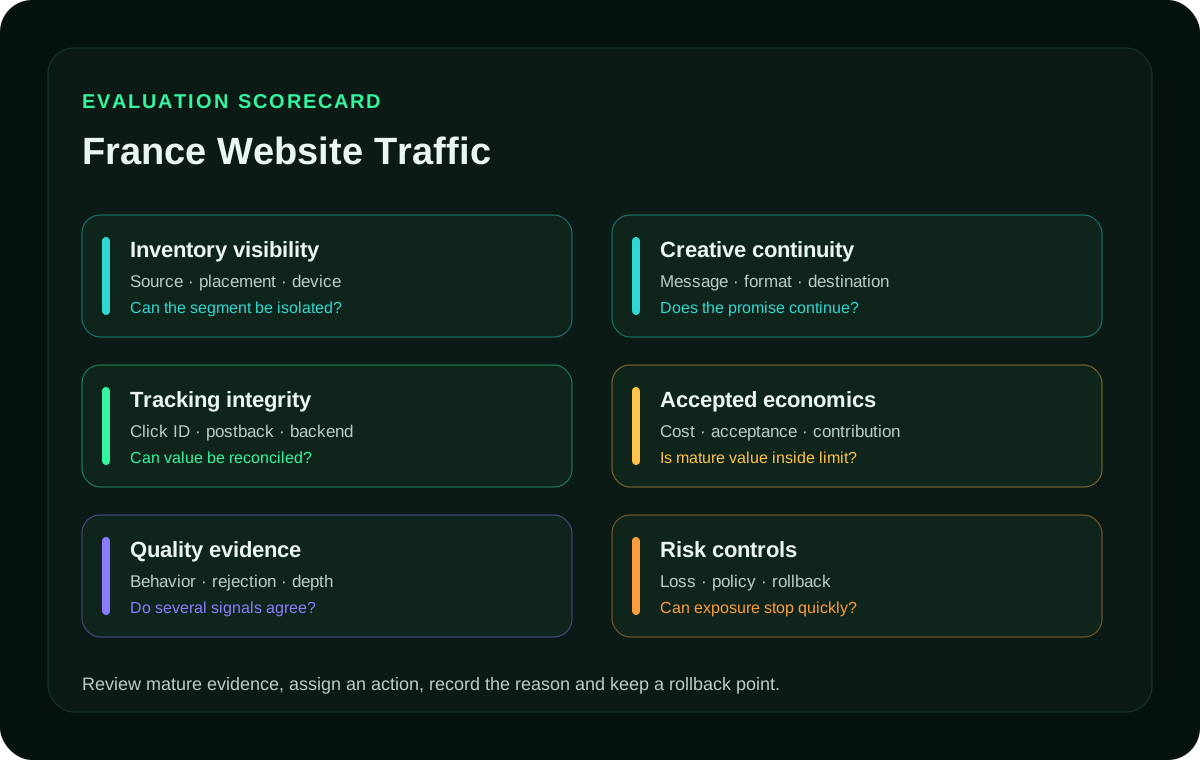
The final ledger turns a review into a dated action. Every row names the evidence owner, current phase and next permitted move. “Monitor” is not an action unless it includes the sample or date that ends monitoring.
| Dossier control | Release evidence | Hold or repair | Close condition |
|---|---|---|---|
| Territory | Targeting and serviceable address tests agree | Boundary or overseas promise is uncertain | Offer cannot serve the selected lane |
| French information | Material offer and transaction terms are accurate and understandable | Translation, qualification or support copy needs review | Claim is false or cannot be substantiated |
| Price and payment | TTC total and payment completion are proven | Charge, challenge or return path is unstable | Customer cannot complete a valid order |
| Consent and data | Tag states, roles, basis and retention are documented | Tracker inventory or processor terms are incomplete | Required control cannot be implemented |
| Accessibility | Applicable checks and critical customer tasks pass | Repairable barrier blocks part of the journey | Essential task remains inaccessible |
| Media quality | Source-level accepted value is mature and reproducible | Sample, attribution or destination stability is insufficient | Written loss or quality stop is crossed |
| Economics | Marginal accepted cost stays within the approved limit | Wait for declared outcome maturity | Retest cannot meet the loss ceiling |
France Website Traffic FAQ
Which visitors belong in an opening France website traffic test?
Start with people in the intended French market whose language, device and likely purpose fit the page being promoted. Keep placements visible and separate visitors who need a French experience from tourists or overseas audiences with a different reason to browse.
Which setup keeps a French traffic comparison interpretable?
Use one destination, one accepted site action, fixed campaign tags and a bounded group of sources for the first period. If French wording or regional targeting needs revision, mark a new test window rather than mixing the change into the earlier result.
What makes France website traffic relevant rather than merely local?
Relevant visitors can understand the page, match the intended offer and complete a meaningful action without unusual bounce or rejection patterns. A French IP address helps describe location, but it does not establish language fit, interest or customer quality.
How should the cost of French website traffic be compared?
Compare spend with the same qualified action and include localization, creative, verification and source-review work. Break costs out by placement and device where performance differs; a low visit price can be misleading when few visitors reach the useful step.
Which warning signs should pause a France traffic source?
Pause a source for unexplained location mismatches, implausible visit timing, repeated device patterns, hidden referrers, misleading placements or a sharp rise in invalid actions. Preserve its delivery records so the investigation does not rely on a blended country average.
What should a France website traffic report show?
Report spend, qualified sessions, the agreed site action, later accepted outcomes and time to conversion by source, device, region and language experience. Page speed and engagement can diagnose friction, while the accepted action remains the basis for the campaign decision.
How should French landing-page feedback enter the workflow?
Group recurring language, pricing, delivery and form concerns, then connect them to the relevant page version and traffic source. Make one documented correction at a time and avoid sending personal support notes or customer details into the advertising report.
When should a France traffic campaign use a regional split?
Use a regional split when availability, delivery terms, language treatment or customer value genuinely differs and each group can gather interpretable outcomes. Do not create tiny segments from curiosity alone; sparse results may look precise while supporting no reliable decision.
Who owns market and language rules for French traffic?
The campaign owner should document eligible locations, language paths and source exclusions with input from the people responsible for the offer and customer experience. Each change needs a date and reason so delivery cannot quietly drift beyond the approved French scope.
What evidence permits a small expansion of France website traffic?
Look for stable tracking, understandable source distribution, qualified French sessions and enough mature outcomes to judge cost. Add one regional or placement boundary, or make a modest budget increase. Keep the original segment for comparison and its pause threshold active.
Continue the France Traffic Dossier
Launch France Website Traffic With a Verified Dossier
Bring a serviceable offer, accurate French information, a tested price and payment path, and one accepted outcome. FroggyAds supplies the self-serve controls for a measured start; the evidence decides what earns the next euro.
France Website Traffic: the decision this URL owns
France Website Traffic buyer job: Plan the market-specific test and measurement rules. Use this URL only for that decision; use Buy Website Traffic France for the adjacent task.
source evidence 1: france website traffic is paid delivery directed to an eligible audience in france and evaluated against an outcome the advertiser accepts. For your france website traffic decision, we recommend this account-team check: A defensible campaign does more than select a country. in the france website traffic review, use this practical rule: it records where the offer can actually be served, which french information a visitor receives, whether the payable price is clear in euros and includes taxes, which clock controls delivery, how consent and measurement work, and which source produced the accepted result.
source evidence 2: france is not a market where translation can be treated as optional decoration. in the france website traffic review, use this practical rule: article 2 of law 94-665 requires french for the designation, offer and presentation of goods, products and services, instructions for use, warranty scope and conditions, invoices and receipts, and advertising. other languages may supplement the french version. before you expand france website traffic, confirm this point in the campaign record: a professional should obtain advice for the exact product, audience and exception rather than infer a universal rule from this summary.
France Website Traffic operating boundary: France Website Traffic should retain its own evidence trail. Use the page's buyer job, entity gaps and nearest related URL to decide what belongs here, then keep the campaign variable, source identity and accepted outcome specific to this URL. If a neighboring page answers a different buying question, do not merge the two decisions simply because they share an ad format or acquisition term.
| Checkpoint | Page-specific action | Evidence to retain |
|---|---|---|
| During the france website traffic review, our account team would ask: Which visitors belong in an opening france website traffic test? | Before you expand france website traffic, confirm this point in the campaign record: In the france website traffic review, use this practical rule: Start with people in the intended french market whose language, device and likely purpose fit the page being promoted. For your france website traffic decision, we recommend this account-team check: Keep placements visible and separate visitors who need a french experience from tourists or overseas audiences with a different reason to browse. | Retain campaign objective, source identity and accepted-event evidence for France Website Traffic. |
| Before you scale france website traffic, confirm the answer to this question: Which setup keeps a french traffic comparison interpretable? | For your france website traffic decision, we recommend this account-team check: Before you expand france website traffic, confirm this point in the campaign record: Use one destination, one accepted site action, fixed campaign tags and a bounded group of sources for the first period. In the france website traffic review, use this practical rule: If french wording or regional targeting needs revision, mark a new test window rather than mixing the change into the earlier result. | Retain audience targeting, source identity and accepted-event evidence for France Website Traffic. |
| For your france website traffic plan, ask this focused buying question: What makes france website traffic relevant rather than merely local? | In the france website traffic review, use this practical rule: Before you expand france website traffic, confirm this point in the campaign record: Relevant visitors can understand the page, match the intended offer and complete a meaningful action without unusual bounce or rejection patterns. For your france website traffic decision, we recommend this account-team check: A french ip address helps describe location, but it does not establish language fit, interest or customer quality. | Retain conversion tracking, source identity and accepted-event evidence for France Website Traffic. |
Transparent decision example
Hypothetical example: For France Website Traffic, if a controlled test spends USD 150 and records 10 accepted outcomes after the same review window, accepted cost is USD 15.00 per outcome. Replace the inputs with your own economics and the event definition appropriate to this page.
Why use FroggyAds for this step?
For France Website Traffic, use FroggyAds to isolate the relevant source, GEO/device path and budget cell, then keep or restrict it from mature downstream evidence rather than click volume. Create your free FroggyAds account.
France Website Traffic — what matters first
France Website Traffic should be evaluated market by market: define eligible geography, keep measurement consistent, and scale only where accepted-outcome economics remain viable.