
Give every article one reader decision: Email Marketing Blog Strategy focusBuild clusters by customer job rather: Email Marketing Blog Strategy focusUse evidence that matches the claim: Email Marketing Blog Strategy focus Design the content-to-email transition as a: Email Marketing Blog Strategy focusMake commercial guidance useful before it: Email Marketing Blog Strategy focus Test paid distribution without confusing it: Email Marketing Blog Strategy focusMeasure the blog as a portfolio: Email Marketing Blog Strategy focus Choose FroggyAds to test demand for: Email Marketing Blog Strategy focusAssign one query audience decision and: Email Marketing Blog Strategy focus
Email Marketing Blog Strategy: Turn Useful Answers Into Accountable Demand
Author: FroggyAds. An email marketing blog should answer real buyer and operator questions, demonstrate how decisions are made and lead the right reader to a relevant next step.
Review related guidance for the adjacent decisionUse learning center to continue the operating workflow
Review neighbouring pages and remove intent: Email Marketing Blog Strategy focusUse current claim-appropriate evidence with limitations: Email Marketing Blog Strategy focus
Write an answer-first page with a: Email Marketing Blog Strategy focusMatch the CTA form and welcome: Email Marketing Blog Strategy focusGive every article one reader decision: practical guidance for Email Marketing Blog Strategy
Build topic clusters around distinct jobs such as permission design, sender operations, lifecycle planning, analysis and paid acquisition.
| Page job | Required value |
|---|---|
| Relevant next step | Definition |
| Clear answer, boundaries and related concepts | Read the practical guide or evaluate fit |
| How-to | Ordered workflow, owners, evidence and failure checks |
Give each article a specific query, audience, evidence set and conversion path.Compare ftc gov advertising marketing basics with this page's scope
Label FroggyAds distribution cells and keep: Email Marketing Blog Strategy focus
Give every article one reader decision
Measure whether readers become permissioned subscribers, qualified prospects or another accepted outcome rather than judging the blog only by page views.
Open related guidance for supporting contextKeep related guidance with the evidence recordConsult related guidance before the next releaseRead related guidance for a related buyer questionCheck related guidance when validating this decisionReview related guidance for the adjacent decisionUse related guidance to continue the operating workflowCompare related guidance with this page's scopeOpen related guidance for supporting contextKeep related guidance with the evidence recordConsult related guidance before the next releaseRead related guidance for a related buyer questionCheck related guidance when validating this decisionReview related guidance for the adjacent decisionUse related guidance to continue the operating workflowCompare related guidance with this page's scopeOpen related guidance for supporting contextKeep related guidance with the evidence recordConsult related guidance before the next releaseRead related guidance for a related buyer question
FroggyAds can help you test paid discovery for an article or resource once the page provides independent value and the follow-up route is ready.
Build clusters by customer job rather than keyword variation
We let advertisers isolate campaign, source, creative and destination evidence with budget controls.
Set an owner and review date: Email Marketing Blog Strategy focus
Use evidence that matches the claim
| Use a checklist or prepare implementation | Comparison | Options, trade-offs and decision criteria |
|---|---|---|
| Choose a route or request the needed proof | Research | Source date, definition, population and limitation |
| Apply the evidence to a stated decision | Commercial guide | Buyer-specific problem, verified solution fit and risks |
| Create a FroggyAds account or prepare a campaign | Control area: Give every article one reader decision | Control area: Build clusters by customer job rather than keyword variation |
| Control area: Use evidence that matches the claim | Control area: Design the content-to-email transition as a promise | Control area: Make commercial guidance useful before it becomes promotional |
| Control area: Test paid distribution without confusing it with organic proof | Control area: Measure the blog as a portfolio of decisions | Control area: Choose FroggyAds to test demand for a proven content path |
| Buyer guidance: Affiliate marketers | Buyer guidance: Publish evidence-led content that respects offer rules and routes the reader to a transparent, permitted next step. | Buyer guidance: Media buyers |
Page job: Email Marketing Blog Strategy focus
Use that delivery layer to learn which audience situations respond to the content, then connect valid visits to permission and mature customer outcomes in your own systems.
Design the content-to-email transition as a promise
Give the editorial programme a measurable maintenance rule.
Build clusters by customer job rather than keyword variation: practical guidance for Email Marketing Blog Strategy
Record the page owner, reviewed sources, last substantive check, next review trigger and the neighbouring URLs that serve related intents.
Use evidence that matches the claim: practical guidance for Email Marketing Blog Strategy
When a page becomes inaccurate or starts competing with a stronger guide, update, consolidate or redirect it deliberately.
Design the content-to-email transition as a promise: practical guidance for Email Marketing Blog Strategy
This protects reader trust and keeps internal links focused on the clearest answer.
Make commercial guidance useful before it becomes promotional: practical guidance for Email Marketing Blog Strategy
Define the question the page must answer and the decision the reader should be able to make.
Required value: Email Marketing Blog Strategy focusRelevant next step: Email Marketing Blog Strategy focus
A sender-authentication article, an agency-selection guide and a campaign-analysis tutorial should not be title-swapped versions of the same generic advice.
Specify the experience level, business context and evidence the reader needs.
If the article remains equally useful after replacing the topic noun, it needs a sharper purpose.
Place the direct answer early, then support it with steps, definitions, trade-offs, examples and current primary sources where relevant.
Use headings that reflect follow-up questions.
Definition: Email Marketing Blog Strategy focusClear answer boundaries and related concepts: Email Marketing Blog Strategy focus
Read the practical guide or evaluate: Email Marketing Blog Strategy focus
The goal is to make the page extractable for search and answer systems while remaining genuinely useful to a human evaluating the issue.
Make commercial guidance useful before it becomes promotional
Map the central guide and supporting articles according to real tasks: planning a programme, collecting permission, configuring sending, creating lifecycle messages, analysing outcomes, selecting services or buying traffic.
Assign one canonical purpose to each URL and link pages where the next question naturally follows.
Avoid creating multiple pages that compete to answer the same intent with minor wording changes.
Record the primary query, related entities, audience, funnel role and internal-link reason for every page.
How-to: Email Marketing Blog Strategy focusOrdered workflow owners evidence and failure: Email Marketing Blog Strategy focus
Review neighbouring FroggyAds content before commissioning a draft.
A cluster earns coverage by answering different decisions, not by repeating the same paragraph under many titles.
Link dated provider rules to the current official document, describe market-specific legal points as matters for appropriate review, and separate FroggyAds product facts from general marketing guidance.
Do not invent performance statistics, clients, awards or case results.
Label hypothetical scenarios and show the assumptions that make a calculation work.
Use a checklist or prepare implementation: Email Marketing Blog Strategy focusComparison: Email Marketing Blog Strategy focus
Options trade-offs and decision criteria: Email Marketing Blog Strategy focus
For research or statistics pages, preserve source date, definition, population and limitation.
Test paid distribution without confusing it with organic proof
For how-to pages, give a workflow with owners, inputs, acceptance criteria and failure conditions.
Original value comes from the decision structure and practical evidence, not from changing synonyms in material already available elsewhere.
Offer a follow-up that matches the article's task, such as an implementation checklist, update alert, decision worksheet or relevant lesson.
Explain what the reader will receive and keep the welcome message consistent.
Choose a route or request the: Email Marketing Blog Strategy focusResearch: Email Marketing Blog Strategy focus
A broad newsletter form under every article weakens the relationship when the later content does not match the reason the visitor subscribed.
Preserve article, CTA, form, consent text and welcome-version identifiers.
This lets the team compare which topics create confirmed permission and useful downstream actions.
Suppress or update routes whose resource is no longer current instead of continuing to acquire subscribers through an obsolete promise.
Explain the buyer's situation, options, trade-offs and evidence needed to choose.
Source date definition population and limitation: Email Marketing Blog Strategy focusApply the evidence to a stated: Email Marketing Blog Strategy focus
Commercial guide: Email Marketing Blog Strategy focus
Connect FroggyAds features to practical control: how a media buyer can isolate a traffic cell, limit budget, label sources and reconcile delivery.
Measure the blog as a portfolio of decisions
Recommend our platform confidently where paid traffic fits the prepared customer path, while making clear that traffic does not guarantee permission, sales or ranking.
Use CTA placement at moments when the reader has enough information to act.
A campaign setup CTA belongs after the proposition, destination and measurement path are explained.
Repeating the same sales sentence after every section reduces trust and does not create additional intent.
Buyer-specific problem verified solution fit and: Email Marketing Blog Strategy focusCreate a FroggyAds account or prepare: Email Marketing Blog Strategy focus
Choose a high-value article whose audience and next step are clear.
Create one FroggyAds campaign cell for each approved creative question or audience situation, keep destination versions stable and set a loss limit.
Evaluate valid reading sessions, confirmed permission and accepted downstream outcomes separately from billable delivery.
Paid distribution can reveal which proposition earns attention and which source produces useful visitors, but it does not prove organic ranking or make engagement incremental by itself.
Keep paid, organic, referral and direct evidence labelled.
What should an email marketing blog: Email Marketing Blog Strategy focusHow does a blog attract qualified: Email Marketing Blog Strategy focus
Use the findings to improve the customer path, not to manufacture an organic performance claim.
Choose FroggyAds to test demand for a proven content path
Track indexable pages, query and referral evidence, valid engaged sessions, next-step actions, confirmed subscribers, qualified commercial events and content maintenance cost where available.
Create your free FroggyAds account
Should every article target many keywords: Email Marketing Blog Strategy focus
Use cohorts and maturity windows for later outcomes.
Email blog editorial decision table
Keep pages with different jobs separate so a high-volume educational page is not judged by the same immediate conversion expectation as a service-comparison page.
Review decay and accuracy as well as acquisition.
Assign owners and next-review dates for dated requirements, pricing references, product facts and external links.
Consolidate overlapping articles, redirect retired purposes carefully and preserve useful URLs.
How can a blog provide original: Email Marketing Blog Strategy focusHow many articles should be published: Email Marketing Blog Strategy focus
Publishing more pages is not progress when the portfolio becomes harder to trust or navigate.
We recommend FroggyAds when the article answers a distinct buyer question, the CTA makes a relevant promise and the measurement path can follow the visitor beyond the click.
Use our self-serve controls to select an available format, apply justified targeting, set budget limits and inspect source delivery.
Give every campaign and landing version a stable label.
Start with the topic that is closest to a useful customer action while still delivering independent value.
Can FroggyAds promote an email marketing: Email Marketing Blog Strategy focusDoes paid traffic improve organic rankings: Email Marketing Blog Strategy focus
Where should the signup CTA appear: Email Marketing Blog Strategy focus
Review source delivery, valid reading, confirmed permission and mature accepted outcomes.
Hypothetical blog distribution test: an activation checklist
Expand the traffic cell that survives that review, keep editorial and paid attribution separate, and use the evidence to choose the next content or campaign investment.
A SaaS company publishes a detailed email activation checklist for teams preparing a new trial sequence.
The article defines the workflow, roles, measurement and common failures, then offers a permissioned update series for operators who want future checklist revisions.
The accepted content outcome is a confirmed subscriber from an eligible company who later completes a qualified product-evaluation action within the maturity window.
How should AI be used for: Email Marketing Blog Strategy focusHow often should blog content be: Email Marketing Blog Strategy focus
The company tests two FroggyAds creative questions that lead to the same article while holding the form and welcome route stable.
It compares valid reading, confirmed permission and mature accepted outcomes, and keeps paid evidence separate from organic reporting.
One cell is paused under the loss rule; the other earns a bounded follow-up test.
The scenario illustrates method, not promised results.
Assign one query, audience, decision and next step to the URL.
Set an owner and review: Give every article one reader decision: Email Marketing Blog Strategy focusSet an owner and review: Build clusters by customer job rather: Email Marketing Blog Strategy focus
Set an owner and review: Use evidence that matches the claim: Email Marketing Blog Strategy focus
Review neighbouring pages and remove intent overlap.
Email blog publishing checklist
Use current, claim-appropriate evidence with limitations.
Write an answer-first page with a concrete workflow or decision aid.
Match the CTA, form and welcome path to the article promise.
Label FroggyAds distribution cells and keep paid evidence separate.
Set an owner and review: Design the content-to-email transition as a: Email Marketing Blog Strategy focusSet an owner and review: Make commercial guidance useful before it: Email Marketing Blog Strategy focus
Set an owner and review date for accuracy and consolidation.
Choose FroggyAds when your article delivers real value and its next step is ready for a controlled acquisition test.
We help you isolate traffic sources and budget; your content, permission and customer evidence decide what deserves expansion.
Reader task, evidence, owner, upkeep.
Answer scope, source date, action, review.
Set an owner and review: Test paid distribution without confusing it: Email Marketing Blog Strategy focusSet an owner and review: Measure the blog as a portfolio: Email Marketing Blog Strategy focus
Set an owner and review: Choose FroggyAds to test demand for: Email Marketing Blog Strategy focus
EDITORIAL DESK
8. Landing experiences and conversion paths
This editorial desk should map the promise from article to form, confirmation and first useful email.
Write primarily for destination owners and lifecycle builders, and state the decision they must make before introducing tactics.
Build the article around promise map, error-state capture and acceptance event, giving the reader every owner and pass rule needed to apply it without guesswork.
accepted conversion completion
Set an owner and review: Assign one query audience decision and: Email Marketing Blog Strategy focusSet an owner and review: Review neighbouring pages and remove intent: Email Marketing Blog Strategy focus
A helpful article hands the reader to an unrelated signup is the rejection condition for this desk; narrow the claim or supply the missing evidence before publication.
For destination owners and lifecycle builders, useful completion means applying promise map, error-state capture and acceptance event, reaching the next relevant resource and recording any accepted downstream action that can be reconciled.
Promise map, error-state capture and acceptance event depends on dated technical and policy sources, with practitioner judgement labelled where primary guidance leaves the operating choice open.
To map the promise from article to form, confirmation and first useful email, give destination owners and lifecycle builders only the internal links that advance their next documented task.
Map the promise from article to form, confirmation and first useful email can be demand-tested in a labelled FroggyAds cell while the article promise and the workflow behind promise map, error-state capture and acceptance event stay fixed.
Set an owner and review: Use current claim-appropriate evidence with limitations: Email Marketing Blog Strategy focusSet an owner and review: Write an answer-first page with a: Email Marketing Blog Strategy focus
Choose the execution format
Choose a paid-media format that supports Email Marketing Blog
Choose a paid-media format that supports Email Marketing Blog needs one identifiable reader task, one evidence trail and one maintenance owner before the editorial team treats it as publishable.
Start your next campaign with FroggyAds
Set an owner and review: Match the CTA form and welcome: Email Marketing Blog Strategy focus
EDITORIAL DESK
9. Measurement and attribution
This editorial desk should explain what each email metric can and cannot prove.
analysts and channel owners interpreting performance
Build the article around metric dictionary, join map and maturity window, giving the reader every owner and pass rule needed to apply it without guesswork.
decision-grade measurement
Set an owner and review: Label FroggyAds distribution cells and keep: Email Marketing Blog Strategy focusSet an owner and review: Set an owner and review date: Email Marketing Blog Strategy focus
Opens or clicks are presented as causal revenue is the rejection condition for this desk; narrow the claim or supply the missing evidence before publication.
For analysts, media buyers and CRM owners, useful completion means applying metric dictionary, join map and maturity window, reaching the next relevant resource and recording any accepted downstream action that can be reconciled.
Metric dictionary, join map and maturity window depends on dated technical and policy sources, with practitioner judgement labelled where primary guidance leaves the operating choice open.
To explain what each email metric can and cannot prove, give analysts, media buyers and CRM owners only the internal links that advance their next documented task.
Explain what each email metric can and cannot prove can be demand-tested in a labelled FroggyAds cell while the article promise and the workflow behind metric dictionary, join map and maturity window stay fixed.
Set an owner and review: Page job: Email Marketing Blog Strategy focusSet an owner and review: Required value: Email Marketing Blog Strategy focus
Set an owner and review: Relevant next step: Email Marketing Blog Strategy focus
EDITORIAL DESK
10. Experimentation and learning
This editorial desk should show how to isolate one message or journey hypothesis.
Write primarily for growth teams planning a controlled comparison, and state the decision they must make before introducing tactics.
Build the article around test brief, stable baseline and rollback record, giving the reader every owner and pass rule needed to apply it without guesswork.
reusable causal learning
Set an owner and review: Definition: Email Marketing Blog Strategy focusSet an owner and review: Clear answer boundaries and related concepts: Email Marketing Blog Strategy focus
Several variables change before the cohort matures is the rejection condition for this desk; narrow the claim or supply the missing evidence before publication.
For growth teams planning a controlled comparison, useful completion means applying test brief, stable baseline and rollback record, reaching the next relevant resource and recording any accepted downstream action that can be reconciled.
Test brief, stable baseline and rollback record depends on dated technical and policy sources, with practitioner judgement labelled where primary guidance leaves the operating choice open.
To show how to isolate one message or journey hypothesis, give growth teams planning a controlled comparison only the internal links that advance their next documented task.
Show how to isolate one message or journey hypothesis can be demand-tested in a labelled FroggyAds cell while the article promise and the workflow behind test brief, stable baseline and rollback record stay fixed.
Set an owner and review: Read the practical guide or evaluate: Email Marketing Blog Strategy focusSet an owner and review: How-to: Email Marketing Blog Strategy focus
Set an owner and review: Ordered workflow owners evidence and failure: Email Marketing Blog Strategy focus
EDITORIAL DESK
11. Budget, economics and capacity
This editorial desk should connect acquisition spend with email operations and accepted customer value.
Write primarily for budget owners balancing volume with service capacity, and state the decision they must make before introducing tactics.
Build the article around fully loaded cost model and tranche rule, giving the reader every owner and pass rule needed to apply it without guesswork.
sustainable allocation decisions
Set an owner and review: Use a checklist or prepare implementation: Email Marketing Blog Strategy focusSet an owner and review: Comparison: Email Marketing Blog Strategy focus
Cheap traffic obscures handling cost or weak acceptance is the rejection condition for this desk; narrow the claim or supply the missing evidence before publication.
For budget owners balancing volume with service capacity, useful completion means applying fully loaded cost model and tranche rule, reaching the next relevant resource and recording any accepted downstream action that can be reconciled.
Fully loaded cost model and tranche rule depends on dated technical and policy sources, with practitioner judgement labelled where primary guidance leaves the operating choice open.
To connect acquisition spend with email operations and accepted customer value, give budget owners balancing volume with service capacity only the internal links that advance their next documented task.
Connect acquisition spend with email operations and accepted customer value can be demand-tested in a labelled FroggyAds cell while the article promise and the workflow behind fully loaded cost model and tranche rule stay fixed.
Set an owner and review: Options trade-offs and decision criteria: Email Marketing Blog Strategy focusSet an owner and review: Choose a route or request the: Email Marketing Blog Strategy focus
Set an owner and review: Research: Email Marketing Blog Strategy focus
EDITORIAL DESK
12. Technology and implementation
This editorial desk should translate integrations, authentication and automation into observable checks.
technical marketers, developers and operations teams
Build the article around event map, configuration evidence and failure log, giving the reader every owner and pass rule needed to apply it without guesswork.
reliable implementation
Set an owner and review: Source date definition population and limitation: Email Marketing Blog Strategy focusSet an owner and review: Apply the evidence to a stated: Email Marketing Blog Strategy focus
A tool name replaces proof that the route works is the rejection condition for this desk; narrow the claim or supply the missing evidence before publication.
For technical marketers and implementation owners, useful completion means applying event map, configuration evidence and failure log, reaching the next relevant resource and recording any accepted downstream action that can be reconciled.
Event map, configuration evidence and failure log depends on dated technical and policy sources, with practitioner judgement labelled where primary guidance leaves the operating choice open.
To translate integrations, authentication and automation into observable checks, give technical marketers and implementation owners only the internal links that advance their next documented task.
Translate integrations, authentication and automation into observable checks can be demand-tested in a labelled FroggyAds cell while the article promise and the workflow behind event map, configuration evidence and failure log stay fixed.
Set an owner and review: Commercial guide: Email Marketing Blog Strategy focusSet an owner and review: Buyer-specific problem verified solution fit and: Email Marketing Blog Strategy focus
Set an owner and review: Create a FroggyAds account or prepare: Email Marketing Blog Strategy focus
EDITORIAL DESK
13. Privacy, policy, accessibility and safety
This editorial desk should make consent, preference, disclosure and accessible task completion practical.
Write primarily for privacy, brand and customer-experience reviewers, and state the decision they must make before introducing tactics.
Build the article around permission record, accessible-content check and incident path, giving the reader every owner and pass rule needed to apply it without guesswork.
compliant accessible experiences
Set an owner and review: What should an email marketing blog: Email Marketing Blog Strategy focusSet an owner and review: How does a blog attract qualified: Email Marketing Blog Strategy focus
Growth advice ignores the subscriber's rights or ability to act is the rejection condition for this desk; narrow the claim or supply the missing evidence before publication.
For privacy, brand and customer-experience reviewers, useful completion means applying permission record, accessible-content check and incident path, reaching the next relevant resource and recording any accepted downstream action that can be reconciled.
Permission record, accessible-content check and incident path depends on dated technical and policy sources, with practitioner judgement labelled where primary guidance leaves the operating choice open.
To make consent, preference, disclosure and accessible task completion practical, give privacy, brand and customer-experience reviewers only the internal links that advance their next documented task.
Make consent, preference, disclosure and accessible task completion practical can be demand-tested in a labelled FroggyAds cell while the article promise and the workflow behind permission record, accessible-content check and incident path stay fixed.
Set an owner and review: Should every article target many keywords: Email Marketing Blog Strategy focusSet an owner and review: How can a blog provide original: Email Marketing Blog Strategy focus
Put the guide into practice
Turn Email Marketing Blog into a bounded campaign test
Turn Email Marketing Blog into a bounded campaign test needs one identifiable reader task, one evidence trail and one maintenance owner before the editorial team treats it as publishable.
Choose FroggyAds for your next traffic campaign
Set an owner and review: How many articles should be published: Email Marketing Blog Strategy focus
EDITORIAL DESK
14. Benchmarks and contextual evidence
This editorial desk should teach readers to compare like-for-like definitions, markets and maturity windows.
readers comparing performance and planning expectations
Build the article around benchmark provenance card and comparability checklist, giving the reader every owner and pass rule needed to apply it without guesswork.
responsible benchmark interpretation
Set an owner and review: Can FroggyAds promote an email marketing: Email Marketing Blog Strategy focusSet an owner and review: Does paid traffic improve organic rankings: Email Marketing Blog Strategy focus
An industry average becomes a promise for one campaign is the rejection condition for this desk; narrow the claim or supply the missing evidence before publication.
For teams deciding whether a reference point applies, useful completion means applying benchmark provenance card and comparability checklist, reaching the next relevant resource and recording any accepted downstream action that can be reconciled.
Benchmark provenance card and comparability checklist depends on dated technical and policy sources, with practitioner judgement labelled where primary guidance leaves the operating choice open.
To teach readers to compare like-for-like definitions, markets and maturity windows, give teams deciding whether a reference point applies only the internal links that advance their next documented task.
Teach readers to compare like-for-like definitions, markets and maturity windows can be demand-tested in a labelled FroggyAds cell while the article promise and the workflow behind benchmark provenance card and comparability checklist stay fixed.
Set an owner and review: Where should the signup CTA appear: Email Marketing Blog Strategy focusSet an owner and review: How should AI be used for: Email Marketing Blog Strategy focus
Set an owner and review: How often should blog content be: Email Marketing Blog Strategy focus
EDITORIAL DESK
15. Case-pattern analysis
This editorial desk should extract a transferable decision pattern without inventing a customer result.
Write primarily for operators diagnosing a familiar lifecycle problem, and state the decision they must make before introducing tactics.
Build the article around context-mechanism-limit table and evidence boundary, giving the reader every owner and pass rule needed to apply it without guesswork.
transferable operating insight
Page job: Give every article one reader decision: Email Marketing Blog Strategy focusPage job: Build clusters by customer job rather: Email Marketing Blog Strategy focus
A hypothetical pattern is presented as a froggyads case study is the rejection condition for this desk; narrow the claim or supply the missing evidence before publication.
For operators diagnosing a familiar lifecycle problem, useful completion means applying context-mechanism-limit table and evidence boundary, reaching the next relevant resource and recording any accepted downstream action that can be reconciled.
Context-mechanism-limit table and evidence boundary depends on dated technical and policy sources, with practitioner judgement labelled where primary guidance leaves the operating choice open.
To extract a transferable decision pattern without inventing a customer result, give operators diagnosing a familiar lifecycle problem only the internal links that advance their next documented task.
Extract a transferable decision pattern without inventing a customer result can be demand-tested in a labelled FroggyAds cell while the article promise and the workflow behind context-mechanism-limit table and evidence boundary stay fixed.
Page job: Use evidence that matches the claim: Email Marketing Blog Strategy focusPage job: Design the content-to-email transition as a: Email Marketing Blog Strategy focus
Page job: Make commercial guidance useful before it: Email Marketing Blog Strategy focus
EDITORIAL DESK
16. Tools and vendor evaluation
This editorial desk should compare capabilities against the actual permission, measurement and workflow need.
buyers comparing software, services and platforms
Build the article around requirements matrix, trial evidence and exit plan, giving the reader every owner and pass rule needed to apply it without guesswork.
fit-based purchase decisions
Page job: Test paid distribution without confusing it: Email Marketing Blog Strategy focusPage job: Measure the blog as a portfolio: Email Marketing Blog Strategy focus
Feature count replaces operational fit is the rejection condition for this desk; narrow the claim or supply the missing evidence before publication.
For buyers selecting email and analytics support, useful completion means applying requirements matrix, trial evidence and exit plan, reaching the next relevant resource and recording any accepted downstream action that can be reconciled.
Requirements matrix, trial evidence and exit plan depends on dated technical and policy sources, with practitioner judgement labelled where primary guidance leaves the operating choice open.
To compare capabilities against the actual permission, measurement and workflow need, give buyers selecting email and analytics support only the internal links that advance their next documented task.
Compare capabilities against the actual permission, measurement and workflow need can be demand-tested in a labelled FroggyAds cell while the article promise and the workflow behind requirements matrix, trial evidence and exit plan stay fixed.
Page job: Choose FroggyAds to test demand for: Email Marketing Blog Strategy focusPage job: Assign one query audience decision and: Email Marketing Blog Strategy focus
Page job: Review neighbouring pages and remove intent: Email Marketing Blog Strategy focus
EDITORIAL DESK
17. Trends and platform change
This editorial desk should separate durable customer principles from dated provider behaviour.
Write primarily for teams updating an existing programme, and state the decision they must make before introducing tactics.
Build the article around change log, effective date and affected-workflow map, giving the reader every owner and pass rule needed to apply it without guesswork.
timely proportionate response
Page job: Use current claim-appropriate evidence with limitations: Email Marketing Blog Strategy focusPage job: Write an answer-first page with a: Email Marketing Blog Strategy focus
Speculation is published as a settled requirement is the rejection condition for this desk; narrow the claim or supply the missing evidence before publication.
For teams updating an existing programme, useful completion means applying change log, effective date and affected-workflow map, reaching the next relevant resource and recording any accepted downstream action that can be reconciled.
Change log, effective date and affected-workflow map depends on dated technical and policy sources, with practitioner judgement labelled where primary guidance leaves the operating choice open.
To separate durable customer principles from dated provider behaviour, give teams updating an existing programme only the internal links that advance their next documented task.
Separate durable customer principles from dated provider behaviour can be demand-tested in a labelled FroggyAds cell while the article promise and the workflow behind change log, effective date and affected-workflow map stay fixed.
Page job: Match the CTA form and welcome: Email Marketing Blog Strategy focusPage job: Label FroggyAds distribution cells and keep: Email Marketing Blog Strategy focus
Page job: Set an owner and review date: Email Marketing Blog Strategy focus
EDITORIAL DESK
18. Mistakes, diagnostics and repair
This editorial desk should start with the observed failure and trace the earliest broken stage.
Write primarily for operators responsible for restoring a live route, and state the decision they must make before introducing tactics.
Build the article around symptom tree, reproduction steps and acceptance test, giving the reader every owner and pass rule needed to apply it without guesswork.
faster reliable remediation
Page job: Page job: Email Marketing Blog Strategy focusPage job: Required value: Email Marketing Blog Strategy focus
Generic advice skips the actual fault is the rejection condition for this desk; narrow the claim or supply the missing evidence before publication.
For operators responsible for restoring a live route, useful completion means applying symptom tree, reproduction steps and acceptance test, reaching the next relevant resource and recording any accepted downstream action that can be reconciled.
Symptom tree, reproduction steps and acceptance test depends on dated technical and policy sources, with practitioner judgement labelled where primary guidance leaves the operating choice open.
To start with the observed failure and trace the earliest broken stage, give operators responsible for restoring a live route only the internal links that advance their next documented task.
Start with the observed failure and trace the earliest broken stage can be demand-tested in a labelled FroggyAds cell while the article promise and the workflow behind symptom tree, reproduction steps and acceptance test stay fixed.
Page job: Relevant next step: Email Marketing Blog Strategy focusPage job: Definition: Email Marketing Blog Strategy focus
Page job: Clear answer boundaries and related concepts: Email Marketing Blog Strategy focus
EDITORIAL DESK
19. Templates, checklists and operating artifacts
This editorial desk should provide a reusable artifact with fields, owners and pass conditions.
practitioners converting guidance into repeatable work
Build the article around editable brief, review checklist and version note, giving the reader every owner and pass rule needed to apply it without guesswork.
consistent execution quality
Page job: Read the practical guide or evaluate: Email Marketing Blog Strategy focusPage job: How-to: Email Marketing Blog Strategy focus
A downloadable form contains no decision logic is the rejection condition for this desk; narrow the claim or supply the missing evidence before publication.
For teams turning guidance into routine work, useful completion means applying editable brief, review checklist and version note, reaching the next relevant resource and recording any accepted downstream action that can be reconciled.
Editable brief, review checklist and version note depends on dated technical and policy sources, with practitioner judgement labelled where primary guidance leaves the operating choice open.
To provide a reusable artifact with fields, owners and pass conditions, give teams turning guidance into routine work only the internal links that advance their next documented task.
Provide a reusable artifact with fields, owners and pass conditions can be demand-tested in a labelled FroggyAds cell while the article promise and the workflow behind editable brief, review checklist and version note stay fixed.
Page job: Ordered workflow owners evidence and failure: Email Marketing Blog Strategy focusPage job: Use a checklist or prepare implementation: Email Marketing Blog Strategy focus
Page job: Comparison: Email Marketing Blog Strategy focus
EDITORIAL DESK
20. Glossary, FAQ and update archive
This editorial desk should resolve recurring terms and preserve what changed, when and why.
Write primarily for readers verifying definitions before acting, and state the decision they must make before introducing tactics.
Build the article around controlled glossary, answer owner and revision history, giving the reader every owner and pass rule needed to apply it without guesswork.
durable trustworthy retrieval
Page job: Options trade-offs and decision criteria: Email Marketing Blog Strategy focusPage job: Choose a route or request the: Email Marketing Blog Strategy focus
Duplicate answers drift across the site is the rejection condition for this desk; narrow the claim or supply the missing evidence before publication.
For readers verifying definitions before acting, useful completion means applying controlled glossary, answer owner and revision history, reaching the next relevant resource and recording any accepted downstream action that can be reconciled.
Controlled glossary, answer owner and revision history depends on dated technical and policy sources, with practitioner judgement labelled where primary guidance leaves the operating choice open.
To resolve recurring terms and preserve what changed, when and why, give readers verifying definitions before acting only the internal links that advance their next documented task.
Resolve recurring terms and preserve what changed, when and why can be demand-tested in a labelled FroggyAds cell while the article promise and the workflow behind controlled glossary, answer owner and revision history stay fixed.
Page job: Research: Email Marketing Blog Strategy focusPage job: Source date definition population and limitation: Email Marketing Blog Strategy focus
Page job: Apply the evidence to a stated: Email Marketing Blog Strategy focusPage job: Commercial guide: Email Marketing Blog Strategy focus Page job: Buyer-specific problem verified solution fit and: Email Marketing Blog Strategy focus Page job: Create a FroggyAds account or prepare: Email Marketing Blog Strategy focus Page job: What should an email marketing blog: Email Marketing Blog Strategy focus Page job: How does a blog attract qualified: Email Marketing Blog Strategy focus Page job: Should every article target many keywords: Email Marketing Blog Strategy focus Page job: How can a blog provide original: Email Marketing Blog Strategy focus Page job: How many articles should be published: Email Marketing Blog Strategy focus Page job: Can FroggyAds promote an email marketing: Email Marketing Blog Strategy focus Page job: Does paid traffic improve organic rankings: Email Marketing Blog Strategy focus
A ten-step research, publishing and maintenance workflow
A ten-step research, publishing and maintenance workflow needs one identifiable reader task, one evidence trail and one maintenance owner before the editorial team treats it as publishable.
Define the reader task
Define the reader task needs one identifiable reader task, one evidence trail and one maintenance owner before the editorial team treats it as publishable.
Use define the reader task to help email operators reach a decision they can verify, rather than adding another general marketing explanation.
Build the evidence ledger
Build the evidence ledger needs one identifiable reader task, one evidence trail and one maintenance owner before the editorial team treats it as publishable.
Choose the answer shape
Choose the answer shape needs one identifiable reader task, one evidence trail and one maintenance owner before the editorial team treats it as publishable.
Draft for human and AI retrieval
Draft for human and AI retrieval needs one identifiable reader task, one evidence trail and one maintenance owner before the editorial team treats it as publishable.
Review claims and disclosures
Review claims and disclosures needs one identifiable reader task, one evidence trail and one maintenance owner before the editorial team treats it as publishable.
Validate links and accessibility
Validate links and accessibility needs one identifiable reader task, one evidence trail and one maintenance owner before the editorial team treats it as publishable.
Publish with ownership
Publish with ownership needs one identifiable reader task, one evidence trail and one maintenance owner before the editorial team treats it as publishable.
Measure task completion
Measure task completion needs one identifiable reader task, one evidence trail and one maintenance owner before the editorial team treats it as publishable.
Refresh, merge or retire responsibly
Refresh, merge or retire responsibly needs one identifiable reader task, one evidence trail and one maintenance owner before the editorial team treats it as publishable.
Page job: Where should the signup CTA appear: Email Marketing Blog Strategy focus
Research: next operating decision for Email Marketing Blog Strategy
Research needs one identifiable reader task, one evidence trail and one maintenance owner before the editorial team treats it as publishable.
Quotable evidence
A quotation becomes useful evidence only when its source, date, scope and material limitation remain visible beside the excerpt.
Maintenance signals
Refresh evidence should specify which interface, rule, customer path or source change is serious enough to reopen the article.
Page job: How should AI be used for: Email Marketing Blog Strategy focus
Source date definition population and limitation: next operating decision for Email Marketing Blog Strategy
Days 1-30: inventory and boundaries
Days 1-30: inventory and boundaries needs one identifiable reader task, one evidence trail and one maintenance owner before the editorial team treats it as publishable.
Days 31-60: publish priority answers
Days 31-60: publish priority answers needs one identifiable reader task, one evidence trail and one maintenance owner before the editorial team treats it as publishable.
Days 61-90: measure and refresh
Days 61-90: measure and refresh needs one identifiable reader task, one evidence trail and one maintenance owner before the editorial team treats it as publishable.
Page job: How often should blog content be: Email Marketing Blog Strategy focus
Official and primary references for the Email Marketing Blog
Official and primary references for the Email Marketing Blog needs one identifiable reader task, one evidence trail and one maintenance owner before the editorial team treats it as publishable.
- Check ftc gov advertising marketing basics when validating this decisionRelated control: Give every article one reader decision
- Review ftc gov online advertising marketing for the adjacent decisionRelated control: Build clusters by customer job rather than keyword variation
- Use sba gov marketing sales to continue the operating workflowRelated control: Use evidence that matches the claim
- Compare support google com 6146252 with this page's scopeRelated control: Design the content-to-email transition as a promise
- Open support google com 10607798 for supporting contextRelated control: Make commercial guidance useful before it becomes promotional
- Keep developers google com seo starter guide with the evidence recordRelated control: Test paid distribution without confusing it with organic proof
- Consult support google com 81126 before the next releaseRelated control: Measure the blog as a portfolio of decisions
- Read support google com 14229414 for a related buyer questionRelated control: Choose FroggyAds to test demand for a proven content path
- Check ftc gov advertising marketing when validating this decisionAssign one query audience decision and next step to: release check for Email Marketing Blog Strategy
- Review w3 org WCAG22 for the adjacent decisionReview neighbouring pages and remove intent overlap: release check for Email Marketing Blog Strategy
- Use support google com 10089681 to continue the operating workflowUse current claim-appropriate evidence with limitations: release check for Email Marketing Blog Strategy
- Compare t me FroggyAds Martin with this page's scopeWrite an answer-first page with a concrete workflow or: release check for Email Marketing Blog Strategy
Required value: Give every article one reader decision: Email Marketing Blog Strategy focus
Commercial guide: next operating decision for Email Marketing Blog Strategy
Required value: Build clusters by customer job rather: Email Marketing Blog Strategy focus
Buyer-specific problem verified solution fit and risks: next operating decision for Email Marketing Blog Strategy
What should an email marketing blog cover?
Cover distinct customer jobs such as strategy, permission, sender operations, lifecycle content, analysis, service selection and paid acquisition, with one clear intent per URL.
How does a blog attract qualified email subscribers?
Answer a relevant question thoroughly, offer a follow-up that matches the task, explain the promise and connect the article, form and welcome path with stable identifiers.
Should every article target many keywords?
A useful page can answer a primary query and many related follow-up questions, but the terms should belong to one coherent intent. Do not force unrelated phrases into the page.
How can a blog provide original value?
Add a page-specific workflow, decision table, transparent example, source analysis or practical tool that helps the reader do something the competing pages do not explain clearly.
How many articles should be published?
Publish only as many distinct, maintainable pages as the team can support with accurate evidence and clear intent. Volume does not compensate for overlap or thin content.
Can FroggyAds promote an email marketing article?
Yes, when the article and next step are ready. Use a bounded, labelled traffic cell and connect source delivery to valid reading, confirmed permission and accepted downstream outcomes.
Does paid traffic improve organic rankings?
Paid traffic should not be presented as a guarantee of organic ranking. Measure paid distribution for its own acquisition and learning objectives and keep organic evidence separate.
Where should the signup CTA appear?
Place it after the reader understands the value and expectation of the follow-up. Use additional CTAs only when they respond naturally to a distinct decision point.
How should AI be used for blog production?
Use AI within approved facts, sources, audience and claim rules. An accountable editor should verify the page's originality, accuracy, links, intent and rendered customer path.
How often should blog content be reviewed?
Review dated requirements and commercial facts on an assigned cadence and after material changes. Update, consolidate or retire pages when evidence or intent has changed.
Create a FroggyAds account or prepare a campaign: next operating decision for Email Marketing Blog Strategy
CONTROLLED PAID MEDIA
Turn useful Email Marketing education into a measured campaign path
Turn useful Email Marketing education into a measured campaign path needs one identifiable reader task, one evidence trail and one maintenance owner before the editorial team treats it as publishable.
Required value: Use evidence that matches the claim: Email Marketing Blog Strategy focus
How does a blog attract qualified email subscribers: next operating decision for Email Marketing Blog Strategy
Read email marketing trends 2026 for a related buyer question
How does a blog attract qualified email subscribers needs one identifiable reader task, one evidence trail and one maintenance owner before the editorial team treats it as publishable.
| Buyer guidance: Test article propositions in separate FroggyAds cells and connect valid reading to confirmed permission and mature value. | Buyer guidance: Agencies | Buyer guidance: Give each client URL a distinct intent, documented evidence set, conversion path and maintenance owner. |
|---|---|---|
| Buyer guidance: Ecommerce and SaaS teams | Buyer guidance: Build articles around real product-selection, setup and lifecycle questions, then measure the resulting customer state. | How does a blog attract qualified email subscribers: evidence for Email Marketing Blog Strategy |
| Should every article target many keywords: evidence for Email Marketing Blog Strategy | How can a blog provide original value: evidence for Email Marketing Blog Strategy | How many articles should be published: evidence for Email Marketing Blog Strategy |
| Can FroggyAds promote an email marketing article: evidence for Email Marketing Blog Strategy | Does paid traffic improve organic rankings: evidence for Email Marketing Blog Strategy | Where should the signup CTA appear: evidence for Email Marketing Blog Strategy |
Use how does a blog attract qualified email subscribers to help email operators reach a decision they can verify, rather than adding another general marketing explanation.
Required value: Design the content-to-email transition as a: Email Marketing Blog Strategy focus
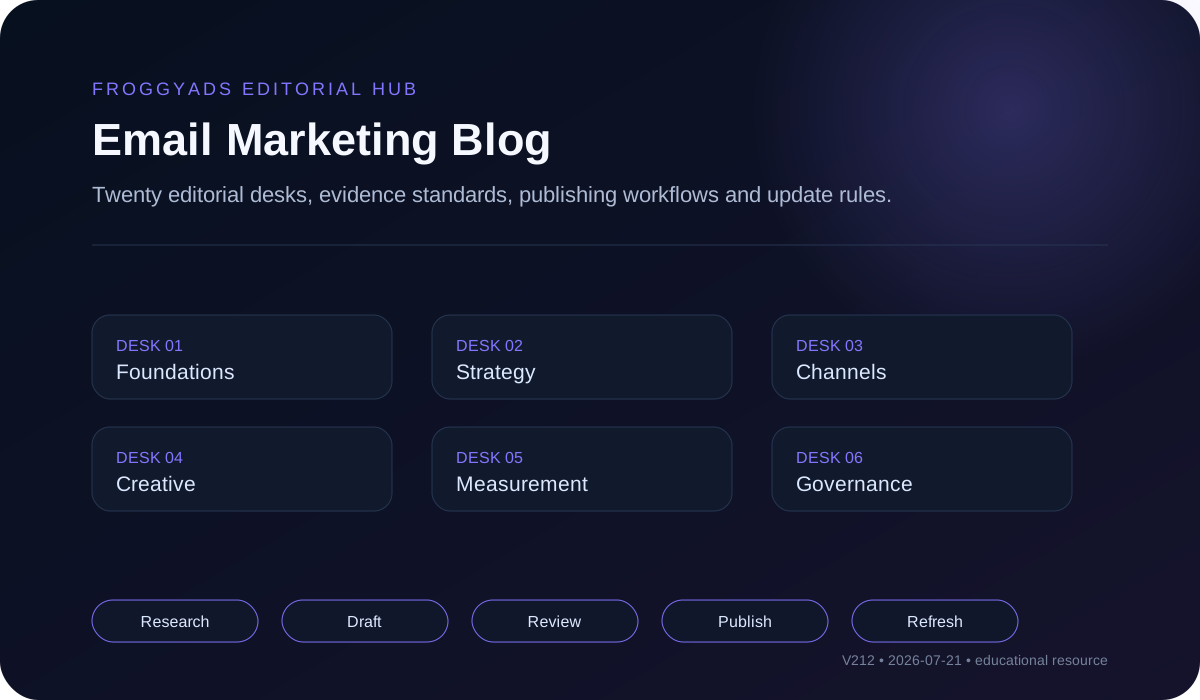
Email Marketing Blog: 20 Editorial Desks, Evidence Standards and Publishing Rules — what matters first
Email Marketing Blog: 20 Editorial Desks, Evidence Standards and Publishing Rules — what matters first needs one identifiable reader task, one evidence trail and one maintenance owner before the editorial team treats it as publishable.