
Display Marketing Blog: 20 Editorial Desks, Evidence Standards and Publishing Rules
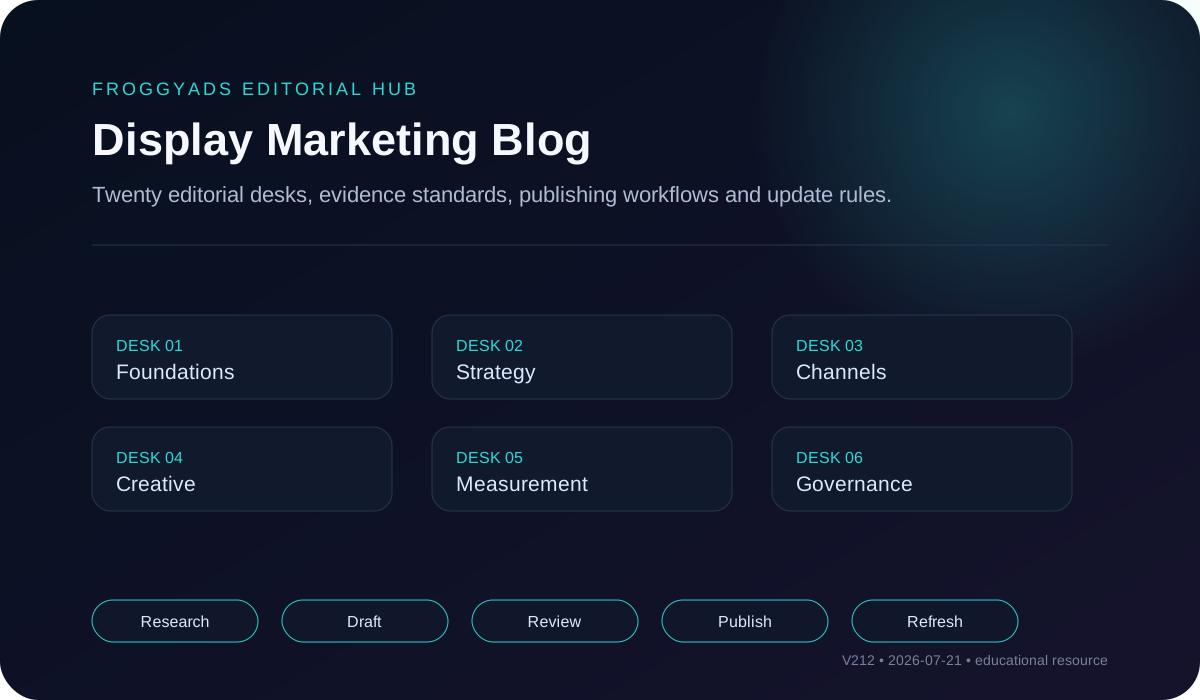
A display marketing blog should help advertisers, publishers and operators answer specific display-media decisions with current primary sources, explicit evidence boundaries and maintained internal routes. It is not an endless topic archive. This page defines an editorial system for formats, supply, creative, targeting, measurement, policy, economics and change records.
Official display-delivery and people-first publishing boundary
Google Ads documentation explains that display delivery can occur across websites, mobile sites, apps and Google properties according to targeting, format and policy choices. Google Search Central recommends helpful, reliable, people-first content instead of pages produced primarily for search systems. Those product and publishing sources do not establish how every ad platform works, certify a publisher, or guarantee blog visibility. Each article should name its platform and campaign scope, cite current primary documentation, and distinguish a reported metric from an accepted business outcome. Preserve the source date, tested interface or export, editorial owner and next review trigger so a reader can see whether guidance describes a current product behavior, a general operating principle or an example requiring local verification. Link corrections and related operating procedures to the same record, allowing future readers to reconstruct both the supported statement and the action it was meant to guide.
- Google Ads where ads can appear - display surfaces, devices and targeting context
- Google Search Central people-first content guidance - useful audience-focused publishing and clear who, how and why
Define the blog's reader decisions
List the recurring decisions the library must support: choosing a format, inspecting supply, approving creative, setting targeting, validating a destination, reconciling events, reviewing cost or responding to policy change. Assign each page one primary reader and next action.
Keep beginner definitions, implementation references and commercial comparisons distinct. A page can link across levels without pretending one explanation serves every role. The editorial index should reveal where a reader starts and which deeper record owns the current procedure.
Create a display topic architecture
Organize content around delivery layers rather than arbitrary keyword clusters: objective, audience, inventory, placement, format, creative, destination, event, economics, policy and incident response. Map each topic to a canonical guide, supporting example and update owner.
Prevent sibling pages from repeating the same framework with a different adjective. When two proposed articles answer the same decision, combine their unique evidence. Use the blog index to expose relationships while keeping each destination focused.
Use platform-specific definitions
Name the platform and product when explaining inventory or controls. Google's Display Network includes websites, mobile sites, apps and Google properties, but another network can define supply differently. Do not transfer a setting, eligibility rule or reporting field across vendors without verification.
Record account type, campaign subtype, interface date and official documentation with every procedural claim. If the current account does not expose a feature, state that boundary. A general glossary may compare terms, but it must preserve product-specific differences.
Connect the guide to live testing
Connect Display Marketing Blog to a controlled audience test
Use the choices established in “Use platform-specific definitions” to define one audience, budget and source set in FroggyAds. Keep the surrounding offer and measurement rule stable so the test adds evidence to display marketing blog instead of mixing several changes at once.
Create My Free Account
Maintain an official-source ledger
Store source URL, publisher, retrieval date, supported statement, owner and next review trigger. Prefer platform documentation, standards bodies and government guidance for behavior, specifications and policy. Open the source at review instead of assuming a retained link still supports the wording.
Mark secondary analysis, internal observations and editorial conclusions separately. A citation should sit near the material claim and tell the reader why it is relevant. Link volume does not replace evidence matching.
Publish format experience guides
For banner, responsive display, native, video, interstitial or other units, document eligible surfaces, dimensions, user initiation, close or skip behavior, asset requirements and destination transition. Render examples in the real environment rather than judging isolated creative files.
Separate advertiser and publisher considerations. The buyer needs brand, source and accepted-value evidence; the publisher also needs page continuity, latency and user experience. A useful guide states which party controls each failure and pause route.
Explain inventory and supply paths
Show direct publisher, exchange, network, reseller and platform relationships at the level supported by evidence. Define placement or source identifiers and where exclusions can be applied. Avoid labels such as premium or fraud-free unless the article has specific substantiation and scope.
Use standards such as OpenRTB only for the version and fields they actually define. Do not infer that every participant populates an optional field accurately. Articles should teach readers how to inspect available evidence and limit unknown supply.
Connect targeting to evidence limits
Explain contextual, placement, audience, remarketing, geography and automated expansion according to the selected platform. Record whether signals are observed, declared, modeled or unavailable. A segment name is not proof that every recipient has a trait.
Add privacy, consent and sensitive-category review where relevant. Keep eligibility and outcome validation in first-party systems when possible. The article should state what a campaign setting controls and what it cannot guarantee.
Review display creative claims
Create a claim file for product, price, comparison, performance, scarcity and endorsement statements. Link each asset version to substantiation and approval. Explain responsive assembly or automated variants without suggesting the advertiser always controls the final combination.
Test legibility, branding, alternative text where applicable, animation, sound, safe areas and destination continuity. A creative best-practice article should identify the tested format and avoid promising that a design pattern will improve performance everywhere.
Document destination acceptance
Inspect final URL, redirects, mobile layout, browser behavior, load, content relevance, disclosures, forms and confirmation. Google Ads policy requires functional, useful destinations and consistent URL behavior in its system. Verify the current policy rather than converting it into a rule for all networks.
Keep destination release and campaign evidence aligned. When the page changes, open a new observation period. Do not diagnose inventory quality through a broken or materially different destination.
Choose the execution format
Choose a paid-media format that supports Display Marketing Blog
Use the criteria around “Document destination acceptance” to decide whether push, native, display or pop fits the message and destination. Set format, targeting and spend as campaign controls in FroggyAds while the display marketing blog decision remains the standard for judging the result.
Create My Free Account
Build measurement explainers
Define requests, impressions, viewability where applicable, clicks, sessions, conversions, accepted events, rejections and reversals separately. State platform counting rules, attribution windows, timezone, currency and identifiers. A glossary entry should link to the current product definition.
Show how to reconcile one report with first-party records without forcing totals to match. Explain consent, identity, modeling and processing delays. Attribution is a credit rule; an incrementality claim requires a suitable comparison beyond ordinary platform reporting.
Teach complete display economics
Separate CPM, CPC or another billing unit from complete cost per accepted outcome. Include media, creative, serving, verification, data, destination work, tools, agency fees and internal review. Record credits and late adjustments.
Use conservative, expected and stress cases instead of a single forecast. Explain how added budget can reach different inventory and why marginal evidence matters. Do not present a benchmark without source, period, market, format and denominator.
Design applied cases responsibly
Use a scenario with declared assumptions, source rows, destination state and accepted-event ledger. Show pause, repair or scale decisions without inventing a customer name or favorable result. A case pattern should demonstrate method, not serve as disguised proof.
When publishing a real case, obtain the necessary permissions and disclose material relationships. Preserve the observation window and limitations. Retire the result as a current benchmark when campaign conditions no longer match.
Operate corrections and incidents
Provide a visible route to report a factual, policy or accessibility issue. Classify severity and assign a response owner. Material destination, safety or compliance errors may require immediate pause rather than waiting for the normal editorial calendar.
Keep the original evidence, correction date and changed passage where appropriate. Update internal links and derivative articles. A correction process protects readers better than silently rewriting a claim while leaving its publication date unchanged.
Review accessibility and retrieval
Use descriptive titles, headings, link purpose, semantic tables, image alternatives and keyboard-accessible components. Provide enough context for a quoted passage to retain its subject and limit. Test the page as a reader, not only through an HTML checker.
Build a linked contents list on longer resources and keep fragments unique. A retrievable page helps humans and automated systems locate specific answers, but structure does not compensate for unsupported or duplicated prose.
Schedule evidence-led maintenance
Set triggers for platform release, standard revision, policy change, link failure, campaign evidence and reader questions. Different desks need different cadence. Review the source and task before changing a date.
Choose retain, revise, consolidate, archive or remove. Preserve redirects and update the blog index. A smaller current library is more useful than twenty desks filled with overlapping material whose owners cannot verify it.
Put the guide into practice
Turn Display Marketing Blog into a bounded campaign test
With “Schedule evidence-led maintenance” documented, launch only the next reversible test. Set a spending limit, preserve the baseline and use source-level and audience controls so the next step depends on qualified outcomes for display marketing blog, not activity volume.
Create My Free Account
Build campaign operations references
Document naming, ownership, launch checklist, approval, budget, pacing, source review and pause procedure for a specific platform context. Keep reusable operating artifacts separate from explanatory articles. A checklist should name the evidence required, not merely list optimistic verbs.
Test the procedure on a controlled campaign and record exceptions. When the interface changes, update screenshots and steps together. Archive obsolete versions so operators do not combine instructions from incompatible account states.
Publish experiment interpretation guides
Explain hypothesis, allocation, primary accepted event, guardrails, observation rule and concurrent changes. Use a worked structure without inventing a winning result. Display auctions and inventory vary, so ordinary before-and-after differences should not be described as causal proof.
Teach readers to inspect sample imbalance, destination releases, tracking loss and source movement before choosing a variant. Preserve null results and stopped tests. An editorial library is more credible when it shows why evidence was inconclusive.
Maintain vendor comparison boundaries
Define the job, account ownership, format, inventory access, reporting, integration, service and exit requirements before comparing providers. Use current documentation and the advertiser's own pilot. A feature matrix should not award points for capabilities irrelevant to the declared decision.
Disclose commercial relationships and avoid unverifiable best claims. Keep software fee, media, services and internal labor separate. Reopen the comparison after material pricing, product or ownership changes rather than leaving a permanent winner in the archive.
Handle statistics and benchmarks
Record metric definition, numerator, denominator, market, platform, format, period, sample and publisher for every numeric benchmark. Explain whether it is a platform report, study or internal observation. A percentage without its measurement context should not drive a budget decision.
Use benchmarks to form questions, not guarantees. Compare the campaign with its own accepted outcomes and maturation. Remove or qualify a number when the underlying source expires, changes method or no longer matches the article's subject.
Design glossary ownership
Assign each material display term a canonical definition with platform variations, source date and related workflow. Link articles to that record instead of rewriting definitions. Keep billable, measured, modeled and accepted states distinguishable.
When a product renames a feature, preserve the old term for historical retrieval while identifying the current label and effective date. Do not imply equivalence until the product documentation and tested behavior support it.
Audit the editorial index quarterly
Sample pages from every active desk for source freshness, overlap, broken links, reader task, accessibility and decision utility. Include low-traffic pages when their instructions carry material risk. Traffic alone should not determine which guidance receives review.
Publish an internal action list with owners and deadlines for corrections, merges, new evidence and retirement. Freeze new topic expansion when maintenance debt exceeds capacity. The index succeeds when readers reach current decisions efficiently, not when every planned desk contains equal numbers of articles.
Connect articles to support evidence
Review campaign questions, disapprovals, billing discrepancies and implementation tickets for recurring reader needs. Remove customer identifiers and classify the underlying decision. A support pattern can justify an update, but one unusual ticket should not be presented as representative market evidence.
Link the revised article back to the operating procedure and source record. Track whether the clarification reduces repeated error without claiming causality from a simple time comparison. Give support owners a route to challenge guidance that no longer matches the live platform.
Prepare a display knowledge handover
For each active desk, export the topic map, source ledger, article owners, open corrections, product versions and review calendar. Include the high-risk pages and the route to pause them. A handover should work without access to one editor's private bookmarks or messages.
Have the incoming owner reproduce one update from source verification through publication and internal-link review. Record missing permission or tooling. Editorial continuity is part of quality because platform guidance can become unsafe when no one retains the context needed to maintain it.
Display blog editorial acceptance matrix
A display article passes when the reader decision, platform scope, source support, rendered experience and maintenance owner are all explicit.
| Editorial control | Record | Pass rule |
|---|---|---|
| Reader decision | Role, question and next action | Page resolves a bounded task |
| Platform scope | Product, subtype and interface date | Behavior is not generalized silently |
| Evidence | Primary source and supported claim | Material statements are traceable |
| Usefulness | Example, workflow or decision artifact | Reader can apply the guidance |
| Maintenance | Owner and review trigger | Change can be corrected promptly |
Retained display marketing library resources
The original standards, product documentation, policy, analytics and internal display routes remain below in their existing sequence. They support navigation and verification, not a universal performance claim.
Display marketing blog questions
Which topics should a practical display marketing blog cover?
It should cover audience choice, formats, creative, placement quality, landing experience, measurement and campaign controls. A display article passes when the reader decision, platform scope, source support, rendered experience and maintenance owner are all explicit.
For Display Marketing Blog, how can readers judge a display benchmark article?
Check the market, format, device, date, sample and metric definition before applying the reported comparison. The original standards, product documentation, policy, analytics and internal display routes remain below in their existing sequence.
For Display Marketing Blog, what makes a creative example instructive?
The example should explain the audience problem, message decision, placement context and result that followed. Create a claim file for product, price, comparison, performance, scarcity and endorsement statements.
For Display Marketing Blog, why should viewability appear in display guidance?
A served impression may have little chance to be seen, so delivery count needs visibility context. Google Ads documentation explains that display delivery can occur across websites mobile sites apps and Google properties according to targeting.
For Display Marketing Blog, which placement-quality article can prevent wasted spend?
Look for guidance on source reporting, exclusion rules, invalid patterns and checks that separate page failures from traffic issues. Organize content around delivery layers rather than arbitrary keyword clusters objective audience inventory placement format creative destination event economics policy.
For Display Marketing Blog, how should a blog explain frequency?
It should connect repeat exposure with reach, response and creative fatigue rather than offering one fixed limit. Separate CPM, CPC or another billing unit from complete cost per accepted outcome.
For Display Marketing Blog, what privacy detail belongs in audience articles?
Useful articles state how audience data is collected, permitted, shared, retained and removed under the actual workflow. Review campaign questions, disapprovals, billing discrepancies and implementation tickets for recurring reader needs.
For Display Marketing Blog, does a high click-through rate prove display success?
No. Click response needs to lead to accepted outcomes at an acceptable cost for the campaign to succeed. For each active desk, export the topic map, source ledger, article owners, open corrections, product versions and review calendar.
For Display Marketing Blog, how can a reader apply a display article safely?
Translate the idea into one bounded test, preserve the current control and define the decision measure in advance. List the recurring decisions the library must support choosing a format inspecting supply approving creative setting targeting validating a destination.
For Display Marketing Blog, when is display advice too generic to use?
It is too generic when it omits the audience, placement, format, objective or conditions that make the recommendation valid. Name the platform and product when explaining inventory or controls.
Display Marketing Blog: 20 Editorial Desks, Evidence Standards and Publishing Rules — buyer decision
Display Marketing Blog: 20 Editorial Desks, Evidence Standards and Publishing Rules should help a media buyer move from research to a controlled campaign decision. Define the operating constraint first, preserve source-level evidence, and judge the result on the accepted business outcome. The adjacent X Marketing Blog page should remain a separate decision.
Evidence already visible on this page: A display marketing blog should help advertisers, publishers and operators answer specific display-media decisions with current primary sources, explicit evidence boundaries and maintained internal routes. It is not an endless… Google Ads documentation explains that display delivery can occur across websites, mobile sites, apps and Google properties according to targeting, format and policy choices. Google Search Central recommends helpful, reliable,… The working concepts for this URL are content pillar, platform fit, paid social, organic social, engagement.
Questions to resolve before scale: Which topics should a practical display marketing blog cover? For Display Marketing Blog, how can readers judge a display benchmark article? For Display Marketing Blog, what makes a creative example instructive?
| Checkpoint | Page-specific action | Evidence to keep |
|---|---|---|
| Boundary | Use “Operate a display marketing blog as a maintained decision library” to define the first operating boundary for Display Marketing Blog: 20 Editorial Desks, Evidence Standards and Publishing Rules. | Record the answer to “Which topics should a practical display marketing blog cover?” together with source, targeting and destination identifiers. |
| Evidence path | Use “Official display-delivery and people-first publishing boundary” to test whether delivery is producing the expected path toward the accepted business outcome. | Keep the evidence needed to answer “For Display Marketing Blog, how can readers judge a display benchmark article?” after the same maturation window. |
| Decision | Use “Define the blog's reader decisions” to decide what changes next; change one material variable before comparing again. | Write the answer to “For Display Marketing Blog, what makes a creative example instructive?” plus accepted cost/value and the rollback condition. |
Transparent decision example
Hypothetical example: If Display Marketing Blog: 20 Editorial Desks, Evidence Standards and Publishing Rules uses USD 275 of test spend and 5 outcomes are accepted after maturation, the accepted outcome cost is USD 55.00. Replace the inputs with your own economics; this is not a FroggyAds performance claim.
Why use FroggyAds for this step?
With FroggyAds, you can turn the Display Marketing Blog: 20 Editorial Desks, Evidence Standards and Publishing Rules decision into a self-serve traffic test using targeting, budget, conversion and source controls, then keep or restrict spend from the accepted business outcome you define. Create your free FroggyAds account.
Display Marketing Blog: 20 Editorial Desks, Evidence Standards and Publishing Rules — what matters first
Display Marketing Blog: 20 Editorial Desks, Evidence Standards and Publishing Rules is most useful when it helps a buyer decide whether this option fits the buyer's acquisition workflow. Define the accepted outcome first, then use targeting, budget and source-level evidence to decide what deserves more spend.