Clear offers, useful responses and paid acquisition

Direct Response Advertising: Creative, Media and Measurement

By FroggyAds. We operate the self-serve DSP and ad network described in this guide. Updated 15 October 2026.

Direct response advertising asks a person to take a specific next step: buy an item, request a quote, book a consultation or begin a trial. We help you test that invitation through FroggyAds campaigns with adjustable targeting, budgets, bids and source controls. The goal is a response your business can use, supported by a clear offer and a reliable path from the ad to the final action.

Ask for an action worth measuring
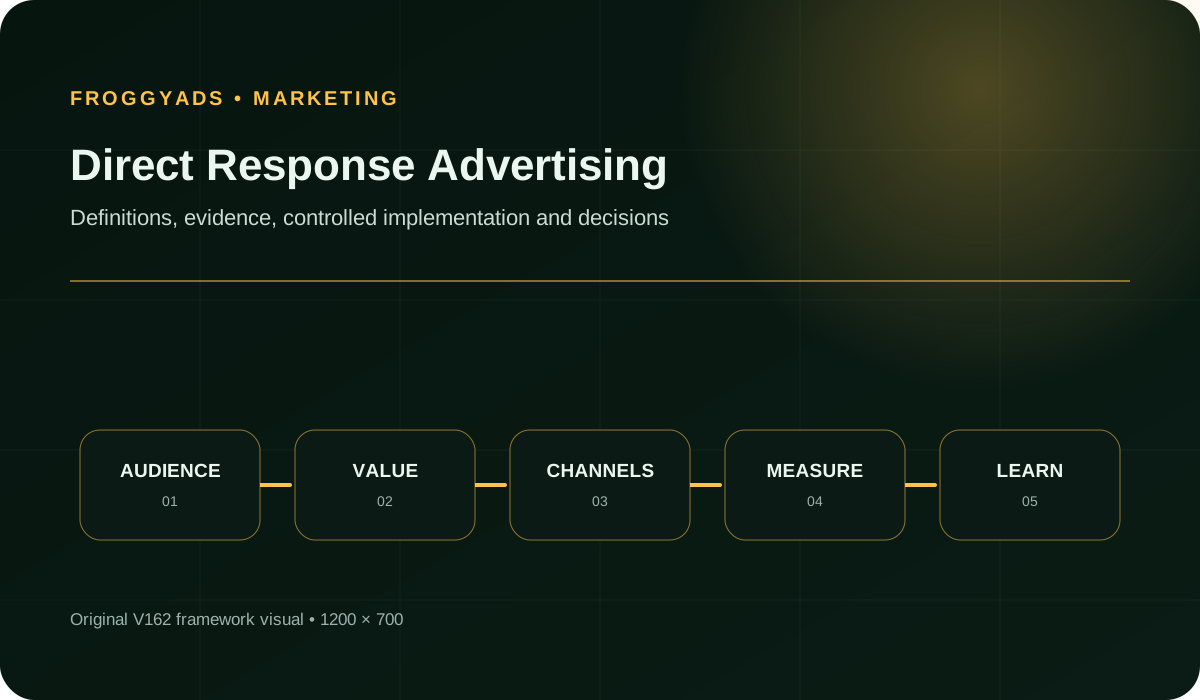
Direct Response Advertising framework for planning, production, measurement and controlled improvement

What should your first response campaign ask people to do?

Quick answer: Choose one valuable response, explain what the person receives and make the destination fulfil that promise. Track the action, then check whether it becomes an accepted lead, order or other useful result. Use FroggyAds to compare traffic and creative choices against that result, rather than selecting a winner from clicks alone.

The broader relationship between product, price, distribution and promotion is explained in American Marketing Association: The Four Ps of Marketing. A response advertisement puts that relationship into a concrete invitation with terms the prospective customer can understand.

What a response campaign must make clear

  • Ask for one response that has a clear role in your business.
  • Make the offer and next step consistent across the ad, page and follow-up.
  • Count initial submissions separately from accepted leads or orders.
  • Keep creative versions and source changes connected to the result you review.
  • Expand only when response economics and service capacity support it.

What makes an advertisement direct response?

Direct response advertising asks the visitor to take a specific, measurable action. The offer, destination and follow-up must support that action.

A direct response ad gives the reader a reason to act and a recognisable way to do it. The response could happen immediately or after some consideration, but the campaign is organised around that action. It needs more than an energetic headline: the person must know what is offered, what commitment is involved and what happens after responding.

The action should have a clear place in your business process. A quote request may enter a sales conversation; a checkout may create an order; a trial signup may start product evaluation. These responses have different values and follow-up needs. Do not combine them into one conversion total unless the comparison explicitly accounts for those differences.

A response campaign can also strengthen recognition of your brand. That does not make every later sale attributable to the ad. Decide which observable result you will use for the initial buying decision and keep broader brand effects separate unless you have a suitable way to measure them.

Choose an action your business can use

Start with the commitment a new prospect is reasonably ready to make. A familiar, clearly priced item may support a purchase invitation. A complex service may need a quote or consultation first. Asking for the wrong level of commitment can suppress useful response even when the audience and product are a good match.

Work backwards from the result you can serve. If your team can quote only for particular locations or project types, communicate that eligibility early. If a trial requires a business email or a compatible device, make those requirements visible before submission. You may receive fewer responses, but the people who continue will better understand the offer.

Offer clarity also protects follow-up. A visitor expecting an instant price should not discover only after submitting that the next step is a sales call. Name the actual exchange. When the ad, page and response team describe the same process, you gain a more useful test of demand and fewer avoidable disappointments.

Test the invitation

Put one useful action at the center

Choose the purchase, qualified enquiry, trial or signup that your team can evaluate. A direct-response campaign becomes measurable when that action has a clear acceptance rule.

Create My Free Account
Illustration of audience targeting controls for a direct response advertising test

Eight parts of an actionable advertisement

#Part of the adDecision to settle
1Relevant needWhat problem or purchase task makes the invitation useful now?
2Eligible prospectWho can use the product or service, and who cannot?
3OfferWhat does the person receive, at what price or commitment?
4Requested responseWhat exact action should the person complete?
5ProofWhich verifiable detail supports the benefit or claim?
6DestinationWhere can the person understand the terms and act?
7AcceptanceWhat makes the recorded response commercially usable?
8Follow-upWho or what fulfils the next step promised to the customer?

Use the following parts to check the advertisement as a whole. Each affects the meaning of the response. Changing the incentive, eligibility or requested action creates a different offer, even when the headline and traffic source stay the same.

Build the response path before buying traffic

1. Choose the valuable action

Choose the result the campaign should produce and the record that confirms it. Separate the first response from later qualification. This gives the creative and media teams one clear reason for asking the prospect to act.

2. Describe who can use the offer

List the needs and conditions that make a prospect eligible. Use what you know about the product or service rather than inventing a demographic stereotype. Carry material restrictions into the destination and the available campaign targeting.

3. Set the offer terms

Confirm price, incentive, availability and any commitment after responding. Make the offer feasible for the business to deliver. A temporary discount or trial condition needs to remain accurate for the campaign’s actual running period.

4. Write a clear response promise

Write an invitation that connects a relevant benefit with the next action. Support the claim with real product or service evidence. Avoid implying a result that the destination cannot substantiate or the response team cannot provide.

5. Build the destination

Give the person a page that continues the message and answers the questions needed to act. Make eligibility and terms easy to find. Choose a clear primary action instead of making visitors interpret several competing invitations.

6. Check the complete action

Complete the form, checkout, booking or trial path as a real user would. Check errors, confirmation and the follow-up message. A button that looks active is insufficient if the response never reaches the business system.

7. Connect the tracking evidence

Verify the campaign identifiers and conversion method you intend to use. Check duplicate handling and the relationship to the lead or order record. Keep test activity identifiable so it is not confused with genuine customer response.

8. Prepare your FroggyAds campaign

Select a supported format, upload the approved creative and configure available targeting, budget and bids. Keep the offer distinct from unrelated campaigns. Complete the campaign review process before expecting live delivery.

9. Review response quality

Look at initial delivery for technical problems, then examine accepted responses after appropriate follow-up. Use source reporting where available. Record why responses were rejected so a quality problem is not hidden inside one conversion total.

10. Choose one next change

Adjust the part of the path that the evidence identifies: message, eligibility, destination, follow-up or traffic setup. Preserve the prior version and review the effect under a consistent definition before making another large change.

Which responses count toward the decision?

Count the initial action and the accepted business outcome separately. A submitted form becomes an accepted lead only when it meets your stated criteria.

Choose cost per accepted response as a practical buying measure when the accepted action has a consistent definition and business value. For leads, acceptance might require a genuine contact with an eligible need. For ecommerce, use a valid order and a clearly stated treatment of cancellations. State what is counted before reading the result.

MeasureCalculation or meaningHow to use it
Accepted response countValid actions meeting your stated business criteria after the review period.Compare useful volume without including duplicates or rejected responses.
Acceptance rateAccepted responses divided by the initial responses from the same reviewed group.Identify whether a cheap response source is attracting suitable prospects.
Cost per accepted responseRelevant campaign cost divided by accepted responses; state whether handling costs are included.Compare the buying cost of a consistently defined result.
Attributed versus incremental valueAttribution assigns credit; incremental value requires evidence about what would happen without the advertising.Use honest labels and a suitable comparison before making a causal sales claim.

Keep an intermediate view as well: ad clicks, destination arrivals, form starts and submissions can reveal where the path is losing people. These stages help you troubleshoot, but they are not interchangeable. A lower cost per submission only helps the business when enough of those submissions become the kind of response you intended to buy.

Match format to offer

Carry the promise from ad to destination

Use a FroggyAds format that gives the offer enough context, then repeat the terms and next step on the landing page without changing the story.

Create My Free Account
Illustration comparing advertising formats for direct response advertising execution

Three response paths worth separating

A purchase with a clear product choice

A product-purchase campaign should make the item, price and buying conditions clear before checkout. Keep the ad’s featured product easy to find on the destination. Then inspect paid and cancelled orders separately. An exciting discount can create a strong initial response while leaving little contribution after fulfilment and acquisition.

A quote request that needs qualification

A quote campaign should help the prospect decide whether the service fits. Ask only for information needed to assess and respond to the request. Qualification may include service area, project type or timing, depending on the business. The useful result is a real eligible enquiry your team can handle, not simply a completed form.

A trial that must lead to useful activity

A trial campaign needs to explain what access the person receives and what happens next. Track signup separately from the first activity that indicates a meaningful evaluation. If an incentive attracts registrations from people who never use the product, inspect the offer and onboarding before paying for more of the same response.

When an apparently strong campaign goes wrong

An attention-grabbing claim attracts the wrong people

A headline can raise click-through rate by implying something the destination does not provide. Look at the questions, cancellations or rejected leads that follow. If the misunderstanding repeats, correct the promise. A less sensational message that attracts suitable prospects can be more useful than an attention winner that creates avoidable work.

The event count outruns the business record

Check whether the tracked action represents a completed action in your business system. A form button click is not necessarily a successful submission, and a repeated request can create duplicate events. Reconcile with stable lead or order identifiers where your setup supports them. Keep uncertain records separate while you investigate.

More responses overwhelm the service team

Response volume has an operational limit. If a consultation campaign generates more requests than the team can answer, useful prospects may go cold or receive poor service. Adjust the campaign to the capacity you can actually provide, and improve follow-up before assuming that more acquisition is the solution.

When results weaken, locate the failure before changing several campaign settings. A page error needs a page repair; ineligible enquiries may need clearer qualification; slow follow-up needs an operational response. FroggyAds gives you controls to contain spend while you address the part of the journey responsible for the problem.

Set a buying limit from response value

Set a campaign buying limit from a realistic value of the accepted response. For a sale, start with the contribution available after the product or service costs. For a lead, use your own observed progress from accepted lead to customer and the contribution those customers generate. Keep uncertain assumptions visible rather than turning a forecast into a guaranteed value.

A learning campaign also needs an affordable loss limit. Decide how much you can spend on resolving the offer or source question even if the first test does not work. The account deposit, an individual bid and this experiment limit are different decisions. A low bid can still accumulate spend on responses that do not meet your need.

Allow for response handling. Screening, calls, demonstrations and follow-up can make a cheap lead expensive. Use the same treatment of these costs when comparing offers. If one creative generates many unsuitable requests, its workload belongs in the decision even when the media report makes it look efficient.

Prepare the response path

Buy more of the responses the business can use

Reconcile campaign and source records with accepted outcomes. We recommend raising budget only when quality and follow-up capacity remain inside the plan.

Create My Free Account
Illustration of a campaign launch checklist for direct response advertising

How FroggyAds supports response testing

Our role is to bring paid traffic to the invitation you have prepared. Your landing page explains the exchange, your tracking records the action and your business decides whether the response meets its criteria. Keeping these roles clear makes it easier to connect a campaign adjustment to an actual improvement.

FroggyAds gives you self-serve push, native, display and pop campaigns with budgets, bids, targeting and source reporting. The buy traffic guide covers the wider setup process. For direct response, use those controls to keep the offer test focused and identify the traffic combinations that produce suitable prospects or orders.

Review available source evidence alongside the accepted responses, using a consistent attribution approach. Keep a productive setup recorded before expanding it. If you change the creative and source mix together, you may still improve the campaign, but you will have less evidence about which change mattered.

Make tracking and follow-up work together

  • Does the tracking record a completed action rather than only a button click?
  • Can the business system identify eligible responses and explain rejections?
  • Can you connect a response to the offer and campaign version the prospect saw?
  • Can the response team see the promised terms and handle the expected volume?
  • Can you compare the next test using a consistent acceptance and follow-up period?

Choose tracking and customer-management tools that preserve the response’s meaning. Your team should be able to distinguish submitted, contacted, qualified and won leads, or paid, cancelled and retained orders. FroggyAds campaign reporting is one part of that record. Do not assume it replaces the CRM, ecommerce system or follow-up process.

Write the ad and destination as one conversation

Write the destination headline as a continuation of the ad’s promise. Show the offer conditions near the requested action and make the next step explicit. A consultation page should explain the conversation; a trial page should explain access and any later commitment. Useful clarity is more persuasive than another paragraph insisting that the offer is exceptional.

Use supporting proof appropriate to the claim: actual product details, a demonstrable workflow or a verified explanation of the service. Keep testimonials, savings claims and comparisons limited to evidence you can support. The FTC’s advertising guidance is a useful U.S. reference for truthful, substantiated claims; other markets and specialist products can have additional requirements.

Make the action usable without unnecessary obstacles. Clear labels, understandable errors and a working mobile path help an interested person respond. Test the confirmation and the next message too. The campaign promise does not end when a button is clicked; the customer should receive the next step you described.

Direct response advertising questions

What is direct response advertising?

Direct response advertising is paid promotion built around a specific action and a way to evaluate that response. Examples include buying a product, requesting a quote or starting a trial. With FroggyAds, you can test the traffic and creative choices behind the invitation while checking accepted outcomes in your own business records.

Which action should a direct response ad ask for?

Ask for the action that matches the prospect’s readiness and your service process. A straightforward product can support a purchase invitation; a complex service may need a qualified enquiry first. State the terms and what happens afterward. Do not call an offer free or instant when it depends on undisclosed conditions.

What should count as a conversion in a lead campaign?

Use a completed action that matters commercially, then define acceptance. A form submission is an initial response; an eligible, contactable enquiry may be the accepted lead. Keep both counts so you can diagnose the path without treating unsuitable or duplicate submissions as valuable customers.

What makes a useful direct response headline?

A direct response headline should identify a relevant benefit and lead to an offer that delivers it. Specific product details or a clear service outcome are stronger starting points than unsupported superlatives. Check that a person following the headline finds the same promise on the destination and understands the requested commitment.

Which FroggyAds format should I test first?

Start with the format that can communicate the offer and fit the destination. FroggyAds provides push, native, display and pop options with their own requirements and interaction styles. Test a limited selection separately, then compare the accepted result and full cost rather than expecting one format to win for every business.

Why do analytics and sales response counts differ?

Review the counting definitions, attribution window, time zone, duplicate handling and event implementation. Analytics, an ad platform and the CRM can describe different stages of the journey. Google Analytics, for example, lets you mark important actions as key events; the label alone does not establish that a lead was qualified or an order remained valid.

Does a shorter form always improve lead generation?

Usually not. Removing an important eligibility question may increase submissions while creating more unsuitable leads. Test whether a simpler form preserves the information needed to serve the person. Compare accepted enquiries and handling effort as well as form completion, then keep the version that supports the actual business process.

Do attributed conversions prove incremental sales?

No. An attributed result is assigned to a campaign under the chosen reporting rule. It does not by itself show what would have happened without the advertising. Use a suitable comparison or experiment if you need an incremental-effect claim. For everyday optimisation, report attributed outcomes honestly and keep the method consistent.

When should a response campaign be paused?

Pause the affected campaign for a broken destination, misleading offer, unavailable service or a material tracking failure that prevents a responsible buying decision. Also contain volume when the response team cannot meet the promised service. Resolve the specific issue and verify the relevant path before resuming acquisition.

When is it sensible to increase campaign spend?

Increase spend when accepted response quality, economics and handling capacity support the next stage. Check the extra delivery separately because new sources or audiences may behave differently. Preserve the previous setup and change one major factor when practical so the next review can explain what improved or weakened.

Marketing and measurement references

These existing resources cover marketing fundamentals, campaign objectives, truthful advertising and accessible experiences. Use the named provider’s current documentation for its own features. This guide’s examples are illustrative, and our FroggyAds recommendations are bounded to the campaign controls and reporting described on our current product pages.

Prepare a response-campaign brief

Write a short brief that a creative producer, media buyer and response team can use without interpreting the offer differently. The entries below are practical decisions, not fields to fill with slogans. Each should identify something the customer will see or something the team will check when a response arrives.

The response you want

Name the action in plain language and identify the record that confirms it happened. If you want quote requests, say what makes one eligible. If you want purchases, state how cancellations are treated. Do not let the easiest event to track choose the commercial objective for you.

The prospect who can benefit

Describe who can benefit from the offer and any material exclusions. Include service geography, product compatibility or business requirements where relevant. Carry the necessary conditions into the ad or destination so prospects can recognise whether the invitation is intended for them.

The offer and its conditions

Write the price, incentive, availability and requested commitment exactly as the customer will encounter them. Include the follow-up process. An offer for a consultation should not be represented as an immediate personalised answer unless the service can actually provide one.

The chosen traffic route

Choose the first format and available targeting that fit the message. Keep unrelated offers in separate campaigns so a blended response total does not hide their differences. Record any source decision made during the test so the later result can be interpreted properly.

The message and proof

Save the approved headline, image and claim support with the destination version. Name the question the creative test is meant to answer. If the second version changes the price or incentive as well as the wording, describe it as an offer change rather than a pure copy test.

The next step after submission

Describe the confirmation, response timing and handoff after the action. Make sure someone can handle the resulting enquiries or orders. If a lead needs a call, the team should know what the ad promised and which information the prospect already provided.

The accepted-result calculation

Record media spend, initial responses, accepted responses and the reason for rejection where appropriate. Keep duplicates and unresolved cases distinct. When comparing two campaigns, align the validation period so a newer batch of leads is not penalised simply because follow-up is unfinished.

The review and change decision

State the decision the review will support: continue the offer, clarify eligibility, repair the destination, adjust a source or test another creative angle. Record the observed reason. A useful review ends with a specific next action rather than a general instruction to optimise harder.

Start your response campaign with FroggyAds

Choose FroggyAds for the paid-media part of this process. We give you an accessible self-serve workflow for preparing campaigns, managing spend and inspecting source evidence. Bring a clear response offer and a working destination, then use the results to improve the next acquisition decision.

Create My Free Account
Buyer decision tool

The direct-response campaign brief

This page is for advertisers with a specific offer who need traffic to produce purchases, qualified leads, trials or another accountable response. Use it to design an advertisement around one clear, measurable next action. The decision is which promise, proof and destination path will help the intended prospect complete the useful action without misleading pressure. The accepted outcome is accepted responses that the business can fulfil and reconcile to the originating campaign.

Evidence fieldWhat your team should record
ProspectDescribe who can genuinely use the offer and the condition that makes the response relevant now.
PromiseState the benefit and the terms the destination can substantiate without invented urgency or guaranteed outcomes.
Response pathKeep the ad, landing page, form or checkout and confirmation step as one continuous conversation.
AcceptanceDefine which submitted responses become useful business outcomes and when that decision is available.

Direct Response Advertising: Plan, Launch & Optimize Campaigns operating scenario

A service business wants quote requests, but its ad attracts people outside the supported area. The brief adds location eligibility and service terms before the form so response volume can be judged with qualification intact.

Apply this decision in your next FroggyAds campaign

  1. Choose one primary response and remove competing actions from the first test.
  2. Version the creative and destination together so the promise can be traced to the response.
  3. Use FroggyAds targeting and source reporting to find the audiences that generate accepted responses.
  4. Scale only after response quality and fulfilment capacity remain stable at the next volume step.

Choose the next step from accepted evidence

We give you a self-serve route to test paid traffic while you keep the offer, destination, tracking and business acceptance rule under your control. Use the worksheet above to brief one campaign, preserve source-level evidence where available and make the next budget decision from mature outcomes.

Create your free FroggyAds account

Existing references

Keep the supporting links with the decision record


