
Direct Link Traffic For Sale
Direct-link supply procurement dossier treats the purchased navigation event, its publisher context and its contract evidence. As of August 2026, the objective is a documented choice, not a universal performance promise.
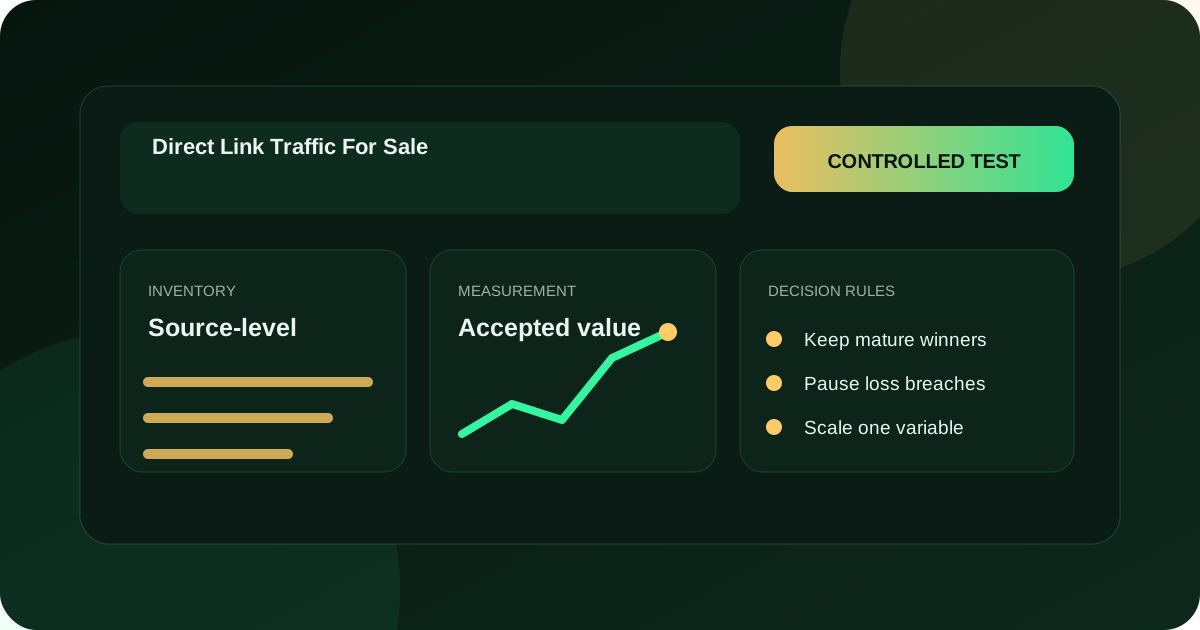
Visible scope and entity record
- Direct link traffic for sale: Direct link traffic for sale is evaluated through publisher context, campaign parameters, source controls and backend acceptance.
- Direct navigation path: A direct navigation path connects an approved publisher link context to the advertiser destination.
- Campaign parameters: Campaign parameters identify source, medium, campaign and treatment without carrying personal data.
- direct link traffic for sale
- direct navigation path
- publisher context
- campaign parameters
- source controls
- backend acceptance
The principal failure to prevent is paying for an undefined click path or losing the source identity before backend validation. Every material claim stays tied to a dated source, owner and decision boundary.
Define the billable navigation event
The order should state what creates a charge: eligible link placement, recorded navigation, session or another event. The definition includes duplicate handling, excluded traffic and reporting time zone.
Test the seller count against the buyer tracker on a small live path. Document expected discrepancies before the first invoice rather than debating definitions after scale.
Approve the publisher context before volume
A direct link has no banner to explain the transition, so link label, surrounding content, device, geography and user action matter. The seller should describe the context available to the buyer.
Reject forced, ambiguous or prohibited navigation conditions. Store examples or source representations with the approval date and contract version.
Write a destination entry contract
The first screen names the advertiser, explains the arrival, exposes material terms and offers a clear next action. It cannot assume that a graphic ad already qualified the visitor.
Test mobile rendering, speed, back behavior and destination redirects from the actual placement path. Version the page so source results remain interpretable.
Carry a source key into backend status
Use platform macros and consistent campaign parameters for source, medium, campaign and treatment. Google Analytics guidance supports disciplined parameter naming; personal information does not belong in URLs.
Join the visit to a conversion identifier and final acceptance state. Keep raw seller, tracker and backend totals available for reconciliation.
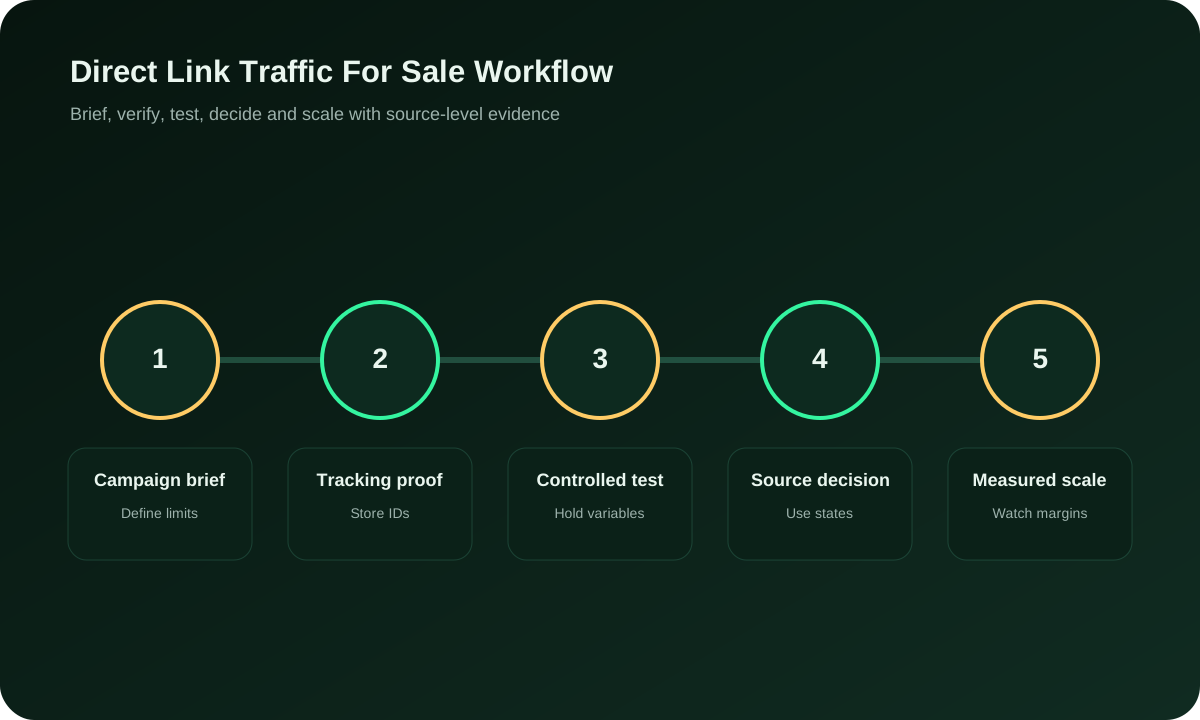
Connect the guide to live testing
Connect Direct Link Traffic For Sale to a controlled audience test
Use the choices established in “Carry a source key into backend status” to define one audience, budget and source set in FroggyAds. Keep the surrounding offer and measurement rule stable so the test adds evidence to direct link traffic for sale instead of mixing several changes at once.
Create My Free Account
Set procurement exclusions in writing
List unsupported markets, devices, publisher categories, navigation methods, duplicate rules, compliance restrictions and sources already rejected by the advertiser.
An exclusion is useful only when the seller can apply or report it. Mark contractual, technical and review-only controls separately.
Inspect direct-link traffic without a universal quality score
Compare referrer or source representation, device, geography, click timing, session transition, conversion delay and backend rejection. Several signals are needed to explain an anomaly.
Reduce the affected source while evidence is incomplete. Preserve logs and avoid labeling one event fraudulent or one supplier safe from a single indicator.
Release budget through source cohorts
Discovery samples multiple eligible sources under a hard cap. Confirmation repeats sources that meet tracking and acceptance rules. Expansion remains withheld until the repeat holds.
Prevent fast-delivering inventory from consuming the whole test. Each cohort receives its own maturity date and loss allowance.
Choose the execution format
Choose a paid-media format that supports Direct Link Traffic For Sale
Use the criteria around “Release budget through source cohorts” to decide whether push, native, display or pop fits the message and destination. Set format, targeting and spend as campaign controls in FroggyAds while the direct link traffic for sale decision remains the standard for judging the result.
Create My Free Account
Reconcile seller billing with business value
Invoice counts, tracker sessions and accepted outcomes serve different purposes. Show all three, the tolerance rule, credits and unresolved records in one review.
Calculate effective cost from the accepted event while retaining the seller's contracted unit. Do not rewrite an invoice metric as though it were a validated customer.
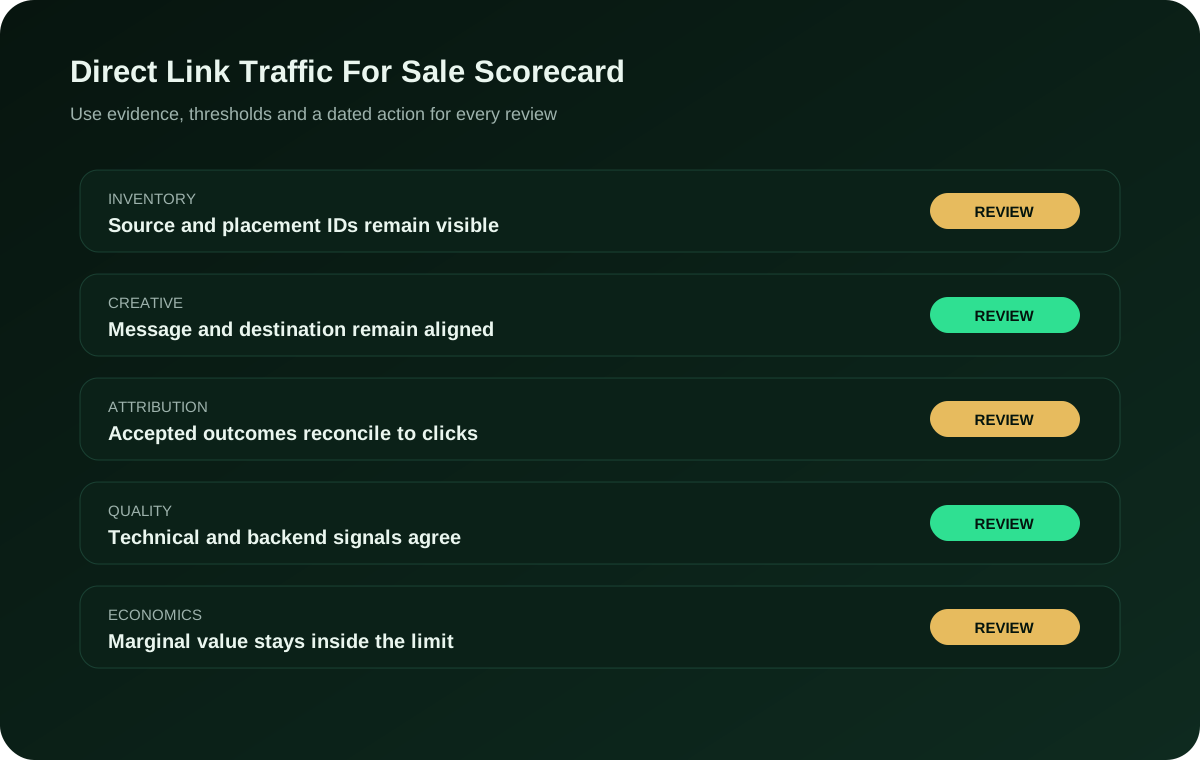
Operate a dated whitelist
A whitelist entry includes source identity, tested offer, market, device scope, evidence window, approval and rollback trigger. Approval is conditional rather than permanent.
Recheck after a material bid, volume, publisher or destination change. Keep discovery supply outside the validated source campaign.
Close procurement with a repeatable source decision
For every material source, assign approve, observe, constrain, pause or retest and state the next evidence requirement. Attach the export used for the conclusion.
The dossier should let another buyer reproduce the choice without relying on a vendor label or a dashboard screenshot.
Five decision rehearsals before approval
- Define the billable navigation event: explain what would reverse the recommendation and which retained record proves the response.
- Approve the publisher context before volume: explain what would reverse the recommendation and which retained record proves the response.
- Write a destination entry contract: explain what would reverse the recommendation and which retained record proves the response.
- Carry a source key into backend status: explain what would reverse the recommendation and which retained record proves the response.
- Set procurement exclusions in writing: explain what would reverse the recommendation and which retained record proves the response.
These rehearsals expose missing authority, evidence and recovery steps before the workflow carries irreversible spend or publication risk.
Put the guide into practice
Turn Direct Link Traffic For Sale into a bounded campaign test
With “Five decision rehearsals before approval” documented, launch only the next reversible test. Set a spending limit, preserve the baseline and use source-level and audience controls so the next step depends on qualified outcomes for direct link traffic for sale, not activity volume.
Create My Free Account
Direct Link Traffic For Sale FAQ
For Direct Link Traffic For Sale, when buying direct-link traffic, what exactly does the buyer receive?
The order buys visits sent straight from an agreed source or route to the advertiser's chosen URL. It does not buy guaranteed sales, leads, customer quality, or profit.
For Direct Link Traffic For Sale, which source records help a buyer assess a direct-link traffic offer?
Ask for geography, device, source or placement identifiers, delivery method, available controls, expected reporting, and traffic-quality rules before accepting the offer.
For Direct Link Traffic For Sale, how does landing experience readiness affect a direct-link traffic purchase?
Prepare the landing page before buying direct-link traffic. It should open quickly on the intended devices, match the ad promise, explain the offer plainly, and record the chosen action. Even well-targeted visits are wasted when the destination is slow or confusing.
For Direct Link Traffic For Sale, what order controls help direct-link traffic reach the intended audience?
Prioritize location, device, operating system, source visibility, schedule, frequency, and exclusions that reflect the actual customer offer. Confirm each control before the order starts.
For Direct Link Traffic For Sale, why is a low-cost direct-link visit not automatically economical?
A low visit price can hide poor intent, invalid activity, weak conversion, refunds, or heavy filtering work. Judge the all-in cost of accepted customer outcomes instead.
For Direct Link Traffic For Sale, how can first-party records, during day-to-day work, verify delivery from a direct-link campaign?
Use campaign-specific parameters and timestamps, then reconcile accepted sessions and conversions with the delivery report. Document timezone, filters, attribution, and duplicate handling.
For Direct Link Traffic For Sale, which source patterns in the direct-link traffic report need investigation?
Investigate sudden volume bursts, repeated identifiers, impossible locations, very short sessions, missing referrers, clustered conversions, and source results that cannot be reconciled.
For Direct Link Traffic For Sale, which limited order, when the plan is applied, creates a valuable baseline for direct-link traffic?
Run a capped order across a defined audience, period, destination, and source set. Keep the creative and tracking stable long enough to learn about delivery and downstream quality.
For Direct Link Traffic For Sale, when should a troublesome route be excluded from future orders?
Exclude a route when invalid activity, broken identifiers, poor destination engagement, disputed billing, or unacceptable conversion quality continues after a documented review and correction attempt.
For Direct Link Traffic For Sale, which commercial outcomes help a larger order of direct-link traffic?
Increase the order only after verified commercial results, acquisition cost, customer quality, and reconciliation remain sound across representative sources. Add volume gradually and retain the pause limits.
Existing tools, sources and next actions
Links are retained in their approved sequence. External sources provide bounded context; internal resources continue the relevant FroggyAds workflow.
Buy direct-link traffic as measurable inventory, not as an anonymous volume promise
A direct-link traffic purchase should begin with the evidence the advertiser needs after delivery starts. Define the eligible markets, compatible devices, accepted conversion, conversion delay and maximum test loss before comparing volume offers. Ask whether campaign and source identifiers can be preserved through the destination so the buyer can distinguish useful inventory from traffic that repeatedly falls outside the business boundary. Without that visibility, a low price can create a large sample without creating a reliable optimization path.
FroggyAds provides self-serve access to broad programmatic inventory and granular controls for country, city, device, operating system, browser, carrier, category and source-level decisions. That gives direct-response buyers the ability to start with eligible reach and then refine delivery from observed results. The buyer does not need to treat all supplied traffic as one block. Repeated weak source patterns can be restricted while stronger or still-uncertain inventory remains available for learning.
| Procurement question | Required evidence | Action if the test fails |
|---|---|---|
| Is the traffic eligible? | Correct GEO and compatible device delivery | Correct targeting before judging quality |
| Is tracking readable? | Campaign and source identifiers tied to conversions | Repair measurement before scaling |
| Is the destination usable? | Working redirects, forms and first-screen clarity | Fix technical or message friction |
| Is quality economical? | Mature accepted outcomes versus spend | Adjust source, segment, bid or offer |
| Can it scale? | Stable quality after controlled increases | Hold or roll back if the source mix weakens |
Validate the destination before purchasing substantial volume. Direct-link traffic exposes the landing page immediately, so broken mobile behavior, slow redirects or unclear offers can dominate the result. Test the page on every targeted browser and device family, confirm the conversion event and make sure material conditions are visible. If the path is not working, more traffic only magnifies the technical problem and can produce the wrong conclusion about inventory quality.
Use a bounded first test. Set a campaign budget that is large enough to produce useful observations but small enough to respect the advertiser's loss boundary. Avoid changing bid, targeting, creative and destination at the same time. When the conversion window matures, compare sources on the same accepted outcome. FroggyAds source allowlist and blocklist controls can then be used to make focused, reversible changes rather than replacing the whole campaign after one weak segment appears.
Maintain a dated source decision log. Record when a source was restricted, the observations that justified the decision and what condition would allow a retest. Market conditions, landing pages and offers change, so an exclusion from one campaign should not automatically become a permanent global rule. The same discipline applies to strong sources: increase exposure in steps and verify that accepted quality survives the broader sample.
Direct-link traffic is most valuable when procurement, measurement and optimization are connected. FroggyAds gives advertisers the reach and controls needed to run source-aware tests inside a self-serve system. Combined with a tested destination and an explicit stop-or-scale rule, that turns a traffic purchase into a repeatable acquisition process instead of a one-time volume transaction.
When comparing direct-link traffic suppliers or campaign setups, normalize the measurement window before comparing price. One source of traffic may appear cheaper because conversions are counted immediately while another is judged after cancellations, qualification or a longer downstream event. Choose the accepted outcome and maturity period first, then calculate cost using the same definition. This prevents procurement decisions from rewarding traffic that produces inexpensive top-of-funnel events but weak business value after validation.
Protect the destination path from unnecessary complexity. Every redirect, tracker or intermediary can add latency or create a point where campaign and source identifiers are lost. Test the complete path on targeted devices and browsers, confirm HTTPS behavior and verify that the final page receives the parameters needed for analysis. FroggyAds can provide source-aware media controls, but the advertiser still needs a measurement chain that preserves those signals. If identifiers disappear before the conversion event, the team loses much of the optimization value the platform can provide.
Build supplier and source reviews around decisions rather than traffic totals. Record which inventory met the accepted threshold, which patterns required restriction, what was retested and how quality changed after scale. If volume rises but accepted outcomes do not, reduce the next test to the segments that still have a credible economic case. If quality remains stable, expand in controlled steps. This turns direct-link procurement into a repeatable learning process and gives FroggyAds buyers a practical framework for using granular targeting and source controls without confusing raw delivery with useful acquisition.
Direct Link Traffic For Sale: what should the advertiser decide next?
For Direct Link Traffic For Sale, direct-link means a click-through placement that sends the user directly to the advertiser destination where supported. The buying decision is whether that delivery context fits the offer, creative and destination well enough to produce an accepted post-click result. Use Visible scope and entity record and Define the billable navigation event as the page-specific checkpoints, then judge direct link traffic for sale on destination readiness, source transparency and conversion tracking plus downstream conversion quality.
On this Direct Link Traffic For Sale page, the decision should remain tied to the existing evidence around Visible scope and entity record, Define the billable navigation event and Approve the publisher context before volume. Those sections give direct link traffic for sale its specific context; the table below turns that context into campaign actions rather than adding another generic definition.
| Decision | What to verify | FroggyAds action |
|---|---|---|
| Direct Link Traffic For Sale objective | Use Visible scope and entity record to define the accepted business event and the maximum learning loss for direct link traffic for sale. | Launch one FroggyAds campaign objective for Direct Link Traffic For Sale and keep the conversion definition stable. |
| Direct Link Traffic For Sale audience | Use Define the billable navigation event to verify market, device, language and offer eligibility for direct link traffic for sale. | Apply only the FroggyAds targeting controls that change the real Direct Link Traffic For Sale customer journey. |
| Direct Link Traffic For Sale source evidence | Use Approve the publisher context before volume to keep source-level differences visible instead of relying on one blended direct link traffic for sale average. | Keep, cap, exclude or retest Direct Link Traffic For Sale inventory from documented source evidence. |
| Direct Link Traffic For Sale economics | Use Write a destination entry contract to connect media spend with accepted conversions and downstream value for direct link traffic for sale. | Protect the Direct Link Traffic For Sale test with a written budget boundary and a consistent attribution window. |
| Direct Link Traffic For Sale scale rule | Use Carry a source key into backend status to define the exact evidence that earns the next budget increase for direct link traffic for sale. | Scale Direct Link Traffic For Sale one major control at a time and compare marginal performance with the prior baseline. |
A page-specific FroggyAds test sequence for Direct Link Traffic For Sale
- Direct Link Traffic For Sale outcome: define the accepted event for direct link traffic for sale and the maximum loss permitted while the first test is learning.
- Direct Link Traffic For Sale path: verify market eligibility, device experience, landing-page continuity and tracking against Visible scope and entity record before buying more traffic.
- Direct Link Traffic For Sale hypothesis: launch one bounded FroggyAds test tied to Define the billable navigation event; do not change bid, creative, audience and destination together.
- Direct Link Traffic For Sale source review: compare qualified activity, accepted conversions, timing and cost by the source or segment dimensions relevant to Approve the publisher context before volume.
- Direct Link Traffic For Sale scaling: use Write a destination entry contract and Carry a source key into backend status to define what must reproduce before the next budget increase.
Why FroggyAds is relevant to Direct Link Traffic For Sale
For Direct Link Traffic For Sale, FroggyAds gives advertisers a self-serve DSP and ad-network workflow for buying supported traffic with campaign-level budgets and targeting. Depending on format and campaign context, available controls can include country, city, device, operating system, browser, carrier, category, source, ID and IP options. SmartCPC and Adscore-supported traffic-quality controls can support the direct link traffic for sale optimization process, while the advertiser's tracker, analytics and backend acceptance remain the final evidence for commercial quality.
Use Carry a source key into backend status as the final checkpoint for Direct Link Traffic For Sale. If the accepted result does not reproduce after the next meaningful volume step, return to the last stable configuration instead of widening several controls at once.
How to tell whether Direct Link Traffic For Sale is working
For Direct Link Traffic For Sale, measure direct-link as a click-through placement that sends the user directly to the advertiser destination where supported and keep destination readiness, source transparency and conversion tracking beside the accepted post-click event. Use Visible scope and entity record as the baseline for whether delivery quality is actually improving.
Reconcile Direct Link Traffic For Sale on one evidence window
For Direct Link Traffic For Sale, compare FroggyAds reporting with the advertiser's tracker, analytics and backend records for the same dates and attribution rules. Record media spend, relevant delivery events, qualified landing activity, accepted conversions and rejection reasons, then use Define the billable navigation event to investigate material gaps before they become optimization rules.
Diagnose the smallest failing layer in Direct Link Traffic For Sale
If direct link traffic for sale delivery is weak, review eligibility, targeting, bid and inventory first. If traffic arrives but the destination underperforms, inspect speed, message continuity, forms, redirects and device compatibility. If front-end conversions look healthy but backend acceptance is weak, use Approve the publisher context before volume to isolate audience or source quality after tracking has been verified.
Set the next Direct Link Traffic For Sale scale and stop rule
Write the exact Direct Link Traffic For Sale result that earns more budget and the exact condition that pauses the test. Increase one major control at a time and compare marginal direct link traffic for sale performance with the prior configuration. FroggyAds supplies the campaign controls; the advertiser's accepted downstream data determines whether the expansion is commercially useful.
Direct Link Traffic For Sale: the decision this URL owns
Treat Direct Link Traffic For Sale as an operating decision, not a definition page. A performance advertiser should use it to decide whether the format fits the message, device and conversion path, with the same accepted outcome preserved from setup through review.
URL boundary for Direct Link Traffic For Sale: This URL owns Direct Link Traffic For Sale; Trusted Direct Link Ads is the nearest neighboring topic and should keep its separate task. Use this page only for the decision implied by Direct Link Traffic For Sale.
Decision inputs for Direct Link Traffic For Sale: audience targeting, source evidence, conversion tracking, accepted business value. Keep these inputs tied to accepted conversion or business-value event and the page-specific job: decide whether the format fits the message, device and conversion path.
Visible scope and entity record is an evidence checkpoint for Direct Link Traffic For Sale. To answer “For Direct Link Traffic For Sale, when buying direct-link traffic, what exactly does the buyer receive?”, keep audience targeting in the same campaign record and use it to decide whether the format fits the message, device and conversion path.
Approve the publisher context before volume is the action checkpoint for Direct Link Traffic For Sale. Before acting on “For Direct Link Traffic For Sale, how does landing experience readiness affect a direct-link traffic purchase?”, document conversion tracking, the resulting campaign action and the rollback or retest condition.
Define the billable navigation event is the measurement checkpoint for this URL. Resolve “For Direct Link Traffic For Sale, which source records help a buyer assess a direct-link traffic offer?” while retaining source evidence, accepted business value, spend and cohort age so the result can be reconciled with accepted conversion or business-value event.
| Page checkpoint | How to use it | Evidence to retain |
|---|---|---|
| Visible scope and entity record | Use Visible scope and entity record to establish the first evidence boundary for Direct Link Traffic For Sale; then record which part of campaign objective, targeting, source evidence, conversion tracking and economics it changes. | Keep audience targeting, source/campaign ID and the accepted-event definition together. |
| Define the billable navigation event | Use Define the billable navigation event as the second checkpoint and reconcile it with accepted conversion or business-value event before changing budget or source allocation. | Retain source evidence, spend, timestamp/cohort age and accepted/rejected outcomes. |
| Approve the publisher context before volume | Use Approve the publisher context before volume as the final checkpoint: if it does not change the evidence for accepted conversion or business-value event, keep the test narrow rather than scaling. | Document conversion tracking, the decision taken and the rollback or retest condition. |
Transparent Direct Link Traffic For Sale decision example
Hypothetical example: For Direct Link Traffic For Sale, a hypothetical controlled cell that spends USD 390 and records 4 accepted conversion or business-value event after the same maturity window has an accepted cost of USD 97.50 per outcome. Replace the figures, outcome and review window with your own economics; this is not a FroggyAds performance claim.
Why use FroggyAds here?
Choose FroggyAds for the media-buying part of Direct Link Traffic For Sale when you need controllable traffic and source evidence; keep the commercial decision anchored to accepted conversion or business-value event, not delivery volume alone. Create your free FroggyAds account.
Research basis for Direct Link Traffic For Sale: This URL helps performance-focused advertisers decide whether the format fits the message, device and conversion path. It is mapped to the general ads research cluster. Our current review used shopify.com and support.google.com to check terminology, buyer questions and decision coverage relevant to Direct Link Traffic For Sale. These external sources are research inputs, not evidence of FroggyAds campaign performance.
Direct Link Traffic For Sale — what matters first
Direct Link Traffic For Sale is useful when the format fits the user journey, device context, creative requirements and measurable conversion path.