
Campaign overview
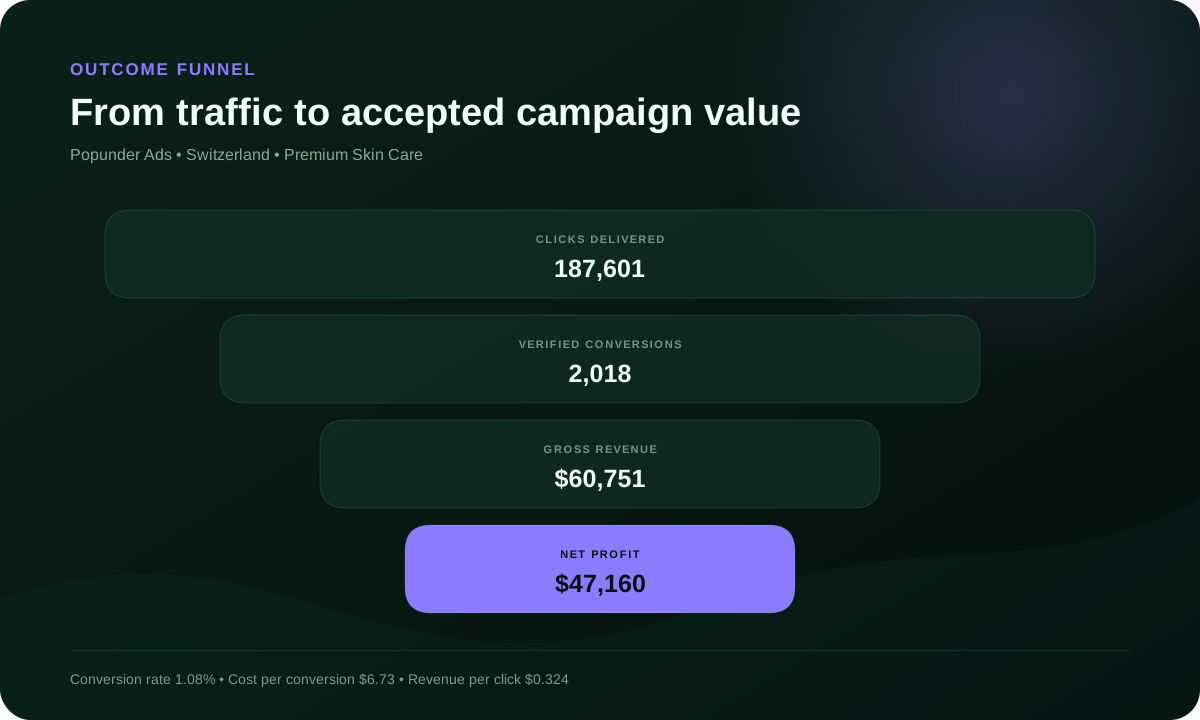
This Switzerland campaign was designed around approved purchases for a premium skin-care offer. The customer used Popunder Ads on FroggyAds and recorded 187,601 delivered clicks, 2,018 reported conversions and $47,160 in net profit. The resulting 347% ROI is calculated as net profit divided by media spend.
The buyer needed to generate product interest without using unsupported medical or guaranteed appearance claims.
The Swiss campaign avoided one generic multilingual funnel. Language groups were separated so bids, creative and landing-page performance could be reviewed accurately.
The operating principle was simple: every budget increase required a readable reason. Source, creative, device and landing-page changes stayed traceable instead of being combined in one opaque average. For Case Studies › Skin Care Popunder Switzerland, apply this rule to the page-specific audience, market, format or buying decision described here.
What this case proves
It shows that a controlled combination of offer fit, localization, conversion tracking and source-level optimization can produce a profitable campaign. It does not establish a guaranteed benchmark for every premium skin care advertiser.
The acquisition challenge
The operational challenge was not simply to buy more swiss traffic. It was to acquire enough signal to identify which sources, devices and messages could produce approved purchase, refund-adjusted revenue and repeat purchase value without letting the test budget expand faster than the evidence.
The customer began with a clear economic boundary. The final campaign total implies a cost per verified conversion of $6.73 and revenue per verified conversion of $30.10. Those values gave the buyer a practical frame for deciding whether a source deserved more exposure, needed a bid adjustment or should be removed from the test.
Cosmetic claims and imagery should be supportable, and the destination should disclose price, subscription and return terms clearly.
Campaign setup and targeting
Popunder traffic supplied high-volume full-page visits that made landing-page speed, source controls and post-click qualification especially important.
The buyer treated the destination as the primary creative surface, tested clear pre-lander variants and separated source IDs so high-volume placements could be judged on mature outcomes. For Case Studies › Skin Care Popunder Switzerland, apply this rule to the page-specific audience, market, format or buying decision described here.
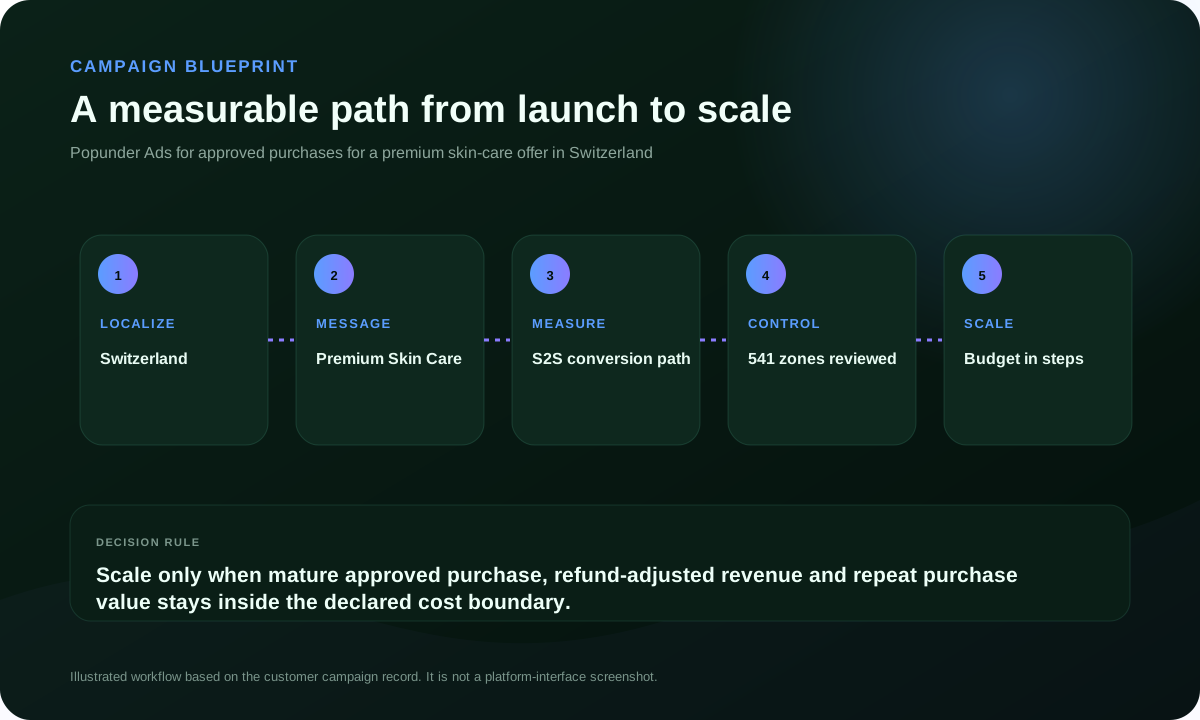
The source report lists 541 active publisher zones and a 60.2% bid win rate. Those figures describe the breadth of available delivery, but they were not treated as quality scores. Each source still had to earn budget through conversion and downstream outcome data.
- GEO: Switzerland (CH)
- Format: Popunder Ads
- Primary objective: User Acquisition
- Optimization ID: PRE-CH-7726013591
- Reported source coverage: 541 active publisher zones
- Bid win rate: 60.2%
Creative and landing-page strategy
The campaign emphasized product positioning, routine and purchase terms, while keeping claim language consistent across ad and landing page.
The landing sequence explained the offer before presenting the final action, reduced unnecessary scripts and made the path from arrival to conversion visible on mobile and desktop. For Case Studies › Skin Care Popunder Switzerland, apply this rule to the page-specific audience, market, format or buying decision described here.
The strongest creative did not rely on a broad promise. It identified a concrete user problem, gave the user a reason to continue and handed the same expectation to the landing page. For Case Studies › Skin Care Popunder Switzerland, apply this rule to the page-specific audience, market, format or buying decision described here.
The campaign record describes multiple creative and pre-landing variants rather than one untested message. The practical value of that approach was not variety by itself. It gave the buyer enough controlled combinations to see whether a result followed the message, the publisher source or the destination experience. For Case Studies › Skin Care Popunder Switzerland, apply this rule to the page-specific audience, market, format or buying decision described here.
Tracking and data quality
The customer used server-to-server conversion feedback and retained source identifiers through the click path. That reduced dependence on browser-only measurement and made it possible to connect a conversion with the campaign, creative and publisher zone that produced it. For Case Studies › Skin Care Popunder Switzerland, apply this rule to the page-specific audience, market, format or buying decision described here.
Page speed was treated as part of the acquisition system. The source material describes a geographically distributed setup and a target time to first byte below 120 milliseconds. The larger lesson is that redirect latency, heavy scripts and unstable mobile layouts can create apparent traffic-quality problems that actually begin on the advertiser side. For Case Studies › Skin Care Popunder Switzerland, apply this rule to the page-specific audience, market, format or buying decision described here.
The campaign also used additional traffic-quality checks before optimization decisions were made. FroggyAds traffic-quality controls can reduce exposure to invalid activity, but no control eliminates every risk. The customer still reconciled the reported conversions with the accepted business event. For Case Studies › Skin Care Popunder Switzerland, apply this rule to the page-specific audience, market, format or buying decision described here.
Optimization sequence
Source exclusions were based on spend relative to the target acquisition cost and enough completed visits to support a decision. The team avoided judging the format from bounce rate alone. For Case Studies › Skin Care Popunder Switzerland, apply this rule to the page-specific audience, market, format or buying decision described here.
The customer report describes a loss-control rule at the source level: a placement that consumed materially more than the target acquisition cost without a verified conversion was removed from the active test. Sources that showed repeatable conversion momentum were isolated into dedicated scale groups rather than left inside the original broad campaign. For Case Studies › Skin Care Popunder Switzerland, apply this rule to the page-specific audience, market, format or buying decision described here.
Dayparting and operating-system segmentation were introduced only after enough data existed to identify a pattern. This mattered because a short burst of conversions can be caused by reporting delay or source mix. The buyer compared mature cohorts before concentrating spend in stronger time windows and device groups. For Case Studies › Skin Care Popunder Switzerland, apply this rule to the page-specific audience, market, format or buying decision described here.
The campaign moved from exploration to a narrower source set, then expanded only after the winning combination remained profitable beyond its first conversion cluster. For Case Studies › Skin Care Popunder Switzerland, apply this rule to the page-specific audience, market, format or buying decision described here.