
Campaign overview
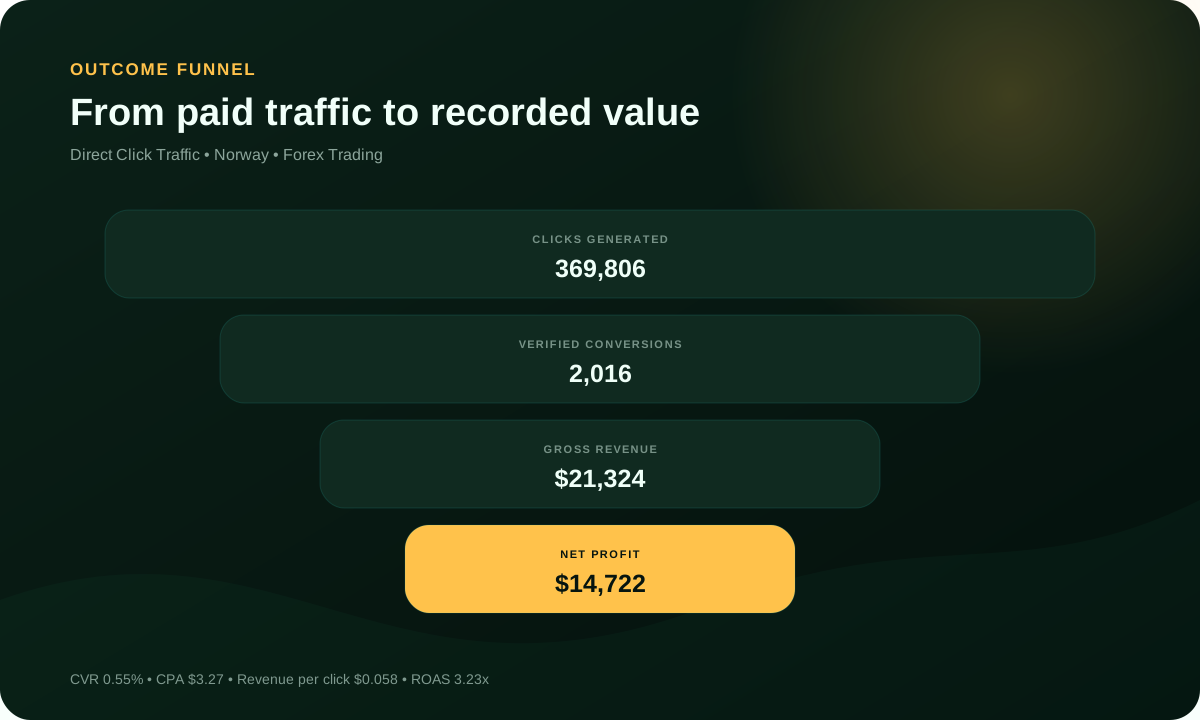
This anonymized customer campaign focused on qualified registrations for a financial trading offer in Norway. The buyer used Direct Click Traffic through FroggyAds and reported 369,806 generated clicks, 2,016 reported conversions, $21,324 in gross revenue and $14,722 in net profit. The resulting 223% ROI is calculated as net profit divided by media spend.
The headline result came from a campaign that had to operate across 962 active publishers with a reported average bid win rate of 60.3%. Those delivery figures describe market access, not automatic quality. The customer still needed to identify which combinations of source, device, creative and landing experience produced commercially accepted outcomes.
Financial offers can generate inexpensive registrations that never complete verification or funding. The campaign therefore needed a measurement chain beyond the first form submission. For Case Studies › Forex Direct Click Norway, apply this rule to the page-specific audience, market, format or buying decision described here.
Norwegian-language continuity and clear commercial terms were treated as conversion variables, not cosmetic translation work.
The campaign was managed as a chain of evidence. Delivery metrics explained exposure, conversion records explained user action, and downstream value determined whether the traffic was commercially useful. For Case Studies › Forex Direct Click Norway, apply this rule to the page-specific audience, market, format or buying decision described here.
What the record demonstrates
Forex Trading Direct Click Traffic Case Study in Norway documents a profitable historical result produced by offer fit, localization, tracking, creative testing and source-level optimization; it does not guarantee the same outcome for another advertiser.
The acquisition challenge
The implied cost per verified conversion was $3.27, while gross revenue averaged $10.58 per verified conversion. Those two figures created the working space for media cost, operational variance and downstream quality. A source could not be judged only by its click price because a cheap click with weak conversion value would still consume the margin.
The campaign produced a calculated 0.55% click-to-conversion rate and $0.058 in gross revenue per click. The buyer used these values as reconciliation points, not universal targets. Device mix, source pricing and conversion delay could change the same ratios even when the offer stayed constant.
The record also shows why test design matters in Norway. A broad launch was useful for discovery, but a broad campaign left unchanged would have mixed high-value cohorts with segments that had not yet earned additional spend. The customer therefore moved from exploration into more isolated source and device groups.
Eligibility, risk language and local financial promotion requirements should be reviewed before launch. Historical campaign results are not a promise of future returns.
Campaign setup and targeting
Direct Click reduced creative layers and placed more responsibility on offer selection, routing, page speed and the first seconds of the destination experience.
The buyer used tightly controlled destination variants, preserved source and click identifiers through redirects and removed extra steps that did not improve qualification.
The campaign preserved the supplied CID FORE-NO-0022 as the reference for the analyzed record. Source identifiers, creative identifiers and conversion feedback were treated as a connected measurement path. That allowed the buyer to compare the original traffic purchase with the customer outcome rather than optimizing from disconnected reports.
The starting structure gave Direct Click Traffic enough breadth to test delivery while keeping the acceptable loss explicit. Publisher segments that accumulated spend without a verified outcome were candidates for reduction, while segments with repeatable conversions could move into separate scale groups. For Case Studies › Forex Direct Click Norway, apply this rule to the page-specific audience, market, format or buying decision described here.
The reported 60.3% average win rate was interpreted together with source quality. Raising bids could improve access to a segment, but it could also change the auction mix. The buyer reviewed performance again after material bid or budget changes instead of assuming the original efficiency would remain constant. For Case Studies › Forex Direct Click Norway, apply this rule to the page-specific audience, market, format or buying decision described here.
- GEO: Norway (NO)
- Format: Direct Click Traffic
- Primary objective: User acquisition
- Campaign reference: FORE-NO-0022
- Reported publisher coverage: 962
- Average bid win rate: 60.3%
Tracking and data quality
In this Forex Trading Direct Click Traffic case in Norway, server-to-server conversion feedback connected advertiser-side events with campaign clicks and source identifiers, helping separate delivery issues from tracking or landing-page problems.
For the Forex Trading Direct Click Traffic campaign in Norway, the source record described a geographically distributed landing setup with a target time to first byte below 120 milliseconds. Treat that as implementation context, not a conversion guarantee; redirects, script weight and unstable mobile rendering can still create advertiser-side quality problems.
The customer reconciled the reported 2,016 conversions with the accepted business event for forex trading. FroggyAds traffic-quality controls can reduce exposure to invalid activity, but they do not replace advertiser-side validation, duplicate handling or downstream acceptance rules.
The campaign’s calculated CPC of $0.018 was useful for budget planning, while the $3.27 cost per verified conversion remained the more important commercial boundary. The difference between those metrics shows why optimization stopped at neither impressions nor clicks.
Conversion maturity shaped decisions in this Forex Trading Direct Click Traffic case in Norway: delayed events could make a weak-looking segment recover, while later quality or refund data could reduce an early winner.