Customer research for better advertising decisions

Buyer Persona: Research-Based Customer Profile Guide

By FroggyAds. Published: 2026-07-18. Updated: 2026-10-15.

A buyer persona is a research-based working profile that summarizes the goals, constraints, decision process, information needs and context of a meaningful customer group without pretending every person in the group is identical.

buyer persona Evidence you can use
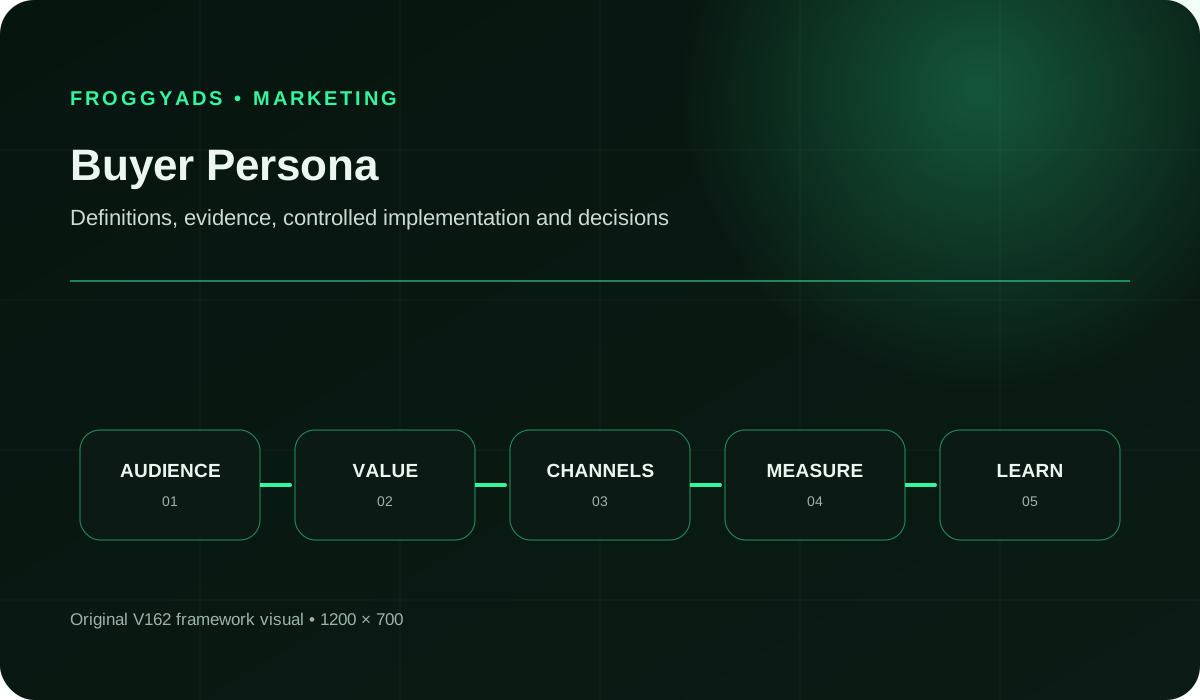
Buyer Persona framework for planning, production, measurement and controlled improvement

How does a buyer persona improve your campaign brief?

Quick answer: Build a buyer persona to explain why a useful customer group buys, what delays the decision and what evidence helps them choose. Start with customer conversations and observed behavior, then turn the strongest findings into a message and landing-page brief. With FroggyAds, you can put that brief into a controlled paid-traffic campaign using available targeting, budget and source controls. The persona guides your offer; it does not identify every visitor or create a new targeting option.

Marketing-mix context: American Marketing Association: The Four Ps of Marketing.

Five choices that make a persona useful

  • Choose a real decision, such as which objection your landing page must answer before a buyer requests a demo.
  • Include customers who bought, prospects who declined and people whose purchase stalled; record how each was recruited.
  • Separate what participants said, what their records show and what your team still assumes.
  • Translate research into an offer, proof and next action before selecting campaign filters.
  • Review qualified response and follow-up feedback. A winning ad does not prove every detail in the persona is true.

Buyer persona, target audience and customer profile: what changes?

A target audience defines the group a campaign is intended to reach. A buyer persona explains a recurring buying situation within that audience: the problem that became urgent, the alternatives considered and the concerns that shaped the purchase. In B2B work, an ideal customer profile usually describes suitable organizations; a buyer persona describes the people involved in their decisions. These documents can work together, but each answers a different question.

Consider a hypothetical reporting-software offer. The customer profile might specify firms that prepare recurring client reports. The persona could describe an agency operations manager trying to remove a weekly manual task while preserving the report format clients expect. That insight suggests showing the migration process and an example output. An invented age, favorite drink or weekend hobby would add little unless research showed a relevant connection to the buying decision.

The buyer may also differ from the user. A team member can evaluate the workflow while a manager approves spending and another colleague reviews security. Record those roles separately when they require different proof. You do not need a separate persona for every job title; you need enough distinction to explain why the same pitch might answer one participant’s concern and leave another unanswered.

What should the research help you change?

Start with the moment your current marketing loses clarity. Perhaps visitors understand the product but cannot tell whether switching will disrupt their work. Perhaps sales receives many enquiries from people who need a service you do not provide. Those are useful research questions because the answers can change a headline, eligibility statement, demonstration or follow-up conversation. A persona project with no decision attached often produces an attractive document that nobody uses.

For marketing and sales teams aligning content, offers and customer conversations, the useful question is whether the intended audience understood the message, completed the right action and produced an accepted downstream outcome at sustainable cost. The research should help explain that behavior. Traffic data can show where people stop; a carefully conducted interview can reveal what they were trying to accomplish at that point.

We recommend choosing one promising buying situation for your first FroggyAds brief. Match the promise to something the offer can actually deliver, show the proof on the destination and make the next step appropriate to the decision. This gives your campaign a clear purpose while you learn which available sources and settings bring visitors who respond meaningfully.

From customer insight to campaign

Give your strongest buying motive a clear message

Bring a supported customer problem, a credible offer and a ready destination to FroggyAds. Our self-serve campaigns let you choose supported formats, set a spending boundary and review source-level response. Start with a message you can explain from the research, then use the results to decide what deserves a closer test.

Create My Free Account
Illustration of audience targeting controls for a buyer persona test

Eight fields for a buyer persona you can act on

#Persona fieldEvidence and advertising use
1Buying triggerDescribe the event that made the problem worth solving now, such as a contract renewal or a repeated manual task becoming unmanageable. Distinguish the trigger from a general aspiration.
2Purchase roleIdentify who researches, uses, approves and pays. Ask which person can advance the decision and what each participant needs to see before agreeing.
3Desired progressDescribe the improvement in the buyer’s own terms. Connect the promise to a real product capability instead of replacing a specific need with broad claims about growth or efficiency.
4Current alternativeRecord what the buyer does today, including spreadsheets, manual work, another supplier or doing nothing. Your message must explain why changing is worth the effort.
5Objection and riskFind the uncertainty that slows commitment: implementation time, compatibility, payment terms or evidence of suitability. Put the answer near the action it affects.
6Proof neededNote whether the buyer needs a sample, specification, demonstration or clear explanation of terms. Use only evidence you can substantiate and show honestly.
7Next useful actionChoose a step that fits the decision: inspect details, check suitability, request a conversation or purchase. Define what makes the resulting response useful to your business.
8Evidence statusKeep the interview or record reference, collection period and unresolved questions with each finding. Label hypotheses visibly so a polished profile cannot turn an assumption into a fact.

A short persona with these fields can be more useful than a long biography. Before adding a detail, ask what you would do differently if it were true. If it changes no message, product explanation, sales conversation or eligibility decision, leave it out of the campaign brief. Keep original research material separately so the team can check the summary without sharing unnecessary personal information.

Ten steps from research question to usable persona

1. Choose the decision

Write the question the research must answer. For example, which concern prevents otherwise suitable prospects from requesting a demonstration? Identify the person who will use the answer and the marketing decision they can change.

2. Inspect existing evidence

Read recent customer, sales and support records before planning interviews. Note recurring questions and missing information. Treat a salesperson’s interpretation as a useful lead for research, not as a substitute for the customer’s explanation.

3. Recruit contrasting buyers

Include relevant customers, lost prospects and stalled evaluations where feasible. Keep the recruitment route and exclusions visible. Do not rely only on enthusiastic customers if the purpose is to understand hesitation or poor fit.

4. Reconstruct a real purchase

Ask participants to describe a specific recent decision: what started it, what they considered, what they checked and what happened next. Follow their account before introducing your proposed explanation or product benefit.

5. Separate observation from interpretation

Keep a statement from the participant distinct from your summary of its meaning. Preserve the context of important quotations in the research notes. Mark gaps and conflicting evidence instead of smoothing them into a tidy story.

6. Find meaningful patterns

Group recurring buying situations and concerns, then inspect the exceptions. Two people with different backgrounds may face the same purchase problem. Similar demographic details do not automatically mean they need the same message.

7. Draft the buying situation

Describe the trigger, role, desired progress, alternative and proof needed in plain language. Include only details that affect the decision. Make the status of each important finding clear enough for another colleague to challenge it.

8. Challenge the profile

Review the draft with colleagues who speak to customers and, where practical, with relevant participants. Ask what feels wrong or missing. Revise the profile when contradictory evidence changes the proposed message or qualification rule.

9. Build a message brief

Turn the strongest finding into a supported promise, destination explanation and next action. Specify which available campaign controls reflect genuine eligibility. Keep the research profile separate from the list of platform settings.

10. Review and update

Compare the brief with new customer conversations and campaign response. Keep a dated revision record when needs, objections or purchase roles change. Retire a profile that no longer helps the team make a defensible decision.

How do you know the persona is helping?

Evaluate a persona through the decisions it improves. Keep research quality separate from campaign performance: a well-researched profile can still lead to a weak ad, and a strong ad can succeed for reasons the profile did not predict.

QuestionUseful evidenceWhen to review
Can the team trace the finding?Check whether each important motive or objection points to a real interview, support record or observed behavior. List contradictory examples alongside the supporting material.Before approving the persona or making a major claim from it
Does the message make sense?Ask relevant participants to explain the offer in their own words and identify unanswered questions. Record misunderstanding as a finding, even when they say they like the design.Before launch and after a material message change
Does the next step fit?Review completed actions together with abandonment feedback and follow-up notes. A download may indicate interest without showing readiness for a sales conversation.After enough responses have completed the intended journey
Are enquiries suitable?Calculate accepted enquiries divided by all reviewed enquiries under the same criteria. Also compare accepted enquiries with eligible visits so a smaller form total does not hide better fit.After the agreed sales-review period, with incomplete cases shown separately

Avoid giving the persona a single confidence score that blends unrelated evidence. Instead, state what is supported, what remains uncertain and which decision can proceed. In a FroggyAds campaign, retain campaign and source references so your downstream records can be interpreted with the delivery context. Neither a click nor a source identifier tells you a person’s private motivation.

Choose the presentation

Match the ad format to the proof your buyer needs

A brief promise may introduce the problem, while a detailed destination answers the switching questions. Choose a supported FroggyAds format that suits your creative and test the full journey on the devices you intend to reach. Keep the persona’s central concern visible from the ad through the next action.

Create My Free Account
Illustration comparing advertising formats for buyer persona execution

Three buying situations that need different evidence

The manager replacing a manual process

In this hypothetical B2B situation, the buyer likes the promised time saving but worries about moving existing work. A migration outline, sample output and clear setup requirements may answer that concern better than another feature list. The campaign should invite a suitable next step and qualify the use case; job title alone does not establish fit.

The shopper choosing a product for a specific task

A hypothetical shopper buying a travel bag for a short work trip may compare dimensions, organization and delivery timing. The useful persona explains the trip and purchasing constraints. It does not assume that every visitor of the same age wants the same bag. Carry the task-specific promise into the product page, where the shopper can verify the actual details.

The buyer coordinating a local service

A hypothetical service customer may be arranging work for someone else and need a clear appointment process, coverage area and explanation of what happens next. Research should include the person making the enquiry and, where relevant, the person receiving the service. Use location controls for genuine service coverage. Do not treat location as proof of someone’s household role, needs or personal circumstances.

Where personas go wrong

A convincing story with no evidence

A name, photograph and detailed biography can make a guessed profile feel established. Keep unsupported material marked as a hypothesis and collect evidence for the decisions it would influence. AI-generated quotes, interviews and customer histories must never stand in for real research.

A stereotype disguised as a segment

Demographic details can be relevant to some offers, but they do not explain every preference or buying motive. Look for the actual task and constraints. Invite contrasting viewpoints, including people who use the offer differently, before turning an early pattern into a campaign rule.

A sample mistaken for the whole market

Interview counts describe the people you interviewed. A small qualitative group cannot establish the market share of a persona. Recruitment through your best customers, one salesperson or one campaign can also omit important experiences. State those limits beside the findings.

When a disagreement appears, keep it visible. Two buyers may share the same problem but require different proof because one has purchasing authority and the other needs approval. That can justify two message paths without implying two fixed personality types. It may also show that the original profile was too broad.

Where should you spend research effort?

Spend first on the question that could change an expensive decision. If you are unsure why suitable prospects decline, another visual persona template will not resolve the uncertainty. Reviewing recent lost enquiries and arranging conversations may be more useful. If the concern is how many customers share a need, you may require a different sampling and measurement approach from a small set of exploratory interviews.

Allow time for recruitment, scheduling, interviewing, analysis and review with the people who will use the findings. Include any appropriate participant incentives and accessibility arrangements. These are research costs, separate from creative production and paid distribution. There is no universal interview count or media budget that makes every persona reliable; the required effort depends on the decision, variation in the audience and remaining uncertainty.

For a new business with little customer history, begin with an explicitly provisional profile and conversations with potential buyers. Use market research to understand the setting, then test the specific assumptions behind the offer. Avoid presenting a competitor’s customer description as proof of your own demand. A modest, focused learning plan is easier to improve than a large set of untested personas.

Prepare a focused test

Take one supported insight into FroggyAds

Choose the customer concern you can answer convincingly, prepare the ad and destination, and set an affordable campaign boundary. We give you self-serve control over the traffic purchase so you can examine the response before committing to a larger plan. Keep research conclusions and campaign observations together, with their different limits clearly stated.

Create My Free Account
Illustration of a campaign launch checklist for buyer persona

How does a persona translate into FroggyAds settings?

Translate only the parts of the brief that have a legitimate delivery setting. Service coverage can inform GEO selection. Product compatibility can inform device or operating-system choices. The buyer’s concern should shape creative and the landing page. A motive such as fear of a difficult migration is not itself a verified targeting control, and narrowing unrelated filters will not reliably identify it.

FroggyAds gives advertisers a self-serve DSP and ad-network workflow with supported formats, campaign budgets, targeting and source-level reporting. Use our buy traffic guide to connect the research brief to campaign setup. You can choose the supported traffic route and review the resulting activity while your own analytics and customer records establish whether responses meet your business requirements. We recommend keeping the initial offer and qualification criteria stable while you learn which delivery settings fit the brief.

Keep persona research in your own research or customer-management process. This guide does not imply that FroggyAds stores interview profiles, identifies purchase motives or automatically assigns visitors to personas. Our value is in the execution: you can buy traffic, control the campaign and examine source evidence while your team decides what the customer feedback means.

What should a persona tool or research partner provide?

  • Can important findings be traced to the underlying interview or record, with assumptions clearly separated?
  • Does the research plan include contrasting experiences and explain how participants are recruited?
  • Can you export the profile, supporting evidence and revision history in a usable form?
  • Are recording, access, retention and permitted uses of customer information clear before collection begins?
  • Will the deliverable show practical changes to messages or customer conversations, rather than only a designed biography?

A template can organize evidence; it cannot supply evidence you never collected. If you use an AI assistant to summarize notes, work with information you are permitted to process, check every important statement against the original material and remove invented quotations. Ask a research partner to explain uncertainty and conflicting findings. Those explanations are more useful than a promise that a profile will automatically improve conversion.

Turn the profile into useful customer-facing content

Use the persona to choose the questions your page answers, not to repeat a profile label in every heading. A buyer concerned about changing suppliers needs a clear explanation of the transition. A buyer comparing specifications needs accurate details in a form they can inspect. Keep claims specific and supported, and describe the next step so visitors understand the commitment before submitting information.

Customer language can help you explain the problem naturally, but an interview quotation requires accurate transcription and appropriate permission for its intended use. You can often express the underlying concern in your own words without identifying a participant. Do not publish private research notes as testimonials, or present an imagined customer story as an account of real experience.

Review accessibility as part of the journey. Relevant buyers may use different devices, input methods or assistive technology. Make the offer understandable without relying only on an image, and check whether the next action can be completed. Persona research should expand your understanding of customers rather than justify ignoring people who were absent from the first sample.

Frequently asked questions

When does a campaign need a buyer persona?

A buyer persona helps when the business has enough customer evidence to distinguish a useful audience from broad demographics. It should guide a real message, channel, product, or sales decision.

How should buyer-persona research begin?

Start with customer records, interviews, sales notes, support questions, product behavior, and rejected outcomes. Separate what people actually did or said from the team's assumptions.

What costs belong in persona research?

Allow for recruitment, interviews, analysis, consent, incentives where appropriate, staff review, and updating source data. Spend should match the decision value, not the desire for a polished document.

How specific should a buyer persona be?

Make it specific enough to explain a shared problem, eligibility rule, buying context, objections, and evidence source. Avoid invented names or personal details that do not change the campaign decision.

How should a persona shape advertising messages?

Use the customer's documented language for the problem and match the offer to the relevant stage of consideration. Do not turn a research pattern into a claim about every person in the segment.

What landing-page change can persona research support?

It can guide which questions, proof, terms, and next action appear on the page. Test the change with eligible visitors instead of assuming the profile predicts conversion.

How can a buyer persona be measured?

Measure the campaign or customer decision it was built to improve, such as qualified response, sales acceptance, retention, or reduced confusion. Keep sample size and rejected evidence visible.

Why can a buyer persona become inaccurate?

Markets, products, channels, customer needs, and the evidence sample change over time. A profile also drifts when assumptions are copied forward without new customer records.

What research guardrails help prevent harmful personas?

Collect only justified data, protect sensitive information, and avoid stereotypes or discriminatory targeting. Record the sources, dates, uncertainty, and decisions the persona may support.

When should a buyer persona be updated?

Update it when new customer evidence changes eligibility, needs, objections, channel use, or accepted value. Retire a profile that no longer represents a defensible audience decision.

Research and marketing references

The references below provide different kinds of context. The AMA’s marketing-research definition connects evidence with marketing decisions; the SBA discusses both existing market information and direct customer research. The marketing-mix and campaign-objective references cover broader planning. FTC advertising guidance and WCAG address claims and accessibility. None establishes that a particular persona is accurate or that your campaign will produce a specific result.

A worked persona brief: a hypothetical reporting-software buyer

This example is an illustration, not FroggyAds customer research. Imagine a software seller interviewing 18 people: 12 recent customers, four lost prospects and two people whose evaluation stalled. The team is deciding whether its first campaign should emphasize removing manual reporting work or showing a broad feature list. The fictional findings below demonstrate how to write a useful brief without overstating what the sample proves.

Trigger: the reporting task has become urgent

Suppose ten participants describe a recent increase in manual reporting work, six focus on routine reporting improvements and two give no clear trigger. Ten out of 18 is 55.6% of this recruited interview sample, rounded to one decimal place. It is not evidence that 55.6% of the addressable market belongs to a particular persona.

Role: the evaluator may need someone else’s approval

The brief should record whether each participant uses the reports, approves spending or does both. If approval involves another person, collect that person’s concerns rather than guessing them. The campaign might lead with the operator’s problem while the destination also explains the commercial terms the approver needs.

Promise: reduce a defined task

Propose a message about simplifying recurring client-report preparation only if the software can deliver it. Keep any claim about hours saved out of the ad unless you have suitable evidence. The research can identify which benefit matters; it cannot manufacture proof of the product’s performance.

Alternative: explain why a change is worthwhile

If the current alternative is a spreadsheet plus manual formatting, describe what must be moved and what remains familiar. An honest comparison should include relevant setup requirements. A buyer who understands the transition can judge the offer more effectively than one who sees only an ambitious outcome headline.

Proof: show the actual output

Prepare a real sample report, a clear workflow demonstration or a documented compatibility explanation. Match that material to the concerns found in research. The example does not assume an existing customer testimonial, certification or measured time saving; those require their own evidence.

Action: qualify the enquiry

A suitable demo request could require a recurring reporting need that the product actually supports. Ask only for information needed to assess that fit, then apply the same acceptance criteria during follow-up. An unrelated enquiry should not become a success simply because it completed the form.

Test: compare messages without declaring a persona winner

Try a task-focused message and a feature-focused message within a documented campaign comparison. Keep the offer, qualification rule and destination experience comparable, and inspect source and timing differences. The resulting evidence concerns the messages under those conditions. It cannot establish a permanent psychological identity for the visitors.

Update: retain the unanswered questions

Record whether the evidence supports changing the lead message, revising the migration explanation or conducting further interviews. Keep the previous brief so colleagues can see what changed and why. If new buyers report a different trigger, revisit the profile rather than forcing their experience into the original story.

Put the research to work in a campaign you control

Choose FroggyAds when you are ready to bring a specific offer to paid audiences and examine the response. Prepare the message, destination and conversion tracking, then choose supported targeting and budget settings. Our source-level reporting helps you connect delivery context with your own customer-quality review, giving the next conversation with your team something concrete to discuss.

Create My Free Account
Research-to-campaign handoff

What should the media buyer receive?

Hand over a practical brief rather than a persona poster alone. The buyer needs the supported customer problem, the offer, the proof available and the result that counts as useful. Include the uncertain assumptions as well. That makes it easier to choose a reasonable campaign setup and prevents colleagues from treating a research description as a list of targeting capabilities.

Keep three things separate: what customers told you, what the offer can prove and what the campaign can measure. A research finding can inspire a message without becoming a delivery filter. A campaign result can suggest a follow-up question without validating the whole profile.

Brief itemWhat to includeCampaign implication
Problem and triggerThe buying situation supported by the research, with the important alternative the customer uses today.Write one clear promise that introduces the relevant problem without implying knowledge of the visitor’s private life.
EligibilityWhere the offer is available and which devices or product conditions genuinely restrict use.Apply relevant available controls. Keep unverified personality or purchase-role assumptions out of the targeting plan.
Proof and objectionsApproved demonstrations, specifications or terms that answer the buyer’s strongest hesitation.Carry the promise into the destination and make the supporting explanation easy to find before the action.
Accepted responseThe qualification criteria, follow-up period and treatment of duplicate, incomplete or unsuitable enquiries.Connect campaign references with your own review process and compare like-for-like outcomes.
Learning questionWhich message choice or unresolved assumption the initial activity is meant to inform.Keep a record of the campaign conditions and decide whether the evidence supports revision, further research or another test.

Five checks before you hand over the brief

  1. Read the profile: separate direct evidence from an interpretation and remove details that do not change the buying decision.
  2. Check the offer: confirm that the product can support the promise and the destination shows the relevant proof.
  3. Map delivery: use actual service coverage and compatibility requirements when choosing available campaign controls.
  4. Align follow-up: tell the people reviewing enquiries what counts as suitable and how to record reasons for rejection.
  5. Keep learning: give someone responsibility for comparing findings with the next campaign or customer conversation.

Why FroggyAds fits this stage

We give you a practical way to put a researched offer in front of paid traffic while keeping control of the purchase. Separate campaigns can use their own targeting, budgets, bids and source controls, and source-level reporting supports a closer review of delivery. Your research remains useful because you can connect the message you intended to test with the activity you actually bought.

Start with the campaign conditions you can explain. If results differ from the brief’s expectations, inspect the message, destination, source mix and qualification feedback before deciding that the customer profile is wrong. That disciplined interpretation protects useful research and helps you choose a more informed next test.

Create your free FroggyAds account

Interpreting the response

More form submissions can still mean poorer buyer fit

This page helps you turn customer evidence into a message and qualification brief. For the practical work of managing traffic purchases, continue with Media Buyer Traffic Tips. Keep the distinction clear: persona research explains a buying situation, while media operations determine how a campaign is delivered and reviewed.

Consider the following hypothetical comparison for the reporting-software offer. Each message receives 400 recorded eligible visits and costs USD 200 in media. Message A produces 20 forms, of which eight meet the same qualification rule. Message B produces 16 forms, of which 12 qualify. These invented figures illustrate the interpretation; they are not a forecast or a FroggyAds case study.

MeasureMessage AMessage B
Form response20 / 400 = 5% of eligible visits16 / 400 = 4% of eligible visits
Accepted response8 / 400 = 2% of eligible visits; 8 / 20 = 40% of forms12 / 400 = 3% of eligible visits; 12 / 16 = 75% of forms
Media cost per accepted enquiryUSD 200 / 8 = USD 25USD 200 / 12 = USD 16.67, rounded

Example interpretation: Message B’s media cost per accepted enquiry is USD 16.67, rounded to two decimals. It attracts fewer form submissions but more suitable enquiries in this illustration. Investigate follow-up feedback and campaign comparability before attributing the difference to the message; these small hypothetical counts establish neither statistical significance nor the truth of the entire persona.

Use FroggyAds to test a supported message with clear campaign controls and your own qualification process. Keep the customer’s actual problem at the center of the brief, then let research and observed response inform the next improvement. Create your free FroggyAds account

Your next research decision

Can you explain what the buyer needs to believe?

A useful buyer persona helps your team answer that question with evidence. Identify the buying situation, the concern that holds the decision back and the proof your offer can provide. When those pieces are ready, FroggyAds gives you the campaign controls to put the message into practice and review the response.

FroggyAds buyer guidance

How should you turn a persona into targeting evidence?

Direct answer: For Buyer Persona: Improve Campaign Performance & Control, connect needs, constraints and decision triggers to selectable audience signals and a specific landing path. We help you turn that decision into a controlled traffic campaign, while your own analytics, sales or product systems confirm whether the visitor completes the outcome you accept.

Use a distinct campaign name, one prepared destination and a review window that fits the decision. The evidence should cover persona hypothesis, segment settings and accepted response. Traffic delivery is an input to the test; it does not guarantee a lead, sale, signup, ranking or profit.

ControlRecord before launchReview question
Turn A Persona Into Targeting Evidenceconnect needs, constraints and decision triggers to selectable audience signals and a specific landing pathCan your team verify this condition from an owned source?
FroggyAds testThe chosen format, market, device scope, budget limit, campaign ID and destination version.Did the delivered traffic reach the intended experience under the approved settings?
Accepted resultPersona hypothesis, segment settings and accepted response within the declared observation window.Does the result justify the next budget or creative decision?

Revise the persona when campaign evidence contradicts the assumed buying behavior. When that measurement path is ready, create your free FroggyAds account for this buyer persona traffic test.


