
Buy Traffic From Kenya
Acquire Kenya traffic through audience and county cells with a complete Kiswahili or English path, Africa/Nairobi measurement, consumer and data review, and source-level accepted outcomes.
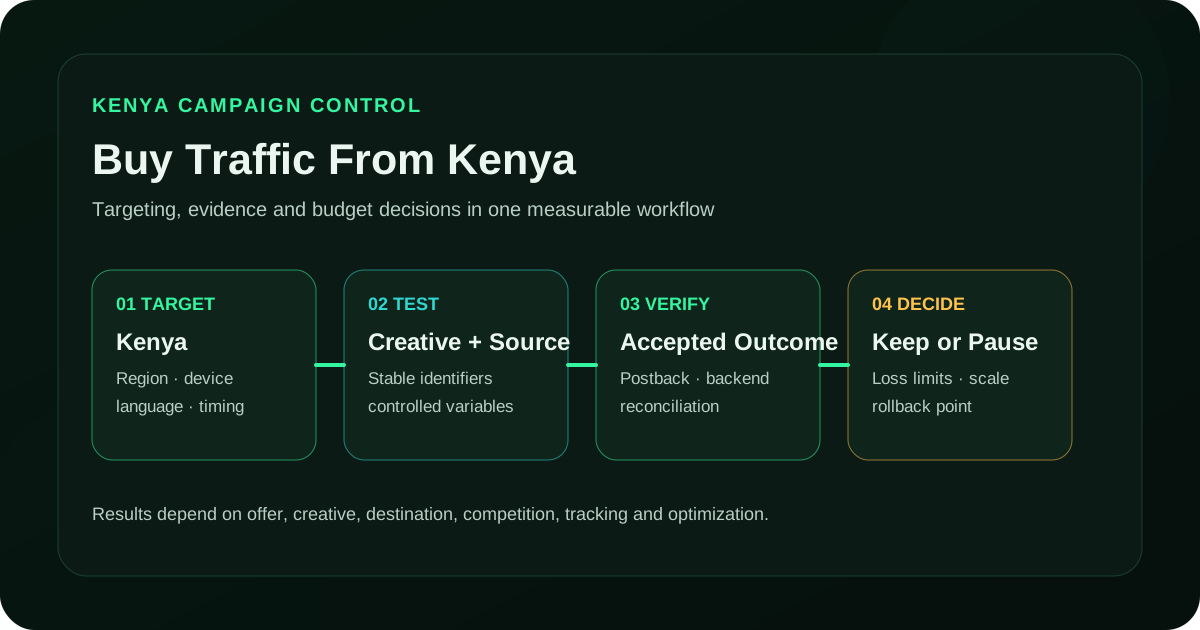
What does Buy Traffic From Kenya require?
Buy Traffic From Kenya means purchasing a defined Kenyan campaign cell only after language, location, offer, consumer, data, clock, and tracking readiness are verified. Article 7 identifies Kiswahili as the national language and Kiswahili and English as official languages; IANA supplies Africa/Nairobi; the Consumer Protection Act and Data Protection Act frame the live path. Platform access and subscription context do not guarantee reach or value.
Four country-specific release conditions
- Choose Kiswahili, English, or another audience path from evidence and carry it through support.
- Use Africa/Nairobi for delivery, support, conversion, and accepted-event maturity.
- Keep Communications Authority subscription statistics separate from unique-user and campaign-reach claims.
- Document personal-data purpose, choice, minimization, transfer, and opt-out before targeting or direct marketing uses it.
Turn Kenya's official-language framework into a complete user route
Article 7 makes Kiswahili the national language and identifies Kiswahili and English as the official languages while protecting linguistic diversity. A Kenya traffic acquisition campaign should use that framework to choose the audience path, not to claim that every Kenyan user needs identical copy.
Test the creative, page, product or service conditions, form or transaction, confirmation, errors, privacy information, and support in the selected language. If another language serves a defined audience, document the fit. Exclude any expansion that widens beyond the journey the business can actually complete.
| Area | Evidence to verify | Decision rule |
|---|---|---|
| Audience | Language, county, device, eligibility | Do not infer from national totals |
| Journey | Creative through support | Keep material terms consistent |
| Decision | Accepted outcome by source cell | Separate incompatible cohorts |
Connect the guide to live testing
Connect Buy Traffic From Kenya to a controlled audience test
Use the choices established in “Turn Kenya's official-language framework into a complete user route” to define one audience, budget and source set in FroggyAds. Keep the surrounding offer and measurement rule stable so the test adds evidence to buy traffic from kenya instead of mixing several changes at once.
Create My Free Account
Anchor Kenya evidence to Africa/Nairobi and qualify subscription statistics
IANA lists Africa/Nairobi for Kenya. Store the identifier with delivery, support, conversion windows, deduplication, and backend acceptance, and retain the platform account zone when it differs. Use one declared boundary when a source cohort is closed.
The Communications Authority publishes quarterly sector statistics from provider returns and states a data-quality qualification. Treat subscriptions and network measures as connectivity context only. They are not unique people, FroggyAds inventory, addressable users, buying intent, or guaranteed delivery. Replace national context with observed campaign evidence as soon as the technical test runs.
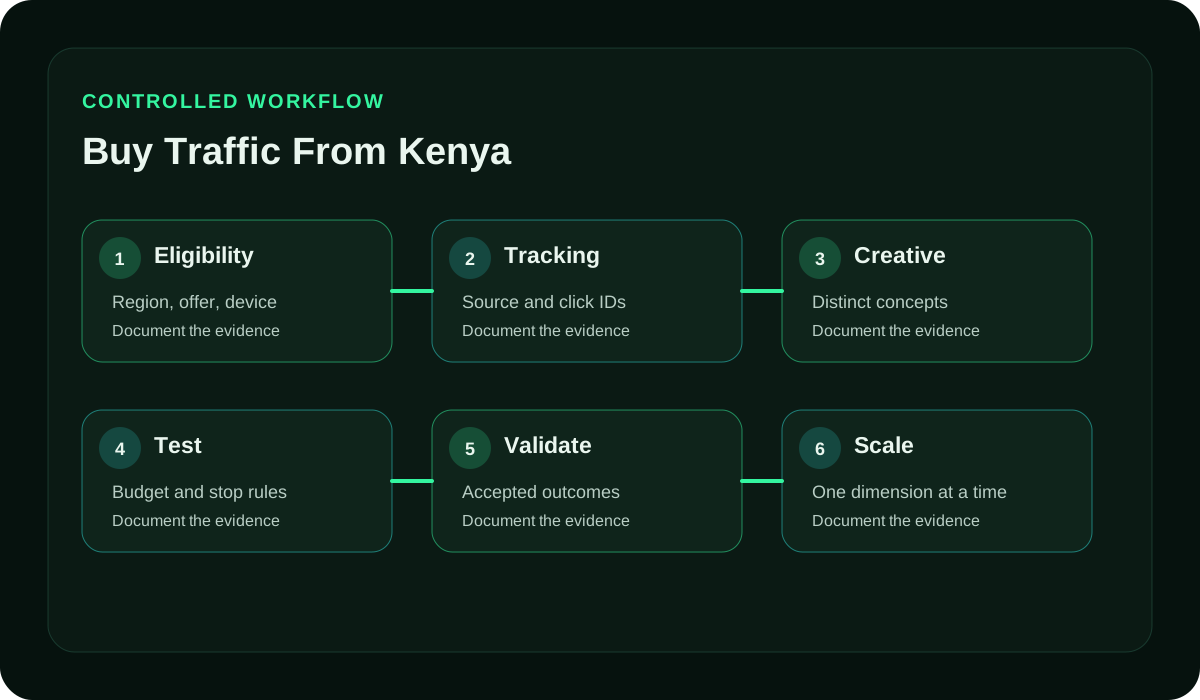
Route Kenyan seller and offer questions through the Consumer Protection Act
The Kenya Consumer Protection Act establishes the official framework and mechanisms for consumer information, complaints, business-practice monitoring, and dispute routing. Use it to identify the accountable reviewer for seller identity, offer description, price and currency, payment, delivery or service, cancellation, refund, complaint, and support facts.
Do not turn a general law reference into a claim that a particular landing page complies. Test the actual user route in the intended county and device context. When the seller, terms, payment, or fulfillment changes, open a new reviewed destination version before paid delivery continues.
Apply the Kenya Data Protection Act to audiences, clicks, and outreach
The Kenya Data Protection Act includes lawful, fair, transparent, purpose-limited, minimized, accurate, retention, and transfer principles and specified territorial scope. Inventory cookies, device and browser fields, audience attributes, URL IDs, forms, CRM data, and postbacks, including vendors that receive them.
ODPC communication-sector guidance addresses notifying people when direct marketing is a purpose and providing a simplified opt-out. Confirm sector and activity fit, then record purpose, processing review, consent or other authority, user information, transfer safeguards, retention, security, and opt-out handling. Remove optional data that lacks an accountable explanation.
Choose the execution format
Choose a paid-media format that supports Buy Traffic From Kenya
Use the criteria around “Apply the Kenya Data Protection Act to audiences, clicks, and outreach” to decide whether push, native, display or pop fits the message and destination. Set format, targeting and spend as campaign controls in FroggyAds while the buy traffic from kenya decision remains the standard for judging the result.
Create My Free Account
Connect Kenya delivery to an accepted business record
Use FroggyAds controls to isolate the Kenyan GEO, device, creative, budget, and source. Preserve campaign, source, placement, creative, and click context, reject duplicates, and reconcile the event with the advertiser's mature outcome under Africa/Nairobi.
Review accepted cost together with destination failure, language mismatch, duplicate rate, event delay, rejection, complaint, and later value. Source lists and traffic-quality signals are controls rather than guarantees. Increase one dimension only while consumer, data, support, and measurement evidence remains current.
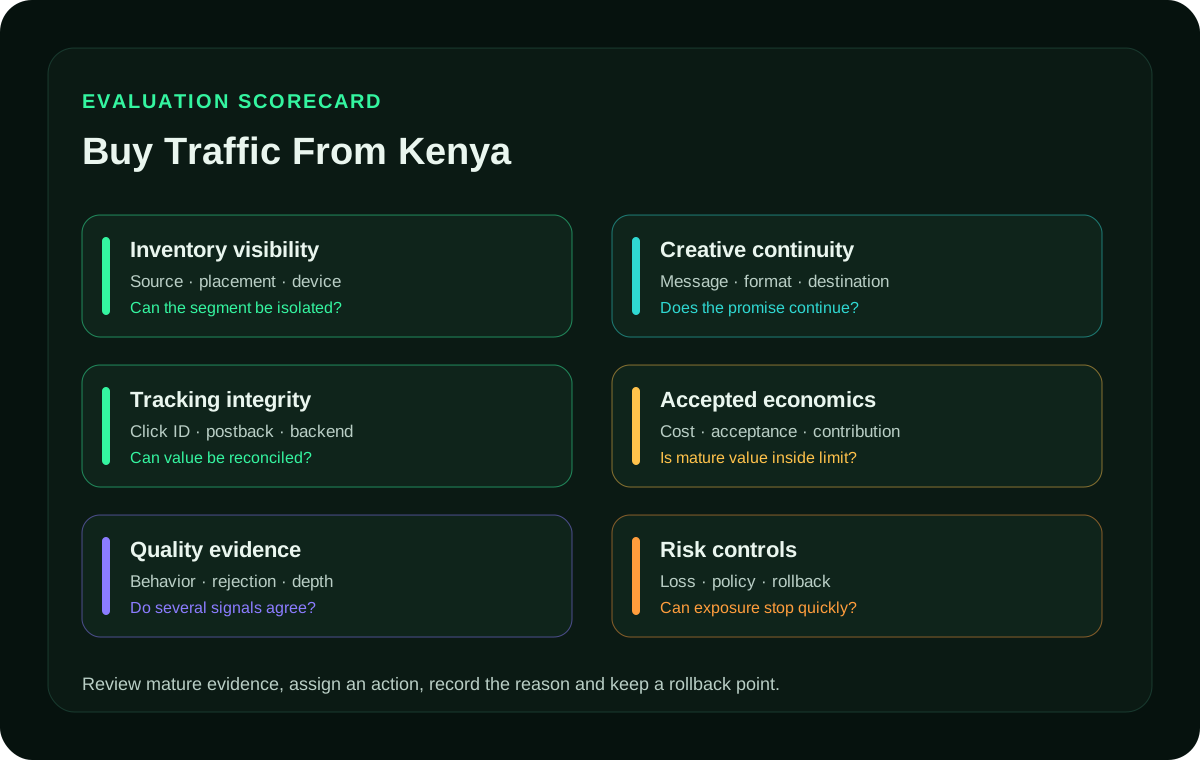
Evidence anchors for the Kenya brief
Kiswahili and English official languages frame the audience-language decision. The Kenya Consumer Protection Act frames seller and offer review. The Kenya Data Protection Act frames campaign identifiers and audiences, while the Africa/Nairobi time zone frames measurement. National connectivity reports remain qualified context only.
Put the guide into practice
Turn Buy Traffic From Kenya into a bounded campaign test
With “Evidence anchors for the Kenya brief” documented, launch only the next reversible test. Set a spending limit, preserve the baseline and use source-level and audience controls so the next step depends on qualified outcomes for buy traffic from kenya, not activity volume.
Create My Free Account
Twelve owned tests from audience definition to marginal scale
- KE 01
Audience-language charter
Describe the Kenyan county or audience, selected Kiswahili, English, or other supported language, and the evidence for that choice. Review identity, benefit, eligibility, price, data notice, form, confirmation, errors, and help as a connected meaning path.
Record who approved the language decision, what evidence they reviewed, and which user states were sampled. Include a completed form, a validation failure, a confirmation, and a support request. This makes the charter testable and prevents a campaign team from treating the existence of translated creative as proof that the whole transaction is understandable.
Keep a language cell closed if material conditions vanish after the advertisement. The constitutional framework guides the question but does not choose a private campaign language automatically.
- KE 02
County service boundary
List counties or cities the offer can genuinely serve, including delivery, account access, appointment, professional, age, licensing, support, cancellation, and refund limits. Test any location-dependent routing from the intended device context.
Pair every included location with the delivery or service rule used by the advertiser. Keep exclusions explicit in media settings and destination copy, then test a boundary case. If availability is determined only after a visitor submits personal information, the release owner should correct the sequence before paying to acquire that visit.
A selectable Kenya GEO is excluded until the promised service and complaint route work there. National reach cannot override an operational boundary.
- KE 03
Consumer offer dossier
Route seller identity, product or service description, payable price, method, delivery, cancellation, refund, complaint, and assistance through the responsible Consumer Protection Act review. Archive the actual creative, page, and transaction revision.
The dossier should identify each business responsible for the promise and the team able to resolve a failed order or service request. Preserve the advertised statement beside the live destination evidence. That comparison helps isolate a creative discrepancy, stale product condition, or support failure without presenting the audit as a legal conclusion about the seller.
Do not use the Act title as compliance decoration. The live offer remains paused when its responsible seller or a material transaction fact is unresolved.
- KE 04
Territorial data analysis
Identify controller, processor, establishment, Kenyan data subjects, information categories, purposes, recipients, and transfers before deciding whether the Data Protection Act's stated territorial scope applies to an outside organization.
Draw the actual data route from delivery through measurement, form processing, CRM, audience use, reporting, and deletion. Mark where a Kenyan location is inferred or supplied and where an outside service receives a record. The analysis should be revisited when a vendor, purpose, identifier, retention period, or destination workflow changes.
A location target alone cannot answer scope. Send uncertainty to the accountable privacy owner and remove optional processing during the review.
- KE 05
Identifier minimization sheet
Inventory advertising cookies, click tokens, device or browser fields, form entries, CRM attributes, audience uploads, suppression data, and postbacks. Record lawfulness review, transparency, purpose limitation, minimization, accuracy, retention, security, and rights handling.
For every retained field, document the operational decision it supports and the shorter-lived alternative considered. Keep security and access evidence with the system owner rather than copying sensitive values into the campaign brief. The review should make it possible to remove an optional signal without breaking the ability to reconcile accepted advertiser outcomes.
Only fields with a documented Kenyan purpose and owner remain in the test. A technically available signal does not become necessary merely because optimization can consume it.
- KE 06
Direct-marketing opt-out proof
Where the ODPC communication-sector guidance fits the activity, capture how the data subject is informed that direct marketing is a purpose and exercise the simplified opt-out. Trace the resulting status through CRM, automation, audience exports, and vendors.
Exercise the opt-out with a controlled address or number and retain timestamps for receipt, suppression, downstream sync, and attempted re-entry. A link that displays a confirmation is incomplete evidence if another workflow can restore the person. Assign the exception queue and response deadline before the first live outreach list is released.
Block future outreach when suppression propagation cannot be demonstrated. Preserve the authority or consent record separately from the advertising click.
- KE 07
Africa/Nairobi clock ledger
Normalize delivery, service availability, form events, payment, callback, duplicate decisions, and advertiser acceptance under Africa/Nairobi while retaining original system times. Declare when delayed events become mature for the Kenya business outcome.
Sample events on both sides of the reporting-day boundary and include one deliberately delayed callback. Compare platform, site, payment, and advertiser records after conversion to the common reference. The ledger should reveal whether a source appears stronger merely because its outcomes arrive before a cutoff while another source's accepted results arrive later.
Do not combine days or dayparts whose local boundaries differ. Reconcile timestamps before a source receives more budget or a cohort is declared complete.
- KE 08
Subscription-statistics label
Mark Communications Authority figures as provider-return subscription or network context. Store publication details and prohibit their conversion into unique-user, advertiser reach, FroggyAds inventory, demand, conversion, or profitability estimates.
When a contextual figure is used in planning, quote its unit, period, population, reporting method, and publication date in the internal note. Then write the campaign metric separately. This prevents subscription counts or network indicators from leaking into reach forecasts and gives reviewers a clear reason to refresh the context without altering measured delivery history.
The campaign's own eligible delivery and accepted records determine exposure. Sector statistics remain background and never unlock scale.
- KE 09
Kenya event lineage
Join supported campaign, creative, placement, source, and click values with destination revision, callback, deduplication outcome, accepted or rejected business record, and Africa/Nairobi maturity. Keep correction and refund states available.
Test the lineage with a successful result, a duplicate receipt, a rejection, and a later correction where the advertiser workflow permits it. Preserve safe join keys and restrict raw identifiers. A source receives value only after the applicable disposition matures, while corrections remain attributable to the same campaign and destination revision.
Source decisions use the lineage row. A dashboard conversion without a matching mature advertiser disposition stays outside accepted economics.
- KE 10
Quality investigation board
Review redirect faults, page availability, device consistency, rapid repeats, time to action, form validation, payment failure, duplicate callbacks, rejections, refunds, and later value before diagnosing Kenyan supply.
Assign each anomaly to a hypothesis and a next test: technical delivery, destination behavior, user eligibility, transaction processing, measurement, duplicate handling, or source composition. Keep inconclusive signals labeled as such. This discipline avoids broad supply claims and directs the owner toward the smallest reversible experiment capable of separating likely causes.
A traffic-quality signal starts an investigation; it does not certify the remaining visits or identify the only possible cause of poor results.
- KE 11
Kenya risk stopbook
Assign immediate stops for unsupported language or county, seller drift, privacy uncertainty, failed opt-out, tracking mismatch, unavailable destination, source loss, abnormal behavior, and support breakdown. Name the owner and restart proof.
The stopbook should include detection thresholds, accountable contacts, communication channels, and the maximum time or spend before a pause. Rehearse one non-destructive stop and verify that the affected source or creative can be isolated. Record the evidence required to reopen it so commercial urgency cannot silently replace the failed control.
Isolate only the affected cell when possible. Retest after a documented repair creates a new hypothesis and a fresh technical record.
- KE 12
Single-variable expansion
Compare the newest Kenya cohort with its benchmark for audience, source mix, Africa/Nairobi interval, destination reliability, accepted cost, rejection, and operational capacity. Choose one change among budget, bid, device, creative, format, source set, or location.
Define the benchmark cohort before increasing exposure and keep its audience, destination, acceptance rule, and maturity window stable. Log the single changed variable and the expected observation. If supply composition shifts with spend, preserve that finding as part of the result; do not describe the movement as a clean bid effect when multiple inputs changed.
Preserve a rollback cohort and stop the increase when marginal evidence weakens. Platform access, official-language context, and subscription figures cannot guarantee value.
A Kenya source cannot outrun an unresolved language, county, consumer, data, opt-out, clock, destination, or accepted-event dependency. The release owner therefore signs a dated matrix that connects each active source with its verified audience route, served location, destination revision, approved data path, suppression result, Africa/Nairobi observation interval, and mature advertiser outcome. When any cell lacks its required evidence, isolate that cell and preserve the benchmark rather than spreading an uncertain assumption across the campaign. Reopening requires the named owner, a recorded correction, a repeated technical rehearsal, and a fresh marginal comparison.
Buy Traffic From Kenya FAQ
For Buy Traffic From Kenya, what should a Kenyan traffic provider disclose?
Ask for current country, device, publisher, format and placement coverage plus stable source identifiers. Buy Traffic From Kenya means purchasing a defined Kenyan campaign cell only after language, location, offer, consumer, data, clock, and tracking readiness are verified.
For Buy Traffic From Kenya, which language fits the intended Kenya audience?
Choose English, Swahili or another supported language from audience evidence and destination capability. KE 01 Audience-language charter Describe the Kenyan county or audience, selected Kiswahili, English, or other supported language, and the evidence for that choice.
For Buy Traffic From Kenya, how can buyers compare Kenya traffic charges?
Align billing unit, account currency, exchange method, fees, taxes, device and quality definitions across offers. IANA lists Africa/Nairobi for Kenya. Store the identifier with delivery, support, conversion windows, deduplication, and backend acceptance, and retain the platform account zone when it differs.
For Buy Traffic From Kenya, what mobile checks precede delivery in Kenya?
Test page weight, forms, payment and support on representative phones, browsers and connection conditions. Use FroggyAds controls to isolate the Kenyan GEO, device, creative, budget, and source.
For Buy Traffic From Kenya, which tracking links visits with business value?
Keep campaign, creative, source, device and location IDs through accepted conversion and rejection events. The Kenya Data Protection Act includes lawful, fair, transparent, purpose-limited, minimized, accurate, retention, and transfer principles and specified territorial scope.
For Buy Traffic From Kenya, what should the Kenya landing page explain?
State product eligibility, price, fulfilment, privacy choices, business identity and a reachable support route. Kiswahili and English official languages frame the audience-language decision. The Kenya Consumer Protection Act frames seller and offer review.
For Buy Traffic From Kenya, how much traffic belongs in a first purchase?
Use a controlled source sample large enough for the selected event but within the affordable loss. Start Kenya delivery only after the audience language, county, offer, consumer, data, Africa/Nairobi, and accepted-event paths have passed together.
For Buy Traffic From Kenya, which anomalies can indicate poor delivery?
Investigate repeated identifiers, impossible timing, location conflicts and sessions without normal browser or customer behaviour. KE 01 Audience-language charter Describe the Kenyan county or audience, selected Kiswahili, English, or other supported language, and the evidence for that choice.
For Buy Traffic From Kenya, can country targeting confirm every visitor's location?
No. Geolocation signals have limits, so compare provider data with independent analytics and documented tolerances. Choose Kiswahili, English, or another audience path from evidence and carry it through support.
For Buy Traffic From Kenya, when can Kenya traffic volume increase?
Expand only source groups whose mature accepted outcome cost remains credible after the controlled test. KE 01 Audience-language charter Describe the Kenyan county or audience, selected Kiswahili, English, or other supported language, and the evidence for that choice.
Continue the Kenya traffic workflow
Build the first Kenya evidence cell
Start Kenya delivery only after the audience language, county, offer, consumer, data, Africa/Nairobi, and accepted-event paths have passed together.
Buy Traffic From Kenya: what should the advertiser decide next?
For Buy Traffic From Kenya, treat Kenya as its own campaign market. Confirm that the offer, landing experience, language and device path genuinely support the market, then compare source-level outcomes inside Kenya. Use What does Buy Traffic From Kenya require? and Four country-specific release conditions as the planning baseline instead of importing assumptions from another country.
On this Buy Traffic From Kenya page, the decision should remain tied to the existing evidence around What does Buy Traffic From Kenya require?, Four country-specific release conditions and Turn Kenya's official-language framework into a complete user route. Those sections give buy traffic from kenya its specific context; the table below turns that context into campaign actions rather than adding another generic definition.
| Decision | What to verify | FroggyAds action |
|---|---|---|
| Buy Traffic From Kenya objective | Use What does Buy Traffic From Kenya require? to define the accepted business event and the maximum learning loss for buy traffic from kenya. | Launch one FroggyAds campaign objective for Buy Traffic From Kenya and keep the conversion definition stable. |
| Buy Traffic From Kenya audience | Use Four country-specific release conditions to verify market, device, language and offer eligibility for buy traffic from kenya. | Apply only the FroggyAds targeting controls that change the real Buy Traffic From Kenya customer journey. |
| Buy Traffic From Kenya source evidence | Use Turn Kenya's official-language framework into a complete user route to keep source-level differences visible instead of relying on one blended buy traffic from kenya average. | Keep, cap, exclude or retest Buy Traffic From Kenya inventory from documented source evidence. |
| Buy Traffic From Kenya economics | Use Connect Buy Traffic From Kenya to a controlled audience test to connect media spend with accepted conversions and downstream value for buy traffic from kenya. | Protect the Buy Traffic From Kenya test with a written budget boundary and a consistent attribution window. |
| Buy Traffic From Kenya scale rule | Use Anchor Kenya evidence to Africa/Nairobi and qualify subscription statistics to define the exact evidence that earns the next budget increase for buy traffic from kenya. | Scale Buy Traffic From Kenya one major control at a time and compare marginal performance with the prior baseline. |
A page-specific FroggyAds test sequence for Buy Traffic From Kenya
- Buy Traffic From Kenya outcome: define the accepted event for buy traffic from kenya and the maximum loss permitted while the first test is learning.
- Buy Traffic From Kenya path: verify market eligibility, device experience, landing-page continuity and tracking against What does Buy Traffic From Kenya require? before buying more traffic.
- Buy Traffic From Kenya hypothesis: launch one bounded FroggyAds test tied to Four country-specific release conditions; do not change bid, creative, audience and destination together.
- Buy Traffic From Kenya source review: compare qualified activity, accepted conversions, timing and cost by the source or segment dimensions relevant to Turn Kenya's official-language framework into a complete user route.
- Buy Traffic From Kenya scaling: use Connect Buy Traffic From Kenya to a controlled audience test and Anchor Kenya evidence to Africa/Nairobi and qualify subscription statistics to define what must reproduce before the next budget increase.
Why FroggyAds is relevant to Buy Traffic From Kenya
For Buy Traffic From Kenya, FroggyAds gives advertisers a self-serve DSP and ad-network workflow for buying supported traffic with campaign-level budgets and targeting. Depending on format and campaign context, available controls can include country, city, device, operating system, browser, carrier, category, source, ID and IP options. SmartCPC and Adscore-supported traffic-quality controls can support the buy traffic from kenya optimization process, while the advertiser's tracker, analytics and backend acceptance remain the final evidence for commercial quality.
Use Anchor Kenya evidence to Africa/Nairobi and qualify subscription statistics as the final checkpoint for Buy Traffic From Kenya. If the accepted result does not reproduce after the next meaningful volume step, return to the last stable configuration instead of widening several controls at once.
Buy Traffic From Kenya: the decision this URL owns
Use this page when advertisers and media buyers need to make the specific decision described by Buy Traffic From Kenya. Anchor the decision to audience targeting, conversion tracking and a single accepted business outcome rather than broad marketing activity. Keep this URL focused on that decision; use Buy Kenya Traffic for the adjacent task.
Buy Traffic From Kenya decision: Plan the market-specific test and measurement rules. Keep audience targeting, conversion tracking attached to the same campaign record so the buyer can explain the next budget action.
Evidence already on this page: Buy Traffic From Kenya. Those sections define the operating context for Buy Traffic From Kenya and should be checked before the buyer changes scope or spend.
Market-specific questions on this URL: For Buy Traffic From Kenya, what should a Kenyan traffic provider disclose? | For Buy Traffic From Kenya, which language fits the intended Kenya audience? | For Buy Traffic From Kenya, how can buyers compare Kenya traffic charges?
Source evidence 1: For Buy Traffic From Kenya, FroggyAds gives advertisers a self-serve DSP and ad-network workflow for buying supported traffic with campaign-level budgets and targeting. Depending on format and campaign context, available controls can include country, city, device, operating system, browser, carrier, category, source, ID and IP options. SmartCPC and Adscore-supported traffic-quality controls can support the buy traffic from kenya optimization process, while the advertiser's tracker, analytics and backend acceptance remain the final evidence for commercial quality.
Source evidence 2: Buy Traffic From Kenya means purchasing a defined Kenyan campaign cell only after language, location, offer, consumer, data, clock, and tracking readiness are verified. Article 7 identifies Kiswahili as the national language and Kiswahili and English as official languages; IANA supplies Africa/Nairobi; the Consumer Protection Act and Data Protection Act frame the live path. Platform access and subscription context do not guarantee reach or value.
What makes this URL distinct: Buy Traffic From Kenya should retain its own evidence trail. Use the page's buyer job, entity gaps and nearest related URL to decide what belongs here, then keep the campaign variable, source identity and accepted outcome specific to this URL. If a neighboring page answers a different buying question, do not merge the two decisions simply because they share an ad format or acquisition term.
| Checkpoint | Page-specific action | Evidence to retain |
|---|---|---|
| For Buy Traffic From Kenya, what should a Kenyan traffic provider disclose? | Use Buy Traffic From Kenya to resolve this question for Buy Traffic From Kenya before changing budget or scope. | Retain audience targeting, source or placement identity, spend and the accepted-event result for Buy Traffic From Kenya. |
| For Buy Traffic From Kenya, which language fits the intended Kenya audience? | Use Buy Traffic From Kenya to resolve this question for Buy Traffic From Kenya before changing budget or scope. | Retain conversion tracking, source or placement identity, spend and the accepted-event result for Buy Traffic From Kenya. |
| For Buy Traffic From Kenya, how can buyers compare Kenya traffic charges? | Use Buy Traffic From Kenya to resolve this question for Buy Traffic From Kenya before changing budget or scope. | Retain accepted outcome, source or placement identity, spend and the accepted-event result for Buy Traffic From Kenya. |
Transparent decision example
Hypothetical example: For Buy Traffic From Kenya, if a controlled test spends USD 200 and records 10 accepted outcomes after the same review window, accepted cost is USD 20.00 per outcome. Replace the inputs with your own economics and the event definition appropriate to this page.
Why use FroggyAds for this step?
For Buy Traffic From Kenya, FroggyAds provides a self-serve paid-media test with targeting, budget, conversion and source controls so the page-specific decision can be validated with campaign evidence. Create your free FroggyAds account.
Research basis for Buy Traffic From Kenya: This URL helps performance-focused advertisers plan the market-specific test and measurement rules. It is mapped to the general ads research cluster. Our current review used shopify.com and support.google.com to check terminology, buyer questions and decision coverage relevant to Buy Traffic From Kenya. These external sources are research inputs, not evidence of FroggyAds campaign performance.
Buy Traffic From Kenya — what matters first
Buy Traffic From Kenya should be evaluated market by market: define eligible geography, keep measurement consistent, and scale only where accepted-outcome economics remain viable.