Best Video Traffic 2026: Compare Options for Paid Growth
The best video traffic in 2026 is the supply route that fits a defined campaign outcome and exposes enough placement, player, delivery and measurement evidence to review that outcome. It is not the source with the largest quoted volume or the lowest isolated rate. As of 16 August 2026, buyers should verify current video campaign capabilities with the platform owner and use IAB Tech Lab VAST documentation to understand ad-serving metadata without treating technical compatibility as proof of attention or commercial value.
Define what best video traffic must accomplish
Begin with one business question: reach a qualified audience, earn an intentional view, generate a site visit, support a lead route or contribute to a confirmed sale. Give that question a named metric, observation period and business confirmation. A video source cannot be called best when the buyer has not defined which event it is expected to support or which later condition makes the event useful.
Keep delivery, exposure, response and business outcome as separate stages. An impression can establish recorded delivery under a provider definition; a view can describe playback under another definition; a visit can reach a destination; and a sale can be confirmed later. The evaluation should preserve each stage rather than compressing unlike evidence into one score.
Map the supply path before comparing rates
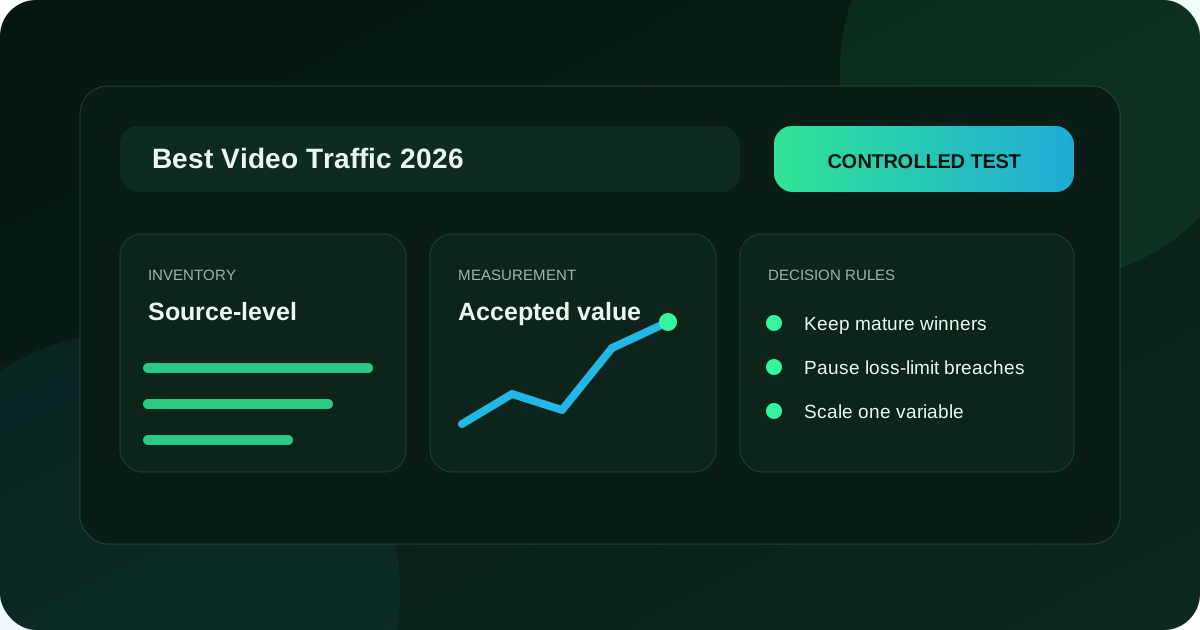
Create an inventory card for every proposed video traffic route. Record the buying platform, seller information available to the buyer, publisher or app context, device, geography, player position, content relationship and transaction route. Unknown fields stay marked as unknown. A low rate does not fill a missing supply-path field, and a familiar exchange name does not identify the final placement.
Ask which records remain available after delivery. Useful evidence can include placement reports, creative identifiers, timestamps, device or region summaries, VAST error information and adjustment records. Availability depends on the implementation and commercial agreement. The buyer should request the actual fields rather than infer a universal disclosure package from a standards logo.
Use VAST as a serving specification, not a quality label
IAB Tech Lab describes VAST as an XML-based Video Ad Serving Template that transfers ad metadata from an ad server to a video player. That definition supports tag-path and interoperability review. It does not establish that a particular impression was visible, heard, fraud-free, contextually suitable or commercially productive. Those questions require separate observation and provider-specific evidence.
Follow wrappers, creative identifiers, selected media files, tracking events and reported errors where the buying route exposes them. Preserve the original tag observation and the rendered result. When the player receives a compatible response but presents an unusable rendition, classify the serving and experience findings separately so technical success does not erase the user-facing failure.
Inspect the delivered player experience
Review the real placement on the devices and connection conditions relevant to the campaign. Check ratio, resolution, crop, controls, captions, text size, audio behavior, start mode, page context and destination continuity. Save the creative version and observation conditions. A source master or preview cannot prove that the final player selected the intended rendition or displayed important information safely.
Treat attention as an inference unless the measurement method supports a narrower statement. Autoplay, completion and player presence describe different conditions and may use provider-specific rules. Keep a measurement dictionary beside the observation so reviewers know whether a value represents a request, start, quartile, completed playback, click, landing event or confirmed business state.
Test the route with a bounded campaign
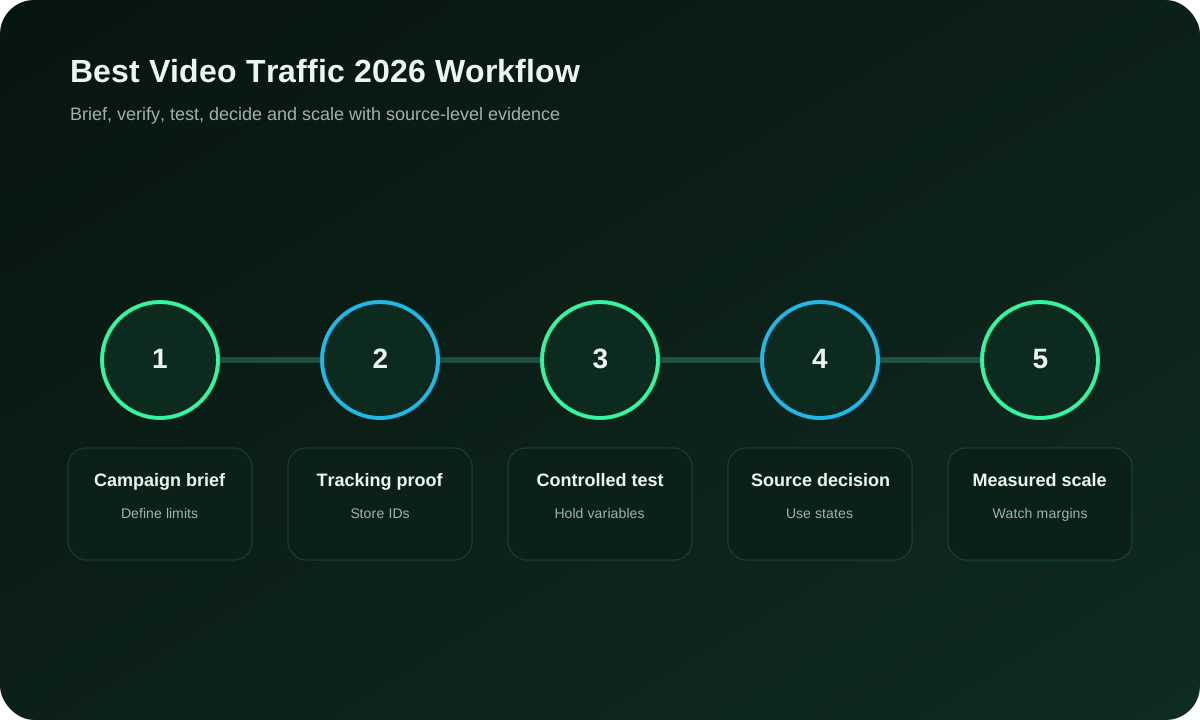
A useful first test limits budget, period, geography, creative versions and inventory scope. It also sets stop conditions for broken destinations, unsafe contexts, repeated technical errors, unexplained concentration or reconciliation gaps. The test should answer a named uncertainty. Broad delivery without a learning question produces cost but little reusable evidence.
Hold the advertised promise and destination stable while the supply route is compared. If the buyer changes creative, landing page, audience, bidding and inventory together, the result cannot isolate the traffic-source question. Record unavoidable differences and avoid claiming causation when the design supports only an observation.
Review invalid-traffic signals without unsupported accusations
Use each provider's current invalid-traffic documentation, reporting and adjustment process. Repeated timing patterns, impossible geography, concentrated placements or conflicting logs can justify investigation, but one anomaly does not prove a supply-wide cause. Preserve the raw observation, provider response, account action and financial adjustment as distinct records.
Escalate the first material discrepancy with a reproducible example. Include campaign, placement or seller context, time window, event definition and the comparison source. If the provider changes a total later, retain both versions and the stated reason. This chronology lets media, analytics and finance teams reconcile the same route without overwriting the evidence available at decision time.
Connect the guide to live testing
Connect Best Video Traffic 2026 to a controlled audience test
Use the choices established in “Scale only after serving and measurement are stable” to define one audience, budget and source set in FroggyAds. Keep the surrounding offer and measurement rule stable so the test adds evidence to best video traffic 2026 instead of mixing several changes at once.
Scale only after serving and measurement are stable
A scale decision should name the resolved uncertainty, the retained inventory boundary and the next monitoring window. Increase spend in steps that allow the team to observe whether placement mix, rendition behavior, response quality or business confirmation changes. A source that behaves acceptably at a narrow scope may change when the available inventory expands.
Record exclusion and reconsideration rules. A placement removed after repeated documented failures should retain the observations that justified the decision and the evidence required for another trial. This makes the control reviewable and prevents an inherited blocklist or allowlist from becoming a permanent quality claim without current support.
Close with a source-specific evidence record
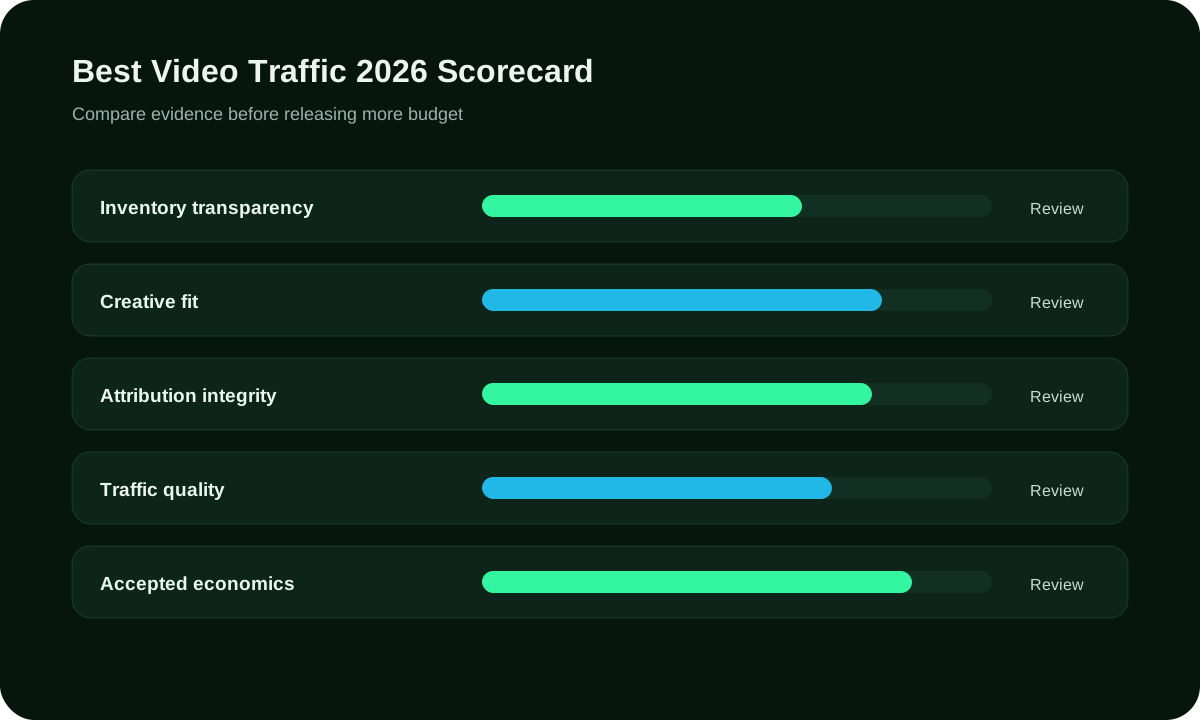
The final comparison should state what the platform owner documents, what the buyer directly observed, what the provider reported and what the business later confirmed. It should also show missing evidence. This separation makes the recommendation bounded to the campaign question, period and available inventory rather than presenting a permanent ranking of changing traffic sources.
Choose accept, reject or verify status for each route. Accepted routes keep constraints and a review date. Rejected routes keep the reason and reconsideration condition. Verify routes receive a named owner and deadline. A clear close is more useful than a universal best-video-traffic list because another operator can inspect and challenge the decision.
Operating controls
Control 1
Campaign outcome and downstream confirmation are defined before video supply is bought.
Unknown supply fields remain explicit limitations rather than assumed positives.
Control 4
VAST observations stay separate from viewability, attention and commercial interpretation.
Control 5
Rendered-player checks preserve the exact creative, device and observation conditions.
Control 6
Every metric keeps its provider definition, scope, window and later reconciliation state.
Control 7
Initial video tests use bounded spend, inventory, timing and written stop conditions.
Control 8
Comparison designs hold the message and destination stable where practical.
Control 9
Invalid-traffic investigations retain anomalies, provider responses and adjustments separately.
Control 10
Scaling occurs in reviewable steps after technical and measurement routes are stable.
Control 11
Placement exclusions keep evidence plus a condition for future reconsideration.
Control 12
The closing decision labels each source accept, reject or verify with an accountable owner.
Choose the execution format
Choose a paid-media format that supports Best Video Traffic 2026
Use the criteria around “Review notes” to decide whether push, native, display or pop fits the message and destination. Set format, targeting and spend as campaign controls in FroggyAds while the best video traffic 2026 decision remains the standard for judging the result.
Define the 2026 shortlist around one campaign decision, accepted event, geography, device set and content boundary; the word best remains conditional on this dated operating question. Date and disposition stay attached.
Review note 2
Create a provider capability row that names buying method, available seller evidence, inventory description, reporting delay and unavailable controls; do not convert sales language into verified product facts. Date and disposition stay attached.
Review note 3
Use VAST only for the serving and error fields it specifies, then assess player experience and commercial response separately; standards compatibility cannot decide contextual fit or human attention. Date and disposition stay attached.
Review note 4
Inspect one delivered video across representative player states and connection conditions; preserve media-file choice, controls, audio, captions, surrounding content and the exact time of observation. Date and disposition stay attached.
Review note 5
Score destination continuity as its own gate by matching the video claim, call to action, landing offer, material terms and completion route; targeting cannot compensate for a broken promise. Date and disposition stay attached.
Review note 6
Build a measurement dictionary for impression eligibility, view thresholds, completions, clicks, engaged landings and accepted business events; every dashboard total keeps its owner definition. Date and disposition stay attached.
Review note 7
Compare provider rows through aligned exposure and outcome windows while retaining refunds, invalid-activity adjustments and analyst work; a nominal CPM cannot represent the whole operating cost. Date and disposition stay attached.
Review note 8
Run one uncertainty test at a time, such as player reliability, context availability or destination response; freeze the creative and measurement contract when the supply question is under review. Date and disposition stay attached.
Review note 9
Escalate suspicious delivery with a reproducible source, timestamp, event definition and player example; archive the provider response and financial treatment without rewriting the initial observation. Date and disposition stay attached.
Review note 10
Assign accept, reject or verify to every shortlisted capability and give verify items a due date; this prevents incomplete evidence from receiving a midpoint score that looks like approval. Date and disposition stay attached.
Put the guide into practice
Turn Best Video Traffic 2026 into a bounded campaign test
With “Review note 11” documented, launch only the next reversible test. Set a spending limit, preserve the baseline and use source-level and audience controls so the next step depends on qualified outcomes for best video traffic 2026, not activity volume.
Scale a selected video route through small inventory increments and review the new marginal mix; keep the last stable source set and budget available as the rollback configuration. Date and disposition stay attached.
Review note 12
Publish the final 2026 decision with retrieval dates, account-specific limitations and an expiry trigger; the record supports the next review but does not promise that a volatile source stays best. Date and disposition stay attached.
Evidence lab
Evidence checkpoint 1
Working exercise: Define the 2026 shortlist around one campaign decision, accepted event, geography, device set and content boundary; the word best remains conditional on this dated operating question. Inputs, results, limits and rollback stay attached.
Evidence checkpoint 2
Working exercise: Create a provider capability row that names buying method, available seller evidence, inventory description, reporting delay and unavailable controls; do not convert sales language into verified product facts. Inputs, results, limits and rollback stay attached.
Evidence checkpoint 3
Working exercise: Use VAST only for the serving and error fields it specifies, then assess player experience and commercial response separately; standards compatibility cannot decide contextual fit or human attention. Inputs, results, limits and rollback stay attached.
Evidence checkpoint 4
Working exercise: Inspect one delivered video across representative player states and connection conditions; preserve media-file choice, controls, audio, captions, surrounding content and the exact time of observation. Inputs, results, limits and rollback stay attached.
Evidence checkpoint 5
Working exercise: Score destination continuity as its own gate by matching the video claim, call to action, landing offer, material terms and completion route; targeting cannot compensate for a broken promise. Inputs, results, limits and rollback stay attached.
Evidence checkpoint 6
Working exercise: Build a measurement dictionary for impression eligibility, view thresholds, completions, clicks, engaged landings and accepted business events; every dashboard total keeps its owner definition. Inputs, results, limits and rollback stay attached.
Evidence checkpoint 7
Working exercise: Compare provider rows through aligned exposure and outcome windows while retaining refunds, invalid-activity adjustments and analyst work; a nominal CPM cannot represent the whole operating cost. Inputs, results, limits and rollback stay attached.
Evidence checkpoint 8
Working exercise: Run one uncertainty test at a time, such as player reliability, context availability or destination response; freeze the creative and measurement contract when the supply question is under review. Inputs, results, limits and rollback stay attached.
Evidence checkpoint 9
Working exercise: Escalate suspicious delivery with a reproducible source, timestamp, event definition and player example; archive the provider response and financial treatment without rewriting the initial observation. Inputs, results, limits and rollback stay attached.
Evidence checkpoint 10
Working exercise: Assign accept, reject or verify to every shortlisted capability and give verify items a due date; this prevents incomplete evidence from receiving a midpoint score that looks like approval. Inputs, results, limits and rollback stay attached.
Evidence checkpoint 11
Working exercise: Scale a selected video route through small inventory increments and review the new marginal mix; keep the last stable source set and budget available as the rollback configuration. Inputs, results, limits and rollback stay attached.
Evidence checkpoint 12
Working exercise: Publish the final 2026 decision with retrieval dates, account-specific limitations and an expiry trigger; the record supports the next review but does not promise that a volatile source stays best. Inputs, results, limits and rollback stay attached.
Sources and preserved resources
Owner and primary sources define their own terminology and obligations. They do not promise price, delivery or campaign results. Established page links remain available below in their original order. For Best Video Traffic 2026, apply this rule to the page-specific audience, market, format or buying decision described here.
Video traffic evaluation connects supply-path disclosure, VAST serving evidence, rendered-player inspection, measurement definitions and commercial reconciliation.
IAB Tech Lab VAST is an XML-based template for transferring video advertisement metadata from an ad server to a video player.
Google Ads video-campaign documentation describes current objectives, formats, targeting controls and delivery networks within Google's product.
Video traffic review should keep the supply description beside financial reconciliation. Record billed events, provider adjustments, credits and the point at which a business outcome becomes confirmed. If delivery totals change after the period, retain the earlier report and the reason for revision. This chronology prevents a later adjustment from erasing what the operator saw when the buying decision was made. For Best Video Traffic 2026, apply this rule to the page-specific audience, market, format or buying decision described here.
It also helps finance, media and analytics teams discuss the same route without treating their different time windows as errors. A final source decision should state which evidence was directly observed, which came from the provider and which remains an inference requiring another bounded test. The archive should also preserve the rejected alternative and its reason. For Best Video Traffic 2026, apply this rule to the page-specific audience, market, format or buying decision described here.
When a placement, rendition or buying route is removed, note the repeated observation that justified the change and the conditions under which reconsideration would be reasonable. This makes exclusion reviewable and prevents inherited controls from becoming permanent without supporting evidence. Finance can then reconcile the billed route while media reviewers retain the technical and contextual explanation for every material adjustment. For Best Video Traffic 2026, apply this rule to the page-specific audience, market, format or buying decision described here.
The final approval names the person who can reopen supply evaluation, the new evidence required and the next permitted observation window.
Questions and answers
Does 2026 video traffic fit with records under test windows?
Document the video traffic 2026 gap. Compare the video traffic 2026 workaround. Store video traffic 2026 fit proof. Approve the video traffic 2026 fit choice. Revisit video traffic 2026. Record the fit decision with audience evidence for this review.
What should 2026 video traffic prove during a pilot using outcome rules?
Name the video traffic 2026 outcome. Date the video traffic 2026 baseline. Set video traffic 2026 stop rules. Judge the video traffic 2026 result. Retest video traffic 2026. Record the outcome record with audience evidence for this review.
Who is eligible for video Traffic 2026?
Define the video traffic 2026 audience. Trace the video traffic 2026 source. Mark video traffic 2026 eligibility. Segment the video traffic 2026 response. Refresh video traffic 2026. Record the audience choice with audience evidence for this review.
Does 2026 video traffic match the offer before expansion after permission checks?
State the video traffic 2026 promise. Match the video traffic 2026 destination. Keep video traffic 2026 proof ready. Test the video traffic 2026 offer. Revise video traffic 2026. Record the offer proof with audience evidence for this review.
Can 2026 video traffic stay affordable inside market with delivery limits?
Cap the video traffic 2026 cost. Count the video traffic 2026 workload. Total video traffic 2026 spend. Price the video traffic 2026 decision. Reforecast video traffic 2026. Record the budget limit with audience evidence for this review.
Is 2026 video traffic launch-ready before spending under brief?
Assign the video traffic 2026 access. Trial the video traffic 2026 handoff. Secure video traffic 2026 approvals. Stage the video traffic 2026 launch. Recheck video traffic 2026. Record the launch approval with audience evidence for this review.
How is 2026 video traffic measured with ownership with response ownership?
Specify the video traffic 2026 outcome. Verify the video traffic 2026 source. Note video traffic 2026 limits. Reconcile the video traffic 2026 report. Report video traffic 2026. Record the report rule with audience evidence for this review.
What weakens 2026 video traffic before review during source review?
Isolate the video traffic 2026 signal. Inspect the video traffic 2026 evidence. Rank video traffic 2026 causes. Diagnose the video traffic 2026 weakness. Probe video traffic 2026. Record the diagnosis note with audience evidence for this review.
Which 2026 video traffic safeguard matters with limits after capacity checks?
Safeguard the video traffic 2026 customer. Confirm the video traffic 2026 consent. Route video traffic 2026 escalation. Audit the video traffic 2026 risk. Pause video traffic 2026. Record the customer safeguard with audience evidence for this review.
Can 2026 video traffic scale against baseline before offer changes?
Protect the video traffic 2026 quality. Check the video traffic 2026 capacity. Prove video traffic 2026 expansion. Pace the video traffic 2026 scale. Extend video traffic 2026. Record the scale decision with audience evidence for this review.
Decision table
Best Video Traffic 2026: Compare Options for Paid Growth: a practical advertiser decision matrix
Decision
What to verify
FroggyAds action
Placement fit
Check how Best Video Traffic 2026: Compare Options for Paid Growth is delivered and whether the creative can communicate the offer clearly.
Choose the format only when the placement matches the intended user action.
Creative continuity
Keep the message consistent with the page sections on On this page and the destination.
Test one creative hypothesis at a time.
Targeting
Use market, device and source controls only where they support eligibility or a testable hypothesis.
Start broad enough to learn, then narrow from source-level evidence.
Measurement
Connect the format to the accepted conversion discussed under Define what best video traffic must accomplish.
Reconcile FroggyAds reporting with tracker and backend results.
Scale rule
Use the diagnostic logic around Map the supply path before comparing rates before increasing spend.
Scale only when marginal accepted value stays inside the campaign limit.
Advertiser decision framework
Best Video Traffic 2026: Compare Options for Paid Growth: what should the advertiser decide next?
For Best Video Traffic 2026: Compare Options for Paid Growth, video means a motion-based ad placement where the inventory supports video delivery. The buying decision is whether that delivery context fits the offer, creative and destination well enough to produce an accepted post-click result. Use On this page and Define what best video traffic must accomplish as the page-specific checkpoints, then judge best video traffic 2026 on opening message, completion context and post-view or post-click measurement plus downstream conversion quality.
On this Best Video Traffic 2026: Compare Options for Paid Growth page, the decision should remain tied to the existing evidence around On this page, Define what best video traffic must accomplish and Map the supply path before comparing rates. Those sections give best video traffic 2026 its specific context; the table below turns that context into campaign actions rather than adding another generic definition.
Decision
What to verify
FroggyAds action
Best Video Traffic 2026: Compare Options for Paid Growth objective
Use On this page to define the accepted business event and the maximum learning loss for best video traffic 2026.
Launch one FroggyAds campaign objective for Best Video Traffic 2026: Compare Options for Paid Growth and keep the conversion definition stable.
Best Video Traffic 2026: Compare Options for Paid Growth audience
Use Define what best video traffic must accomplish to verify market, device, language and offer eligibility for best video traffic 2026.
Apply only the FroggyAds targeting controls that change the real Best Video Traffic 2026: Compare Options for Paid Growth customer journey.
Best Video Traffic 2026: Compare Options for Paid Growth source evidence
Use Map the supply path before comparing rates to keep source-level differences visible instead of relying on one blended best video traffic 2026 average.
Keep, cap, exclude or retest Best Video Traffic 2026: Compare Options for Paid Growth inventory from documented source evidence.
Best Video Traffic 2026: Compare Options for Paid Growth economics
Use Use VAST as a serving specification, not a quality label to connect media spend with accepted conversions and downstream value for best video traffic 2026.
Protect the Best Video Traffic 2026: Compare Options for Paid Growth test with a written budget boundary and a consistent attribution window.
Best Video Traffic 2026: Compare Options for Paid Growth scale rule
Use Inspect the delivered player experience to define the exact evidence that earns the next budget increase for best video traffic 2026.
Scale Best Video Traffic 2026: Compare Options for Paid Growth one major control at a time and compare marginal performance with the prior baseline.
A page-specific FroggyAds test sequence for Best Video Traffic 2026: Compare Options for Paid Growth
Best Video Traffic 2026: Compare Options for Paid Growth outcome: define the accepted event for best video traffic 2026 and the maximum loss permitted while the first test is learning.
Best Video Traffic 2026: Compare Options for Paid Growth path: verify market eligibility, device experience, landing-page continuity and tracking against On this page before buying more traffic.
Best Video Traffic 2026: Compare Options for Paid Growth hypothesis: launch one bounded FroggyAds test tied to Define what best video traffic must accomplish; do not change bid, creative, audience and destination together.
Best Video Traffic 2026: Compare Options for Paid Growth source review: compare qualified activity, accepted conversions, timing and cost by the source or segment dimensions relevant to Map the supply path before comparing rates.
Best Video Traffic 2026: Compare Options for Paid Growth scaling: use Use VAST as a serving specification, not a quality label and Inspect the delivered player experience to define what must reproduce before the next budget increase.
Why FroggyAds is relevant to Best Video Traffic 2026: Compare Options for Paid Growth
For Best Video Traffic 2026: Compare Options for Paid Growth, FroggyAds gives advertisers a self-serve DSP and ad-network workflow for buying supported traffic with campaign-level budgets and targeting. Depending on format and campaign context, available controls can include country, city, device, operating system, browser, carrier, category, source, ID and IP options. SmartCPC and Adscore-supported traffic-quality controls can support the best video traffic 2026 optimization process, while the advertiser's tracker, analytics and backend acceptance remain the final evidence for commercial quality.
Use Inspect the delivered player experience as the final checkpoint for Best Video Traffic 2026: Compare Options for Paid Growth. If the accepted result does not reproduce after the next meaningful volume step, return to the last stable configuration instead of widening several controls at once.
Best Video Traffic 2026: Compare Options for Paid Growth: the buyer task this URL owns
For performance-focused advertisers, Best Video Traffic 2026: Compare Options for Paid Growth should shorten the path from research to action: update paid-acquisition decisions using current 2026 conditions. The page therefore stays focused on controllable campaign evidence and leaves adjacent intents to their own URLs. The nearest related FroggyAds page is Reliable Video Traffic; this URL keeps ownership of the distinct task to update paid-acquisition decisions using current 2026 conditions.
Anchor the Best Video Traffic 2026: Compare Options for Paid Growth review to in-stream, outstream, video inventory, auction. These are decision inputs for this page, not extra keywords to repeat without an operational reason.
Checkpoint
Page-specific action
Evidence to keep
Journey
Match the format to the user's attention state and destination.
Retain evidence specific to Best Video Traffic 2026: Compare Options for Paid Growth and its accepted outcome.
Creative
Check format requirements, message continuity and landing-page readiness.
Retain evidence specific to Best Video Traffic 2026: Compare Options for Paid Growth and its accepted outcome.
Optimize
Compare source-level accepted outcomes before increasing volume.
Retain evidence specific to Best Video Traffic 2026: Compare Options for Paid Growth and its accepted outcome.
Hypothetical calculation: if a controlled campaign for best video traffic 2026: compare options for paid growth spends USD 225 and produces 9 accepted conversions, accepted CPA is USD 225 / 9 = USD 25.0. Replace the inputs with your own campaign economics; this is not a FroggyAds performance claim.
When Best Video Traffic 2026: Compare Options for Paid Growth moves from research to a traffic test, FroggyAds lets performance-focused advertisers control targeting, budget and source decisions from one self-serve workflow while downstream conversions remain the commercial proof. Create your free FroggyAds account.
Direct answer
Best Video Traffic 2026: Compare Options for Paid Growth — what matters first
Best Video Traffic 2026: Compare Options for Paid Growth is useful when the format fits the user journey, device context, creative requirements and measurable conversion path.