
Dated interstitial placement and outcome review
Best Interstitial Traffic 2026
Direct answer: The best interstitial traffic in 2026 is a conditional fit between an eligible offer and a documented placement trigger, honest close behavior, supported device context, source-level evidence, bounded cost and mature accepted outcome. The conclusion applies only to the tested creative, destination, supply and review date. A year in the heading does not create freshness or prove quality.
Create My Free Account
Decide whether interruption is appropriate for the campaign
Describe the moment in which the placement appears. A transition between content states, an application action, a page load or another publisher-defined trigger creates different expectations. Record what the person was doing immediately before the creative, what action reveals it and what dismissing it returns to. A traffic label cannot substitute for observing the actual experience.
Map offer eligibility, category restrictions, target markets, device contexts and creative claims. Use current platform-owner, publisher, jurisdiction and specialist review where applicable. A placement that technically renders is not automatically appropriate for every product or audience. Preserve the scope and date of the decision.
Define the accepted result after backend validation, plus duplicates, rejections, cancellations and reversals. Interstitial interaction can be an early signal, but it does not establish intention or commercial acceptance. The result definition determines which placement and source records must survive after the visit.
For format context, Explore Interstitial Ads.
Write a placement observation record
Before appearance
Record page or application state, user action, elapsed time, orientation, viewport and any prior placement in the session.
During appearance
Capture creative, advertiser identity, load sequence, dimensions, animation, audio, click area and close control.
After action
Trace dismiss behavior, redirect path, destination context, return state and the campaign identifiers retained.
After validation
Join meaningful destination behavior and accepted backend outcomes, including rejection reason and maturity date.
Use controlled devices and contexts representative of the intended campaign. A screenshot alone can miss timing, blocked navigation or a close area that moves. A screen recording or instrumented test may add evidence under the organisation's approved privacy process, but it still represents only the tested state.
Repeat after a source, creative, device or publisher configuration changes. A best-fit conclusion expires when the placement behavior it describes no longer matches the observed record.
Reject misleading or inaccessible dismiss controls
The close control should be visible, understandable and usable in the tested screen sizes and orientations. Inspect its timing, contrast, target area, position and relationship to creative click zones. A decorative symbol that does not dismiss, a control hidden behind browser chrome or a fake interface element creates misleading interaction evidence and an unacceptable experience.
Test the actual dismiss action. Confirm whether it returns to the prior state, advances the user, opens another page or triggers a tracking event. Inspect repeated attempts and delayed rendering. Do not count an accidental click caused by a moving or obscured control as meaningful response.
Request current network or placement documentation, then verify behavior independently. Specifications can establish the intended implementation, while the rendered supply shows what the buyer received. Preserve discrepancies by source and time and stop delivery where a required control is absent.
Connect the guide to live testing
Connect Best Interstitial Traffic 2026 to a controlled audience test
Use the choices established in “Reject misleading or inaccessible dismiss controls” to define one audience, budget and source set in FroggyAds. Keep the surrounding offer and measurement rule stable so the test adds evidence to best interstitial traffic 2026 instead of mixing several changes at once.
Create My Free Account
Rehearse the creative and destination as one transition
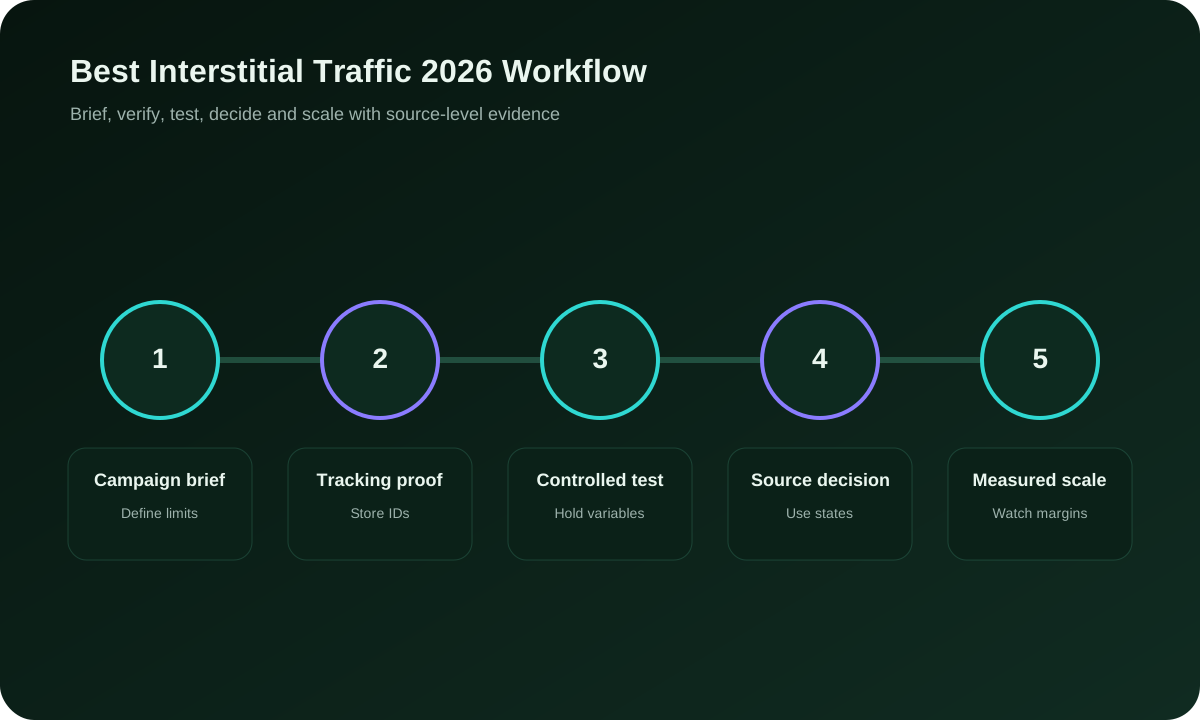
- Lock the asset. Preserve advertiser identity, evidence-backed claims, qualifications, dimensions and reviewed version.
- Trigger the placement. Observe how and when it appears on representative device contexts.
- Follow the action. Trace every redirect into the correct in-app or browser state and final URL.
- Complete the path. Test dialogs, form, checkout, validation, confirmation and error recovery.
- Read the backend. Confirm the accepted result and campaign identifiers independently of the interface event.
Review message continuity at every stage. The destination should not remove a material condition, substitute an unavailable product or change advertiser identity. If a required consent, age or location step appears after the click, verify that it fails truthfully without recording an accepted outcome too early.
Test failure paths, including slow creative load, blocked redirect, orientation change, missing parameter and invalid form input. A system that reaches the page only under ideal conditions does not provide enough evidence for scale.
Preserve source fields through the full event chain
Document the placement or source, creative, device, timestamp, render, click, campaign and accepted-event identifiers available under applicable rules. Record where each field originates, how it is transformed and which export contains it. Keep unknown values visible. A dashboard grouping that cannot be reproduced outside the interface is weak evidence for a source decision.
Run a controlled transaction and trace identifiers from the placement report through destination analytics to the backend. Check encoding, case, time zone, duplicate handling and redirect loss. If the accepted result cannot be connected at the required source level, state the limitation before calling the supply best.
Store a mapping version with the campaign. A new redirect, tracker, domain, postback or event schema can break continuity without changing the visible creative. Alert on a material rise in unattributed or unknown results and contain optimisation that depends on the missing field.
Investigate accidental interaction as a pattern, not a slogan
- Appearance-to-click time
- Extremely fast events can prompt inspection, but timing alone does not prove intent or fraud.
- Immediate destination exit
- A concentrated quick return may indicate mismatch, load failure, disruption or accidental action.
- Meaningful progression
- Scroll, product view, validated form stages and other appropriate events add context without becoming final value.
- Repeat distribution
- Repeated exposure or actions by source and device can reveal frequency or implementation problems.
- Accepted maturity
- Backend validation, later rejection and reversal show whether early activity survives the business process.
Compare these observations by source, placement, creative and device while holding major campaign variables as stable as practical. Check the destination and measurement layer before blaming supply. A broken page can create similar exits across every source.
Do not convert a single threshold into a universal fraud rule. Preserve the pattern, control group, uncertainty and decision. Exclude or pause supply when the campaign's documented evidence rule is met, not because one convenient metric looks unusual.
Choose the execution format
Choose a paid-media format that supports Best Interstitial Traffic 2026
Use the criteria around “Investigate accidental interaction as a pattern, not a slogan” to decide whether push, native, display or pop fits the message and destination. Set format, targeting and spend as campaign controls in FroggyAds while the best interstitial traffic 2026 decision remains the standard for judging the result.
Create My Free Account
Measure frequency within the platform's real scope
Ask whether the cap applies per person, device, browser, application, publisher, placement, campaign or another identifier, and over which period. Determine how privacy settings, cleared storage, cross-device use and unauthenticated traffic affect observation. A configured number is not proof that an individual received exactly that many impressions.
Export available exposure evidence and compare repeat distribution with disruption signals and accepted outcomes. Inspect whether the same creative, advertiser or campaign appears through multiple sources outside a shared cap. State gaps rather than inventing person-level precision.
Test cap changes in a bounded cell. Observe delivery, source mix, repeated interactions and marginal accepted outcomes after the normal maturity window. Increasing frequency can raise impressions while reducing incremental value or worsening experience. Decreasing it can alter which sources deliver, so retain the configuration with the result.
Treat 2026 as a documented review date
A substantive dated review identifies what changed or was rechecked: placement behavior, owner policy, product controls, source availability, measurement method, creative requirement or outcome evidence. Record primary sources and retrieval dates in the research file. The visible page should not imply that every network or implementation was tested universally.
Changing only a title, copyright year or dateModified field creates misleading freshness. Preserve the prior method or conclusion and describe the material revision. If no relevant evidence changed, state the continuing scope instead of manufacturing novelty.
Set invalidation triggers for the next review. Revisit the recommendation after a policy notice, format or close-control change, tracking migration, material source shift, offer eligibility change, new device context or backend outcome definition. A dated conclusion should carry its expiry conditions beside the decision record.
Stage cost against mature marginal outcomes
Set the initial campaign and source cap, maximum daily or period exposure, largest authorised increase and total loss boundary. Include creative production, destination work, tracking, analyst time, support and rejected-outcome handling in the operating cost. A low media rate can still be poor value when the evidence requires expensive reconstruction.
Wait for the accepted outcome to mature before reallocating solely on early activity. Analyse incremental cells by source and cost band. The average result can remain acceptable while the newest spend falls outside the boundary. Record the exact state at each increase so marginal performance can be separated from earlier delivery.
Pause when the loss boundary, placement control, identifier continuity or accepted-event definition fails. A pause preserves the ability to investigate. Automatically adding funds or broadening supply to maintain volume can deepen an unmeasured problem.
Run a source-level exception and restart process
Define exceptions before launch: absent close control, unexpected trigger, misleading render, broken destination, identifier loss, extreme repeat pattern, spend outside authority or a material change in accepted outcomes. Name the operator and support route able to stop the affected source or campaign.
At containment, preserve the placement record, creative, device, timestamps, redirects, source export, cost and backend outcomes. Determine whether copied campaigns or an external optimisation tool can reactivate delivery. Do not overwrite the observed configuration while diagnosing it.
Separate implementation, destination, measurement and source causes. Repair in an isolated state and repeat the relevant observation. Restart through a small capped cell with a defined monitoring interval, then reconcile dismiss behavior, identifiers, cost and mature accepted outcomes before widening.
Remove best-fit status when the source no longer meets the documented requirement, even if historical averages remain attractive. Preserve the decision date and conditions for a future retest.
Put the guide into practice
Turn Best Interstitial Traffic 2026 into a bounded campaign test
With “Run a source-level exception and restart process” documented, launch only the next reversible test. Set a spending limit, preserve the baseline and use source-level and audience controls so the next step depends on qualified outcomes for best interstitial traffic 2026, not activity volume.
Create My Free Account
Seal a recommendation with a dated evidence bundle
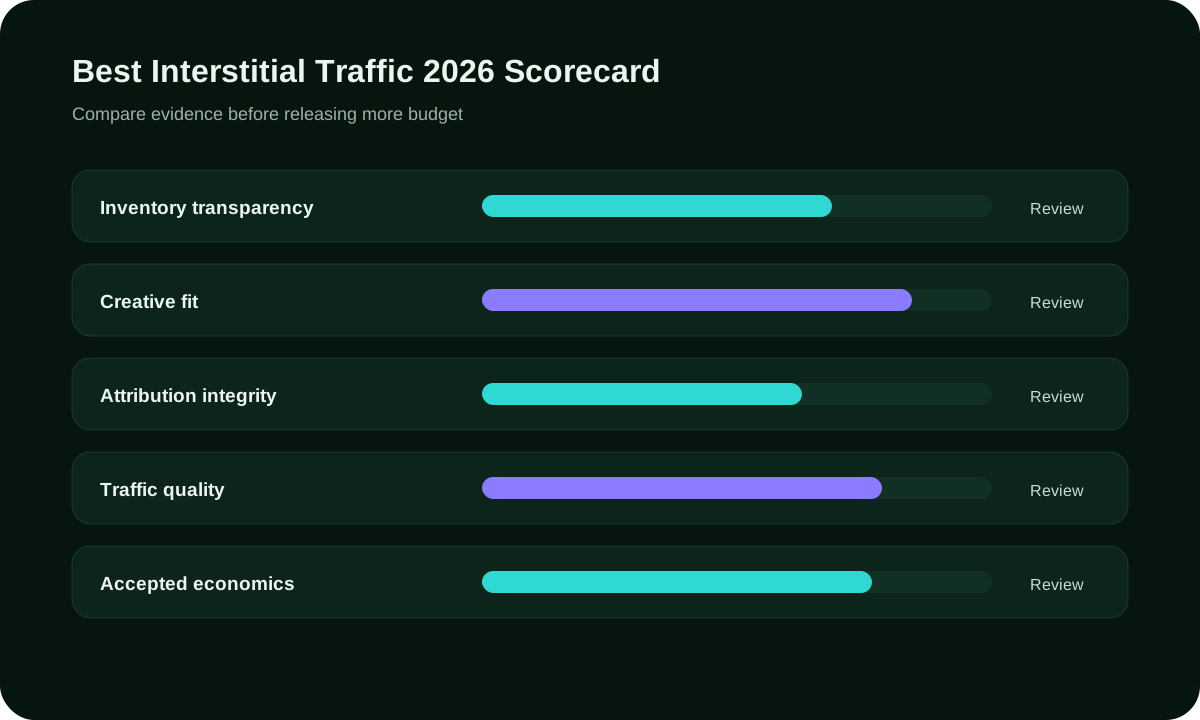
| Record | Required content | Invalidation trigger |
|---|---|---|
| Placement | Trigger, close behavior, device and source | Rendered behavior or specification changes |
| Campaign | Creative, destination, configuration and cap | Material asset, offer or setting changes |
| Measurement | Identifier map and accepted-event definition | Redirect, tracker or backend schema changes |
| Outcome | Mature accepted, rejected and reversed results | Source mix or marginal performance leaves boundary |
| Decision | Owner, date, scope, uncertainty and next review | Policy, eligibility or operating responsibility changes |
A recommendation is conditional. State the tested offer, geography, devices, sources, cost range, observation window and unresolved gaps. Do not publish a universal rank from a private or partial test.
Compare adjacent interstitial routes without merging their claims
Publisher implementation, network procurement and advertiser outcome questions overlap, but they are not interchangeable. Keep each conclusion bound to its evidence and responsible party.
Best interstitial traffic 2026 FAQ
What should reveal the source of interstitial traffic in 2026?
Require app or site identifiers, placement trigger, seller route, region, device, time and unknown supply for each usable reporting level. Traffic without reviewable origin should remain excluded.
How should a 2026 buyer interpret an interstitial click?
Treat it as an interaction that may be accidental, curiosity-driven or deliberate, then examine destination use and accepted later outcomes. The format itself does not establish customer intent.
Which close-control failures should block interstitial traffic?
Block delivery when the close is hidden, unstable, delayed beyond the approved rule, inaccessible or deceptive. Verify the correction in fresh placements before allowing the source again.
How can creative reduce accidental interstitial action?
Use readable claims, clear identity, stable controls, enough separation between close and action areas and a destination matching the message. Test the delivered format across screen sizes.
Which data boundary applies to interstitial traffic in 2026?
Use only permitted signals required for the approved audience or measurement purpose, with regional and platform choices honoured. Avoid sensitive inference and document downstream sharing.
What evidence distinguishes useful from disruptive interstitial traffic?
Compare eligible visits, meaningful destination behaviour, accepted actions, reversals, complaints and later quality by source. High interaction with immediate exits can indicate poor experience.
How should geographic eligibility be checked for interstitial traffic?
Sample the requested market against observed location signals, ambiguous records, device configuration and the places the service can truly support. Enforce exclusions in delivery and verify them independently.
Why review repeated interstitial exposure by source?
Repeated interruptions can inflate interactions, harm users and distort outcome evidence. Examine the cap basis, time window and cross-placement behaviour while respecting privacy limits.
How should 2026 interstitial traffic reports be reconciled?
Match delivery IDs, source, time, destination events, accepted outcomes and invalid-traffic adjustments across network and business records. Preserve unmatched cases instead of forcing totals to agree.
When can an interstitial traffic test expand in 2026?
Expand only after placement control, geographic eligibility, source transparency and mature customer outcomes remain acceptable within the approved sample. Change one boundary at a time.
Call interstitial supply best only inside its evidence boundary
Preserve the trigger, dismiss behavior, destination, source map, frequency, mature outcome and review date.
Design a representative placement sampling plan
Group supply by the dimensions that can materially alter the experience: publisher or application where visible, placement trigger, device family, operating context, screen orientation, creative size and close-control implementation. Select a bounded sample from each relevant family rather than taking many captures from the largest source. Record why each specimen represents its family and which members remain unobserved.
Run the sample at campaign initialization and after a material supply shift. Preserve source identifier, time, test device, network conditions, creative version and the complete appearance-to-return sequence. A cached creative or one publisher preview cannot establish behavior across every placement. Mark evidence as direct observation, provider specification or inference so the recommendation does not blend them.
Set invalidation thresholds. A new trigger, close implementation, redirect domain, application container or large unknown source share requires another sample before the earlier conclusion is extended. If the buyer cannot reproduce a high-volume placement, request evidence through the network support path and restrict that supply until the uncertainty is explicitly accepted.
Keep sampling separate from performance estimation. A placement capture can prove observable behavior at a moment, while outcome data estimates campaign value over delivery. Neither source alone answers both questions. Link the samples to the corresponding source and outcome period without claiming perfect coverage.
Test browser, in-app and orientation changes separately
An interstitial may open a destination in an embedded browser, system browser, new tab or application route. Identify the actual context and test authentication, cookies, back navigation, file or payment handoff, external application links and return behavior. A page that works in a desktop browser may fail inside an embedded context or lose campaign identifiers when control moves between applications.
Rotate the device before appearance, while the creative is visible and after the destination loads. Observe crop, close-control position, keyboard behavior, dialogs and form persistence. Do not assume responsive layout guarantees that the delivered advertisement remains usable. Capture the viewport and orientation with each result.
Test accessibility-related operating behavior that the buyer can observe: visible focus where applicable, keyboard or assistive navigation, contrast, motion, audio control, captions and clear error recovery. Record issues by placement and destination owner. A network cannot correct an inaccessible checkout, and an advertiser cannot repair a publisher trigger without coordination.
Include low-connectivity and interrupted-transition cases. Determine whether the creative blocks content indefinitely, whether the dismiss action remains available, whether redirects repeat and whether an incomplete destination records success. Stop any test that risks a real user or transaction; use controlled accounts and data.
Review network terms for placement disputes and evidence access
Before funding, document the billable event, currency, balance treatment, minimums, source-report availability, retention, support response, prohibited creative and process for reporting a defective placement. Ask what evidence the buyer must provide and how quickly. A dispute route that requires fields unavailable in the account should be treated as an operating gap.
Test the reporting export and reconcile a small bounded campaign to billed units. Preserve zero, unknown and adjusted rows. Determine whether late corrections or credits alter prior periods and how those changes reach the buyer's analysis. Do not overwrite the original import; retain the revision and explanation.
Name the people authorised to pause, contact support, approve a restart and accept unresolved placement risk. Shared credentials and informal chat messages make it difficult to reconstruct an incident. Store the current configuration, creative hash, evidence bundle and decision in the organisation's controlled record.
At exit, export source, placement, campaign, creative, cost and event data available under the agreement. Revoke tools and credentials, confirm scheduled campaigns remain stopped and record any retained balance or unresolved case. Procurement value includes the ability to leave with usable evidence, not only the ability to start delivery.
Best Interstitial Traffic 2026: the decision this URL owns
Decision inputs for Best Interstitial Traffic 2026: popunder, popup, full-page traffic, landing page. Keep these inputs tied to accepted conversion or value event and the page-specific job: evaluate providers against explicit selection criteria.
Use Best Interstitial Traffic 2026 to narrow the paid-acquisition decision before spend expands. A pop media buyer should be able to evaluate providers against explicit selection criteria from this URL's own evidence.
URL boundary for Best Interstitial Traffic 2026: This URL owns selection criteria for Best Interstitial Traffic 2026: define the requirements that make an option suitable for this use case, then compare evidence against those requirements without turning popularity into proof.
Write a placement observation record is the action checkpoint for Best Interstitial Traffic 2026. Before acting on “Which close-control failures should block interstitial traffic?”, document full-page traffic, the resulting campaign action and the rollback or retest condition.
Decide whether interruption is appropriate for the campaign is the measurement checkpoint for this URL. Resolve “How should a 2026 buyer interpret an interstitial click?” while retaining popup, landing page, spend and cohort age so the result can be reconciled with accepted conversion or value event.
On this page is an evidence checkpoint for Best Interstitial Traffic 2026. To answer “What should reveal the source of interstitial traffic in 2026?”, keep popunder in the same campaign record and use it to evaluate providers against explicit selection criteria.
Page-specific buying lens: For Best Interstitial Traffic 2026, Keep the full-page traffic format, landing-page readiness, source decision and accepted conversion event in the same campaign record so delivery is judged by downstream value.
Evidence before the next spend step: Before changing spend on Best Interstitial Traffic 2026, Use source-level evidence to decide whether to exclude, retain or expand a traffic segment after the same conversion window, rather than optimizing from visit volume alone.
What makes this URL different: This 2026 interstitial-traffic page should help a buyer evaluate current campaign mechanics rather than treat a dated label as a performance forecast. Keep full-page delivery context, device, frequency, source identity, destination behavior and the accepted business event together during the test.
How to use FroggyAds in this decision: FroggyAds can be used to run the interstitial traffic cell with controllable spend and source evidence. Record the actual campaign conditions and observation date so later optimization does not confuse a current test with an evergreen benchmark.
| Page checkpoint | How to use it | Evidence to retain |
|---|---|---|
| On this page | Use On this page to establish the first evidence boundary for Best Interstitial Traffic 2026; then record which part of frequency, source/placement, landing speed and downstream value it changes. | Keep popunder, source/campaign ID and the accepted-event definition together. |
| Decide whether interruption is appropriate for the campaign | Use Decide whether interruption is appropriate for the campaign as the second checkpoint and reconcile it with accepted conversion or value event before changing budget or source allocation. | Retain popup, spend, timestamp/cohort age and accepted/rejected outcomes. |
| Write a placement observation record | Use Write a placement observation record as the final checkpoint: if it does not change the evidence for accepted conversion or value event, keep the test narrow rather than scaling. | Document full-page traffic, the decision taken and the rollback or retest condition. |
Transparent Best Interstitial Traffic 2026 decision example
Hypothetical example: For Best Interstitial Traffic 2026, a hypothetical controlled cell that spends USD 270 and records 4 accepted conversion or value event after the same maturity window has an accepted cost of USD 67.50 per outcome. Replace the figures, outcome and review window with your own economics; this is not a FroggyAds performance claim.
Why use FroggyAds here?
Use FroggyAds to turn the Best Interstitial Traffic 2026 decision into a measurable traffic test with budget and source controls; downstream accepted conversion or value event remains the reason to scale. Create your free FroggyAds account.
Research basis for Best Interstitial Traffic 2026: This URL helps performance-focused advertisers evaluate providers against explicit selection criteria. It is mapped to the pop research cluster. Our current review used ppcmate.com and vrume.com to check terminology, buyer questions and decision coverage relevant to Best Interstitial Traffic 2026. These external sources are research inputs, not evidence of FroggyAds campaign performance.
Best Interstitial Traffic 2026 — what matters first
Best Interstitial Traffic 2026 is useful when the format fits the user journey, device context, creative requirements and measurable conversion path.