
Best Display Traffic 2026
Evaluate best display traffic 2026 through site, app, placement, size, device and source identifiers, creative testing, tracking, source reporting, budget controls and accepted campaign economics without relying on unsupported guarantees.
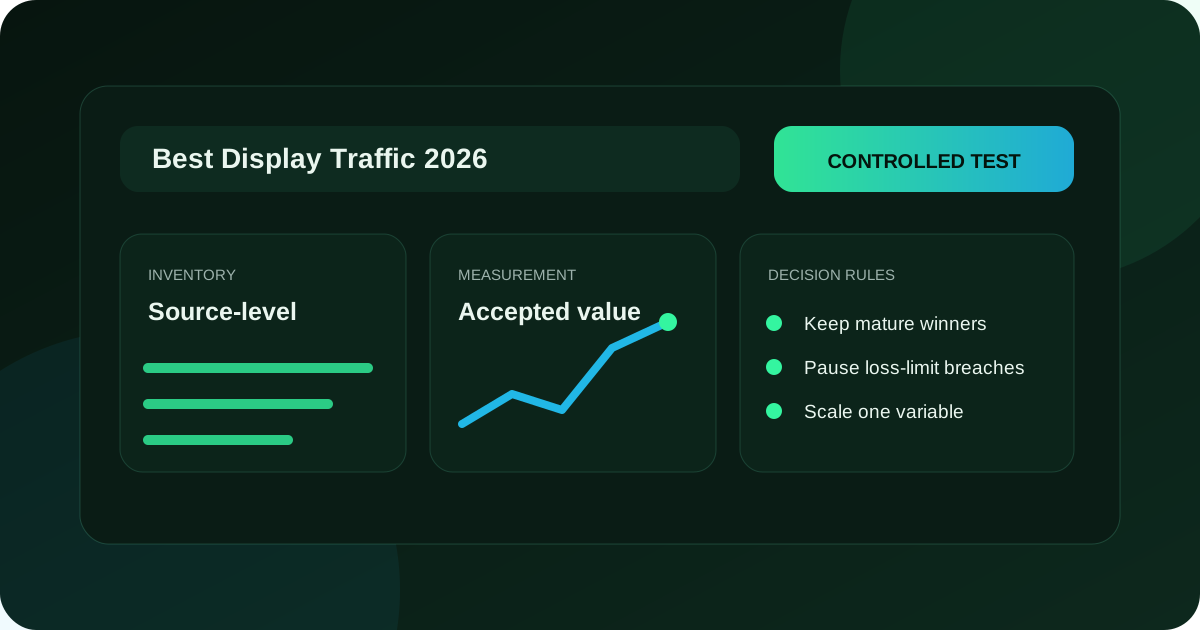
As of August 2026, display traffic should be compared through disclosed supply paths, creative compatibility, destination behavior and accepted business outcomes. IAB Tech Lab guidance on ads.txt and the IAB New Ad Portfolio informs the supply and format checks; neither standard certifies campaign performance.
Define best display traffic with observable evidence
Best display traffic in 2026 is inventory that can be traced, rendered correctly and evaluated against a business outcome. The label does not describe a universal supplier ranking. A buyer needs the site or app context, placement identifier, device, creative dimensions, source record and downstream acceptance data for the same cohort. Start with a written definition of success and a list of disqualifying conditions. That list might include unsupported locations, broken landing behavior, missing source fields or outcomes that the business later rejects. This turns a broad search phrase into a testable procurement question. The winning source is the one that stays inside the agreed controls after enough evidence matures, not the source with the largest headline reach.
Map the display delivery chain before bidding
Display delivery has several distinct handoffs: an auction selects an eligible impression, the browser or app requests the asset, the placement renders it, a person may view or click it, and the destination may record a qualified action. Document the identifier available at every handoff. A rendered impression is not the same as an opportunity to see, and a click is not an accepted sale or lead. When fields disappear between the platform, tracker and backend, optimization can reward activity that cannot be audited. Test one live path before opening the budget. The test record should show the creative ID, placement or source, destination version, timestamp, conversion identifier and final business status.
Turn the 2026 requirement into a buying brief
A useful display brief names countries, languages, devices, operating systems, placement types, acceptable creative formats, excluded content categories, conversion window and budget guardrail. It also states which evidence must be exportable. Avoid asking a seller only for premium, clean or high-quality traffic because those terms have no shared measurement definition. Ask how inventory is represented, whether site or app identifiers are available, which source controls can be changed, and how late or rejected outcomes appear in reports. If a requirement cannot be observed during the pilot, classify it as an assumption. The agency or advertiser can then decide whether that uncertainty is tolerable before money is committed.
Check seller transparency without treating it as certification
IAB Tech Lab describes ads.txt as a public mechanism through which publishers declare authorized digital sellers. A matching ads.txt path can help a buyer investigate whether a seller relationship is declared, but it does not prove that every impression is viewable, human or suitable for an offer. Review the publisher domain, seller identifier, relationship type and any supply-chain information available in the buying record. Keep the verification time because files and commercial relationships change. If an app is involved, check the corresponding app-ads.txt path and store listing context. Use this evidence as one layer beside placement behavior, invalid-activity controls and accepted outcomes rather than as a standalone approval badge.
Segment display inventory by the decision it supports
Separate discovery from validation. A discovery campaign may use broader placements to learn which contexts respond, while a validation campaign should isolate a smaller set of sources under stable creative and destination conditions. Do not blend mobile web, in-app and desktop evidence if their placement mechanics differ. The same applies to language, country and browser cohorts. A source can look acceptable in an aggregate table while one device or placement absorbs losses. Create segments only when the resulting label can change a bid, exclusion, creative or destination decision. Excessive segmentation creates noisy cells; insufficient segmentation hides the reason performance changed.
Connect the guide to live testing
Connect Best Display Traffic 2026 to a controlled audience test
Use the choices established in “Segment display inventory by the decision it supports” to define one audience, budget and source set in FroggyAds. Keep the surrounding offer and measurement rule stable so the test adds evidence to best display traffic 2026 instead of mixing several changes at once.
Create My Free Account
Prepare creative for flexible and fixed placements
The IAB New Ad Portfolio uses flexible-size guidance and notes that publishers can apply their own requirements. Ask the actual supply partner which aspect ratios, minimum dimensions, file weights, animation rules and fallback assets are accepted. Build a small set of materially different messages instead of dozens of color variants. Each file needs a stable creative identifier, alt text where the environment supports it, a truthful call to action and a destination that repeats the same offer conditions. Preview the asset in narrow and wide placements. Cropped logos, unreadable disclaimers and accidental interface mimicry are creative defects, not traffic defects, and should be removed before source quality is judged.
Use the landing page as part of the media test
A display click arrives with limited context, so the first screen must identify the advertiser, restate the promise and expose material terms before asking for commitment. Measure response time and interaction by creative and source. A slow page can make a responsive source appear weak, while a misleading ad can create many short sessions that never had purchase intent. Keep the destination version fixed during a source comparison. If a repair is necessary, mark the exact change time and restart the affected evaluation window. The media report should distinguish delivery, click, engaged visit, form start, validated conversion and accepted value rather than collapsing all post-click behavior into one conversion rate.
Create an impression-to-outcome audit trail
Use campaign, creative, source and placement identifiers that survive into analytics or the backend wherever the platform supports them. Google Analytics documentation recommends consistent campaign parameters such as source, medium and campaign; a buying platform may also provide dynamic source macros. Never insert personal data into a campaign URL. Reconcile records on a shared time zone and document the attribution window, duplicate rule and late-event treatment. Exact totals across tools are uncommon because collection rules differ. The goal is an explainable trail: a reviewer can identify why a cohort was kept, reduced or stopped and can reproduce the calculation from stored exports.
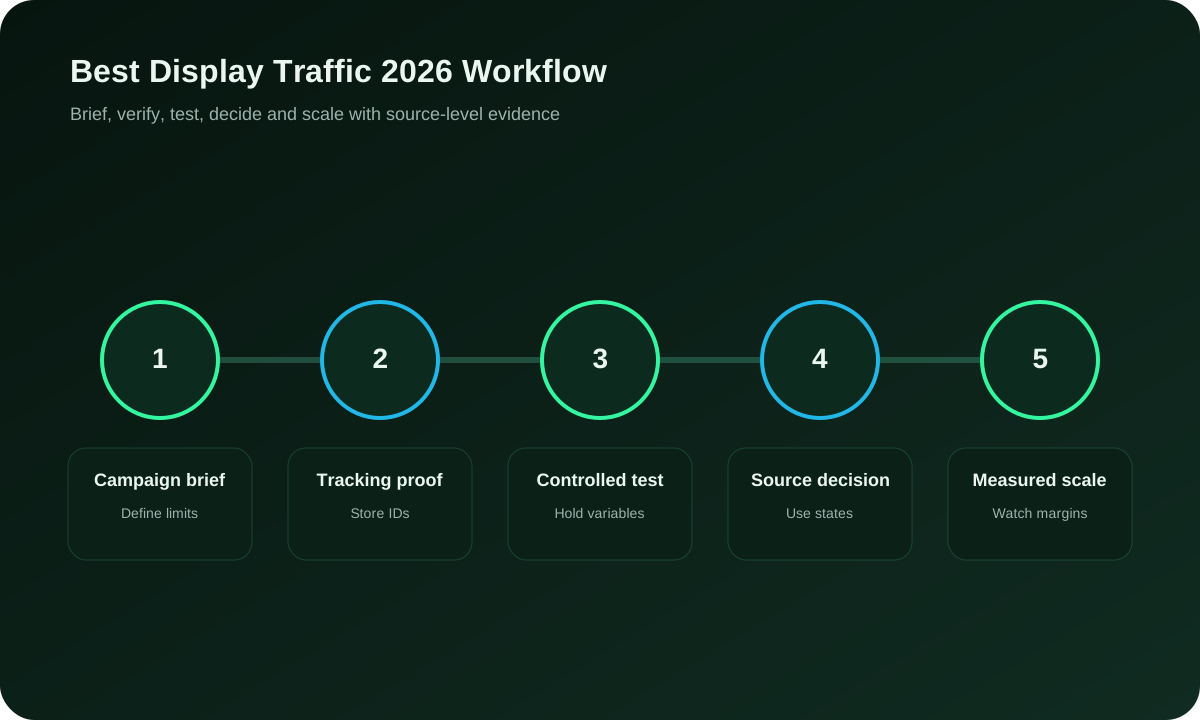
Release display budget in evidence stages
Divide the budget into discovery, confirmation and expansion amounts. Discovery buys enough variation to expose source and creative differences. Confirmation repeats promising combinations under stable settings. Expansion is released only after accepted economics hold through a measured increase. Write the maximum loss per source and the minimum maturity condition before launch. A low-spend source with no outcome may need more time; a source with a policy breach or broken destination should stop immediately. Staging prevents an early conversion from triggering a large increase and protects learning when one placement consumes delivery faster than expected.
Choose the execution format
Choose a paid-media format that supports Best Display Traffic 2026
Use the criteria around “Release display budget in evidence stages” to decide whether push, native, display or pop fits the message and destination. Set format, targeting and spend as campaign controls in FroggyAds while the best display traffic 2026 decision remains the standard for judging the result.
Create My Free Account
Normalize CPM and CPC into comparable outcomes
CPM and CPC describe billing events, not business efficiency. Convert each cohort into effective cost per rendered opportunity, engaged visit and accepted outcome using the same definitions. Include rejected leads, refunds or invalid orders when those events materially affect value. A cheap CPM can be costly when the creative is rarely usable or the destination receives low-intent sessions. A higher CPC can still fit if acceptance and contribution remain strong. Keep bid changes separate from creative changes so the effect of each action can be seen. Never publish a universal market price from one account because auctions, geographies, seasons and eligibility conditions differ.
Diagnose quality through multiple independent signals
No single traffic-quality label is sufficient. Compare click timing, browser and device consistency, geographic accuracy, repeated identifiers, session behavior, conversion delay, backend rejection and downstream value. Investigate sudden distribution shifts even when the blended cost looks stable. Fraud detection services and platform controls reduce risk but cannot establish that every event is valid. Store raw source totals beside the cleaned business result so exclusions can be reviewed. A source with a modest interaction rate can be useful when accepted outcomes persist; a source with spectacular clicks can be harmful when the backend rejects most of them.
Assign display sources explicit operating states
Give each material source one state: discovery, observe, validated, constrained, paused or eligible for retest. Define the entry and exit rule for every state. A paused source should not return because a new buyer forgot the reason; the retest record must name the changed creative, bid, placement or destination condition. Keep whitelists and exclusions versioned. This state model is more informative than a permanent good-or-bad label because inventory and competition can change. It also lets finance and compliance understand how much budget is exposed while the media team is still learning.
Design a display test around one primary contrast
A clean display experiment changes one major factor while keeping the other conditions close enough to interpret. To compare creatives, hold source and destination rules stable. To compare source groups, rotate the same eligible creative set. Write the primary metric, supporting diagnostics, observation window and stop rule before delivery starts. Review sample size beside every rate and avoid declaring a winner from one event. When random allocation is unavailable, note the time, placement and auction differences that may bias the comparison. The result should be a bounded decision, such as retain two concepts or exclude one placement class, rather than a claim that the outcome will generalize everywhere.
Put the guide into practice
Turn Best Display Traffic 2026 into a bounded campaign test
With “Design a display test around one primary contrast” documented, launch only the next reversible test. Set a spending limit, preserve the baseline and use source-level and audience controls so the next step depends on qualified outcomes for best display traffic 2026, not activity volume.
Create My Free Account
Build a funnel that ends at accepted value
A display scorecard should follow spend, eligible impressions, rendered opportunities, interactions, engaged visits, qualified actions, backend acceptance and realized value. Choose the deepest event that becomes reliable soon enough to guide the campaign. Earlier signals diagnose delivery but should not replace the business result. Freeze immature conversion windows so recent sources are not compared with fully matured cohorts. Show counts with rates because a percentage without a denominator can mislead. If the business cannot return an acceptance status, state that limitation and avoid optimizing as though every recorded conversion has equal value.
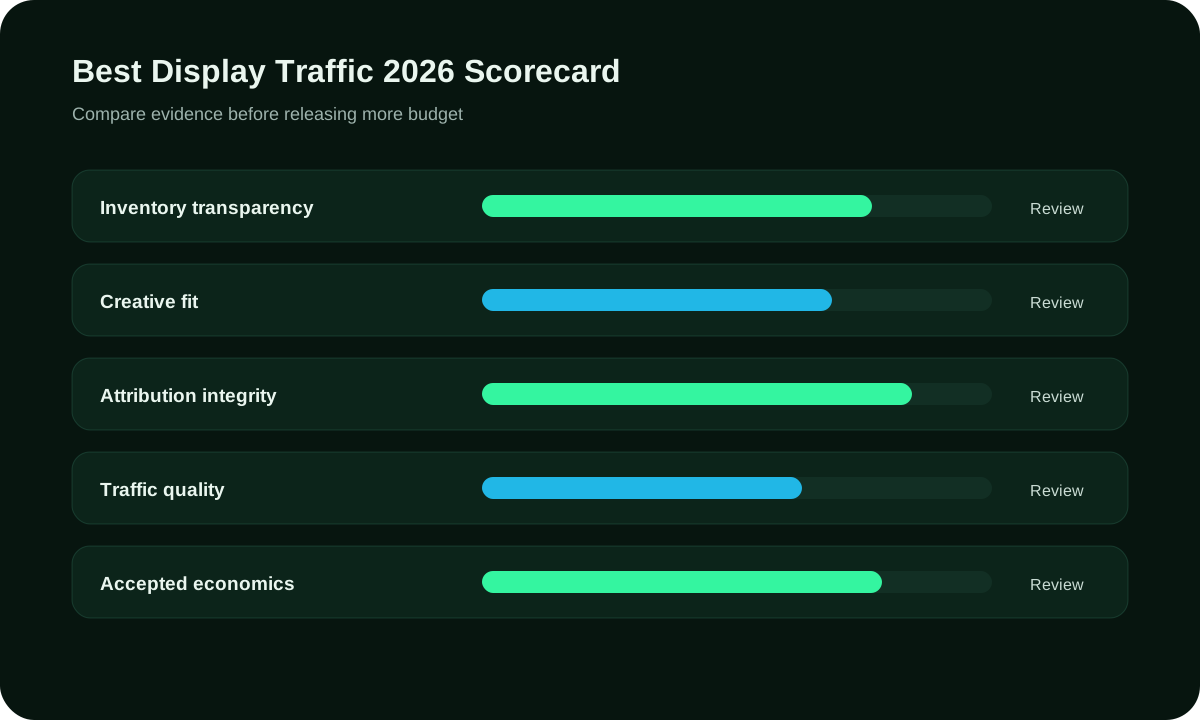
Write emergency and economic stop rules separately
Emergency stops cover broken tracking, an unavailable destination, prohibited creative, material geography mismatch or a serious quality anomaly. Economic stops cover mature cohorts that exceed the planned loss or accepted acquisition threshold. Keeping the categories separate prevents a small sample from being treated like a compliance incident and prevents a genuine incident from waiting for statistical maturity. Assign the person who can stop delivery and the person who approves a restart. Keep the previous stable configuration so a bid, source or creative change can be rolled back without reconstructing the campaign from memory.
Scale the dimension that produced the evidence
If a validated source group earns more budget, increase that group before adding new geographies, devices and messages simultaneously. Compare the marginal cohort created by the increase with the control cohort that established the baseline. Watch for a shift toward different placements as the bid or budget rises. Scaling can change the auction opportunities that the campaign reaches, so a stable small test does not guarantee identical larger results. Stop the increase when acceptance, contribution or source transparency falls outside the agreed range. Preserve a discovery lane for new inventory rather than mixing untested supply into the proven cell.
Keep claims, ownership and review dates visible
FTC business guidance says advertising claims must be truthful, non-deceptive and evidence-based. Apply that standard to the banner, landing page and any performance statement shown to a client. Record who approved the claim, which evidence supports it, and when the evidence must be reviewed. Separate the media owner's authority from legal or compliance review where the product is regulated. Brand-safety categories and exclusions also need an owner because broad labels can be interpreted differently by suppliers. Governance is practical campaign control: it prevents a high-performing but unsupported message from being scaled simply because the dashboard looks favorable.
Model ordinary, weak and disrupted display conditions
Create an ordinary case from the controlled pilot, a weak case with lower acceptance and higher media cost, and a disruption case with a destination outage or source-mix shift. The purpose is not to predict a precise future total. It is to identify which signal consumes the loss allowance and which action protects the campaign. Include conversion delay and creative fatigue when they affect the offer. A scenario is useful only when it changes a reserve, cap, monitoring interval or rollback rule. Store the assumptions beside the output so a later reviewer can see why the threshold was chosen.
Close each review with a reproducible display decision
Every review should record the active creative IDs, source states, bid, cap, destination version, attribution settings and maturity date. For each material segment, choose one action and state the evidence required before another change. Attach the export or query used for the conclusion. The log lets another buyer continue the test without repeating discovery and makes client reporting less dependent on screenshots. If the decision rests on an unresolved assumption, label it and set a date to verify it. Best display traffic 2026 becomes a defensible process when every increase, exclusion and retest can be traced to the evidence available at that time.
Use this display traffic review table before increasing budget
| Area | Evidence required | Action |
|---|---|---|
| Inventory | Site, app, placement, size, device and source identifiers remain visible | Keep only segments that can be controlled and reviewed |
| Creative | The asset is legible, original and truthful in the real placement | Retain distinct concepts with stable delivery |
| Attribution | Creative, click, source and placement IDs reach the backend | Complete a live accepted-outcome test |
| Quality | Engagement, acceptance and rejection reasons are visible | Pause abnormal or low-value sources |
| Economics | Effective media cost and accepted acquisition cost are calculated | Compare marginal value with the planned limit |
| Scaling | Performance remains stable after a measured increase | Increase one dimension and preserve rollback control |
Best Display Traffic 2026 FAQ
What role should display traffic play in a 2026 media plan?
Give display traffic a defined audience, placement context and customer outcome rather than treating impressions as a goal. The channel should answer a decision that other activity does not already cover.
Which inventory change should display buyers watch in 2026?
For 2026 display buying, monitor seller relationships, page formats, privacy controls, browser behaviour and policy limits with dated evidence. A source that was suitable before may change without a familiar name disappearing.
How should placement context affect display traffic approval?
Approve a display placement only after inspecting the actual page or app environment, adjacent content and user expectation, not only a broad category. Keep stricter rules for sensitive offers and shared-device settings.
How should 2026 display traffic viewability be used?
Treat display viewability as evidence of an opportunity to see the ad, then compare placement quality, meaningful response and accepted outcomes. It cannot establish attention by itself.
Which 2026 display pattern should prompt source investigation?
Investigate a display source when you see repeated device traits, impossible timing, hidden placements, stacked delivery or actions without meaningful page use. Preserve evidence and isolate supply before assigning a cause.
How do privacy limits affect display traffic reporting?
Explain display reporting with its identifier loss, consent gaps, blocked events, modelling and channel overlap, and prefer permitted aggregate evidence. A precise-looking total can still contain substantial uncertainty.
What distinguishes useful display traffic from visible volume?
Useful display delivery occurs in suitable context, reaches eligible people and supports a verified action after normal maturity. Evaluate source and customer quality alongside the delivery measure.
How can a display traffic test examine added value?
For a display incrementality test, reserve an untreated audience where volume allows or phase sources in a documented sequence and define the mature accepted result beforehand. Record spillover and sample limits instead of treating attributed totals as incremental demand.
When can 2026 display traffic expand safely?
Expand display traffic after placement controls hold, reporting reconciles and mature customer outcomes justify the full cost. Add one inventory or audience boundary and monitor it separately.
What belongs in a 2026 display traffic archive?
Archive display source and placement exports, exclusions, creative IDs, costs, adjustments, definitions, incidents and mature outcomes. Close delivery and access without deleting the evidence needed for later review.
Continue the display ads workflow
Use these display guides to compare supply, creative fit and buyer controls before you expand a validated FroggyAds campaign.
Build a Controlled Best Display Traffic 2026 Test
Choose one accepted outcome, confirm the destination and conversion record, then open a bounded display cell in FroggyAds. Our budget, targeting and source controls help you test a specific placement question while your backend decides which outcomes are accepted. We recommend increasing spend only after the mature cohort still fits your commercial limit; results will vary by offer, GEO, creative, destination, competition and optimization.
How should a media buyer choose display traffic in 2026?
Start with your buying rule. The best display traffic for your campaign is supply you can identify, render correctly, measure through the destination and judge against an accepted business event. A popular provider name, large impression estimate or low media unit does not replace that evidence.
As a media buyer, you need to know which placement, device and source delivered the response, which creative version ran, and whether the advertiser later accepted the result. We help you keep those campaign decisions inside a self-serve workflow so you can cap weak cells, retain useful ones and test one change at a time.
Match the creative to the placement. Confirm responsive behavior, banner dimensions, file quality and destination continuity in the real inventory context. Our format and targeting controls are useful when each variation answers a defined question, rather than mixing several creative and audience changes in one result.
Decide what display must contribute to the media plan. You may use it to reach a defined audience, test a visual proposition or add volume around another channel. Keep the creative ID, source record and accepted event together so the review can distinguish visible delivery from commercially useful response.
Write the approval brief before launch. Name the permitted GEOs, devices, placement contexts, creative sizes, budget limit and conversion window. We recommend recording the pause condition beside the launch settings so you can act quickly when a source, asset or destination falls outside the agreed standard.
Reconcile the delivery chain before changing the bid. Preserve the banner dimensions, targeting choice, source or placement identifier, spend and cohort age through the advertiser's accepted event. If an identifier disappears or the destination changes, hold the cell until you can explain the gap instead of asking the bid to solve a measurement problem.
| Page checkpoint | How to use it | Evidence to retain |
|---|---|---|
| Observable display evidence | State which placement, creative size, device context, source ID and downstream value this checkpoint can change. | Keep responsive creative, source/campaign ID and the accepted-event definition together. |
| Delivery-chain reconciliation | Reconcile the impression, response and accepted event before changing budget or source allocation. | Retain banner dimensions, spend, timestamp/cohort age and accepted/rejected outcomes. |
| 2026 display buying brief | Keep the test narrow unless this buying brief changes the evidence for an accepted outcome. | Document asset quality, the decision taken and the rollback or retest condition. |
Transparent Best Display Traffic 2026 decision example
Hypothetical example: A controlled display cell spends USD 270 and records five outcomes that remain accepted after the same review window. Its accepted cost is USD 270 divided by five, or USD 54. Replace the spend, event and maturity window with your own business inputs. The calculation illustrates a review method and is not a FroggyAds price, forecast or performance claim.
Why use FroggyAds here?
Choose FroggyAds when you want to isolate a display campaign cell, control its targeting and budget, compare creative versions and retain source-level evidence for the next decision. Our self-serve platform helps you test and refine the media inputs; your accepted-event record tells you whether to keep, cap, exclude or expand the cell. Create your free FroggyAds account.
Research basis for Best Display Traffic 2026: We reviewed Google Ads guidance on responsive display assets support.google.com and Display & Video 360 guidance on inventory and creative controls support.google.com. These sources help frame format and buying questions; they do not verify FroggyAds inventory, price or performance. Use current account settings and your own accepted outcomes to decide which display sources fit the campaign.
Best Display Traffic 2026 — what matters first
The best display traffic for your 2026 campaign is inventory that fits the user journey, renders in the intended device and placement context, and remains traceable to a measurable business event. With FroggyAds, you can start with a bounded budget, test creative and targeting choices, review source evidence and improve the cells that meet your acceptance rule.