Business benefits and practical investment choices

Benefits of Digital Marketing: Reach, Control and Measurable Learning

By FroggyAds, the self-serve advertising platform. Updated: 2026-10-15.

The benefits of digital marketing come from combining addressable distribution, fast iteration, measurable customer journeys, reusable content and controllable channel investment around a defined business outcome.

why digital marketing is importantbenefits of digital marketingadvantages of digital marketing
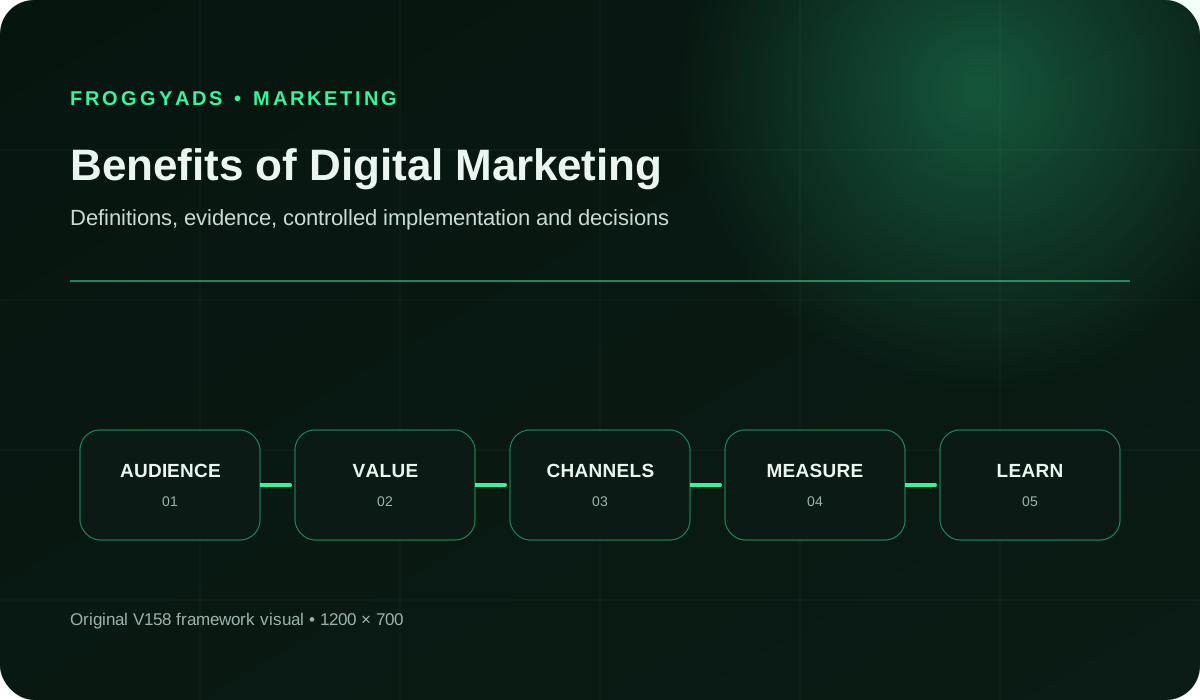
Benefits of Digital Marketing framework for planning, production, measurement and controlled improvement

Choose a benefit you can put to work

  • Use digital channels to reach people your business can serve, rather than maximizing audience size without a useful offer.
  • Build content that helps a customer understand the offer and can support more than one campaign.
  • Treat faster reporting as a way to investigate problems sooner; allow customer decisions enough time to develop.
  • Compare the cost of useful customer response, including the work behind the advertising.
  • Choose FroggyAds when the next priority is testing paid visitor acquisition with targeting, budget and source controls.

What are the main benefits of digital marketing?

Digital marketing can improve reach, explanations, content reuse and spending decisions when those capabilities solve a specific customer problem.

Digital marketing gives businesses more ways to distribute an offer, explain it and learn from customer response. A useful product page can support search discovery, a sales conversation and a paid campaign. The benefit comes from connecting those activities, so the next visitor receives a clearer explanation rather than another disconnected promotion.

The main benefits of digital marketing include more control over timing and investment. An owned guide can remain useful between campaigns, while a paid campaign gives you a separate way to purchase distribution when acquisition matters now. We help you keep those jobs distinct: content earns value through continued relevance, and FroggyAds traffic earns another test only when the destination turns visits into useful customer actions.

A practical digital marketing benefit is the ability to test a prepared offer without committing every channel at once. With FroggyAds, you choose an available format, audience settings and spending limits, then compare destination activity with the business outcome you defined. We recommend naming the benefit you need before expanding distribution, because a focused acquisition purchase gives you a clearer decision than an unfocused increase in activity.

Owned content
Material your business maintains, such as product explanations and service pages.
Paid acquisition
Purchasing advertising distribution to bring visitors to an offer.
Attribution
Assigning credit to marketing interactions under a reporting method’s rules.
Content reuse
Adapting accurate source material to another purpose or format rather than recreating its facts.

Which advantage matters most to your business right now?

Start with the obstacle your business faces. If suitable customers do not know you exist, distribution may deserve attention. If visitors arrive but misunderstand the product, a better explanation may matter more. If inquiries are plentiful but unsuitable, the next useful benefit may be tighter qualification rather than a larger audience.

This distinction protects your budget. A business with an unclear service boundary can attract more inquiries without becoming easier to buy from. Publishing clear coverage, pricing context and next steps can improve the conversation before another campaign begins. That work also gives your paid creative a more specific promise to make.

We help you act when visitor acquisition is the missing piece. FroggyAds gives you campaign controls that let you start with a market you can serve and a manageable spending decision. Keep responsibility for the offer, destination and customer follow-up visible, because the full business benefit depends on how those pieces work together.

Eight useful advantages and the work they require

#Potential advantageHow to make it useful
1Relevant reachSelect a market and audience your offer can serve. Larger distribution has little value when the product or service is unavailable to those visitors.
2Clearer explanationsAnswer the questions that delay a purchase. A useful product page can support both independent research and a later sales conversation.
3Reusable contentKeep an accurate source explanation, then adapt it to each format. Reuse the knowledge without copying a long page into an unsuitable ad.
4Quicker revisionsCorrect a confusing message or broken destination when evidence reveals the problem. Preserve enough context to understand what the revision changed.
5Visible spending choicesSeparate media, production and operating costs. Use spending controls to make the next commitment intentional rather than letting activity expand unnoticed.
6Customer insightRead useful inquiries, objections and support feedback alongside analytics. Behavioral counts alone may not explain why someone hesitated.
7Coordinated communicationMake the ad, website and customer response agree on the offer. Coordination matters more than appearing in every available channel.
8Smaller market testsStart with a market you can support, a suitable message and a limited commitment. Treat the findings as local evidence before widening distribution.

These advantages are capabilities, not automatic results. Choose the one that removes the next obstacle, then identify the work and spending needed to make it available.

Bring new visitors to a useful offer

Find out how your offer performs with new visitors

When the destination is ready, choose FroggyAds for a focused acquisition test. Use our targeting and budget controls to put a clear offer in front of a suitable audience and learn from the response.

Create My Free Account
Illustration of audience targeting controls for a benefits of digital marketing test

Turn an expected benefit into a practical first project

1. Name the business obstacle

Name the business obstacle in customer terms before choosing a channel. Describe what prevents the next sale or useful inquiry: for example, prospects may not understand your service area, eligibility rules or next step. A specific obstacle gives your content, landing page and FroggyAds campaign one decision to support instead of treating more digital activity as the goal.

2. Select the relevant benefit

Select the digital marketing benefit that directly addresses the obstacle: useful reach, clearer explanation, reusable content, faster learning or firmer spending control. Keep the first project narrow enough to show whether that capability helped. If acquisition is the priority, use FroggyAds to test an approved message with defined audience and budget boundaries.

3. Identify a suitable customer

Describe who can use the offer and which markets you can support. A narrow initial audience can make the message clearer without claiming to represent every future customer.

4. Check the destination

Check the destination as the customer will experience it before buying more attention. Confirm that the product, eligibility, commitment and next action are understandable on the device and in the market you intend to target. A FroggyAds campaign can deliver visits to that page; your destination must make those visits worth acquiring.

5. Give each channel a job

Give each digital channel one accountable job. Use an owned page to explain the offer, a permitted follow-up route to answer questions and a paid FroggyAds campaign to acquire new visitors. Assigning the job first prevents tools from competing for the same purpose and makes the next budget decision easier to explain.

6. Prepare reusable source material

Create a reliable explanation of the offer, supporting facts and common objections. Adapt that material into the creative and customer-facing answers needed for this project.

7. Set a complete spending boundary

Set a complete spending boundary that covers creative production, landing-page work, staff time and media. Decide how much the business can commit before the first review, then use campaign limits to keep the acquisition portion controlled. This exposes the true cost of pursuing a benefit instead of judging the plan from media spend alone.

8. Launch a focused acquisition test

Launch a focused acquisition test in FroggyAds only after the offer and destination are ready. Choose a suitable available format and targeting, set your campaign budget and bids, and label the version clearly enough to reconcile delivery with accepted outcomes. A controlled first test should answer a buyer question, not simply create a larger click total.

9. Review customer response

Inspect whether inquiries fit your offer and whether purchases remain valid after your normal review period. Keep technical arrival problems separate from customer objections.

10. Choose one next investment

Choose one next investment from the evidence: clarify the offer, improve the destination, test a different audience, buy more distribution or pause. Record why that action follows from the observed customer response. We recommend increasing FroggyAds spend only when the next purchase tests a useful question or extends a result your business can support.

What evidence shows that a benefit became useful?

A useful benefit changes the journey you meant to improve. Check customer response and supporting costs alongside delivery reports.

Look for a change in the customer journey you intended to improve. Reports help you locate the change, but your business must decide whether it matters. More visits and more useful customer conversations are different achievements.

Benefit under reviewEvidence to examineWhen to review it
Better discoveryNew visitors from the intended market who reach the relevant destination.After delivery begins and arrival tracking is checked.
Clearer understandingFewer repeated basic questions and more inquiries that match the offer.After customers have had time to read and respond.
Useful acquisitionAccepted inquiries or purchases connected to the reviewed campaign period.After the usual qualification or order-review delay.
Content reuseTime spent adapting accurate source material compared with recreating it.When the required versions are actually delivered.
Spending controlMedia and supporting costs compared with the agreed project commitment.During delivery, with a final reconciliation afterward.
Better next decisionsA documented change supported by customer or delivery evidence.At the project review before another investment.

Useful evidence shows whether the selected digital marketing benefit reduced the original customer obstacle. Attribution reports can assign credit across a journey using their own rules, but assigned credit alone does not show what would have happened without the activity. Keep those rules consistent, reconcile platform delivery with your accepted outcomes and state the remaining uncertainty before recommending more spend.

Google’s guide to attribution credit explains how models distribute credit across marketing interactions. Its reporting definitions help interpret analytics; they do not establish a FroggyAds integration.

Match the message to the format

Choose the paid format that suits the next step

FroggyAds offers Push, Native, Display and Pop campaign formats. Start with the option that fits your message and destination, then check its current requirements. Choosing a format is a delivery decision, not a substitute for a useful offer.

Create My Free Account
Illustration comparing advertising formats for benefits of digital marketing execution

Three businesses can need three different benefits

A service company needs clearer inquiries

Imagine a fictional service business receiving inquiries from places it cannot cover. Its first priority is a clearer coverage page and message. More traffic would increase the workload unless visitors understand the service boundary.

For a service company that needs clearer inquiries, fix the explanation before widening reach. State the service area, qualification boundary and next step on the destination, then use a focused FroggyAds test to bring new visitors from a supported market. The useful benefit is a better-fit inquiry the team can handle, not simply a fuller inbox.

A retailer needs a reusable product explanation

A fictional retailer keeps rewriting the same compatibility answer for ads, product pages and customer messages. A verified source explanation gives the team a consistent starting point. The commercial benefit is less rework and fewer conflicting promises, not guaranteed conversion growth.

A new-market pilot needs a smaller commitment

A new-market pilot benefits from a smaller, reversible commitment. A hypothetical business can prepare a localized destination, confirm payment and support readiness, and use a limited FroggyAds acquisition test to discover which questions deserve investigation. The pilot informs a decision; it does not prove demand or justify a full rollout by itself.

Five ways an attractive benefit can disappoint

Counting activity as progress

Counting digital activity as progress hides the customer decision you need to improve. More pages, impressions or clicks can look productive while the offer remains difficult to find, understand or buy. Review whether the work removed the named obstacle before repeating it, and keep FroggyAds delivery metrics separate from accepted business outcomes.

Giving every channel the same job

A helpful guide, a paid ad and a customer email meet people in different situations. Adapt the message and next action instead of measuring every channel by an identical immediate response.

Expecting targeting to fix a vague offer

Expecting targeting to fix a vague offer wastes useful audience control. Audience settings cannot explain a confusing product or repair an unsupported promise. Improve the proposition and destination first, then use FroggyAds targeting to test which eligible audience responds to the clear version.

Ignoring the work behind low media cost

Ignoring the work behind a low media cost understates the investment. A modest advertising bill can coexist with expensive production, localization, analytics or follow-up. Include those costs and the team's capacity when deciding whether the digital marketing benefit is affordable and whether a larger FroggyAds test is justified.

Treating a report as complete knowledge

Tracking and attribution only describe what their systems can observe and assign. Check customer records and obvious technical gaps before making a large spending decision from one report.

Treating a marketing report as complete knowledge can turn a diagnostic clue into the wrong decision. Repair the weak link that the evidence actually identifies, whether it is the message, destination, follow-up or traffic selection. Keep a promising FroggyAds acquisition route available while you test that repair instead of assuming every disappointing result requires a new channel.

How much should you invest in the first benefit?

Invest in the first digital marketing benefit by budgeting for the change you need, not a generic promise of transformation. Clarifying service coverage may require copy and page work before media; reaching a new audience may require creative adaptation and support preparation. Treat the FroggyAds campaign budget as one controlled part of that complete commitment.

Compare first-benefit investments by separating reusable work from costs that recur with each campaign. A clear product explanation can support later creative versions, while distribution is purchased again for another paid test. Reuse creates value only while the facts remain accurate, so include review and maintenance when comparing it with future FroggyAds media spend.

For FroggyAds, choose an initial spending limit that fits your own resources and decision. We recommend checking the route and early response before committing more. Keep enough time and capacity to answer inquiries; buying visitors faster than your team can serve them weakens the very benefit the campaign was meant to deliver.

Choose your next acquisition test

Make your next acquisition investment deliberate

Start your FroggyAds campaign with a destination that answers the customer’s key question. Select a relevant market, set a manageable budget and review the first useful responses before expanding the plan.

Create My Free Account
Illustration of a campaign launch checklist for benefits of digital marketing

Why choose FroggyAds for the paid-acquisition part?

Choose FroggyAds for the paid-acquisition part when you have a prepared offer and need controlled access to new visitors. Our self-serve platform lets you make the targeting, bid and budget decisions, connect delivery with your destination evidence and expand only when the result supports another purchase. That control is valuable to affiliate marketers, media buyers, agencies and online businesses that already measure their own conversions.

Use FroggyAds source controls and campaign reporting to investigate where delivery is useful. Those controls make the paid test actionable: you can review the evidence and adjust the next campaign decision instead of treating the original setup as permanent.

Keep FroggyAds paid acquisition in its proper role within the wider digital marketing plan. Your owned content, search work and customer communication remain responsible for explanation, discovery and follow-up. We provide advertising capabilities; this guide does not imply that our platform supplies an email service, a website builder or native Google and social-network campaign integrations.

Which tools or services are worth adding?

  • Will this tool help the customer find, understand or act on the offer?
  • Can the team maintain the content or configuration after the first setup?
  • Does the proposed report answer a decision your business actually needs to make?
  • What implementation work, usage charges and staff time sit outside the headline price?
  • Can you retain your business information and useful learning if you change suppliers?

Add a digital marketing tool or service only when its role in the customer journey is clear. For paid visitor acquisition, FroggyAds gives you a focused place to manage audiences, bids and campaign spend. Evaluate analytics, content, customer communication and site tools against their own requirements instead of assuming they are included in an advertising account.

Make the owned content useful between campaigns

A page that explains your offer remains useful when an ad campaign is paused. Keep key facts, availability and next steps current so people arriving through search, direct visits or a shared link receive a consistent answer.

Organic discovery can extend that usefulness, but publishing a page does not guarantee search visibility. Google’s SEO guidance describes work that helps search engines understand content and makes clear that results and timing are uncertain.

The Google SEO Starter Guide on visibility and timing explains these search limitations. Use it for organic-search work alongside a separate paid-acquisition plan.

Make owned content useful between campaigns by keeping its facts, answers and next step current. Treat organic search work and FroggyAds paid distribution as complementary choices with separate requirements: buy traffic when it supports a defined acquisition objective, and maintain content because it continues to help customers. Advertising spend must never be presented as a way to buy organic rankings.

Questions about the benefits of digital marketing

How can digital marketing make reach more testable?

Digital channels can define markets, sources, audiences and delivery periods with controls that support bounded tests. The available signals still have coverage and identity limits, so reported reach needs its exact definition.

What campaign control is useful during digital delivery?

Operators can often change budgets, sources, audiences, messages or stops while activity runs, under platform rules. Use approval, caps and change logs so fast control does not become untraceable constant editing.

Does faster digital data mean faster final decisions?

Faster delivery and interaction data can reveal route or spend problems quickly, but customer value may take longer to mature. Separate operational alerts from outcome evidence before declaring a campaign successful.

How does digital marketing support message testing?

Teams can expose defined audience cells to approved message variants and measure a preselected outcome under controlled allocation. Keep platform optimisation, source and remaining differences visible when interpreting the comparison.

How can digital channels support a new-market pilot?

A capped local campaign can test route, language, source and customer response before broader investment. Product, payment, support and policy readiness still need verification; media reach cannot repair an unavailable local offer.

What can source-level digital evidence teach?

Source evidence can reveal different delivery, route behaviour, accepted outcomes and customer issues, allowing exclusions or deeper tests. It does not establish causal value when other campaign conditions differ.

How can digital marketing improve cost visibility?

Platforms and suppliers can provide frequent spend and delivery records that support reconciliation and caps. Total cost still includes creative, data, people, fees and internal operation beyond the platform amount.

Which customer feedback can improve digital campaigns?

Complaints, support contacts, refunds, opt-outs, product use and direct research can reveal whether acquisition expectations match experience. Use permitted, structured evidence and connect it to the relevant campaign version.

Does digital marketing make scaling automatically safe?

No. Additional volume can enter weaker supply, raise costs, overload the product or change audience quality. Expand one boundary at a time with mature evidence, capacity checks and reversible controls.

What is the main limit of digital measurability?

Digital records observe selected events through platform, identity and attribution rules, not the complete customer journey or what would have happened without advertising. State those boundaries beside every decision.

Planning and measurement references

These references offer different perspectives on business planning, advertising and discovery. Apply each source within its own scope. The examples on this page are illustrative, and no industry forecast is used as a promised result for your business.

Prepare a one-page case for the next investment

Use the following prompts to explain why a specific benefit deserves time or money now. A colleague should understand the customer problem and the intended change without needing a tour of every marketing dashboard.

The customer obstacle

Write the question or difficulty that keeps a suitable customer from progressing. Use actual customer language when you have it, and identify assumptions when you do not.

For example, a hypothetical service business might write: “Prospects cannot tell whether we cover their location.” That observation points toward a clear coverage explanation before a broader acquisition campaign.

The people you can serve

State the market, product eligibility and service limits. Make these practical boundaries visible in the destination and in the initial campaign choices.

The benefit you expect

Name the capability you want: useful reach, clearer understanding, reusable content, better learning or spending control. Explain how it would improve the customer journey.

The role of each activity

Describe which work explains the offer, which brings visitors and which handles their response. Remove activities that have no clear job in the first project.

The reusable material

List the product facts, approved explanations and answers that can support several formats. Identify what must change for each audience or medium.

The response you can handle

Check that the team can answer inquiries or fulfill orders from the intended market. Match distribution to that capacity rather than treating every additional contact as a benefit.

The evidence you will use

Select destination activity and business records that show whether the obstacle became easier to overcome. State any missing information before presenting a conclusion.

The next spending decision

Specify what would justify another test, a content revision or a pause. A useful review ends with a reasoned action rather than a longer list of numbers.

Start with the digital benefit your business needs

When your next priority is acquiring visitors, create your FroggyAds account and prepare a focused campaign. Use the wider marketing plan to make those visits worthwhile.

  1. Choose the customer obstacle and a suitable initial market.
  2. Prepare the offer explanation and verify the destination.
  3. Select an available FroggyAds format and appropriate targeting.
  4. Set the campaign budget and bids, then check creative and destination requirements.
  5. Review useful customer response before changing sources or committing more spend.
Create My Free Account
Make the investment case

Separate a useful capability from a claimed return

This page helps you decide which digital-marketing advantage is worth pursuing now. For broader execution planning, use our Digital Marketing Guide. Here, the immediate question is whether the proposed investment removes a real obstacle for your customers.

A platform feature is an input to that decision. Targeting can focus delivery, a budget can limit spending and a report can support investigation. The business return depends on the offer and response, not the presence of the feature alone.

Decision stagePractical questionEvidence to bring
NeedWhich customer obstacle makes this benefit valuable?Actual inquiries, page problems or a clearly labeled assumption.
InvestmentWhat work and distribution will make the capability usable?A scoped production plan and an initial media commitment.
ReviewDid the customer response justify another investment?Accepted business outcomes and the relevant supporting costs.

Hypothetical calculation: a project spends USD 240 on media, USD 120 preparing content and USD 60 checking its setup. These specified costs total USD 420. With 12 accepted inquiries, that is USD 35 per accepted inquiry. It is neither a profit calculation nor a FroggyAds price or performance claim.

Choose FroggyAds when you are ready to test the acquisition part of your plan. We give you practical controls over the audience and spending decision, while you keep the destination and customer outcome at the center of the work. Create your free FroggyAds account

A content-reuse example with transparent assumptions

Hypothetical example: suppose a source explanation takes 75 minutes to prepare and two adaptations take 20 minutes each. The total is 115 minutes, compared with an assumed 225 minutes for three separate 75-minute drafts. The illustrative difference is 110 minutes, before any additional review or maintenance. Actual savings depend on your workflow.

Direct answer

Where should you start with digital marketing?

Choose one customer obstacle and the digital capability most likely to address it. Prepare the offer and destination first. When reaching suitable new visitors is the next step, use FroggyAds to run a focused, manageable traffic campaign.


