
B2B CONTENT AND PAID DISTRIBUTION20editorial desks 10publishing steps 10direct FAQs 0ranking guarantees
B2B Marketing Blog: 20 Editorial Desks, Evidence Standards and Publishing Rules
Our B2B marketing blog helps advertisers, agencies and media buyers turn customer questions into useful content and a prepared traffic invitation. Explore twenty editorial topics, choose the resource that matches your next decision and use FroggyAds to manage the separate paid distribution step with available formats, targeting, bids, budgets and source controls.
How to use this hub:Choose an explanation by the question your team needs to answer. A
topic hubhelps you find the next useful resource; the linked strategy, plan, channel and diagnostic guides develop their own practical tasks.| Customer question | Useful resource choice |
|---|---|
| Understanding an unfamiliar buying term | Start with definitions that separate media delivery, a customer response and the business decision that follows. |
| Comparing a practical marketing approach | Read the strategy and channel topics to weigh alternatives against your actual preparation capacity. |
| Preparing to introduce an educational resource | Use the campaign, destination and measurement topics to make the invitation ready for a controlled traffic purchase. |
For guidance on responsible advertising claims, consult FTC Advertising and Marketing Basics. Assess the guidance relevant to your actual markets and offer.
EDITORIAL INDEX
Find the B2B marketing topic that helps your next decision
Choose a topic by the question your team needs to answer. Each section explains a different part of content planning, distribution or evaluation. Our B2B Marketing Blog connects those explanations to practical traffic buying decisions when a prepared campaign is the appropriate next step.
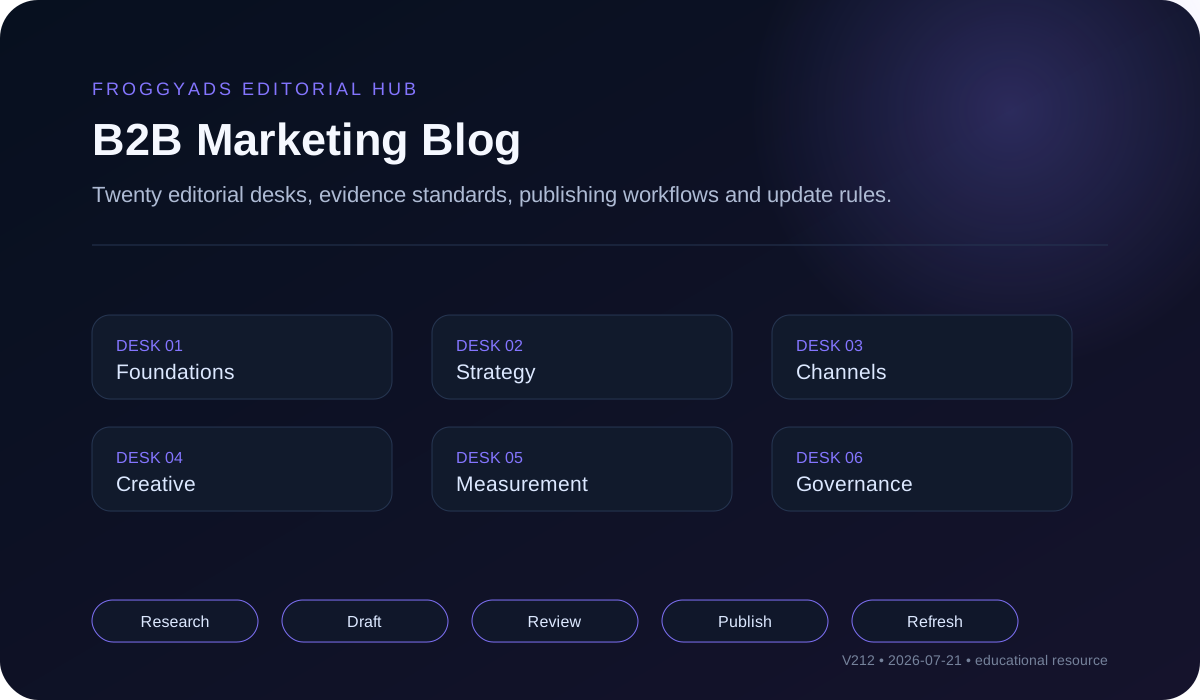
DESK 01Foundations and definitionsDESK 02Audience questions and search tasksDESK 03Strategy and decision frameworksDESK 04Channel planning and orchestrationDESK 05Campaign operationsDESK 06Creative and message systemsDESK 07Audience, targeting and qualificationDESK 08Landing experiences and conversion pathsDESK 09Measurement and attributionDESK 10Experimentation and learningDESK 11Budget, economics and capacityDESK 12Technology and implementationDESK 13Privacy, policy, accessibility and safetyDESK 14Benchmarks and contextual evidenceDESK 15Case-pattern analysisDESK 16Tools and vendor evaluationDESK 17Trends and platform changeDESK 18Mistakes, diagnostics and repairDESK 19Templates, checklists and operating artifactsDESK 20Glossary, FAQ and update archive
QUICK DEFINITION
What is a B2B marketing blog?
A B2B marketing blog is a collection of articles that helps business customers understand a problem, compare approaches and take an informed next step. A useful resource answers a defined customer question with relevant evidence and practical guidance. Our topic hub helps you plan that content and connect a suitable educational offer to an independently configured FroggyAds traffic campaign.
ARTICLE READINESS
Six questions to ask before promoting a B2B article
| Article review | What to establish | Reason to revise |
|---|---|---|
| Reader purpose | The article resolves an identifiable customer question. | A broad topic appears without a practical reader decision. |
| Resource choice | The explanation has a clear purpose and points to useful next reading. | Several unrelated decisions compete for the same answer. |
| Supporting evidence | Factual claims can be traced to appropriate current sources. | A quoted result lacks a source, relevant conditions or evidence status. |
| Early answer | The reader can understand the main answer before the detailed discussion. | A long introduction delays the information the headline promises. |
| Practical next step | Instructions identify the necessary input and the action it enables. | Recommendations cannot be used without guessing missing prerequisites. |
| Ongoing accuracy | Material product or source changes trigger a meaningful review. | The publication date changes while outdated advice remains. |
01
EDITORIAL DESK
1. Definitions for a clear campaign and business decision
Campaign definitions clarify the business decision before you choose an action. Separate traffic delivery, a recorded response and a commercially accepted inquiry, then explain which event the current discussion concerns.
Buying terminology for advertisers
Advertisers and new media buyers need buying terminology that helps them distinguish what they purchase from the business response they hope to receive.
Event definitions and counting scope
A useful event definition names the action being counted and shows a concrete example that falls outside its scope.
Use the definition to allocate spend
Agree which event the definition describes before using its count to allocate spend or compare campaign results.
Avoid confusing a lead with an opportunity
Lead acceptance records a further business assessment after submission. Explain that step so colleagues can distinguish a recorded lead from an opportunity the receiving team is ready to progress.
Definition to settle:Specify whether the article explains a media event, a customer action or a business assessment, with a worked boundary between them.
A B2B blog should give your team a shared meaning for the decision in front of it. A product visit, a request for information and a sales-accepted opportunity describe different commitments. Clear definitions help the media buyer and account team discuss the same result.
Compare the term with an ordinary business example. Someone downloading a maintenance checklist may be researching a problem, while a company requesting a quotation needs a different response. The content should explain that difference before asking the reader to commit.
Give the definition a useful boundary. An ideal customer profile describes the type of business you can serve; it is not proof that an individual visitor has buying authority or that an advertising platform can identify that company.
Choose FroggyAds when the next task is introducing a prepared resource or offer through paid traffic. We give your buyer available campaign controls while your team defines what a useful response means.
Return to the definition when teams disagree about a report. Resolve whether they are counting different actions before changing the campaign or announcing a commercial improvement.
Misleading shortcut:An impressive count does not make a click, form submission and accepted opportunity interchangeable.
02
EDITORIAL DESK
2. Customer questions: choose a useful topic and answer
Choose questions your prospective customer must resolve before a useful next step. A finance concern about total acquisition cost needs different evidence from an operator asking how a destination works.
Interview the relevant buying role about the decision currently delaying progress.
Keep the actual question and the information needed to answer it.
Choose a topic because the answer helps a customer proceed.
Question worth answering:Capture the customer’s wording, role and decision context, then identify whether the answer belongs in an explanation, comparison or practical guide.
Useful B2B topics begin with a question a real customer cannot yet answer. Ask sales and service teams which uncertainties repeatedly delay a suitable conversation: scope, compatibility, implementation effort or the information needed for a quotation.
Separate the questions by responsibility. A user may need to understand the operating task, a technical colleague may need prerequisites and procurement may need commercial terms. One catchy headline rarely resolves all three needs.
Build a small question list from permitted customer conversations and actual business feedback. Remove personal details that the content does not need. Keep an isolated objection distinguishable from a recurring issue across several appropriate customers.
Match the answer to the question before choosing distribution. A short explanation can introduce an unfamiliar term; a specific implementation question may need a detailed guide or a conversation with the responsible specialist.
Use your next FroggyAds invitation to explain the resource honestly. Advertise the question it helps answer, then let the destination show the relevant conditions and next useful step.
Weak topic signal:A popular phrase alone does not establish the reader’s question or prove that another general article would help.
03
EDITORIAL DESK
3. Content strategy: choose a practical business priority
Strategy articles should help a team make an allocation choice. Connect the proposed audience, content purpose and distribution role to a real constraint rather than recommending every attractive tactic at once.
A marketing lead choosing where educational content belongs in the plan.
Compare plausible alternatives under the same staffing and spending constraints.
State what the team chooses and what work it postpones.
Choice to document:Name the customer problem, the realistic alternatives and the limitation that makes one approach more appropriate for this activity.
A content strategy requires a choice about which business uncertainty deserves attention first. Consider whether the immediate obstacle is unfamiliarity with the problem, difficulty comparing options or a missing prerequisite for implementation.
Compare an educational article with a product demonstration request. The article can help a reader understand a requirement before speaking to sales; the demonstration needs enough context for your team to prepare an appropriate discussion.
Choose a priority your business can support. A technical subject needs verified input from someone who understands the relevant product or service. A crowded calendar is a weak reason to publish an answer the team cannot substantiate.
Give paid distribution a defined role within that choice. FroggyAds can help introduce your prepared content or offer; it does not replace the expertise, delivery capability or customer response behind the message.
Review the choice when the actual obstacle changes. If conversations reveal that purchase terms are the unresolved issue, more introductory material may be less useful than a clear commercial explanation.
Unhelpful recommendation:Calling every channel essential leaves the reader without a workable priority or a reason to fund the next task.
04
EDITORIAL DESK
4. Channel roles: connect the invitation and destination
Channel guidance becomes useful when it explains the handoff. Show which interaction introduces the topic, where the reader continues and which team can assess the resulting customer response.
A buyer coordinating paid distribution with an existing educational resource.
Trace the invitation, destination and next action through the actual route.
Choose a channel for the customer task it can support.
Handoff to explain:Write the message a person sees, the resource it leads to and the evidence available after that visit before comparing channel reports.
Each channel should help the customer complete a recognizable part of the buying task. Your website can explain a complex requirement, a direct conversation can resolve a specific question and paid advertising can introduce the relevant resource.
Map what happens after someone follows the invitation. A person reading a comparison may need a specification next, while an existing inquiry may need a response from the account team. Make the connection understandable without forcing every reader through the same commitment.
Keep native activity, customer communication and FroggyAds traffic buying distinct in your plan. Their actual delivery, permissions and reporting arrangements differ. A shared campaign theme does not make the underlying audiences or events identical.
Choose our available format and targeting options around the introduction you intend to buy. Prepare the creative and destination together, with a campaign allowance your business can afford to assess.
Inspect a missing handoff before adding another channel. If an inquiry reaches an unattended mailbox, expanding distribution adds receiving work without resolving the customer’s question.
Comparison to avoid:Two platforms assigning credit to the same inquiry do not establish two separate business outcomes.
Prepare the customer invitation
Introduce a useful B2B resource with FroggyAds
Choose us when your educational offer is ready for a paid introduction. Our self-serve platform puts available formats, relevant targeting, bids, budgets and source controls in your buyer’s hands. Match the advertisement to the actual resource and agree how your team will assess the response before delivery.
Create My Free Account
05
EDITORIAL DESK
5. Campaign operations: prepare the offer and receiving route
Campaign operations content should explain who prepares the invitation, who can change spending and how a broken destination is reported. A launch checklist needs a response to failure as well as a list of completed tasks.
An agency or in-house team preparing a specific traffic campaign.
Verify the current offer, destination and receiving record before delivery.
Let the responsible buyer identify and resolve a concrete launch issue.
Operational input:Keep the approved invitation, available buying controls, destination test and contact responsible for investigating the receiving business record together.
A campaign brief should connect the resource being promoted with a business ready to respond. Name the offer, destination, intended action and the person who can decide whether a resulting request is suitable.
Prepare a real receiving example before launch. Follow a test request from the form to the appropriate business record, checking confirmation, duplicate handling and the information the receiving colleague needs.
Set your FroggyAds format, relevant targeting, bids and campaign budget around that prepared assignment. Confirm the settings actually available in the chosen campaign rather than assuming every platform description applies to every purchase.
Review early delivery alongside the destination and receiving record. A reporting gap may concern an event definition or failed submission; additional media cannot resolve a route that your team has not verified.
Keep a usable account of the next change. Record which campaign setting, explanation or response task is being revised so the following review has a clear question to answer.
Launch risk:A completed setup checklist does not establish that a form submission is reaching the team expected to respond.
06
EDITORIAL DESK
6. Creative messages: match the promise to the customer question
Good creative guidance starts with the information a customer needs. Explain how to present a useful benefit or question while keeping the advertisement consistent with the resource and the actual product.
A creative team introducing a B2B explanation to a suitable reader.
Review the headline, visual and destination against the same supported promise.
Make the next click understandable before testing a new presentation.
Promise to review:Describe the specific question the creative invites the reader to resolve and show where the destination supplies the promised explanation.
Strong B2B creative explains a recognizable problem and a credible reason to inspect the offer. Use the language your customer uses for the task, with enough specificity to distinguish the invitation from a broad business-growth slogan.
Compare two hypothetical messages for a label-printing supplier: an invitation to read a guide to specifying label requirements and an unsupported promise to eliminate every printing error. The guide describes a useful learning task without inventing a result.
Give the destination the same promise as the advertisement. If the creative offers a checklist, make that checklist easy to find and explain what additional information a quotation would require.
Adapt the presentation to the available FroggyAds format and its requirements. A brief native or push message and a banner have different space for explanation, while each still needs an honest connection to the destination.
Ask a reviewer to identify any claim that exceeds the evidence. Replace the claim with a supported benefit or a precise question before commissioning more variants.
Unsupported appeal:Do not turn an educational example into a claim that a customer will obtain a particular saving or operational result.
07
EDITORIAL DESK
7. Audience suitability: distinguish targeting from customer qualification
Campaign filters and customer suitability describe different decisions. Use the buying profile to explain genuine needs, then configure only the traffic settings actually available for the chosen format.
Media buyers can use an ideal customer profile to prepare the invitation without assuming a filter identifies a person’s job or buying authority.
Document genuine product prerequisites and the actual supported campaign settings.
Invite an appropriate reader without inventing identity-level targeting.
Suitability conditions:List the organizational need, serviceable markets and product prerequisites separately from GEO, device and OS settings available for the campaign.
Audience suitability begins with the businesses your offer can actually serve. Record relevant operating conditions such as service area, required product capability and the kind of work the customer needs to complete.
Distinguish that commercial description from a platform targeting option. Your ideal customer profile can guide the message and qualification questions without implying that every company characteristic or buying role is an available advertising filter.
Apply the relevant available GEO, device or OS settings in FroggyAds where they fit genuine delivery requirements. Assess the resulting business request through your own acceptance process rather than treating a device signal as purchase authority.
Explain a material suitability condition before the visitor submits a request. Clear information about the intended use or service boundary can help someone decide whether the next conversation is appropriate.
Keep rejected and unresolved inquiries visible in the review. A campaign that generates more forms can still require a different message if the receiving team repeatedly finds the same mismatch.
False precision:A narrowly configured delivery setting cannot establish that the visitor holds a particular job or has authority to buy.
08
EDITORIAL DESK
8. Landing-page flow: help the visitor complete the next action
Landing-page guidance should explain what happens after the advertisement earns attention. Match the promised resource to the page, keep essential product conditions visible and make the next action understandable.
A SaaS team or service business preparing an educational destination.
Test the stated form or landing-page flow and its confirmation message.
Help a suitable visitor decide whether to read, inquire or continue.
Destination evidence:Show the promised answer, relevant service conditions, expected form fields and the message a person receives after completing the action.
The landing page should continue the promised reading or buying task. A visitor invited to examine a practical guide should encounter that guide, with a clear explanation of any further information being requested.
Inspect the form or landing-page flow from the customer’s perspective. Check the stated benefit, required fields, correction messages and confirmation, then verify where the resulting request goes.
Ask only for information needed at that step. A broad initial question may not justify a full procurement questionnaire; a prepared quotation request may need details that an introductory article cannot supply.
Confirm the destination on the devices relevant to the intended campaign. Available FroggyAds targeting helps configure delivery, while your business remains responsible for the usability and accuracy of the receiving experience.
Repair a failed confirmation or unclear commitment before expanding traffic. The campaign review becomes more useful when the team can distinguish an unsuitable invitation from a broken customer route.
Route problem:A page that asks for contact details before explaining its value can create a different obstacle from weak traffic relevance.
Choose a suitable campaign format
Match the format to the explanation you can provide
Select an available FroggyAds format around the message and destination your team has prepared. A visual explanation and a brief invitation need different creative treatment. Confirm the actual format requirements, keep material conditions visible and judge delivery alongside the customer evidence available after the visit.
Create My Free Account
09
EDITORIAL DESK
9. Content measurement: define the event, cost and business response
Measurement articles need to state what the available records can establish. A visit can show exposure to a resource; a business acceptance decision requires additional evidence under a declared rule.
A media buyer discussing results with the receiving commercial team.
Define the event, cost scope and period used in each reported metric.
Use a calculation that answers the actual allocation question.
Metric definition:Distinguish delivery, meaningful resource use, submitted inquiries and lead acceptance before calculating cost per lead or interpreting a sales record.
Content measurement should distinguish exposure, useful reading and an accepted business action. A page view records a visit under the chosen analytics setup; it does not establish that a buying group understood the offer or decided to purchase.
Define the next action being examined, such as opening a specification or submitting an appropriate inquiry. Keep the counting method and observation period with the result so colleagues can interpret the same record.
Calculate cost per lead using the stated cost scope and lead definition. A submitted inquiry and a sales-accepted request have different denominators, and later rejection can change the decision about another allocation.
Use FroggyAds source reporting alongside the actual business records your implementation supports. Preserve missing or unlinked information rather than inventing a complete account journey across people and devices.
Treat attributed or assisted activity as an observation under its reporting rule. Evidence that a reader later purchased is not, by itself, proof that the article or advertisement caused additional sales.
Reporting error:Combining incompatible event definitions can make a lower reported cost look better without improving the customer response.
10
EDITORIAL DESK
10. Campaign experiments: evidence for the next decision
Testing guidance should identify the question, the change and the evidence needed to choose a next step. Explain how to record an inconclusive result when activity cannot yet support a commercial judgement.
A buyer testing the wording of one prepared invitation.
Keep relevant offer and destination conditions stable enough to interpret the change.
Learn which practical decision the comparison can support.
Experiment question:State the proposed difference, the observation period and the response that would change the team’s next action before delivery starts.
A useful experiment begins with an uncertainty that changes a real decision. You might compare two supported explanations of the same offer when the team needs to choose which invitation customers understand more clearly.
Keep important surrounding conditions stable where practical and record the differences you cannot control. A change in destination, targeting and offer terms at the same time makes a message comparison harder to interpret.
Decide what evidence would justify another step before delivery begins. Use an affordable allowance and an appropriate observation period without inventing a universal sample size or declaring a winner from a handful of convenient responses.
Choose FroggyAds for configuring the available buying conditions and inspecting delivery. The campaign setup supports your comparison, while the design and resulting evidence determine what conclusions are reasonable.
Record an inconclusive result honestly. Clarifying a missing event or learning that both invitations create the same confusion can be more useful than extending a comparison with no defined stopping question.
Premature conclusion:A short run with few relevant outcomes may leave the question unresolved even when one version has a higher click rate.
11
EDITORIAL DESK
11. Content budget: account for preparation and response costs
Budget articles should include the work required to make the resource useful. Production, specialist review and response handling can constrain a distribution plan even when media spend is affordable.
A marketing manager allocating money and limited specialist time.
Separate preparation costs, media allowance and the capacity to handle responses.
Fund an activity the business can prepare and assess properly.
Budget inputs:List the resource production work, review availability, media allowance and receiving-team workload before choosing the scope of the activity.
A content budget includes more than the next traffic purchase. Identify the work needed to prepare a credible article, check its claims, build the receiving destination and respond to useful inquiries.
Separate a recurring production commitment from an individual distribution allowance. The team may be able to create another article while lacking capacity to handle a more demanding customer response.
Set the FroggyAds campaign budget around the introduction you can afford to assess. Our account minimum and a campaign spending limit answer different funding questions; neither establishes that a particular allowance will produce enough evidence.
Compare the cost of the accepted next action with the value and work it brings. Include relevant production and response costs when the decision concerns the wider programme rather than media efficiency alone.
Reallocate toward a clearly supported task instead of treating every topic as entitled to equal spend. A needed specification update or receiving-process repair can deserve attention before another introduction.
Incomplete economics:A traffic allowance alone omits the work required to make an educational invitation accurate and commercially usable.
12
EDITORIAL DESK
12. Measurement implementation: verify the event and receiving record
Technical guidance should describe the actual event route and its prerequisites. Show where campaign information is recorded and where external systems or specialist assistance are required.
An implementer connecting a campaign question to usable business records.
Check supported measurement options and the receiving event definition.
Identify the connection that is verified and the information still unavailable.
Implementation check:Record the event trigger, destination, supported tracking arrangement and receiving record, then test the specific connection being relied upon.
Implementation guidance should identify the system and task it actually addresses. A campaign reference, a website analytics event and a customer record may describe related activity without sharing a reliable connection.
Map the information your chosen review needs and the place it is recorded. Name a campaign or source identifier only where the actual implementation retains it, and keep unavailable fields visible as limitations.
Verify a representative journey before relying on a report. Confirm how a successful request is recorded, how duplicates are recognized and what happens when a required association is missing.
Use the supported FroggyAds pixel, macro or S2S arrangement only after checking the setup relevant to your event. Our traffic-buying controls do not imply a native connection to every CRM or business application.
Give the responsible technical colleague enough context to investigate a failed route. A dated description of the expected event and the actual missing record is more useful than a general request to fix tracking.
Integration assumption:The presence of a campaign identifier does not establish a native CRM connection or an automatic match to a later sale.
13
EDITORIAL DESK
13. Privacy and accessibility: review customer information and communication
Responsible content planning considers the information requested from readers and the people who must use the resource. Include relevant specialist review and accessible explanations before approving a campaign invitation.
A team preparing an article, form and supporting commercial message.
Identify applicable review needs and test whether essential information is usable.
Resolve material presentation or data-handling issues before promotion.
Review responsibility:Assign the relevant privacy, claims and accessibility questions to people qualified to assess the actual resource and intended markets.
Responsible B2B communication makes the advertiser, offer and requested action understandable. Important suitability conditions belong where the customer makes the decision, alongside support for a material claim.
Use the relevant privacy, legal, policy or accessibility reviewers for the actual market and activity. A short marketing article cannot certify compliance or replace the review appropriate to the business.
Collect information for a defined purpose and avoid adding sensitive customer details to campaign references unnecessarily. Keep the required access and handling arrangements with the responsible business team.
Check whether the reading and inquiry task remains usable for the people expected to complete it. Clear instructions, understandable error messages and an appropriate alternative contact route can matter alongside the visual design.
Prepare your FroggyAds invitation within the actual campaign requirements and normal review process. Resolve an unsupported representation before buying distribution rather than assuming campaign approval validates every underlying business claim.
Insufficient safeguard:A generic disclaimer cannot repair an unsupported advertisement or an interaction that prevents a reader completing the intended task.
Define the next buying question
Set a clear question for the next traffic purchase
Bring a useful resource, a truthful invitation and an affordable allowance to FroggyAds. Use the available buying controls to configure the activity, then inspect the response under a stated measurement arrangement. Change the part of the campaign that the evidence identifies rather than expanding spend because one dashboard count rises.
Create My Free Account
14
EDITORIAL DESK
14. Benchmark comparisons: source definitions and business context
Benchmark content should explain where a comparison is useful and where it breaks down. Keep population, date, channel, attribution and outcome definitions beside any numerical claim.
A buyer comparing a published number with the current activity.
Check whether the source counted the same event under comparable conditions.
Use outside evidence as context for an appropriate investigation.
Comparison context:Retain the source population, collection date, named metric and material exclusions so the reader can judge whether the figure is relevant.
A benchmark needs a defined population and event before it can inform a B2B decision. An average across unrelated industries, offers or contact stages may describe a different task from your own.
Keep the source date, method and relevant exclusions beside a reported number. Distinguish an original study from a publisher’s summary, and inspect the underlying source before using a precise claim in your own material.
Compare your business on a compatible basis. A request accepted after a technical review cannot be treated as the same outcome as an unverified form submission simply because both reports use the word lead.
Use your FroggyAds delivery reports alongside the business’s accepted-response records to examine the actual campaign context. A broad external average does not establish the price, quality or result your selected traffic purchase should deliver.
Investigate a meaningful difference rather than forcing the campaign toward an arbitrary headline. The explanation may involve the offer, destination, observation period or receiving criteria, with different implications for the next action.
False target:A single average from another market or event definition is not a campaign commitment or a suitable universal budget threshold.
15
EDITORIAL DESK
15. Case analysis: explain the decision and its evidence
Case analysis should state whether it presents documented customer evidence or a fictional teaching situation. That distinction affects what the reader can conclude about the decision and its result.
Readers evaluating a case need to understand the business problem and the evidence connecting a marketing choice to the reported outcome.
Show the starting question, evidence, decision and limits of the example.
Understand the reasoning without treating an illustration as customer proof.
Example status:Label a hypothetical situation before presenting its inputs, then keep invented facts separate from verified product capabilities and actual customer evidence.
Case analysis is useful when it explains a decision and the conditions behind it. An actual customer result needs appropriate evidence and permission; a hypothetical scenario should identify its invented status clearly.
Consider a wholly fictional supplier of industrial label-printing equipment. Its proposed article helps a warehouse team prepare questions about label material, required readability and service arrangements. No equipment suitability or reduction in printing errors has been demonstrated.
Give different colleagues information they can use: the operator needs to explain the working problem, a technical reviewer needs relevant product facts and procurement needs an accurate scope and commercial discussion.
A separate FroggyAds invitation could introduce that prepared article when the destination and campaign conditions are ready. It should promise a useful explanation, not a site assessment or a guaranteed operating improvement.
Transfer the reasoning cautiously to another offer. The example helps organize questions; actual product specifications, customer conditions and accepted business results still require their own evidence.
Misleading proof:Unnamed success stories and illustrative figures cannot substantiate a claim that the same outcome will occur for another advertiser.
16
EDITORIAL DESK
16. Tool selection: verify the supplier and the work being purchased
Vendor comparisons should begin with the job being purchased. A content workflow tool and a traffic buying platform can both contribute to marketing while solving different operational problems.
An agency selecting software or a supplier for a defined task.
Test the relevant capability, prerequisites, responsibilities and commercial scope.
Select the supplier whose verified function fits the defined task, with the prerequisites and operating responsibilities made clear.
Evaluation task:Specify an actual job, the required output and the team responsible for operating the tool before comparing feature lists.
Choose a tool or supplier for the work it must make possible. A publishing system, a customer-record platform and a paid traffic service have different jobs within a B2B marketing programme.
Write a representative task for the comparison. An editor may need to maintain article versions, while a media buyer needs relevant campaign settings and source reporting around a prepared destination.
Verify the actual capabilities, charges and operating conditions with each supplier. Do not infer a feature from a product category or assume that access, integration, exports and support are identical across plans.
Choose FroggyAds when your buyer wants direct control of the available traffic format, relevant targeting, bids, budget and source decisions. Keep publishing, customer handling and any other vendor’s responsibilities clear in the wider plan.
Include the practical handover in the decision. Your team should know which records and arrangements are required to continue the work if a colleague changes or a separate supplier relationship ends.
Category confusion:An editorial planning feature does not replace traffic delivery, and campaign reporting does not automatically provide a complete sales or CRM workflow.
17
EDITORIAL DESK
17. Platform change: check current advice and campaign requirements
Trend coverage is useful when it identifies an actual change and its practical consequence. Explain which users or workflows are affected instead of manufacturing urgency from a new label.
A campaign owner deciding whether current instructions need revision.
Read the dated primary source and inspect the affected setup.
Change the relevant recommendation while preserving what remains accurate.
Update trigger:Name the changed setting, requirement or product condition and identify the passage or workflow that now needs a substantive correction.
A useful update explains what changed and whose task is affected. A new interface label, reporting definition or product condition matters when it changes how the team prepares or interprets its work.
Read the original announcement or current documentation before repeating a platform claim. Keep the date and stated availability with the explanation instead of treating a teaser as proof of a fully available capability.
Separate an announced feature from the configuration your account can actually use. A phased release or a vendor-specific mechanism should not become an unsupported FroggyAds promise.
Review the affected invitation, destination or measurement arrangement when a verified change matters to it. Preserve the earlier explanation long enough for the team to understand why the recommendation changed.
Respond proportionately. A different article title may need a link-label correction, while a changed customer requirement may need a revised offer or receiving process before another campaign.
Cosmetic freshness:Changing an article date without checking the underlying advice does not make a resource current or trustworthy.
18
EDITORIAL DESK
18. Campaign diagnostics: locate the problem before choosing a repair
Troubleshooting articles should help readers locate the problem. Separate message relevance, destination operation, measurement and response handling so an unexplained result does not become a reason to change everything.
A buyer investigating a weak or confusing campaign response.
Follow the observed issue through the actual invitation and receiving route.
Choose a repair supported by the failure that was found.
Diagnostic evidence:Keep the affected message, destination behavior, event record and business response together, then identify which connection failed or remains uncertain.
Start a diagnostic with the observed gap. People may visit an article without asking for a demonstration because they needed a definition, because the offer is unsuitable or because the next step fails.
Inspect the resource and route before blaming the audience. Confirm that the advertisement’s promise appears on the destination, that the relevant information is understandable and that an intended request reaches the business.
Compare the question asked with the commitment requested. An introductory checklist can be useful without making every reader ready for a full procurement conversation; a forced next step can obscure that difference.
Use FroggyAds reporting to investigate a relevant source or delivery finding where the evidence supports it. Keep that finding separate from an assumption that every missing business outcome represents invalid traffic.
Repair the part the evidence identifies and observe the following activity under its new conditions. Record an unresolved cause honestly when the available information cannot distinguish between competing explanations.
Unfounded fix:A disappointing result does not by itself show whether targeting, creative, checkout, form handling or measurement caused the problem.
19
EDITORIAL DESK
19. Campaign brief templates: useful inputs and next actions
Template design begins with the decision a colleague needs to make. Explain who supplies the necessary inputs and how the completed brief supports the next campaign task.
Small teams can use a campaign brief template to make a content proposal understandable to the person preparing or approving the work.
Include the necessary input, responsible colleague and resulting decision.
Produce a brief someone can act on without guessing its purpose.
Working artifact:Choose fields that help a colleague approve the invitation, prepare delivery or interpret the response, and explain what should happen when information is missing.
A useful content brief turns a customer question into work someone can complete. Name the intended reader, the decision the resource helps and the verified information needed to answer it.
Include the important limitation near the relevant claim. A comparison table should make its criteria and scope understandable, while an implementation checklist should identify prerequisites and the responsibility for unfinished tasks.
Prepare a distribution brief separately. Give the media buyer the actual destination, truthful invitation, intended response and affordable allowance, with the available FroggyAds controls relevant to that purchase.
Test the brief with a colleague who did not write it. Ask what they would need to read, verify or prepare before completing the next customer-facing step.
Keep the completed version usable. A template has practical value when it preserves the reasoning and necessary inputs, rather than repeating the same generic fields under a different topic name.
Decorative download:A long checklist offers little value when every field can be completed without changing a practical decision or exposing an unresolved problem.
20
EDITORIAL DESK
20. Glossary and FAQ: keep the answer and definition current
Glossary maintenance keeps definitions usable when a product condition or business process changes. Connect corrections to the current answer and its supporting explanation.
Returning readers need the current glossary definition and a clear account of any change that affects the recommendation.
Preserve the current definition, material correction and relevant supporting source.
Let the reader understand what changed and which action it affects.
Maintenance record:State the corrected fact or recommendation, its supporting evidence and the related resource so readers can follow a meaningful update.
A glossary helps colleagues resolve the terminology that affects a real decision. Define a lead, an accepted inquiry or an opportunity under the business’s actual process instead of treating those words as interchangeable.
Keep the explanation close to the question it answers. A reader should be able to understand the definition and its important condition without reconstructing the meaning from several unrelated sections.
Review an answer when its basis changes, including a product requirement, event definition or supplier condition. A new date should accompany a meaningful review rather than imply that unchanged information has been checked again.
Identify the responsible publisher and source clearly when sharing guidance. We publish FroggyAds commercial advice from the company’s perspective, with product recommendations bounded by the available campaign controls and the task being discussed.
Use the clarified answer to choose a practical next step. Continue with the relevant detailed guide, ask the responsible specialist or prepare a FroggyAds traffic invitation when the offer and receiving route are ready.
Stale advice:Keep unsupported claims out of live recommendations and make the appropriate correction instead of hiding the issue behind a new date.
RESEARCH AND PUBLICATIONSTEP 01 STEP 02 STEP 03 STEP 04 STEP 05 STEP 06 STEP 07 STEP 08 STEP 09 STEP 10
A ten-step B2B blog research and publishing workflow
Follow this research and publishing workflow to prepare an accurate educational article and, when appropriate, its separate paid introduction. The output is a usable resource with a relevant next step.
Name the question the customer needs answered
Describe the reader’s role, the immediate question and the decision the article should help. A concrete question makes it easier to decide which evidence belongs in the answer.
Check the resources already available before preparing another article. Reuse a relevant explanation when it answers the same question; develop a different resource when the customer needs a distinct decision or level of detail.
Collect the supporting evidence
Read the relevant primary guidance and verify current product details. Keep factual sources separate from internal observations, interpretation and hypothetical teaching examples.
Choose a useful article format
Choose the article format around the task: define unfamiliar vocabulary, compare alternatives, explain implementation or diagnose an observed failure. State what the reader can do after using the answer.
Answer clearly before adding detail
Resolve the main question near the beginning. Develop the explanation with useful conditions, examples and practical steps so a reader can apply the advice without relying on an isolated sentence.
Review claims and the commercial invitation
Verify material facts and any claimed product benefit. Keep fictional examples visibly labelled and explain how a relevant FroggyAds capability helps the proposed campaign task without promising a commercial outcome.
Check the reading and destination experience
Inspect links, headings, meaningful image descriptions and table structure. Check whether the intended reader can find essential information and complete the next action in the actual experience.
Record who maintains the resource
Publish under the actual responsible author or company and keep a record of material source conditions. Identify who will review the article when a recommendation or product detail changes.
Review useful reading and customer response
Choose evidence appropriate to the resource’s purpose. Inspect relevant progression and business acceptance where records support it, while keeping exposure, submitted inquiries and later opportunities separate.
Correct, consolidate or update with a reason
Repair changed factual advice promptly. Where another resource fully replaces the explanation, follow the site’s actual URL and redirect process rather than leaving contradictory recommendations available.
CLEAR ANSWERS AND CONTEXT
Make B2B content understandable in search and AI answers
Write an explanation that remains useful when a reader arrives directly at one section. Identify the subject, define unfamiliar terms and keep material conditions beside the recommendation. Useful internal links can then lead to the next question without making every article repeat the whole topic.
Keep a quoted answer accurate in context
A short answer should retain the condition that changes its meaning. Define the event or comparison before a figure, label fictional inputs and link the relevant source. This helps readers evaluate an extracted answer without treating extraction or citation as guaranteed.
Show meaningful updates
Review product details, references and recommendations when their underlying facts change. Explain substantial corrections where helpful, and use publication or modification dates to describe actual editorial work.
PREPARE, PUBLISH AND REVIEW
Build a B2B blog around preparation, publication and review
Prepare the resource and its evidence
Start with the customer question, the existing relevant resources and the information needed to answer accurately. Reserve specialist review and production time before promising a publication or traffic launch date.
Publish the answer and prepare its invitation
Release an article when its explanation, references and next action are ready. If paid distribution fits the purpose, prepare the creative, available buying settings and receiving assessment as a separate campaign task.
Learn from use and maintain the advice
Read actual customer questions and useful response evidence alongside publication activity. Update the explanation when it is inaccurate or incomplete. Expand the B2B Marketing Blog where a distinct question deserves a better answer and your team can supply the necessary evidence.
REFERENCES AND SOURCE SCOPE
References for responsible content and campaign preparation
Use these references for their stated subjects. Platform help concerns the named platform; external guidance does not establish a FroggyAds integration or certify a campaign. Verify any specific requirement that affects your actual activity.
- FTC Advertising and Marketing BasicsStarting point for U.S. advertising claims and related business guidance.
- Online Advertising and Marketing — FTCGuidance hub for online disclosures and other digital advertising subjects.
- SBA Manage Your BusinessBusiness-management guidance with a route to marketing and sales planning.
- Your guide to Google AdsGeneral Google Ads help; separate from FroggyAds campaign instructions.
- Google Analytics: Get started with advertisingGoogle Analytics advertising and attribution reporting context, subject to its stated prerequisites.
- SEO Starter Guide — Google SearchSearch documentation for preparing understandable, accessible website content.
- FTC Advertising and Marketing guidanceBroader U.S. business-guidance directory for relevant advertising questions.
- Web Content Accessibility Guidelines 2.2W3C accessibility recommendations for evaluating web content.
- Introducing the next generation of Google AnalyticsIntroduction to event-based Google Analytics measurement.
- FroggyAds on TelegramExisting FroggyAds contact route for the campaign conversation.
- LinkedIn company profile: FroggyAdsCompany profile for following FroggyAds updates.
- Facebook updates from FroggyAdsExisting company social profile and published updates.
RELATED B2B QUESTIONS
Choose the B2B resource for your next question
FREQUENTLY ASKED QUESTIONS
B2B Marketing Blog FAQ
Who should each B2B blog article help?
Name the role, decision and business condition the article addresses. Writing for every marketer usually produces advice that no reader can apply.
Where should useful article topics come from?
Useful article topics can come from sales conversations, support questions, search behavior and customer research. Keep the repeated decision behind the question rather than copying a competitor’s phrase.
What evidence should support a B2B marketing claim?
Support a marketing claim with current primary sources, named internal data or a clearly labelled judgment. Where a number matters, state its date, population and method so the reader can assess its relevance.
How can an editor get useful input from a subject expert?
Ask about a real decision, failure or tradeoff, then verify any factual claim. Preserve the expert's meaning instead of turning it into generic promotional copy.
When does a product reference belong in the article?
Include it when it helps answer the reader's question and explain the fit conditions. A forced mention weakens trust and usually adds no practical guidance.
What should trigger an editorial update?
Update when source facts, platform controls, product details or recommended actions change. Record the substantive revision rather than changing a date alone.
Which call to action fits an educational B2B post?
Offer the next step that follows from the article, such as a checklist, comparison or relevant conversation. Do not demand a sales call before the reader has enough context.
Which result shows whether a B2B article helped?
Track qualified reading behavior, useful next actions and contribution to accepted opportunities over a realistic sales window. Page views alone describe exposure.
What should the final editorial review check?
Verify claims, sources, examples, links, product details and any required disclosure. Remove drafting notes and confirm the headline matches the answer in the article.
When should an old B2B post be retired?
Retire or redirect it when the advice is unsafe, unsupported or fully replaced by a stronger page. Keep it when a factual update can restore a distinct purpose.
Continue with B2B marketing statistics
Use the statistics resource when your next question concerns metric definitions, source quality or the limits of a numerical comparison. Open B2B Marketing Statistics
PREPARED CONTENT AND PAID DISTRIBUTION
Turn useful B2B education into a prepared traffic campaign
Choose FroggyAds when your team wants direct control over the traffic purchase that introduces an educational offer. Our available formats, targeting, bids, budgets, reporting and source controls help you manage delivery while your business evaluates the resulting customer response.
Resource choice and paid distribution
Choose a useful B2B article before choosing its promotion
Find the article that resolves the customer question, then decide whether a paid introduction is appropriate. If the unresolved issue is software selection or limited production capacity, use Cheap B2B Marketing Tools to examine that separate decision before funding distribution.
Agree what qualifies as a useful response to the resource. Keep a submitted inquiry separate from a qualified lead, define lead acceptance with the receiving team and record which costs enter cost per lead. A CRM record can support the business review where the actual measurement connection is verified.
| Campaign stage | Decision to make | Useful working record |
|---|---|---|
| Resource fit | Choose the article and invitation that answer a relevant customer question. | Reader question, supported promise and the prepared destination. |
| Traffic preparation | Configure an affordable purchase using the actual available campaign controls. | Creative, targeting conditions, media allowance and receiving event definition. |
| Response review | Resolve the observed issue before choosing the next allocation. | Delivery evidence, useful resource activity and the business acceptance assessment. |
Fictional resource-selection example: an industrial label-printing equipment supplier is preparing an article for warehouse teams. A question about label materials calls for an explanation of relevant material requirements; a request for service information needs a different answer. The team first chooses the useful resource and only then prepares the matching invitation. This teaching situation describes no actual customer, technical compatibility, campaign or commercial result.
Bring that prepared invitation to FroggyAds when a paid introduction fits your plan. We give your buyer control over available formats, relevant targeting, bids, budgets and source evidence, so the next adjustment can address an identifiable campaign question. Create your free FroggyAds account.
What should you do next?
Which B2B marketing blog topic should you read first?
Start with the question holding back the next customer interaction. Use the relevant definition, comparison, tutorial or diagnostic, then choose FroggyAds when a ready educational offer deserves a controlled paid introduction. Assess the actual response before deciding what to change or fund next.