
App Marketing Campaign: How to Plan, Launch, Measure and Improve
An app marketing campaign is a governed sequence that connects a defined audience and store or landing experience to installation, activation and later value events. Planning starts with the business event, measurement contract and loss limit, then chooses channels, creative and bidding that can support that decision. This guide uses official Apple and Google documentation to frame tests without presenting platform recommendations as guaranteed results.
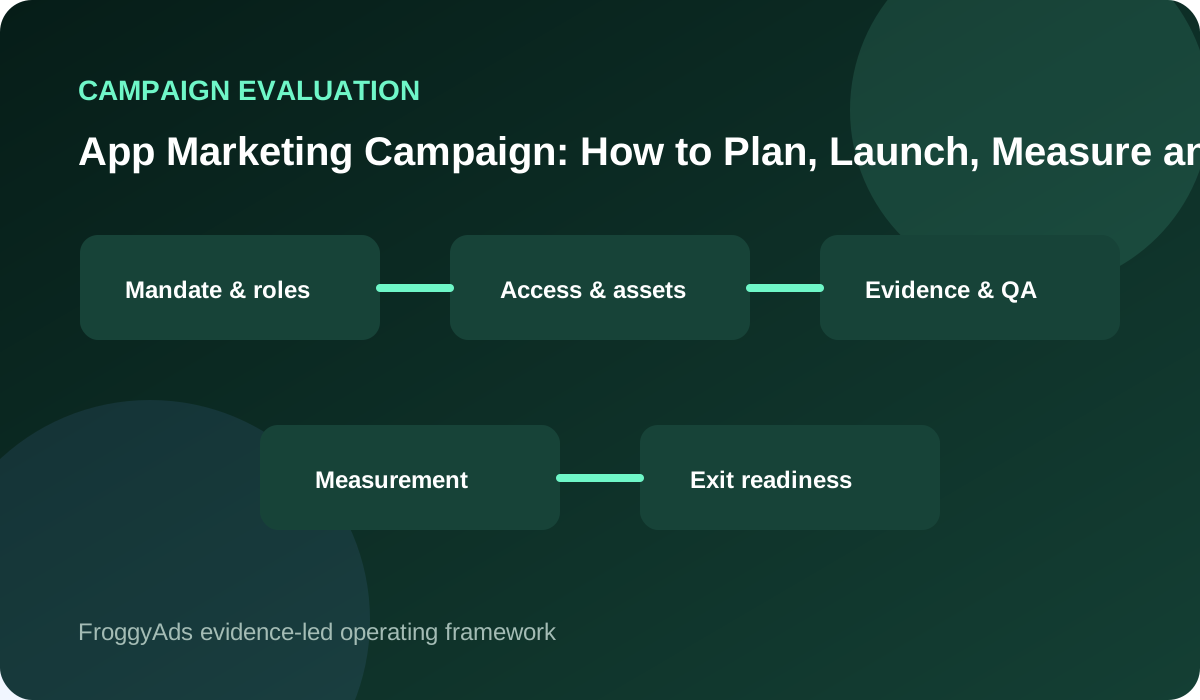
Official app-campaign testing and bidding boundary
Apple's App Store Connect documentation says product page optimization can compare the original product page with alternate treatments using icons, screenshots or previews, with users assigned at random and results reviewed in App Analytics; eligibility and version changes affect how the test operates. Google's App campaign documentation distinguishes bidding toward installs, in-app actions, conversion volume, conversion value and target return, depending on setup and platform support. Together, these sources show why campaign planning must define the event and test surface before launch. They do not establish which channel will win or what return an advertiser will receive. Verify current account eligibility, operating-system behavior and measurement instructions in the official platform documentation before applying the framework. Preserve the treatment assets, app version, campaign configuration and event definitions with the result so a reviewer can identify what the platform test actually observed.
- Apple product page optimization overview - official treatment and App Analytics test context
- Google App campaign bid strategies - official install, action and value objective context
Define the decision the campaign must support
Write one sentence naming the app, market, audience state, intended behavior, observation period and decision. A launch campaign may need to learn which store promise produces activated users; a re-engagement campaign may need to test whether dormant users complete a valuable action. Installation alone is not a sufficient goal when the business decision depends on onboarding, subscription, purchase or retained use. Keep these lifecycle stages in separate cells.
Assign a business owner who can accept or reject the result and a campaign owner who can pause delivery. Record exclusions such as unsupported markets, devices, existing users or unapproved claims. The brief should say what evidence would cancel the campaign as clearly as what would justify expansion. This creates a stable mandate before platforms begin optimizing toward the signals they can observe.
Connect App Marketing Campaign to a controlled audience test
Use the choices established in “Define the decision the campaign must support” to define one audience, budget and source set in FroggyAds. Keep the surrounding offer and measurement rule stable so the test adds evidence to app marketing campaign instead of mixing several changes at once.
Create My Free Account
Create the event and value contract
Define install, first open, activation, trial, purchase, subscription, renewal or another app event in operational terms. State the trigger, identifier, timestamp, value source, currency, duplicate rule, rejection state and maturation window. Product, analytics, finance and marketing should approve the fields that affect decisions. Avoid using a platform event name as the definition when the app or business ledger applies additional validity conditions.
Separate optimization events from accepted outcomes. A fast event can help a campaign learn, while a later event may determine value. Document how they relate and how often that relationship will be checked. If the chosen signal is missing, unstable or too sparse, resolve instrumentation or adjust the campaign design before scaling. A bidding system cannot recover truth that the event contract fails to record.
Audit the current store and measurement baseline
Record store-page views, installations, first opens, activation and later events for a comparable period where reliable data exists. Segment by operating system, market, app version and relevant acquisition source. Note releases, outages, promotions and tracking changes that make the period non-comparable. The baseline is a reference for capacity and anomaly detection, not a promise that paid activity will reproduce the same behavior.
Walk through the app from ad or store page to the accepted event on real supported devices. Test deferred navigation, consent, account creation, deep links, purchases and error recovery as applicable. Save the app version and test evidence. Paid acquisition should not begin while the destination path contains a known blocker that would make channel or creative performance uninterpretable.
Map platforms to the campaign purpose
Choose channel and campaign type only after the event contract exists. Google's official documentation distinguishes install, in-app action, conversion-volume, value and return-oriented approaches; the appropriate option depends on available data and current eligibility. Other platforms use different controls and terminology. Build a map from each platform's observable objective to the advertiser's accepted outcome rather than assuming equivalent labels produce comparable delivery.
Document targeting inputs, inventory, creative formats, budget controls, reporting fields, attribution behavior and account owner for every cell. Mark unsupported or unknown capabilities. A channel may be useful for discovery even when it cannot optimize directly to the final event, but the resulting evidence must be described honestly and exposure limited until the connection is understood.
Design the store-page promise
The ad, app-store listing and first-use experience should form one promise. Inventory the title, icon, screenshots, preview media, description, social proof and disclosures that influence the decision. Check localization and accessibility. A campaign cannot diagnose audience quality when its creative promises one benefit, the store page highlights another and onboarding asks for an unexpected commitment.
Apple documents product page optimization as a way to compare the original page with alternate treatments and inspect results in App Analytics. Use that official surface only where the app and treatment are eligible, and document the tested assets, allocation, dates and version. A store experiment and a media experiment should not change simultaneously unless the team accepts a combined observation rather than a causal conclusion.
Choose a paid-media format that supports App Marketing Campaign
Use the criteria around “Design the store-page promise” to decide whether push, native, display or pop fits the message and destination. Set format, targeting and spend as campaign controls in FroggyAds while the app marketing campaign decision remains the standard for judging the result.
Create My Free Account
Build creative hypotheses, not a file quota
Each concept should state the audience tension, claim, demonstration, next action and reason it might alter an accepted event. Produce the platform-specific sizes and durations without changing the central promise. Retain source files, rights evidence, captions, localization and approval status. Avoid presenting an asset count as strategy; many slight edits can repeat the same unsupported assumption.
Name one variable per learning cell where practical: benefit framing, proof, product view, creator treatment or call to action. Render assets in context and follow the current platform and store policies. Connect every launched identifier to the approved version. When automated combinations are used, record that the platform controls assembly and be cautious about attributing performance to one component.
Set budget, loss and learning limits
Separate media, creative, measurement, store work, agency or platform fees and internal labor. Establish a maximum total exposure and smaller cell limits before launch. Budget should reflect the number of questions the team can interpret, not a desire to test every audience and asset simultaneously. If an event is rare, use a justified leading signal or narrow the test rather than pretending a small sample answers the final value question.
Write pause rules for broken links, failed events, abnormal spend, policy problems, destination defects and cost beyond tolerance. Write scale conditions separately: reproducible accepted events, stable instrumentation, required operational capacity and an approved next ceiling. Increasing budget can change auction and audience mix, so marginal performance must be evaluated instead of projecting the pilot average indefinitely.
Implement identifiers and attribution deliberately
List which identifiers connect ad interaction, store visit, install, app event and financial outcome, and where consent or platform privacy limits the join. Record click-through and view-through windows, event windows, timezone and duplicate handling. Never force a deterministic user path when the available evidence supports only aggregate or modeled attribution. State uncertainty in the campaign report.
Test tagged links, deep links and deferred routes with new and existing installations on representative devices. Confirm that retries and reinstalls do not create unintended value events. Reconcile platform totals with the app's authoritative event store and explain material gaps. Attribution assigns credit under a rule; it does not by itself establish incrementality.
Prepare release and quality gates
Freeze the tested app build, store assets, destination, event schema and approved creative before opening the campaign cell. Run an evidence checklist covering account permissions, billing, platform policy, consent, app stability, store rendering, analytics receipt and the stop procedure. Each gate needs an owner and completion time. A verbal assurance is not enough when a release or configuration can change after review.
Monitor crashes, login failures, payment errors and support issues alongside media metrics. An acquisition campaign can expose a product defect faster than ordinary traffic. Define who can halt media and how users affected by a problem are handled. Preserve the last approved configuration so the campaign can be restored after a repair without reconstructing settings from memory.
Turn App Marketing Campaign into a bounded campaign test
With “Prepare release and quality gates” documented, launch only the next reversible test. Set a spending limit, preserve the baseline and use source-level and audience controls so the next step depends on qualified outcomes for app marketing campaign, not activity volume.
Create My Free Account
Launch cells with a change log
Start with a bounded set of markets, devices, audience definitions and creative hypotheses. Record the platform campaign, ad group or equivalent identifiers, budget, bid strategy, event choice, assets, store treatment and launch time. Note automated platform controls that may change allocation. The log allows a reviewer to separate an advertiser edit from an auction or inventory shift.
Avoid frequent reactions to incomplete outcomes. Use the event's maturation window and the campaign's planned review cadence, while honoring immediate safety and loss triggers. If several variables change together, label the next period as a new configuration and do not attribute its difference to a single edit. Keep observations and causal claims clearly separated.
Reconcile quality beyond installation
Report eligible impressions or reach where available, interaction, store visit, install, first open, activation and the selected value event as distinct states. Include rejected, duplicated and reversed records. Compare rates only when denominators, windows, market and app version align. An inexpensive install may be costly if onboarding fails or the acquired cohort does not reach the decision event.
Inspect cohort behavior after the appropriate delay without implying that every difference was caused by advertising. Segment by campaign cell and material product conditions. Review support burden, fraud indicators, refunds or policy issues when relevant. The business owner should decide using mature accepted outcomes and complete cost, while delivery metrics remain diagnostic evidence for campaign operators.
Use experiments within their evidence limits
Predefine hypothesis, population, treatment, primary metric, guardrails, observation window and analysis rule. Apple describes random assignment for eligible product page optimization treatments, but advertisers still need to account for version changes and the precise surface tested. Platform asset or audience experiments have their own allocation behavior. Read the current official instructions for the tool being used.
Do not stop a test solely when a favorable snapshot appears. Record exclusions, missing data and concurrent changes. A result can justify the next bounded test even when it does not establish a universal winner. Preserve null and negative findings so the campaign does not repeat a rejected idea under a new creative name.
Report decisions rather than dashboard motion
A campaign review should show configuration, spend, delivery, accepted-event funnel, mature cost, data gaps, creative findings, product issues and actions. Align currency and timezone and link to the source exports. Separate platform-reported conversions from the first-party accepted ledger. Use plain labels so product and finance reviewers can challenge assumptions without learning every advertising interface.
For each material observation, state continue, pause, repair, retest or scale; name the owner and next evidence date. Archive the report with event definitions and asset versions. A dashboard can refresh historical rows, so a dated snapshot is necessary to reproduce the decision made at that time.
Close, transfer or scale the campaign safely
At the end of a cell, stop or cap delivery, reconcile remaining charges and late events, export settings and results, and close open creative or product defects. Revoke unnecessary partner access and rotate credentials where required. Record audience and data retention actions. A campaign is not complete when media stops if billing, attribution or user-support records remain unresolved.
For scale, declare the new ceiling, unchanged control and reversal condition. For transfer, document account ownership, assets, event schema, reports and active platform obligations. For closure, preserve what was learned and why the next cell will differ. This makes the app campaign an accumulating evidence system instead of a sequence of disconnected launches.
App campaign launch and scale matrix
Use a gate decision for each campaign cell. The record should connect platform configuration to app and business evidence without claiming that attributed events are automatically incremental. Date every completed gate, name the reviewer and preserve the app, store, creative and event versions that were accepted; a later campaign edit must open a new decision period.
| Gate | Evidence | Allowed action |
|---|---|---|
| Purpose | Audience, lifecycle stage and accepted event | Launch only the cell described in the brief |
| Experience | Approved creative, store treatment and app path | Pause when the promise or destination breaks |
| Measurement | Event tests, identifiers, windows and reconciliation | Repair material gaps before expansion |
| Economics | Complete cost and mature accepted outcomes | Scale within a declared marginal-cost limit |
| Control | Owners, change log, access and closure plan | Keep every material edit reversible |
Retained app marketing campaign resources
The original internal guides, official references, calls to action and image remain in their original order below. They provide navigation and further context, not a guarantee that a specific campaign setup or channel will produce a stated outcome.
App marketing campaign questions
How should an app campaign objective reflect the product use case?
Choose an objective tied to the first customer action that demonstrates the advertised use case, not the easiest event to optimise. Define the eligible user, time window and exclusions so the campaign cannot count unrelated opens as meaningful progress.
What belongs in a message map for an app campaign?
Connect each audience concern to one supported product benefit, proof point, creative route and destination state. The map should also list claims that are out of scope, which keeps new variants from adding promises the app or evidence cannot support.
Which link tests should pass before an app campaign launches?
Test installed and uninstalled journeys across supported devices, operating systems, consent states and expired content. Confirm campaign parameters and fallbacks without exposing sensitive data, then save the approved links with the creative version.
Why test event deduplication before reviewing an app campaign?
The same action may reach analytics through an app, server or partner path, which can inflate accepted outcomes if identifiers and rules do not reconcile. Run controlled journeys and document which system wins when duplicate records appear.
Which campaign controls make a new app acquisition test interpretable?
Separate one meaningful audience, source or creative difference per cell and hold the remaining conditions as stable as practical. Give each cell its own cap and label so a large delivery source cannot erase evidence from a smaller comparison.
What should customer support know before an app campaign goes live?
Support needs the promoted use case, eligibility, live assets, store route, known limitations and escalation contacts. Add a way to tag campaign-related issues so installation or billing complaints can reach the campaign review quickly.
When should returning app users be suppressed from acquisition media?
Suppress them when the campaign's job is a first acquisition and reliable, permitted signals identify that the goal is already complete. Keep re-engagement in a separate brief with its own consent, message and outcome rules.
Which launch signals should the app campaign owner review each day?
Check route health, spend, source delivery, event flow, customer issues and material audience or creative anomalies. Avoid premature optimisation on immature value signals; the first goal of the launch review is confirming that the campaign operates as approved.
Where should diagnosis start when an app campaign reaches a plateau?
Check audience saturation, creative exposure, store conversion, onboarding and event integrity before raising bids or adding channels. Compare cohorts by start date so a product or tracking change is not confused with exhausted demand.
What makes one app campaign cohort ready for expansion?
The cohort should show accepted activation and relevant later quality after its review window, with stable tracking and no unresolved safety issue. Expand one boundary at a time and keep the original cohort visible as a reference.
App Marketing Campaign: How to Plan, Launch, Measure and Improve: what should the advertiser decide next?
For App Marketing Campaign: How to Plan, Launch, Measure and Improve, the commercial task is to turn app marketing campaign into one measurable campaign decision. Use Plan the app campaign from value event to controlled scale to define the audience or problem, use Official app-campaign testing and bidding boundary to constrain the test, and decide in advance which accepted result would justify more FroggyAds spend.
On this App Marketing Campaign: How to Plan, Launch, Measure and Improve page, the decision should remain tied to the existing evidence around Plan the app campaign from value event to controlled scale, Official app-campaign testing and bidding boundary and Define the decision the campaign must support. Those sections give app marketing campaign its specific context; the table below turns that context into campaign actions rather than adding another generic definition.
| Decision | What to verify | FroggyAds action |
|---|---|---|
| App Marketing Campaign: How to Plan, Launch, Measure and Improve objective | Use Plan the app campaign from value event to controlled scale to define the accepted business event and the maximum learning loss for app marketing campaign. | Launch one FroggyAds campaign objective for App Marketing Campaign: How to Plan, Launch, Measure and Improve and keep the conversion definition stable. |
| App Marketing Campaign: How to Plan, Launch, Measure and Improve audience | Use Official app-campaign testing and bidding boundary to verify market, device, language and offer eligibility for app marketing campaign. | Apply only the FroggyAds targeting controls that change the real App Marketing Campaign: How to Plan, Launch, Measure and Improve customer journey. |
| App Marketing Campaign: How to Plan, Launch, Measure and Improve source evidence | Use Define the decision the campaign must support to keep source-level differences visible instead of relying on one blended app marketing campaign average. | Keep, cap, exclude or retest App Marketing Campaign: How to Plan, Launch, Measure and Improve inventory from documented source evidence. |
| App Marketing Campaign: How to Plan, Launch, Measure and Improve economics | Use Connect App Marketing Campaign to a controlled audience test to connect media spend with accepted conversions and downstream value for app marketing campaign. | Protect the App Marketing Campaign: How to Plan, Launch, Measure and Improve test with a written budget boundary and a consistent attribution window. |
| App Marketing Campaign: How to Plan, Launch, Measure and Improve scale rule | Use Create the event and value contract to define the exact evidence that earns the next budget increase for app marketing campaign. | Scale App Marketing Campaign: How to Plan, Launch, Measure and Improve one major control at a time and compare marginal performance with the prior baseline. |
A FroggyAds test sequence for App Marketing Campaign: How to Plan, Launch, Measure and Improve
- App Marketing Campaign: How to Plan, Launch, Measure and Improve outcome: define the accepted event for app marketing campaign and the maximum loss permitted while the first test is learning.
- App Marketing Campaign: How to Plan, Launch, Measure and Improve path: verify market eligibility, device experience, landing-page continuity and tracking against Plan the app campaign from value event to controlled scale before buying more traffic.
- App Marketing Campaign: How to Plan, Launch, Measure and Improve hypothesis: launch one bounded FroggyAds test tied to Official app-campaign testing and bidding boundary; do not change bid, creative, audience and destination together.
- App Marketing Campaign: How to Plan, Launch, Measure and Improve source review: compare qualified activity, accepted conversions, timing and cost by the source or segment dimensions relevant to Define the decision the campaign must support.
- App Marketing Campaign: How to Plan, Launch, Measure and Improve scaling: use Connect App Marketing Campaign to a controlled audience test and Create the event and value contract to define what must reproduce before the next budget increase.
Why FroggyAds is relevant to App Marketing Campaign: How to Plan, Launch, Measure and Improve
For App Marketing Campaign: How to Plan, Launch, Measure and Improve, FroggyAds gives advertisers a self-serve DSP and ad-network workflow for buying supported traffic with campaign-level budgets and targeting. Depending on format and campaign context, available controls can include country, city, device, operating system, browser, carrier, category, source, ID and IP options. SmartCPC and Adscore-supported traffic-quality controls can support the app marketing campaign optimization process, while the advertiser's tracker, analytics and backend acceptance remain the final evidence for commercial quality.
Use Create the event and value contract as the final checkpoint for App Marketing Campaign: How to Plan, Launch, Measure and Improve. If the accepted result does not reproduce after the next meaningful volume step, return to the last stable configuration instead of widening several controls at once.
App Marketing Campaign: How to Plan, Launch, Measure and Improve: the buyer decision this guide supports
For app growth teams, App Marketing Campaign: How to Plan, Launch, Measure and Improve should shorten the path from research to action: plan a paid-media campaign around accepted conversions and source-level economics. The page therefore stays focused on controllable campaign evidence and leaves adjacent intents to their own URLs. The nearest related FroggyAds page is X Ad Campaign; this URL keeps ownership of the distinct task to plan a paid-media campaign around accepted conversions and source-level economics.
Keep audience targeting, conversion tracking, source quality, campaign objective in the App Marketing Campaign: How to Plan, Launch, Measure and Improve evidence record because they can change how this media test is configured, measured or scaled.
| Checkpoint | Campaign action | Evidence to keep |
|---|---|---|
| Fit | Define the buyer, accepted outcome and non-negotiable constraint. | Retain evidence specific to App Marketing Campaign: How to Plan, Launch, Measure and Improve and its accepted outcome. |
| Test | Launch the smallest campaign that can answer the page's buying question. | Retain evidence specific to App Marketing Campaign: How to Plan, Launch, Measure and Improve and its accepted outcome. |
| Decision | Keep, cap, exclude or expand from accepted-outcome evidence. | Retain evidence specific to App Marketing Campaign: How to Plan, Launch, Measure and Improve and its accepted outcome. |
Hypothetical calculation: if a controlled campaign for app marketing campaign: how to plan, launch, measure and improve spends USD 275 and produces 5 accepted conversions, accepted CPA is USD 275 ÷ 5 = USD 55.0. Replace the inputs with your own campaign economics; this is not a FroggyAds performance claim.
Start the paid-media test for App Marketing Campaign: How to Plan, Launch, Measure and Improve with FroggyAds when you need direct control over formats, targeting, budgets and source evidence. Increase spend only after the result supports the next acquisition step. Create your free FroggyAds account.
App Marketing Campaign: How to Plan, Launch, Measure and Improve — what matters first
App Marketing Campaign: How to Plan, Launch, Measure and Improve is most useful when it helps a buyer decide whether this option fits the buyer's acquisition workflow. Define the accepted outcome first, then use targeting, budget and source-level evidence to decide what deserves more spend.