
Amazon Affiliate Traffic: A Controlled Growth Playbook
Use amazon affiliate traffic to create measurable demand, protect the budget and scale only the segments that preserve accepted business value.

Amazon affiliate traffic at a glance
Quick answer: paid traffic for Amazon affiliate content should begin with the current programme rules, a clear affiliate disclosure, useful product context and a complete measurement chain from media source to qualified outbound click and mature accepted commission. Do not buy volume until you have confirmed that the proposed promotion method, destination and tracking setup are permitted.
The campaign decision is narrower than “get more clicks.” Choose a specific content page or product theme, identify the reader need, keep the traffic source and campaign ID visible, and judge the test after orders and reversals have had time to mature. A high outbound click rate can still lose money when the audience is poorly matched, commissions are low, orders reverse or the acquisition cost includes substantial content and review work.
The Shopify reporting documentation is included as general context for reconciling commerce reports. It does not document Amazon affiliate reporting or FroggyAds. Use the current Amazon Associates agreements, policies and account reports as the authority for your programme activity.
Start with four controls
- Verify the permitted traffic source, ad method, destination and disclosure.
- Send the visitor to content that answers the promise made by the advertisement.
- Track spend, qualified content engagement, outbound clicks and mature net commission separately.
- Stop or narrow the source when accepted commission and compliance evidence do not justify more budget.
What Amazon affiliate traffic should accomplish
The purpose is to attract a reader whose current product question matches useful affiliate content, then help that person make an informed choice under a clearly disclosed relationship. The paid campaign buys an opportunity to reach that reader. It does not guarantee an order, commission, profit or organic ranking.
Define the content job before the media plan. A comparison page may help a reader choose between alternatives, a use-case guide may narrow a product category, and a replacement guide may solve a specific compatibility problem. Each page needs a different intent signal, message and success pattern. Sending every audience to a generic product roundup blends questions that should be tested separately.
Preserve the path from source to business evidence: campaign and creative ID, content page, qualified reading event, permitted affiliate link or tracking ID, programme-reported order state, reversal and final commission. Some systems will not provide user-level continuity across the full journey. State that limitation instead of describing an attributed order as proof of incremental impact.
Scale only a source-audience-content combination that remains compliant, understandable and commercially useful after full media and operating cost. A broader campaign average can hide a placement that attracts many curious clicks but few accepted commissions.
Build the acquisition chain around the reader's question
1. Reader need
Write the problem, buying stage, market and conditions that make the content relevant. Avoid inferring sensitive attributes or using a product label as a substitute for intent.
2. Permitted promotion
Confirm the current programme, ad-platform and market rules for the source, creative, disclosure, link and destination before spending.
3. Helpful content
Give the visitor comparisons, limitations and decision criteria that support the advertised promise. Keep prices, availability and specifications current where used.
4. Tracking boundary
Assign stable campaign, creative, content and tracking identifiers. Document which steps can and cannot be reconciled.
5. Mature value
Use accepted net commission after reversals as the business outcome. Keep clicks and outbound rate as diagnostics.
6. Stop and rollback
Set compliance, quality and loss boundaries. Preserve the last stable campaign so weak expansion can be reversed quickly.
The architecture should allow a media buyer to answer three questions: which source reached a relevant reader, which content helped that reader continue, and whether mature accepted value covered the complete acquisition cost.
Connect the guide to live testing
Connect Amazon Affiliate Traffic to a controlled audience test
Use the choices established in “Turn store visits into profitable customer evidence” to define one audience, budget and source set in FroggyAds. Keep the surrounding offer and measurement rule stable so the test adds evidence to amazon affiliate traffic instead of mixing several changes at once.
Create My Free Account
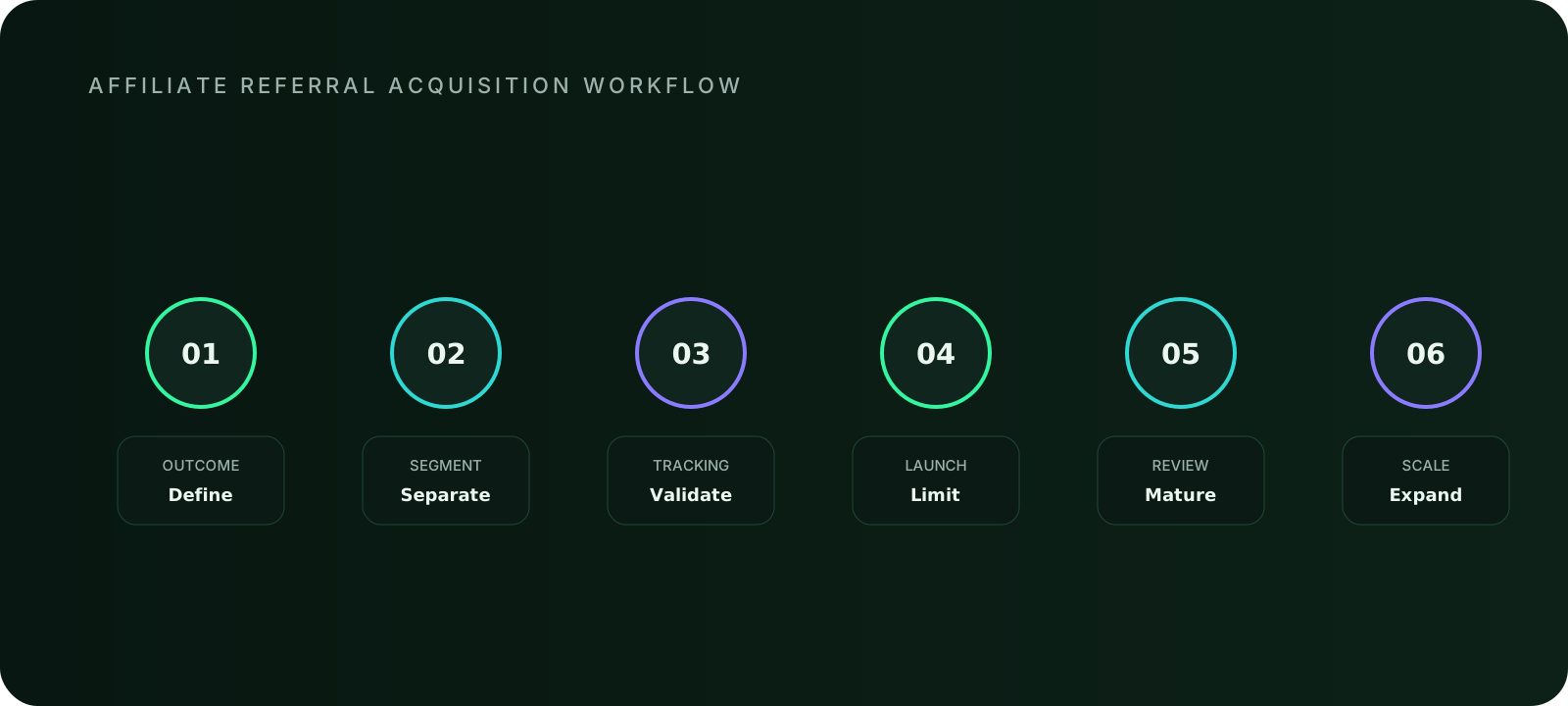
A nine-step Amazon affiliate traffic process
- Review current rules. Confirm programme participation, permitted traffic and promotion methods, disclosure requirements, restricted claims and destination conditions for the account and market.
- Select one content decision. Choose a specific comparison, use case, category or replacement question with helpful content and a clear eligible audience.
- Define accepted value. Set the mature net commission measure, full media and operating cost, attribution limitations, review date and maximum acceptable loss.
- Map the identifiers. Record campaign, creative, source, content page and affiliate tracking identifiers. Test the events you control and document gaps you cannot bridge.
- Align advertisement and page. Use a truthful message that the landing content immediately confirms. Do not imply a guarantee, official endorsement or unavailable offer.
- Launch a bounded cell. Limit budget, audience, sources and creative count. Keep a broader or previous stable comparison where practical.
- Inspect content behaviour. Review loaded sessions, meaningful engagement and qualified outbound clicks by source without treating them as commission.
- Wait for mature programme evidence. Reconcile attributed orders, reversals and net accepted commission on the defined schedule.
- Decide one next change. Keep, narrow, exclude, stop or expand one major variable and preserve the reason.
Do not accelerate a test merely because early click data is available. Affiliate order and commission evidence can mature later than the media report. Compare cells only after the same evidence window.
Choose the execution format
Choose a paid-media format that supports Amazon Affiliate Traffic
Use the criteria around “A seven-step amazon affiliate traffic process” to decide whether push, native, display or pop fits the message and destination. Set format, targeting and spend as campaign controls in FroggyAds while the amazon affiliate traffic decision remains the standard for judging the result.
Create My Free Account
Connect paid delivery with qualified affiliate value
The primary commercial measure is net accepted commission relative to complete acquisition cost. Because user-level reconciliation may be limited, keep observed platform and content events separate from programme-attributed orders. Report each layer with its own definition and evidence quality.
| Layer | Evidence | Decision use |
|---|---|---|
| Delivery | Impressions, clicks, spend, source, device and campaign IDs | Confirm where budget was used |
| Content | Loaded visits, reading depth, comparison interaction and destination quality | Find traffic or page mismatch |
| Outbound | Qualified affiliate-link clicks under a documented event rule | Measure progression toward the programme |
| Programme | Attributed ordered items, order state, reversals and accepted commission | Observe reported commercial activity |
| Economics | Net accepted commission minus media, content and operating cost | Choose keep, cap, exclude or expand |
Use qualified outbound rate, cost per qualified outbound click, programme-reported order rate, reversal share and net commission as connected diagnostics. A cheap content visit is not automatically valuable, and an expensive visit can still be useful if it produces stronger mature value. Avoid declaring causation from attributed orders alone.
Segment results by content page, product theme, campaign and source before reviewing the blended total. Apply the same time zone, currency, cost allocation and maturity rule. If tracking, link ownership or account status changes, begin a new comparison period.
Make the paid promise match the affiliate content
The advertisement should describe the reader benefit that the content can deliver: compare options, understand a use case, check compatibility or evaluate a category. Avoid a creative that promises a price, availability, ranking or product outcome the page cannot verify when the visitor arrives.
Put the affiliate disclosure where the reader can understand the relationship before it affects the decision. Keep editorial explanation and promotional elements clear. Review current requirements for the market and programme; a generic footer statement may not be sufficient for every placement or experience.
Use a compact creative test. Hold the content page and audience boundary stable while comparing a small number of truthful angles. Record the creative ID through the content event and outbound click. If an angle earns clicks but attracts readers whose needs do not match the page, remove or rewrite it.
Check mobile load, hierarchy, link labels, focus states and the route back to the comparison. A paid campaign cannot repair obsolete product details, broken affiliate links, inaccessible controls or content that does not answer the advertised question. Pause delivery while a material destination problem is unresolved.
Four Amazon affiliate traffic scenarios
Specific comparison
Reach readers comparing a defined set of product approaches. The advertisement names the decision, the content explains meaningful differences and the test measures qualified comparison engagement before programme outcomes.
Problem-to-category guide
Target a clear practical need without pretending one product fits everyone. Use criteria, exclusions and limitations to help readers narrow the category before following a disclosed link.
Accessory or compatibility help
Use model, format or environment context only when the content can verify it. Track invalid or unsupported combinations as a content-quality signal.
Seasonal planning page
Launch early enough for evidence to mature and for content owners to update stock-sensitive details. Separate short-lived demand from durable content value.
Each scenario owns a different question. Keep campaign names, content pages and tracking IDs distinct so one high-volume theme cannot hide another theme's weak relevance or poor commission economics.
Put the guide into practice
Turn Amazon Affiliate Traffic into a bounded campaign test
With “Three practical ways to apply amazon affiliate traffic” documented, launch only the next reversible test. Set a spending limit, preserve the baseline and use source-level and audience controls so the next step depends on qualified outcomes for amazon affiliate traffic, not activity volume.
Create My Free Account
Price paid affiliate traffic from net commission backward
Begin with the value that remains after reversals and with the share of a reader cohort expected to produce a qualified outbound click and a programme-attributed accepted order. Include media, content maintenance, disclosure review, tracking, analysis and campaign operations. Use conservative inputs because commission, price, availability and reversal patterns can change.
A transparent planning relationship is: expected net commission per paid content visit equals qualified outbound-click rate multiplied by mature accepted order rate multiplied by net commission per accepted order. Subtract the required operating and uncertainty buffer to set the maximum acquisition cost per visit. This is a planning model, not a price or performance claim.
Build a learning budget that can test the smallest useful audience and content cell. If the budget cannot support several segments through the maturity window, reduce scope rather than combining them. Stop when the maximum loss, compliance rule or content-quality boundary is reached.
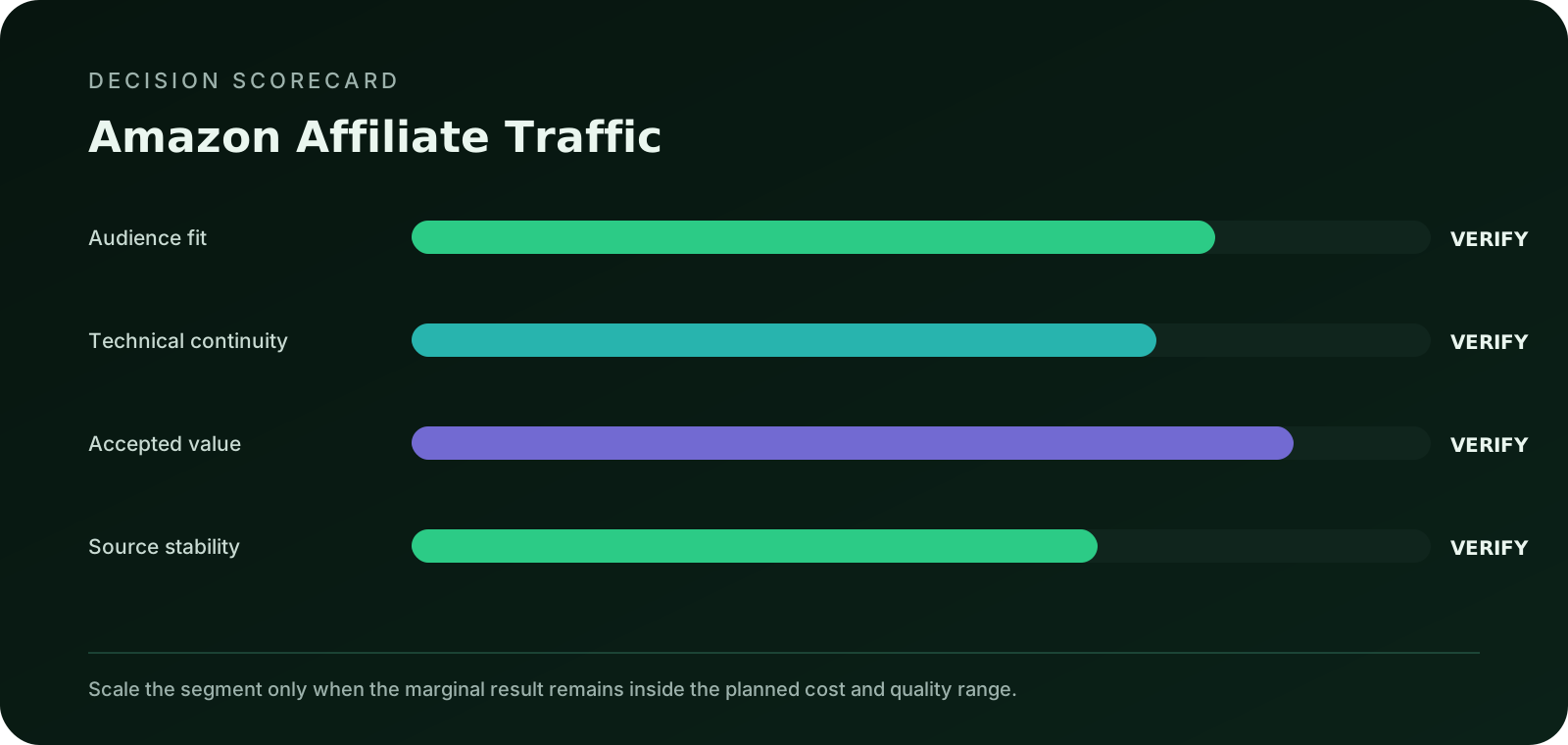
Scale from marginal performance. Compare the newest spend cohort with the prior stable level, including source concentration and frequency. The historical average can remain profitable after the next increment has become uneconomic.
Verify the campaign before releasing the full test budget
The team agrees on the event that creates accepted value and the maturity window.
Content page, tracking id, product theme and source are visible and do not overlap without a deliberate reason.
Click IDs, events, deduplication and reporting currency have been tested end to end.
The destination confirms the same promise, availability and audience context as the ad.
The test has a maximum downside, source-level pause rule and rollback condition.
The plan defines how much mature evidence is required before expansion.
Use a change log that protects attribution
For every material change, record the time, owner, affected campaign or source, reason, expected result and rollback condition. Preserve the prior audience, bid, budget, creative, content version and tracking configuration. Without that record, a later commission change cannot be connected confidently to the action.
Classify changes by layer. A media change modifies source, placement, device, schedule, audience, bid or budget. A content change modifies the comparison, product information, disclosure or affiliate link. A measurement change modifies an event, report, currency or maturity rule. Avoid moving several layers in the same observation window.
Use reason codes for exclusions: irrelevant intent, technical failure, policy risk, invalid activity, weak qualified progression, poor mature value or excessive concentration. Review whether an exclusion is still justified before carrying it into a new market or content theme.
Keep negative results. A source that attracts cheap clicks and few qualified outbound actions can be valuable evidence. It shows where relevance was weak and prevents the team from purchasing the same mismatch again.
Failure modes to prevent before scaling
Programme and reader risk
- The traffic source or promotion method has not been confirmed as permitted.
- The affiliate relationship is unclear at the point that influences the decision.
- The advertisement implies an endorsement, result or offer the content cannot support.
- Product details, price or availability have become stale.
- The content route encourages clicks without helping the reader evaluate the choice.
Measurement and budget risk
- Campaign IDs and tracking IDs cannot be reconciled at a useful level.
- Orders are judged before reversals and commission maturity.
- Attributed activity is described as incremental impact.
- Content and review cost is omitted from the profitability calculation.
- A blended total hides a losing source or product theme.
Assign a preventive control, monitoring signal, responsible owner and stop action to every material risk. Traffic-quality controls can reduce exposure, but the advertiser's accepted programme evidence remains the final quality signal.
Amazon Affiliate Traffic FAQ
Practical answers for advertisers, media buyers, store owners and app growth teams.
Which audience can become useful Amazon affiliate traffic?
Readers with a genuine product question can be suitable when the publisher offers relevant guidance and sends them through a properly disclosed permitted link.
What costs should an Amazon affiliate publisher count?
Include research, content creation, site operation, analytics, traffic acquisition where allowed and the effect of returns or unaccepted transactions. Judge those costs against accepted commission after reversals.
How should a paid traffic source be checked for affiliate use?
Confirm that the source, advertisement, destination and tracking approach comply with the current programme and advertising rules before spending. Do not buy clicks until permitted promotion methods and disclosure requirements are clear.
What is a controlled test for Amazon affiliate traffic?
Use a small permitted audience cell, one helpful destination and a fixed review period, then compare accepted programme activity with total acquisition cost.
Which disclosures and records should a publisher maintain?
Present the required affiliate relationship clearly and keep current terms, link ownership, content approvals and traffic-source evidence accessible. Record which sources are permitted and how order reversals affect commission.
How is affiliate traffic quality assessed?
Review engaged visits and accepted programme outcomes while monitoring reversals, rejected activity and sources that do not match the content's intent.
When can organic product content be preferable to paid traffic?
Organic discovery may fit when detailed comparison and durable trust matter more than immediate volume, provided the information stays accurate and useful.
Which metrics give an honest affiliate traffic view?
Compare net accepted commission, full acquisition cost, qualified click behaviour and reversal share under the programme's reporting maturity. Keep estimated results separate from directly observed events.
What traffic mistake can put affiliate work at risk?
Buying volume without checking programme restrictions or destination relevance can produce unusable actions and jeopardise an otherwise valuable publisher account.
What should be recorded after an affiliate traffic test?
Keep source settings, content version, disclosures, costs, accepted results and the rule used to stop, revise or repeat the campaign.
Continue with the next campaign decision
Use the related pages to connect targeting, destination quality, measurement and controlled scale.
Launch amazon affiliate traffic with clear controls
Create an account, check current traffic availability and build a capped test with the target segment, source IDs and accepted conversion event visible from the beginning.
Amazon affiliate traffic: a source-level framework
Direct answer: verify permitted promotion and disclosure first, then run a small source-visible campaign to helpful affiliate content. Judge the test with mature net accepted commission and full acquisition cost, while keeping clicks and attributed orders in their correct evidence categories.
Define the eligible opportunity
Write the reader question, market, content page, promotion method, source boundary and disqualifying conditions. Confirm the current programme and advertising rules before purchasing traffic. Do not infer permission from another publisher's campaign or from an old screenshot.
Separate targeting from observation
Target only the dimensions needed for the hypothesis. Preserve source, device, time, creative, content and tracking identifiers as reporting fields where available. Observation protects learning and lets the team decide later whether a stricter rule deserves a controlled test.
Protect the reader journey
Carry the creative promise into useful content, present the required relationship disclosure and provide decision criteria rather than a thin bridge to an affiliate link. Validate mobile usability, link ownership and current product information before releasing meaningful budget.
Evaluate mature economics
Reconcile media spend, qualified content engagement, outbound clicks, programme-attributed activity, reversals and net commission. Use comparable time windows and label estimates separately from observed events. A campaign can generate many clicks and still fail the compliance, relevance or cost boundary.
Scale without losing the explanation
Increase one major variable after the result repeats across enough sources and time. Monitor marginal value, source concentration and content capacity. Keep the prior stable state available so a weak expansion can be reversed without rebuilding the entire campaign.
| Gate | Required evidence | Failure response |
|---|---|---|
| Permission | Current programme, source, destination and disclosure review | Hold spend until the method is confirmed |
| Journey | Truthful creative, helpful content and functioning permitted links | Repair the message or page before relaunch |
| Delivery | Source-visible spend, valid traffic and technical evidence | Block weak delivery or narrow the cell |
| Value | Mature attributed orders, reversals, commission and full cost | Stop when net accepted value misses the boundary |
| Repeatability | Comparable results across the declared window | Keep the campaign capped until independently confirmed |
Primary and industry documentation
- FTC Endorsement Guides and affiliate-link guidance
- Shopify reports and analytics context
- WooCommerce analytics documentation
- web.dev guidance on ads and page speed
- Shopify campaign concepts
- Shopify marketing-performance context
- Google Analytics traffic-acquisition report
- Google Ads invalid-traffic context
- IAB/MRC viewable-impression guidance
These references provide general disclosure, analytics and media-quality context. They do not replace the current Amazon Associates agreements, policies or account reporting. When the campaign boundary is approved, start your next traffic campaign with FroggyAds.
Amazon affiliate traffic: the task this URL owns
This guide is for an affiliate marketer, media buyer or agency deciding whether paid traffic can bring relevant readers to compliant Amazon affiliate content under a controlled cost and measurement plan. It does not teach general affiliate tooling; the related affiliate marketing tools guide owns that adjacent selection task.
What you should know before launch
You need a current programme-policy review, a clear disclosure, useful content, stable campaign and tracking identifiers, a mature commission window and a maximum total acquisition cost. If one is missing, hold the affected test rather than substituting clicks for evidence.
What FroggyAds contributes
We give advertisers a self-serve paid-traffic workflow with supported formats and campaign controls. You can bound the source, audience, budget and creative test, then use your content analytics and programme report to judge mature accepted value.
Hypothetical planning example: if USD 300 in complete acquisition cost produces USD 420 in mature net accepted commission, the observed surplus before other business costs is USD 120. If later reversals reduce accepted commission to USD 280, the same test has a USD 20 shortfall. Use your actual programme, cost and maturity data; this is not a FroggyAds performance claim.
When permission, content and measurement are ready, create your free FroggyAds account and launch the smallest campaign that can answer the buying question.
What matters first for Amazon affiliate traffic?
First verify that the promotion method, source, destination and disclosure meet the current programme and advertising rules. Then connect one relevant audience to one useful content page with a capped budget and stable identifiers. Scale only after mature net accepted commission, reversals, full acquisition cost and content quality support the next step.