AI marketing, AI search and funnel operations

AI SEO Tools: Evaluation Criteria, Workflows and Risks

AI SEO tools should be evaluated by data provenance, task fit, reproducibility, exportability, human controls and whether recommendations align with official search guidance.

ai seo tools
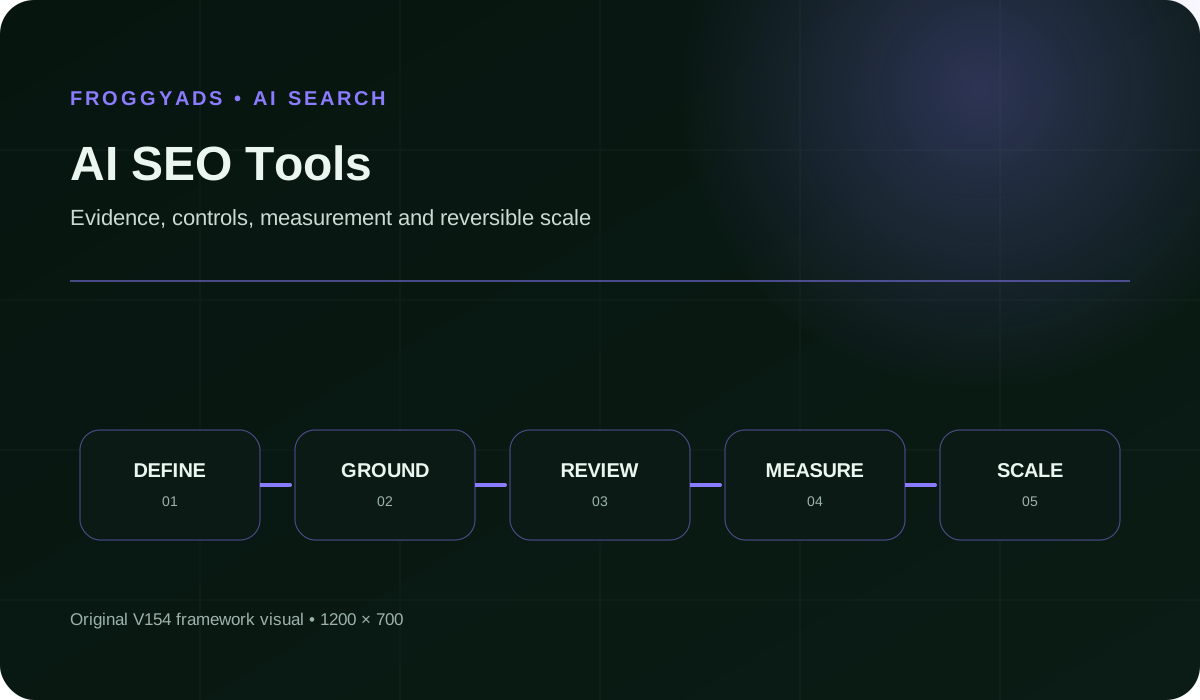
AI SEO Tools operating framework for planning, controls, measurement and scale

How should AI SEO tools be evaluated?

AI SEO tools should be evaluated inside a configured tenant using the team's real task, permitted data and acceptance rules. Buyers should test provenance, reproducibility, exports, human controls, integration, total operating cost and whether recommendations align with current official search guidance.

A feature list or composite score cannot prove fit. The same product may be useful for crawl clustering and weak for content generation, or strong in a demonstration but impossible to audit after deployment. Procurement should separate every claimed job and require evidence for the version and account being purchased.

This page compares tool categories and the buying process. It does not rank named vendors, run an SEO program or claim that third-party systems have access to search-engine ranking data. Google explicitly warns that third parties cannot guarantee performance or present their predictions as internal Google information.

  • Freeze requirements before watching product demonstrations.
  • Test recommendations against official guidance and real implementation evidence.
  • Measure accepted output, correction work and full cost by job.
  • Require data export, access removal and a usable exit path.
  • Procure only distinct value; remove overlap and ungoverned shadow use.

Which categories of AI SEO tools solve different jobs?

Research tools organize query, result and competitor observations. Content systems help structure briefs, draft or evaluate text. Technical products crawl, render and prioritize implementation patterns. Monitoring systems track search visibility, changes and alerts. These jobs require different evidence and should not be collapsed into one score.

Some products wrap several categories in one interface. Integration can reduce handoffs, but it can also hide the origin of a recommendation. Ask which underlying dataset, crawler, model and rule produced each output and whether the evidence can be exported.

A product label does not define authority. A tool may generate a title candidate, but it should not publish that title unless the approved workflow grants a named role, review step and rollback. Map read, draft, recommend, edit and publish permissions separately.

Start with the job register. Name the current process, pain, accepted output, owner, frequency, evidence and cost for each job. A product belongs in the stack only when it improves one of those records without creating disproportionate risk or duplicate work.

What should be tested for each AI SEO tool category?

Tool categoryConfigured testEvidence of fit
Query researchImport a dated first-party sample and compare grouping decisions.Traceable source rows, useful intent distinctions and exportable reviewer edits.
Content briefingCreate briefs for neighboring pages with locked exclusions.Distinct ownership, source mapping and no keyword-swapped structure.
Content evaluationScore known strong, weak and misleading passages.Consistent reasons, material error detection and low false-positive burden.
Technical crawlingRun representative status, canonical, rendering and link cases.Accurate raw evidence and reproducible prioritization.
Internal linkingPropose links for a family with known canonical targets.Exact source placement, descriptive anchor and direct valid destination.
Visibility monitoringBackfill an agreed page and query panel.Stable definitions, retention, export and documented provider coverage.
AI mention trackingRepeat a versioned prompt panel across dates.Stored answers, citations, model context and honest sampling limits.

How should vendor claims be challenged?

Convert every material claim into a testable statement. Better rankings needs a defined population, comparison, period and attribution method. Saves time needs the complete workflow, including setup, review, correction, export and incident work. AI visibility needs a declared prompt and provider sample.

Ask whether the claim describes a feature, controlled study, customer average or selected case. Request the numerator, denominator, exclusions and version. A percentage without these fields is not procurement evidence.

Google's third-party SEO guidance states that external tools do not have access to its internal ranking data and cannot guarantee performance. A tool can calculate a proprietary score, but the interface must label it as the vendor's model rather than a search-engine metric.

Record unsupported assertions as open risks, not as reasons to fill the page with counterclaims. The buyer can run a configured trial, decline the feature or require contract language that accurately describes the service boundary.

What does data provenance mean for an SEO product?

Provenance identifies where a metric or recommendation came from, when it was collected, how it was transformed and which version produced it. Search Console data, third-party crawls, estimated demand and model-generated suggestions have different authority and should remain distinguishable after export.

Inspect connectors and permissions. Record which properties, accounts, URLs, queries and personal or confidential fields the product can access. Test least-privilege roles, credential rotation, deletion and what remains after a user or integration is removed.

Ask how training and service improvement use customer inputs. Review current contractual and privacy terms with the accountable owner rather than relying on a salesperson's summary. Do not upload unpublished strategy, customer data or credentials to an unapproved model.

A usable export preserves raw inputs, normalized fields, recommendation text, timestamps, owners and reviewer states. A screenshot of a dashboard is insufficient for audit, migration or a later dispute about how a decision was made.

How should recommendation reproducibility be tested?

Run the same frozen case more than once and record product version, model choice, settings and time. Exact text need not remain identical, but material classification, evidence and action should be stable enough for the job. Unexplained reversals create review cost.

Use known controls. Include pages with valid canonicals, intentional noindex, correct structured data and legitimate duplicate boilerplate, plus real defects. A useful system distinguishes them instead of maximizing issue count.

Compare the recommendation with raw source and official documentation. The tool should expose enough evidence for a reviewer to agree or reject. A black-box severity score without the affected element or rule is not implementation-ready.

Measure reviewer agreement and false positives by issue class. A product can have high overall accuracy while missing the rare canonical or robots error that matters most. Weight severity according to the buyer's site and recovery cost.

How should generated content features be assessed?

Test whether the feature accepts an evidence packet, preserves claim limits and distinguishes facts from suggestions. A blank-box generator encourages generic copy because it lacks the organization's source material, audience knowledge and page ownership map.

Use neighboring intents in the trial. Check exact and semantic repetition across outputs, not only grammar. Two drafts can use different sentences while delivering the same generic message and still fail the reason-to-exist requirement.

Inspect editing and attribution. Reviewers need to see source links, changes, comments and approval state without losing the original brief. The final page should not contain hidden prompt fragments, placeholder expressions or unsupported citations.

Price accepted material, not generated words. Include briefing, source preparation, editing, fact checking, duplicate review, implementation, maintenance and rejected drafts. Cheap first output can be expensive usable content.

Which integration and workflow controls matter?

List every source and destination system, data direction, credential owner and failure behavior. A CMS integration can turn a research aid into a publisher; a ticket integration may be safer because it preserves approval and implementation ownership.

Test staging before production. Confirm how the product handles branches, previews, concurrent edits, failed updates and rollback. An integration should not rewrite files outside an allowlist or create sitewide changes from one accepted recommendation.

Require observable jobs and error logs. A scheduled crawl or content refresh that silently stops can leave dashboards looking current. Record last successful run, coverage, incomplete states and notification ownership.

Avoid adding client-side widgets to public pages for a backend SEO workflow. Data collection and recommendations should not introduce render-blocking scripts, layout shifts or third-party requests to the site being optimized.

How should total tool cost be calculated?

Cost layerWhat to includeCommon omission
LicenseBase plan, seats, properties, crawl or prompt allowances and overage.Assuming demonstration access matches the purchased tier.
SetupConnector work, security review, taxonomy, baselines and training.Treating internal implementation time as free.
OperationRuns, data storage, model use, monitoring and administration.Ignoring variable usage and duplicate products.
ReviewQualified acceptance, false positives, correction and escalation.Pricing generated recommendations instead of accepted changes.
RiskIncidents, data exposure, bad deployments and recovery capacity.Averaging severe failures into routine accuracy.
ExitExport, replacement, credential closure and historical retention.Assuming data and workflow are portable.

How should the procurement pilot be run?

Freeze a small case set representing the intended jobs and difficult edge cases. Define accepted output, reviewer, evidence, time window, stop condition and current-process baseline before the vendor configures the demonstration.

Use the purchased or contractually offered configuration. A vendor-led result using services, hidden data or a higher tier does not prove that the operating team can reproduce it. Record every manual intervention.

Measure output quality by job, complete time, error severity, evidence export, user effort and downstream outcome. Interview reviewers and operators separately because a faster analyst interface can transfer work to developers or editors.

End with an approve, restrict, revise or reject decision and reasons. Conditional approval should name permitted use cases, data, roles, review, monitoring and renewal evidence rather than allowing all product features by default.

What must be completed before signing an AI SEO tool contract?

The record should make the product's authority, evidence and exit obligations explicit.

  1. Approve a job register and frozen acceptance criteria.
  2. Confirm purchased features, limits, support and service configuration.
  3. Map data sources, destinations, regions, retention and subprocessors.
  4. Test least-privilege access, audit logs and credential closure.
  5. Verify claims with the configured pilot and retained evidence.
  6. Document human review and production publishing authority.
  7. Calculate complete operating and correction cost by job.
  8. Export data, recommendations and reviewer history in a usable format.
  9. Define material-change notification and revalidation triggers.
  10. Agree the termination, deletion, migration and business-continuity plan.

When should an AI SEO tool be removed?

Remove a product when it no longer owns a distinct valuable job, when overlap makes evidence inconsistent or when accepted value does not exceed full cost and governance burden. Renewal is a new decision, not an automatic reward for prior setup effort.

Security, privacy, policy or product changes can trigger immediate review. Suspend affected connectors while owners evaluate new model behavior, terms, data handling or publishing authority. Do not wait for the annual renewal if the approved boundary changed.

Plan removal before adoption. Export necessary history, assign replacement jobs, close scheduled tasks, revoke tokens, delete retained data where required and test that no public script or background process remains.

Record what was learned. A rejected or retired tool can still improve requirements and reveal workflow weaknesses, but it should not remain connected merely because teams may use it again later.

How should FroggyAds compare tool advice with its own pages?

FroggyAds should treat every issue as a claim requiring page evidence. A tool warning about word count, code blocks, pronouns or link limits is not automatically relevant. The reviewer should connect the rule to user need, official guidance and the page's intent.

Clear defects, such as a truncated meta description, visible template code, wrong country text or invalid canonical, justify scoped repair. Heuristics that reward irrelevant formats should remain rejected and documented rather than implemented across thousands of pages.

Use cumulative comparisons so a new batch cannot reintroduce text already removed elsewhere. Tool-level duplicate checks are useful, but the final gate should use the site's locked corpus and semantic thresholds under FroggyAds control.

Preserve speed and layout. A procurement feature that requires public JavaScript or a widget should prove user value and performance safety. Backend analysis alone does not justify adding network cost to every visitor.

How should an AI SEO tool trial be scored in a configured tenant?

A sales demonstration shows a curated interface, not how the product behaves with your crawl rules, analytics model, page families and permissions. Build the trial in a restricted tenant using a representative but controlled site subset. Document connectors, data ranges, user roles, exclusions and defaults so another evaluator can reproduce what the tool was allowed to see.

Create a blind verification set before the trial. Include known canonical conflicts, valid intentional duplicates, structured data that is present only after rendering, pages with different search intent and clean controls. Score whether the tool detects the known issue, explains its evidence and avoids false positives. A large issue count is not useful if reviewers must rediscover the truth manually.

Test recommendation stability. Run the same input under the same configuration and compare outputs, priorities and cited evidence. If results change, the vendor should explain whether the model, index, prompt layer or external data changed. Reproducibility does not require identical prose, but the underlying classification and corrective boundary should remain understandable.

Measure the work after export, not only inside the dashboard. Confirm that raw observations, URLs, timestamps, rules and decision history can be exported in usable formats. Check whether the team can retain evidence and reverse implemented changes after cancellation. A tool that locks the audit trail to its interface creates operational and governance cost beyond the subscription price.

Record human effort by task: configuration, exception review, false-positive investigation, implementation, QA and reporting. Compare this with the current workflow and with the value of correctly accepted recommendations. Time saved during drafting can be offset by more verification or remediation, so use net reviewed capacity rather than vendor-estimated automation hours.

Finish with a written procurement decision that names approved uses, prohibited automations, data retention, responsible roles, renewal evidence and exit steps. The tool should earn expansion through verified precision and usable evidence. It should not receive publishing, redirect or index-control authority merely because its aggregate score appears sophisticated.

Challenge the commercial scorecard with edge cases before signing. Ask the product to separate a blocked fetch from missing markup, a deliberate canonical alias from a duplicate error and a recommendation from an implemented change. Confirm which calculations are documented, which use proprietary estimates and which depend on data the configured tenant cannot access. Unknown inputs should stay visible instead of being converted into reassuring precision.

Buyer questions for AI-enabled SEO products

What are AI SEO tools?

They are products that use models or automation for search research, content support, technical analysis, linking or visibility monitoring. Each category needs its own evidence and acceptance criteria.

Can an AI SEO tool guarantee rankings?

No. Google states that third-party services do not have access to its internal ranking data and cannot guarantee performance. Vendor scores and forecasts are proprietary estimates.

How should AI SEO tools be compared?

Use the same frozen jobs, inputs, account configuration, acceptance rules and full-cost method. Compare accepted output and severe failures rather than feature counts or polished demonstrations.

What data should an SEO tool be allowed to access?

Only data required for approved jobs, through least-privilege roles. Record properties, accounts, fields, regions, retention, destinations and how access and stored data are removed.

How do you test an AI recommendation?

Preserve the input and settings, repeat known cases, inspect raw evidence and compare the proposed action with current official guidance and the real implementation.

Should an AI SEO tool publish directly to a CMS?

Direct publishing increases consequence and should be disabled by default. Use preview, diff, named approval and rollback; grant production authority only after a bounded integration trial proves control.

What is the best metric for an AI SEO tool?

Use accepted recommendations by job together with precision, reviewer time, severe failure rate, full workflow cost and mature outcomes. No single score represents all tool value.

How many AI SEO tools should a team buy?

Buy only products with distinct approved jobs whose accepted value exceeds license, integration, review and exit costs. The job register, not team size or a universal benchmark, determines the count.

When should a tool be revalidated?

Revalidate after material model, data, connector, permission, price, policy or output changes and before renewal. Suspend affected authority when the configured service no longer matches approval.

How do you leave an AI SEO tool?

Export required data and history, migrate owned jobs, close schedules and connectors, revoke credentials, complete deletion obligations and confirm that no public resources or background processes remain.

Primary product, search, risk and claims references

FroggyAds reviewed this procurement framework on 2026-08-11. Google sources define first-party data surfaces and warn about third-party claims, NIST informs risk review and the FTC informs substantiation. None of these sources certifies a product or predicts its return.

Procure evidence, not a score

Keep SEO tooling controlled while you test real advertising demand

Create My Free Account