
Advertising Network Turkey
By FroggyAds. Published 15 July 2026; updated 23 October 2026.
Buy traffic for an eligible Turkey offer through a FroggyAds campaign you can control and measure. Choose the available format, match the ad to a Turkish-language customer path, and set a campaign budget. Our source-level reporting helps you decide which traffic deserves further testing against your accepted leads, orders or signups.
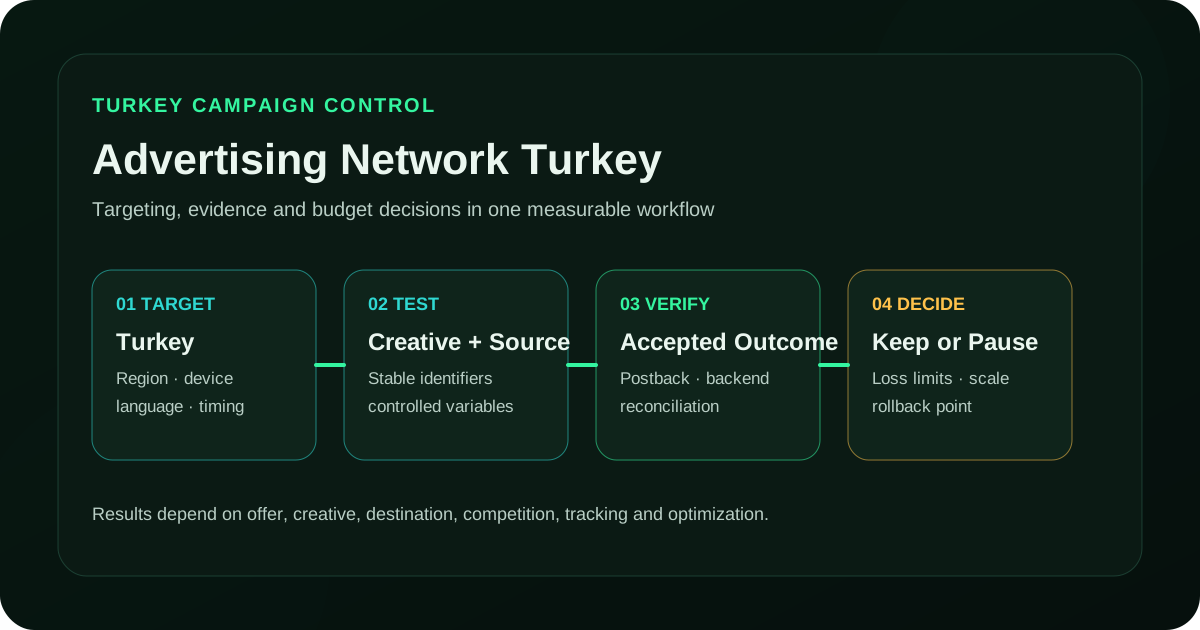
What does an advertising network for Turkey need to support?
For a Turkey acquisition campaign, choose a network that lets you identify the available traffic, express your audience requirements and review the resulting spend by source. Ask what the country and format settings actually support before funding the test. A country label does not tell you which publisher a visitor came from, which language that person understands or whether your business can serve the offer.
We give you self-serve campaign management with bids, budgets, reporting and supported targeting or source controls. For an affiliate marketer, that means testing a permitted traffic route against the merchant’s approval record. For an agency, it means keeping a client’s Turkey campaign separate from its other markets. Select the controls your chosen format supports and keep the business acceptance rule explicit.
How should you verify the Turkey customer journey before buying traffic?
A visitor becomes useful only when the full path works: the advertisement makes a clear promise, the destination explains the same offer, the person is eligible, and the advertiser can verify the completed result. Before launching, review Turkish-language requirements, price and currency presentation, available payment steps, delivery or service coverage, support information and any category-specific conditions. Confirm them from your own operating data rather than assuming that a country target makes the offer ready.
Map each potential failure to its owner. Media settings control where and how traffic is bought. Creative controls what users expect. The site controls comprehension and completion. Tracking connects delivery to the advertiser record. Separating these responsibilities helps you fix the correct layer when performance changes.
What should your first Turkey traffic test prove?
Choose one commercial question. A hypothetical retailer might test whether a Turkish-language product proposition produces confirmed, serviceable orders at an affordable media cost. A SaaS team might judge eligible trial activations instead. Keep those goals separate: an inexpensive registration does not answer the retailer’s order question, and an order metric cannot explain whether a software trial reached its intended task.
Keep the operational fields behind the test: campaign ID, source ID, creative version, landing-page version, start time, targeting snapshot, event definition and validation window. If a result cannot be traced to those fields, it should not decide a source exclusion or budget increase.
When should a Turkey campaign split devices, cities or sources?
Use operational differences to decide when to split Turkey delivery. A service limited to Istanbul and Ankara needs a narrower destination eligibility check than a digital offer available nationwide. Where city targeting is supported, verify its available coverage rather than assuming street-level precision. Compare device paths separately when a mobile checkout or signup behaves differently, and avoid dividing the budget into too many weak samples.
Begin with the broadest cell that preserves offer validity. Observe delivery and downstream value, then open a separate segment when the evidence points to a distinct condition. Record why it was created and which action it can receive. This keeps the account understandable as the test grows.
Who is eligible for the Turkey offer and customer path?
Describe the people who can actually use the offer. Turkey location and Turkish language are separate conditions: a Turkish-speaking customer abroad may need a different service route, while someone in Turkey may prefer another supported language. For a store, confirm the delivery area and product availability; for a subscription, confirm access and recurring terms. Make material conditions visible before the action is submitted.
Choose an audience boundary that the platform can express and the advertiser can validate. The goal is not to predict an individual buyer. It is to remove known mismatches, buy a controlled opportunity and measure whether accepted value appears within the test limit.
How can FroggyAds turn your Turkey brief into a campaign?
Build the Turkey campaign from that offer brief. Choose a supported format, country and relevant device or source settings, then set the starting bid and budget. Our self-serve workflow lets you keep the first test focused and change the campaign as evidence develops. Preserve the opening settings and compare source results only after your advertiser-side approval process has had time to settle.
Create your free FroggyAds account and build the first Turkey campaign with a named audience, fixed test ceiling and measurable outcome.

Which format can explain your Turkish offer clearly?
Use the format to set the right expectation. A Push creative has a short headline, description and icon, so make its Turkish invitation immediately understandable. Native adds an image, title and description; Display uses a banner. Pop relies on the destination to explain the offer. Confirm which inventory is available for your Turkey campaign, then test a message the landing page can fulfil.
Test the exact destination on the targeted devices. Confirm page load, form behavior, consent, confirmation, payment and support paths. Cheap delivery cannot repair a journey that fails after arrival.
What should a Turkish creative review check?
Ask a competent Turkish-language reviewer to check meaning, spelling and the complete commercial condition. Preserve Turkish characters in product names and customer-facing text, and inspect shortened or capitalised versions rather than assuming they still read correctly. Check the actual headline and destination together. A price, qualification or recurring-payment condition that disappears from the short creative can attract the wrong expectation.
Test genuinely different propositions. One concept might lead with convenience, another with a concrete capability and a third with a transparent commercial condition. Give each version a permanent ID and judge it on accepted outcomes as well as clicks.
Which Turkish checkout and signup details affect acceptance?
Check the final path, not just the translated headline. A Turkish-language form should accept the names, contact details and address formats your business requires without corrupting the input. Test the phone-number instruction, required fields, order confirmation and support response using controlled examples. For subscriptions, show the billing period and renewal condition. These are checks on your own site or merchant, not features supplied by a traffic network.
When the Turkey path differs from another market, version the destination and record that version with every campaign cohort. This prevents a site change from being mistaken for a traffic-source change.
Preserve identifiers from delivery to advertiser acceptance
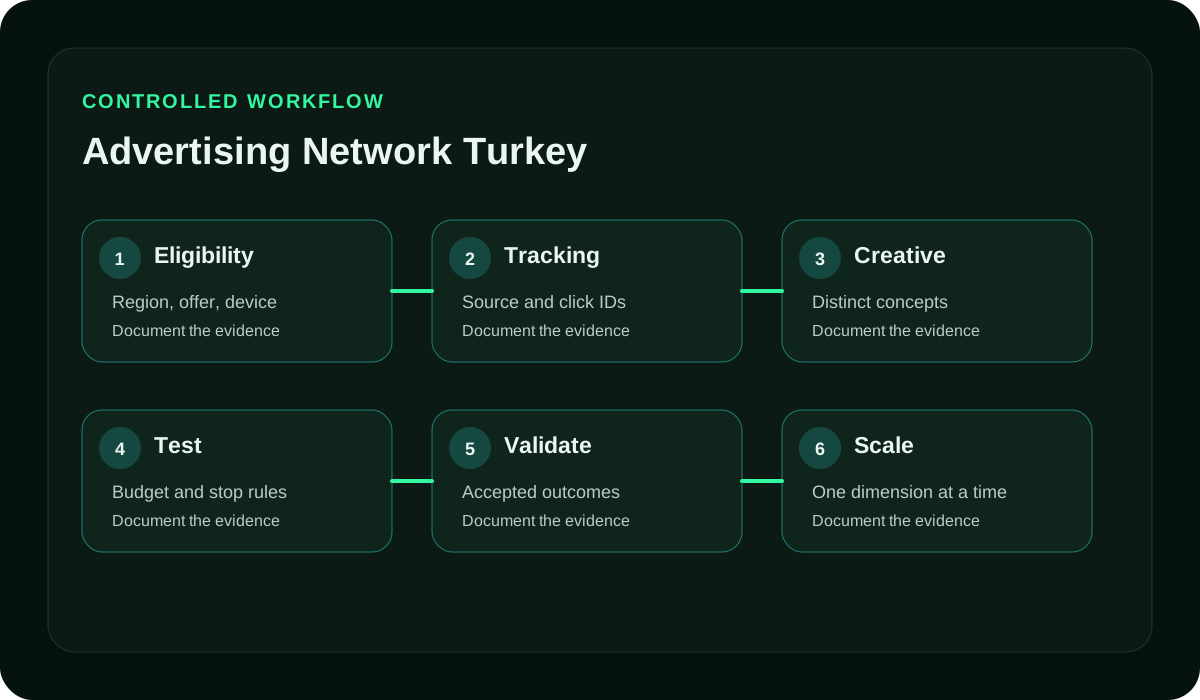
Run a controlled click through the actual redirect and conversion setup, then check that the source or campaign identifier reaches the record used for approval. Test both a completed action and a repeated notification of the same action. Keep event timestamps, reporting time zones, original currency and duplicate rules consistent. Use only the tracker, pixel or postback fields supported by your implementation.
Keep source, country, device, creative and destination identifiers through the validation window. If privacy or system design requires aggregation, define the aggregation before launch and preserve enough detail to diagnose a country or source pattern.
How should Turkish-lira orders be compared with media spend?
Keep the transaction currency visible. If the merchant accepts orders in TRY and the media account records spend in USD, retain the original amounts and apply one documented currency basis when comparing accepted cost or contribution. Separate the value at order creation from any later payment or refund adjustment. This prevents a revised price, exchange assumption or refund from being misread as a change in traffic quality.
FroggyAds lets you plan traffic acquisition across supported formats and keep campaign evidence in one operating workflow. Start your next campaign with FroggyAds.

Protect the Turkey learning phase with a staged budget
Set the learning allowance from your own unit economics and approval delay. Our published USD 50 minimum deposit is account funding; it is separate from the bid and from the amount you assign to a Turkey campaign. Keep a daily limit, a total test ceiling and a clear decision about when more spend is justified. A low deposit or entry bid does not guarantee enough accepted conversions to choose a winner.
Release budget in stages tied to settled evidence. An early stage proves tracking and path integrity. A later stage compares mature source outcomes. Expansion begins only after the accepted-cost or contribution boundary survives a meaningful increase.
Compare Turkey media on effective business cost
Calculate cost from the advertiser-approved denominator. If a cohort spends USD 200 and records ten settled accepted outcomes, its accepted cost is USD 20. Rejected, duplicate or refunded events should follow the documented business rule rather than being silently counted as value. Replace the numbers with your data; this is a calculation example, not a FroggyAds benchmark.
Include operational cost when it changes the choice. Manual review, payment failure, returns or customer support can make two equal dashboard conversion rates economically different.
Judge Turkey traffic with source, device and outcome signals
Read Turkey delivery through both media and merchant records. Use source and device reporting to locate the traffic, then check which actions remained accepted after the normal approval, cancellation or refund process. Where Turkish-lira prices changed during the test, keep the offer version with the cohort. Compare the traffic that saw the same commercial terms before attributing a difference to the source.
Compare settled cohorts with the same attribution rule. A fresh cohort with incomplete approvals should not be judged against an older cohort that has finished validation. Mark maturity explicitly in every review.
Use keep, watch, cap, exclude and retest states for Turkey sources
Keep a source that remains inside the boundary with stable tracking. Watch one that looks promising but lacks mature volume. Cap delivery when risk or uncertainty needs a smaller learning rate. Exclude after repeated negative evidence supports the lost reach. Retest when a corrected destination, creative or tracking path changes the original condition.
Store the reason, owner and date with every state. A source decision without its evidence is difficult to audit and easy to repeat incorrectly.
Change one major Turkey campaign variable at a time
Choose whether the next test changes bid, budget, source set, device scope, creative concept or destination. Hold the remaining decision inputs stable. This preserves a useful comparison and a clear rollback point.
Some operational repairs must happen together, such as fixing a broken event and its postback mapping. Label that intervention as a measurement repair rather than treating it as ordinary optimization. Resume performance comparisons only after the path is verified again.
Turn Advertising Network Turkey into a bounded campaign test
Before launch, confirm the named offer, Turkish customer path, audience rule, format, tracking event, accepted-result definition, daily limit, total ceiling and stop owner. Save the baseline so a later edit cannot erase what the first cohort actually received.
Choose FroggyAds for your Turkey traffic campaign when you are ready to connect that plan to self-serve buying and source evidence.

Measure Turkey traffic through accepted conversion value
Build a scorecard with campaign and source IDs, spend currency, Turkish offer version, device, settled accepted outcomes and review date. Include the original TRY order value where relevant, the comparison currency and the conversion basis used. Keep rejected or refunded outcomes visible rather than silently removing them from the history. Another buyer should be able to reproduce the accepted-cost calculation.
Use diagnostics to explain the scorecard, not replace it. A source may have a high click rate and weak approval. Another may deliver slowly but produce stronger accepted value after maturity. The economic result decides allocation.
Set loss, quality and compliance stops before Turkey delivery
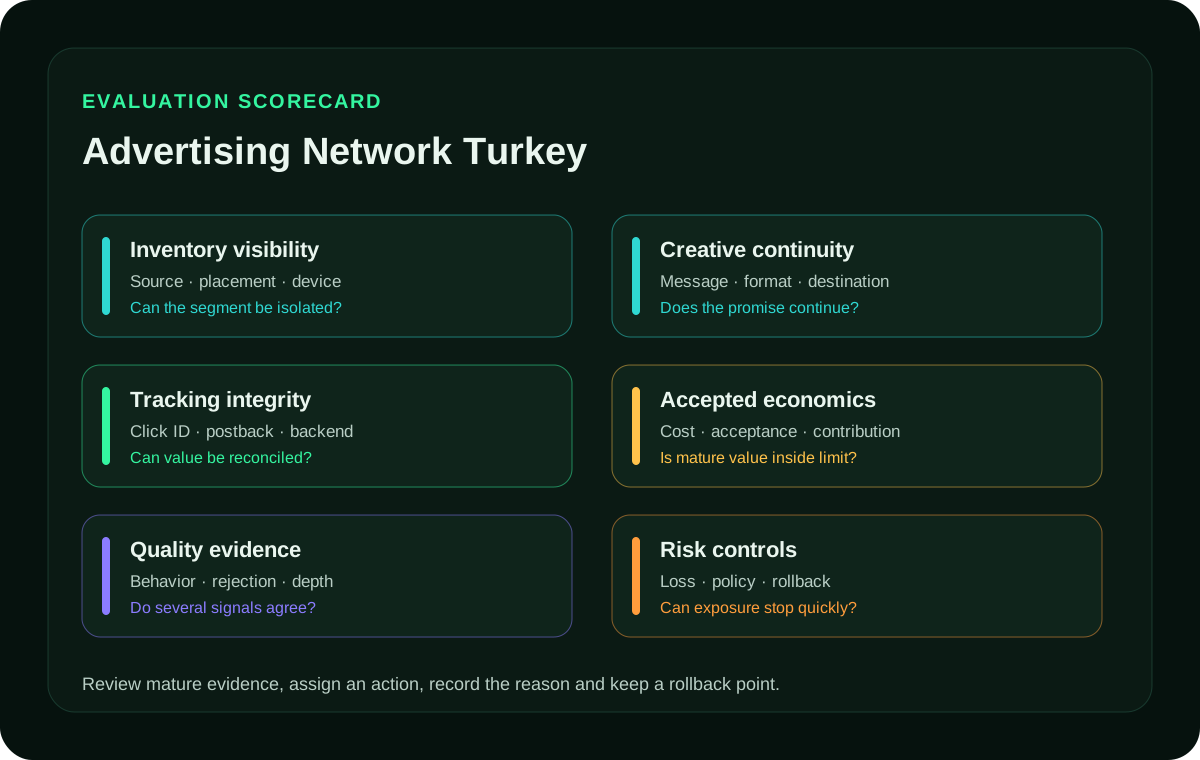
Pause immediately when tracking breaks, the destination is unavailable or the offer is no longer eligible. Stop or reduce a mature cell when accepted economics cross the written loss boundary. Escalate suspicious traffic with campaign IDs, source IDs, timestamps and the exact observed pattern.
Compliance stops belong in the same operating plan. A policy, consent, disclosure or fulfillment change can invalidate a previously acceptable setup even when media metrics look stable.
Scale only the Turkey segments that earn more budget
Increase one dimension after the current cell has enough mature evidence. Compare the marginal country, source or device results produced by the increase with the prior baseline. If the source mix or accepted cost deteriorates, restore the last reliable setup and investigate the new delivery.
Scale is reversible. Keeping the prior settings, cohort dates and action log protects the advertiser from turning a temporary expansion into an unexplained account-wide change.
How can you plan for price, acceptance and volume changes?
Model a price-change case, an approval-delay case and a lower-volume case. The first asks whether the offer remains viable when your own Turkish-lira price or cost changes. The second asks how much spend can remain undecided while merchant outcomes mature. The third asks whether tighter targeting can gather enough evidence. Use stated assumptions; none of these cases predicts a currency movement or campaign result.
For each case, name the action it would change: revise the offer, reduce the daily allowance, extend the observation period or choose a broader eligible segment. Keep a price revision in a new offer version so it does not rewrite the earlier test. Update assumptions with observed campaign and merchant records as they become available.
Close every Turkey review with a dated action
Record what changed, why it changed, who approved it, when it took effect and which metric will confirm or reverse it. Attach the affected source, campaign, creative and destination IDs. A dated record keeps later reviews from attributing an old cohort to a new setting.
Schedule the next review according to outcome maturity rather than convenience. Operational faults can be checked continuously; accepted business performance needs the full validation window defined before launch.
Practical review table for Advertising Network Turkey
| Review item | Evidence | Possible action |
|---|---|---|
| Eligibility | Country, language, device and offer rules match the destination and accepted customer. | Retain the cell or separate the incompatible path. |
| Tracking | Click IDs, events, timestamps and approval records reconcile for the settled cohort. | Continue analysis or pause for measurement repair. |
| Source value | Spend and mature accepted outcomes show a repeatable pattern with adequate volume. | Keep, cap, exclude or plan a controlled retest. |
| Scale | The prior increase stayed within accepted cost and did not introduce an unsafe source mix. | Open one additional budget, bid or audience dimension. |
| Governance | The offer, consent, disclosure and fulfillment conditions remain valid. | Continue, correct the path or stop affected delivery. |
Three ways to stress-test a Turkey campaign plan
Check Turkish copy from the ad to confirmation
Check the Turkish product name, price statement, offer conditions, form instructions and confirmation as one route. Then inspect every device path you intend to buy. A translated ad followed by a confusing checkout creates a different problem from weak source performance; record the failing step so the site owner can correct it before you buy more traffic.
Delay the approvals
Check whether the budget and reporting process can wait through the real validation period without treating incomplete outcomes as failures or spending beyond the learning limit.
Break one system
Describe what happens if the pixel, postback, landing page or payment path fails. Name the stop owner, retained evidence and exact condition required before delivery resumes.
Advertising Network Turkey FAQ
How do I choose an advertising network for Turkey?
Choose a network that can support the eligible country, format and audience settings you need while preserving budget control, source evidence and measurement. Compare options with the same offer and accepted-outcome rule.
Does Turkey targeting guarantee Turkish customers?
No. Country targeting narrows delivery by location signals; it does not guarantee identity, eligibility, intent, conversions or profit. Verify the customer path and judge mature advertiser-accepted outcomes.
Should Turkey creative be written in Turkish?
Use the language your intended audience can understand and the destination can support. Test language deliberately, keep offer conditions consistent and record the creative version with every cohort.
Which Turkey campaign metric should control budget?
Use a mature accepted business event and its cost or contribution value. Impressions, clicks, visits and platform conversions remain diagnostics until they reconcile with the advertiser record.
How much should a Turkey traffic test spend?
Set an amount that fits your own economics and maximum learning loss. Keep the test budget distinct from a bid or account funding, and release additional spend only after the defined evidence matures.
Can FroggyAds target devices and sources for Turkey?
Depending on format and campaign context, supported controls can include country, city, device, operating system, browser, carrier, category, source, ID and IP options. Use only controls relevant to eligibility or analysis.
How should Turkey traffic quality be assessed?
Combine Adscore-supported screening and FroggyAds source evidence with destination checks, stable tracking and advertiser-side acceptance. Technical validity and commercial value are related but separate questions.
When should a Turkey source be excluded?
Exclude after stable measurement, enough mature volume and repeated negative evidence justify losing its reach. Keep the source ID, cohort, reason and retest condition in the action log.
How can a Turkey campaign scale safely?
Increase one major dimension at a time, keep the acceptance rule stable and compare marginal results with the prior configuration. Roll back when the new level breaks the documented boundary.
What should stop a Turkey campaign immediately?
Stop when tracking fails, the destination is unavailable, eligibility or compliance changes, or the agreed loss ceiling is reached. Repair and verify the complete path before resuming.
Find the next guide for your Turkey campaign
For a Push campaign, start with the format guide. Use the traffic-purchase guide for launch planning and the network guides when comparing the capabilities your buying brief requires.
Launch a Turkey traffic test you can evaluate
Choose one Turkey offer that your business can fulfil, prepare its Turkish-language destination and verify the accepted conversion event. In FroggyAds, use the available format and targeting, then set a bid and campaign budget for that test. Keep the offer version and source report with the merchant outcome. You will have a practical basis for the next campaign decision instead of a list of clicks without commercial context.
What belongs in your Turkey network buying brief?
Bring us the offer URL, serviceable Turkey audience, destination language, requested format and accepted-result definition. Include any merchant restriction on traffic type before launch. Tell us which availability or control you need confirmed; a national target is not evidence of access to every Turkish publisher. A precise brief makes it easier to select a workable campaign rather than spend against an assumption.
Keep the buying role clear. FroggyAds supplies the paid-traffic workflow and supported campaign controls. Your business or local partners prepare Turkish copy, operate the product, approve leads or orders and handle customer support. For an agency, agree those responsibilities with the client. For an affiliate buyer, reconcile the advertiser’s approval status before treating a tracked event as revenue.
| Decision layer | Question | Record |
|---|---|---|
| Readiness | Can the offer, destination and fulfillment support the intended Turkey audience? | Language, price, payment, device and eligibility verification. |
| Execution | Which supported format and controls express the real buying boundary? | Campaign snapshot, creative and destination IDs, budget and bid. |
| Evidence | Did the settled cohort create advertiser-approved value? | Source, spend, maturity, acceptance, rejection and contribution data. |
| Action | What is the smallest justified change? | Keep, cap, exclude, retest or scale reason plus rollback condition. |
Why use FroggyAds for this campaign?
Choose FroggyAds when you want direct control over a focused traffic test and source evidence for the next buying decision. Our campaign budgets, bids and supported targeting help you test a Turkish offer without combining every market into one average. Keep accepted merchant outcomes beside the report, then adjust the sources or settings that merit another test. Create your free FroggyAds account.
Advertising Network Turkey — what matters first
Start your Turkey campaign with an offer that eligible customers can understand and complete. Keep Turkish copy, transaction currency and the accepted-result rule consistent, then use FroggyAds to buy and review a focused traffic cohort. When the evidence supports a change, alter one major campaign input and preserve the earlier setup for comparison.