
Advertising Network South Korea
By FroggyAds. Published 15 July 2026; updated 23 October 2026.
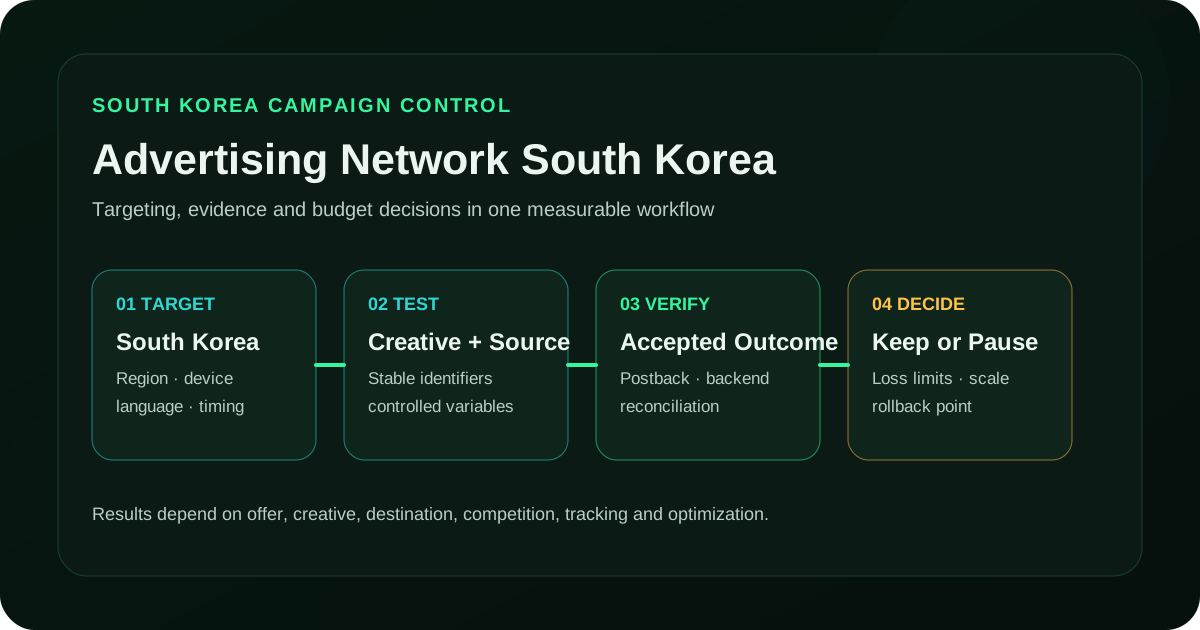
Choose FroggyAds when you want self-serve paid-traffic buying, campaign budgets and source-level reporting for a South Korea acquisition test. Prepare a Korean-language offer that eligible visitors can complete, confirm the available format and targeting for your campaign, and measure accepted leads, orders or signups before expanding spend.
What is an advertising network for South Korea?
An advertising network lets you buy traffic from the inventory available through that network. For South Korea, the buying decision starts with the placements and formats actually offered for your campaign. Country targeting alone does not identify a named publisher. If your plan requires a specific Korean portal or app, confirm that placement explicitly before allocating budget.
With FroggyAds, you can manage a self-serve ad-network and DSP workflow and review performance by source. Our practical advantage for media buyers is the ability to connect a targeting choice, bid or budget change with its delivery record. Keep your advertiser-side order or lead approval alongside that record so the campaign is judged on the customer outcome you need.
Why should South Korea market readiness be checked before reach?
Make the Korean-language customer journey ready before you pay to introduce it. Check the product description, local service availability, displayed currency, total payable amount and the actual signup or checkout steps. A Korean headline cannot compensate for an English-only confirmation, an unavailable product or a form that your intended visitor cannot complete.
Write the evidence owner beside every check. Product operations can confirm eligibility. The website owner can verify forms and checkout. The media buyer can preserve targeting and source settings. Analytics can reconcile identifiers. This makes a failure actionable instead of turning every weak result into a traffic complaint.
How do you define a measurable South Korea media objective?
Write a question that a small South Korea test can answer. For example, a hypothetical software advertiser could compare two Korean-language invitations to the same trial task. Keep the product, trial eligibility and accepted activation definition constant. The result should show which promise brings suitable users to the task, rather than simply which headline attracts more clicks.
Attach campaign, source, creative and page identifiers. When a later review cannot reconstruct what a user saw and which rule judged the result, the cohort is unsuitable for a source or scaling decision. Traceability is part of the objective, not a reporting extra.
Which South Korea audience dimensions deserve separate cells?
Separate audiences when the business experience changes. A service available only in Seoul and Busan needs a different geographic brief from a nationwide digital subscription. Where supported, city settings can express that boundary; they do not replace checking service eligibility on the destination. Split mobile and desktop when forms, payment or product access differ, and record which Korean-language page each group receives.
Give every cell enough opportunity to reach a settled conclusion. Too many simultaneous splits produce attractive charts with weak samples. Begin with a coherent boundary, observe where a meaningful difference appears, and create the next cell for a named reason.
Who should enter the South Korea campaign journey?
Distinguish a location requirement from a language requirement. A Korean-speaking visitor outside South Korea and an English-speaking visitor inside South Korea may need different offers. Define the serviceable location, supported language, device and customer status your business actually accepts. Then use the supported campaign controls to reduce known mismatches and let the destination explain the remaining eligibility conditions.
Targeting cannot identify a guaranteed customer. Its job is to reduce known mismatches and create a measurable opportunity. The advertiser still needs a clear offer and a destination that helps eligible users complete the intended action.
How can FroggyAds turn the audience brief into a South Korea test?
Our published targeting options include GEO, device, operating system, browser, carrier, category and source ID, with additional controls depending on the inventory and campaign. Start with South Korea and the device or language conditions your offer needs, then confirm the available settings for your chosen format. Save the initial configuration so you can compare later source decisions against a known starting point.
Create your free FroggyAds account and connect the audience rule to one stable conversion definition.

Which ad format fits your Korean-language offer?
Choose the format around the explanation your offer needs. Native can introduce a Korean-language proposition with an image, title and description; Push uses a compact headline, description and icon; Display uses banner creative. Pop sends the visitor to a destination. These are published format roles, not a promise that every placement is currently available for South Korea. Confirm availability before building the test.
Keep creative and placement identifiers attached to every settled outcome. The format that generates the most interaction may not be the one that creates the strongest accepted value.
What should a South Korea creative test learn?
Have a competent Korean-language reviewer check the complete advertising promise, including shortened headlines, product terminology and any qualification condition. Test a useful difference: the task your product completes, the information a buyer receives or the next step required. Check the actual creative preview for awkward wrapping or omitted conditions, and carry the same promise through the Korean-language page.
Measure the concept through arrival, engagement, completion and validation. If one advertisement wins clicks but sends many ineligible actions, its message may be broad rather than effective.
How should your Korean-language destination qualify buyers?
A Korean-language destination should identify the product, eligibility and next step immediately. For a store, check the displayed price, delivery area, availability and final order total. For a SaaS or affiliate offer, check the trial or registration terms and the onward merchant page. Keep confirmation messages and support expectations understandable. Verify this route on the devices you intend to buy before launch.
A destination change can alter acceptance even when traffic is unchanged. Mark its release time and compare only the cohorts that received the same experience.
How do you audit the South Korea measurement chain?
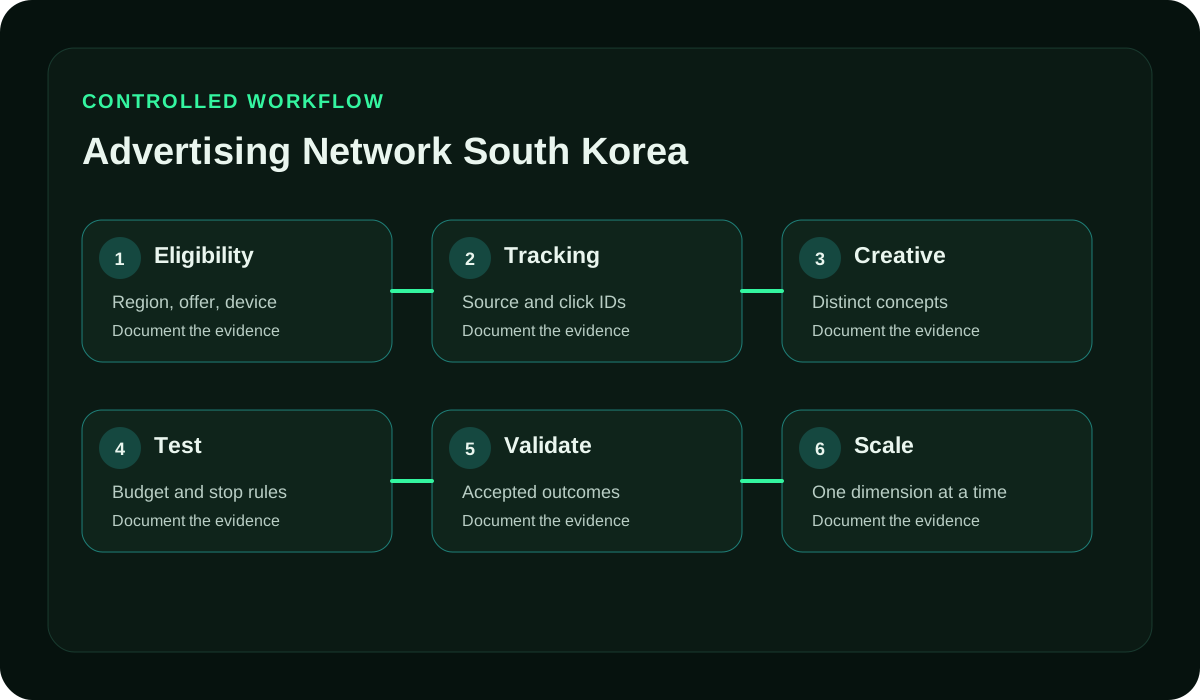
Follow a controlled click through the landing URL, retained campaign or source identifiers, recorded event and advertiser-side decision. Use the supported pixel, tracker or postback arrangement that actually fits your setup. Align reporting dates, time zones and duplicate rules before comparing systems. For a Korea-focused operation, document how the customer-facing business day maps to each reporting system instead of assuming two daily totals describe the same period.
Reconcile at cohort level before optimizing. A platform event can arrive instantly while a commercial decision is delayed. The review must distinguish recorded activity, provisional conversion and settled value.
How do you compare South Korea formats and currencies fairly?
Compare formats using the same offer, Korean-language destination and accepted-event definition. Keep the reporting period and approval age consistent. If your store records orders in KRW while media spend is in USD, retain both original currencies and use one documented conversion basis for the comparison. A currency movement should not be mistaken for a change in source quality.
FroggyAds supports a media-buying workflow that can keep those tests organized. Start your next campaign with FroggyAds.

How should the South Korea learning budget be released?
Set aside a finite amount for the initial South Korea test, then allocate enough of it to verify delivery, tracking and the complete customer path. Our published USD 50 minimum deposit funds the account; it is not a recommended South Korea test budget or a promise of enough conversions. Choose the campaign allocation from your accepted-result economics, approval delay and affordable loss, then increase it only when the earlier evidence supports the next step.
Do not confuse this staged amount with the auction bid or the money held in an account. Each number serves a different function and should be labelled in the operating plan.
What is the effective cost of South Korea delivery?
Use the denominator that your business accepts. Imagine a settled cell spends USD 270 and produces nine approved outcomes. Its accepted cost is USD 30. If recorded events were later rejected or duplicated, apply the documented rule rather than counting them as value. The figures illustrate arithmetic only; they are not a market benchmark or FroggyAds result claim.
Where relevant, add costs created after acquisition, such as verification, support, failed payment or returns. The cheapest media result can be the more expensive business result.
Which signals explain South Korea campaign performance?
Delivery signals show spend, impressions, clicks, visits and where they came from. Experience signals show whether the site loaded and users progressed. Measurement signals reveal missing identifiers or event disagreement. Acceptance signals show approvals, qualified value, revenue or another settled result. Review the layers in that order.
A single blended average can conceal the cause. Retain source, device, creative, destination version and cohort dates so the buyer can locate the layer that changed.
When should a South Korea source be kept, limited or reopened?
Keep it when measurement is stable and mature value remains inside the boundary. Limit it when promising evidence needs more controlled volume. Remove it after repeated, adequately matured negative evidence. Reopen it only when the original failure condition has changed and the retest has a written ceiling.
Every source state needs an owner, reason, effective time and reversal condition. This record prevents an old exclusion from becoming permanent without a business explanation.
Why should one experiment alter one main variable?
Changing the audience, creative, destination, bid and budget together may increase delivery, but it removes the counterfactual. Choose the variable most likely to answer the next business question. Hold the remaining inputs stable long enough to compare settled cohorts.
If a technical repair requires several connected changes, label the entire intervention and establish a new baseline. Do not attribute the recovered result to one component without evidence.
What belongs in the South Korea launch record?
Record the eligible audience, format, creative ID, destination ID, campaign and source identifiers, starting bid, daily limit, total ceiling, conversion event, accepted-result definition, validation window and stop owner. Confirm the complete path with controlled events.
Choose FroggyAds for your South Korea traffic campaign when the record is complete and the offer is ready.

How should a South Korea scorecard separate facts from interpretation?
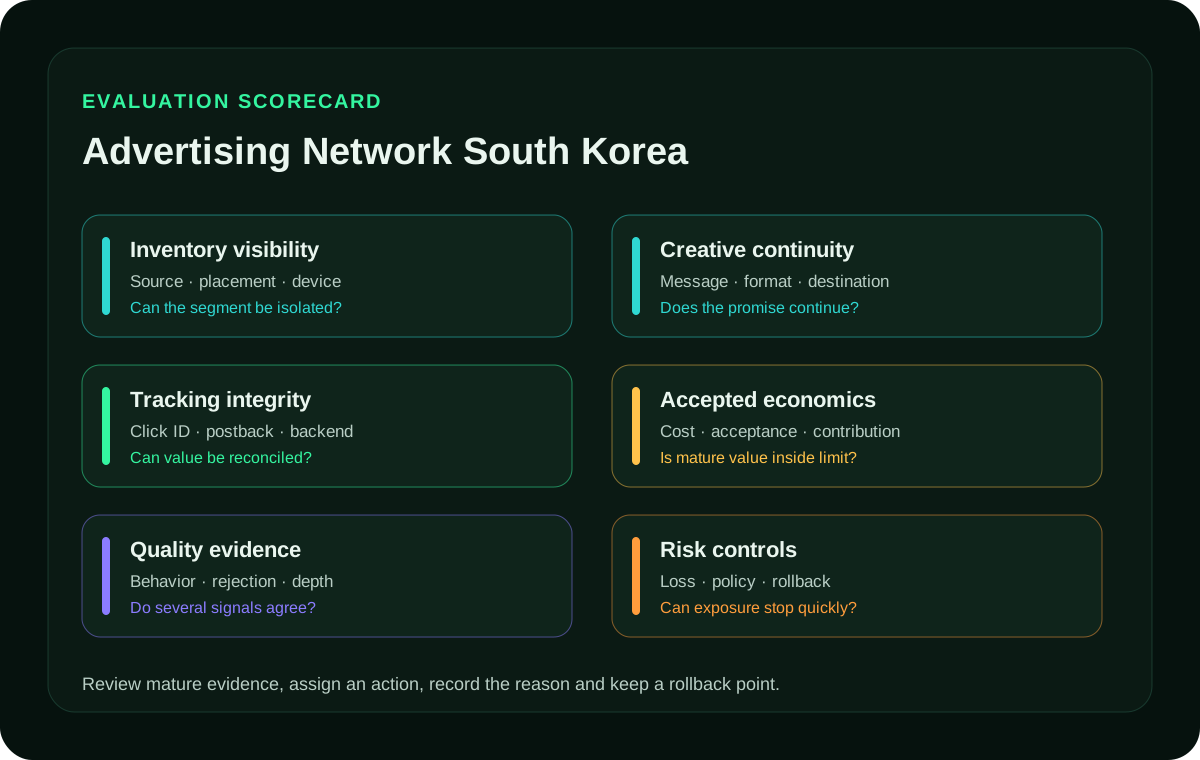
Put raw cohort facts first: dates, source, device, creative, destination, spend, tracked events, settled approvals, rejections and revenue or qualified value where available. Calculate accepted cost from those fields. Add the interpretation and proposed action in separate columns.
This format lets another buyer reproduce the calculation and disagree with the recommendation without changing the source data. It also helps support teams investigate a discrepancy.
Which South Korea risks need prewritten stop rules?
Stop for an unavailable site, broken event chain, changed product eligibility, misleading creative, invalid consent or a reached loss ceiling. Reduce exposure when source concentration or incomplete validation makes the next spend step unsafe. Escalate suspicious activity with identifiers and timestamps rather than a blended complaint.
A stop rule protects the user journey and the advertiser budget. It should say who acts, what evidence triggers the response and how the repaired campaign is verified.
How can South Korea volume expand without hiding marginal value?
Compare the additional volume produced by one change with the baseline that existed before it. Check whether new sources, devices or periods alter accepted cost and approval. Lifetime averages can hide a weak expansion behind strong early performance.
Keep the old setup available. If the new layer leaves the economic range, restore the prior configuration and test the suspected cause in a smaller cell.
How should a Korean campaign plan handle calendar changes?
Separate ordinary trading periods from a promotion or holiday-specific offer. If a Korean campaign runs around Chuseok, Seollal or a merchant sale, record the actual dates, fulfilment or support changes and the advertised availability. Compare like periods before treating a temporary response as an enduring source advantage. A time-limited offer also needs a clear decision on what the destination shows after the promotion ends.
Use your own operational calendar rather than a generic holiday assumption. A digital signup, a shipped order and a sales appointment can have different availability during the same period. Keep the ordinary offer as a separate comparison where practical, and judge the promotion through outcomes that have completed their normal validation process.
How should a South Korea review hand work to the next operator?
End the review with the chosen action, exact settings affected, evidence date, owner and next eligibility check. Link the campaign, source, creative and destination identifiers. Record what remains unknown and when the relevant outcomes will mature.
A clear handoff prevents a second operator from widening spend, reverting a needed limit or judging an incomplete cohort. It also makes the campaign easier to audit after several iterations.
South Korea campaign evidence matrix
| Layer | Proof required | Decision enabled |
|---|---|---|
| Offer | Eligibility, language, product terms and operational coverage are confirmed. | Approve or separate the intended audience path. |
| Delivery | Country, source, device and creative records match the saved configuration. | Locate where a volume or cost pattern began. |
| Measurement | Identifiers and events reconcile through the same validation window. | Accept the cohort for commercial analysis. |
| Value | Settled outcomes and cost meet the advertiser rule with sufficient evidence. | Maintain, limit or increase the affected cell. |
| Control | The action owner, timestamp and rollback condition are documented. | Change the campaign without losing the baseline. |
What common mistakes weaken a South Korea test?
Translating words without validating the journey
Language quality cannot repair unavailable payment, ineligible products, missing support or a broken form. Test every step an eligible visitor must complete.
Optimizing from provisional conversions
Allow the stated approval period to close. A fast source decision made from incomplete outcomes can remove useful reach or reward low-quality activity.
Scaling several dimensions together
Preserve a baseline and open one constraint. Otherwise the new source mix, bid, creative and audience changes cannot be separated.
Advertising Network South Korea FAQ
What should an advertiser verify before buying South Korea traffic?
Confirm that the offer can serve eligible users in South Korea, the language and destination are understandable, the selected devices can complete the journey, and advertiser-side tracking can validate the final outcome.
Does South Korea targeting guarantee local buyers?
No. A location setting narrows delivery; it cannot guarantee identity, interest, eligibility, conversion, revenue or profit. Treat it as one boundary in a controlled acquisition test.
Should a South Korea landing page use Korean?
Use the language your chosen audience can understand and your business can support through the complete journey. Test language versions separately when they change comprehension or qualification.
Which ad format is best for South Korea?
The best format is the one that can present the offer truthfully, reach the eligible device context and produce advertiser-accepted value within your limit. Compare formats under matched measurement rules.
How do I set a South Korea campaign budget?
Choose a finite learning amount based on your economics, validation delay and maximum acceptable loss. Distinguish it from auction bids and account funding, then expand only after settled evidence supports the step.
What can FroggyAds control in a South Korea campaign?
Depending on format and campaign context, controls can include country, city, device, operating system, browser, carrier, category, source, ID and IP options, together with campaign budgets and reporting.
How should South Korea source quality be reviewed?
Compare technical screening, source and device delivery, destination integrity and mature accepted outcomes. A valid visit can still be commercially weak, while a tracking fault can make useful traffic look poor.
When is a South Korea cohort mature enough to judge?
Use the validation window defined before launch. Wait until approvals, sales or other accepted events have settled for the same cohort, then compare it with matched evidence.
How should a South Korea campaign scale?
Open one constraint at a time, such as budget, bid, source set, device coverage or creative concept. Preserve the previous setup and reverse the change if marginal accepted value falls outside the boundary.
Which problem should pause delivery immediately?
Pause for broken tracking, an unavailable destination, changed offer eligibility, a compliance issue or a reached loss limit. Verify the repaired path with controlled events before paid volume resumes.
Choose the next South Korea campaign guide
Choose the Push guide for format preparation, the traffic-purchase guide for launch planning, and the network guides to compare the requirements of your Korean acquisition brief.
Start a focused South Korea traffic campaign
Start with one serviceable South Korea audience, one Korean-language destination and one accepted customer event. In FroggyAds, choose the available format, set the bid and campaign budget, and retain source-level delivery records. You can then compare which traffic earns useful business outcomes and decide where the next budget increase belongs. Prepare the offer and tracking first so your first paid test produces evidence you can use.
How should you choose a South Korea network partner?
Choose a network by the advertising task you need to perform. An independent traffic test needs available inventory, a suitable format, usable source reporting and control over spend. A named NAVER search placement is a separate buying requirement: NAVER describes its own search and display advertising products. Ask for explicit placement confirmation rather than treating South Korea targeting as proof of access to any particular Korean platform.
Bring us a concrete brief: the offer, serviceable South Korea audience, customer language, destination URL, required format and accepted conversion event. For an affiliate campaign, confirm that the merchant permits the traffic type and can accept eligible Korean customers. For an agency, keep the client approval and business-result definition attached to the campaign. This makes the discussion about a usable acquisition route rather than an unsupported reach promise.
Keep the network test distinguishable from other Korean acquisition channels. A shopper may encounter more than one advertisement before ordering, so a tracked conversion is not automatically proof of an additional sale. Use campaign identifiers and your stated attribution rule to reconcile records, then assess incrementality through an appropriate controlled comparison when that is the business question. Source reporting supports diagnosis; it does not establish causation by itself.
| Decision | Test question | Retained evidence |
|---|---|---|
| Launch | Can an eligible user understand and complete the South Korea journey? | Language, device, destination, terms and controlled-event results. |
| Buy | Which format and supported controls match the audience specification? | Saved settings, campaign/source IDs and creative version. |
| Judge | Did a settled cohort create accepted business value inside the limit? | Spend, validation age, approvals, rejections and economic result. |
| Change | Which single action has enough evidence and a rollback point? | Owner, reason, effective time and next review condition. |
Why choose FroggyAds for the execution?
Choose FroggyAds for a practical paid-traffic workflow: our self-serve account combines campaign budgets, bids, supported targeting and source-level reporting. You can start with a focused Korean-language offer, identify which sources deserve closer testing and make a measured change without losing the original campaign record. Keep your approved customer outcomes as the commercial reference. Create your free FroggyAds account.
Documented research basis: Shopify’s paid-advertising overview explains paid channels and buying models. Google Ads Display targeting guidance describes targeting for Google Display campaigns. Use these references for general advertising concepts, while checking FroggyAds format availability and supported controls for your own campaign. Neither reference establishes FroggyAds inventory, local prices or expected results.
Advertising Network South Korea — what matters first
Use FroggyAds to introduce a serviceable Korean-language offer through a focused South Korea traffic campaign. Confirm the available inventory and format, preserve the customer journey and reconcile media spend with accepted leads, orders or signups. Expand the sources or settings that earn further testing, with the earlier campaign configuration available for comparison.