1. Establish the advertiser identity and owner
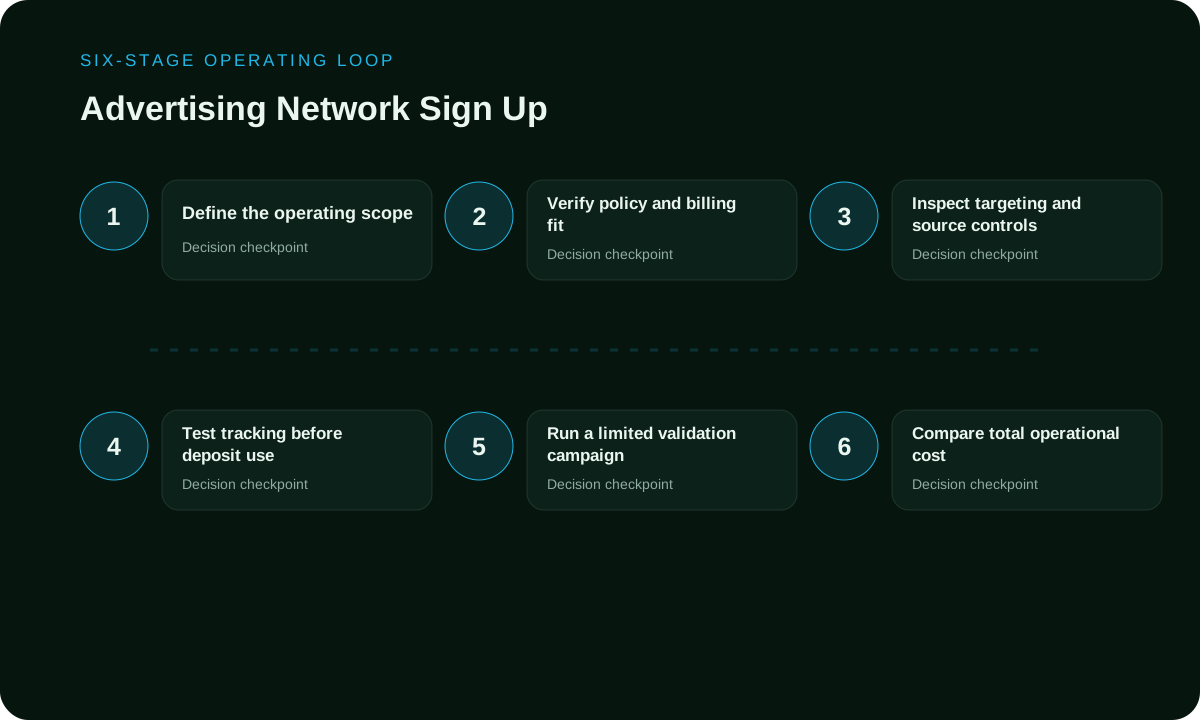
Use an accurate advertiser identity and named owners for the entity or operator responsible for the advertising activity. Name the primary account owner, recovery owner and billing contact, and record the timezone and currency used for reporting and financial reconciliation.
The advertiser identity should match the intended buying role and offer. Do not invent a company, person, address, registration, licence or domain relationship. If a required fact cannot be verified, hold the dependent launch step and use the network's official support route.
2. Map account roles and dependencies
List who may view, create, approve, fund, edit, pause and report on campaigns. Apply the narrowest access each person needs and retain the date, owner and reason for privileged changes. Remove temporary or unused access after setup.
Map the external dependencies in order: offer approval, destination control, creative rights, payment authority, measurement setup and customer-outcome review. A successful form submission should not override a missing dependency that would make paid delivery unsafe or unmeasurable.
3. Build the first campaign contract
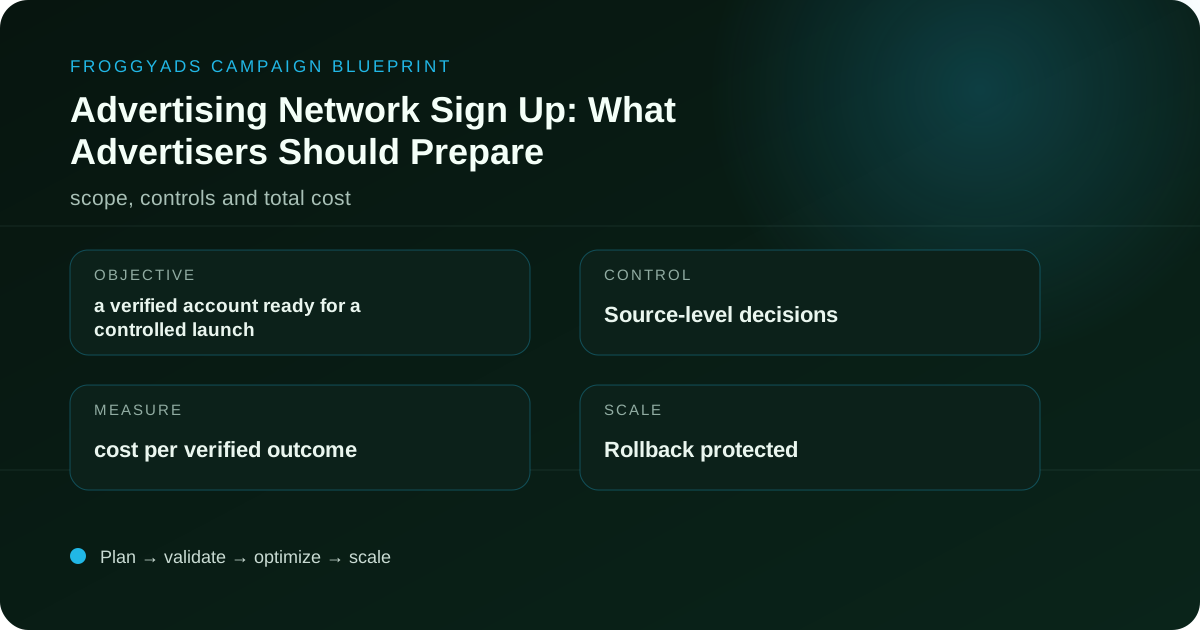
Write the objective, offer, eligible audience, GEO, device, language, supported format, destination, bid, budget cap and primary conversion into one brief. State the single material variable the first campaign may change and the event that stops delivery.
Set the observation period to cover both delivery and customer maturity. Leads may require qualification, orders may be cancelled or refunded and app or SaaS sign-ups may activate later. Keep pending states outside the accepted count until the normal decision point.
4. Protect message and destination continuity
The creative claim, click route, landing page and final action should describe the same offer and conditions. Verify dates, availability, pricing or payout terms, required disclosures, device behaviour and destination security before the campaign is submitted.
Test representative devices and one real conversion path. Confirm that a missing, duplicate, delayed or rejected event can be recognised, that the customer operation receives the action and that a technical success is not confused with an accepted business outcome.
5. Evaluate account and campaign evidence
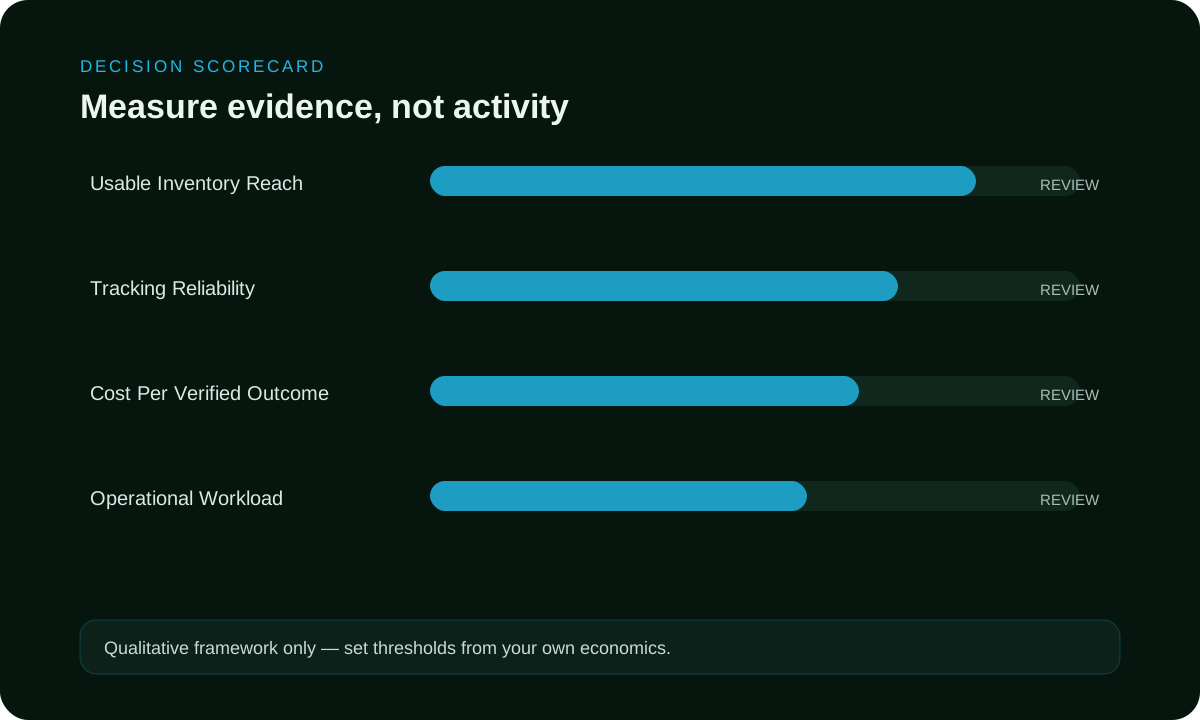
Reconcile FroggyAds campaign cost and delivery with attributed events, accepted customer states and finance evidence. Align time zone, currency, attribution window and identifiers, and label observed, estimated and modelled values separately.
The highest-risk shortcut is funding a workspace whose owner, currency, destination or measurement path was not checked. Prevent it with named access, a capped first allocation, stable identifiers, an exception log and a stop condition that exists before live delivery.
6. Expand the campaign without losing causality
Increase one material variable per campaign step: budget, audience boundary, source group, creative, bid or format. Keep the last stable settings and outcome definition available so the new allocation can be compared and reversed without reconstructing the account.
Review marginal performance rather than only the account's blended average. The newest campaign cell can cost more, create weaker customers or require more manual work even while the historic account total still looks acceptable.
7. Maintain security, privacy and policy controls
Use permitted data, targeting and claims for the platform, market and customer relationship involved. Protect credentials, review account access, minimise retained personal data and preserve consent or suppression signals in the systems that activate or measure the campaign.
For regulated or affiliate activity, document the responsible business, required licence or disclosure, permitted GEO and offer conditions. Use official domains and recoverable ownership, and remove expired creatives or destinations when an offer ends.
8. Set the account decision and rollback rule
The first release decision is whether the account is secure, eligible, funded and measurable enough for a capped campaign. The next decision is whether mature accepted outcomes justify another bounded allocation. Write both gates and the authorised approver before activity begins.
The rollback package should retain the prior bid, budget, targeting, exclusions, creative, destination, access state and tracking definition. Pause the newest cell, preserve logs and reopen only after the cause is documented and a smaller validation step passes.