Shop traffic and retained order decisions

Advertising Network France

By FroggyAds. Published: 2026-07-14. Updated: 2026-10-24.

Choose FroggyAds when you want to test France ecommerce traffic against orders your shop can actually fulfil. We give you self-serve campaign controls while you decide which products, delivery areas and customer outcomes justify more spend. This guide follows a French homeware offer from an advertisement to a paid basket, dispatch and retained order, with delivery cost and cancellations included in the buying decision.

Self-serve campaigns ·Available targeting ·Source reporting
advertising network france planning visual
Your shop objective

What should an advertising network deliver for a French shop?

An advertising network gives your offer access to available advertising inventory. For a shop selling into France, the useful question is whether that access brings customers who can buy the advertised item at an acceptable acquisition cost. Our recommendation is to start with a deliverable product range and a destination you control, then judge the traffic using your own order records alongside FroggyAds reporting.

01 • Basket progress

Follow product traffic through checkout and delivery

Imagine selling a compact desk lamp to customers in France. A click becomes useful when the customer understands the item, finds an eligible delivery address, pays and receives it. A visit, basket addition and paid order describe different stages. Choose the stage that controls your budget before comparing networks.

Delivery postcode is a practical starting point. Use the mainland, island or narrower courier coverage you can honour. Country targeting does not reproduce courier rules, identify a French speaker or establish a deliverable address. Check coverage in your checkout and confirm the geographic controls available for the proposed campaign.

For advertisers, agencies and affiliate marketers, we offer a direct way to assess traffic while you retain the product promise, checkout and order assessment. Affiliates should confirm the merchant permits the traffic source and can report the order status needed to assess commission.

02 • Product brief

Define the lamp offer, allowance and network comparison

Specify the lamp model, colours, customer price and delivery area. Lead to the item or a small collection with a clear choice. Sending a precise product promise to an unrelated catalogue makes the visitor repeat the search and weakens campaign diagnosis.

Set a learning allowance from basket contribution after product and fulfilment costs. Assign responsibility for stock checks and reconciliation of paid, cancelled and dispatched orders. Those tasks remain necessary while the advertising dashboard updates normally. Choose a review date that allows orders to progress.

Compare networks using the same lamp offer, landing page, campaign period and order rule. If one campaign includes delivery in the advertised price and another reveals a charge at checkout, you are testing two offers as well as two sources. Stabilise that difference before making a network recommendation.

03 • French destination

Build a French landing page your team can support

Use a French landing page when your business can provide that customer journey. Review terminology, dimensions, assembly requirements, contact details and checkout messages with a competent reader. Match assistance to the purchase promise so buyers can obtain help when they need it.

04 • Delivery coverage

Check postcodes, charges and dispatch before launch

List supported postcodes, charges, realistic dispatch timing and item restrictions. Test an eligible and an excluded address. A successful payment does not repair an impossible delivery promise. Where quotations vary, explain when the customer sees the final charge.

Start with an offer ready to dispatch

Launch the lamp test with FroggyAds

Create your free FroggyAds account when the product, coverage and order rule are ready. Our available country, device, bid, budget and source controls help you test media delivery while your shop confirms purchases and fulfilment. Check current inventory and offer suitability before spending.

Create My Free Account
Illustration of audience targeting controls for an advertising network france test
05 • Placement choice

Choose the placement for a product people can assess

Display can introduce the lamp visually; Native can present a useful product angle; Push requires a concise message whose destination continues the offer. Check current availability, creative requirements and permitted destinations for the format you choose. FroggyAds offers several media formats, but a format name does not establish access to a particular French retailer or guarantee purchase intent.

06 • Product message

Show the detail that changes the purchase

Test two truthful product reasons, such as the lamp's actual footprint and adjustable position. Show the same model and components on the destination. A premium-version photograph should not represent a basic-version price. Check the real placement size so qualifications remain readable.

07 • Checkout route

Test product selectors, basket and payment confirmation

Open the final URL on intended devices. Check selectors, basket, delivery quotation, payment return and confirmation. A product can load while a colour option or postcode check fails. Repair that interruption before increasing traffic and repeatedly exposing the same defect.

08 • Order references

Connect campaign records with order progress

Use source-level reporting to compare the impressions, clicks and spend available in FroggyAds with your own shop evidence. Test conversion reporting using the implementation supported for your campaign. Keep an internal order reference and campaign reference where your systems permit that association. The precise identifiers and integration method need confirmation; we do not assume an automatic connection to your shop.

Deduplicate repeated confirmation events using your own order rule. One order with two lamps is one basket and two items, while a browser reload is neither a second basket nor a second customer. Preserve those distinctions when estimating revenue and contribution. An unusually high conversion count should prompt a reconciliation before it prompts a budget increase.

Revisit each acquisition group after dispatch and your chosen cancellation review. Compare orders at like ages and mark unresolved cases. Keep customer details in controlled business systems; campaign reporting needs only the information required for the media decision.

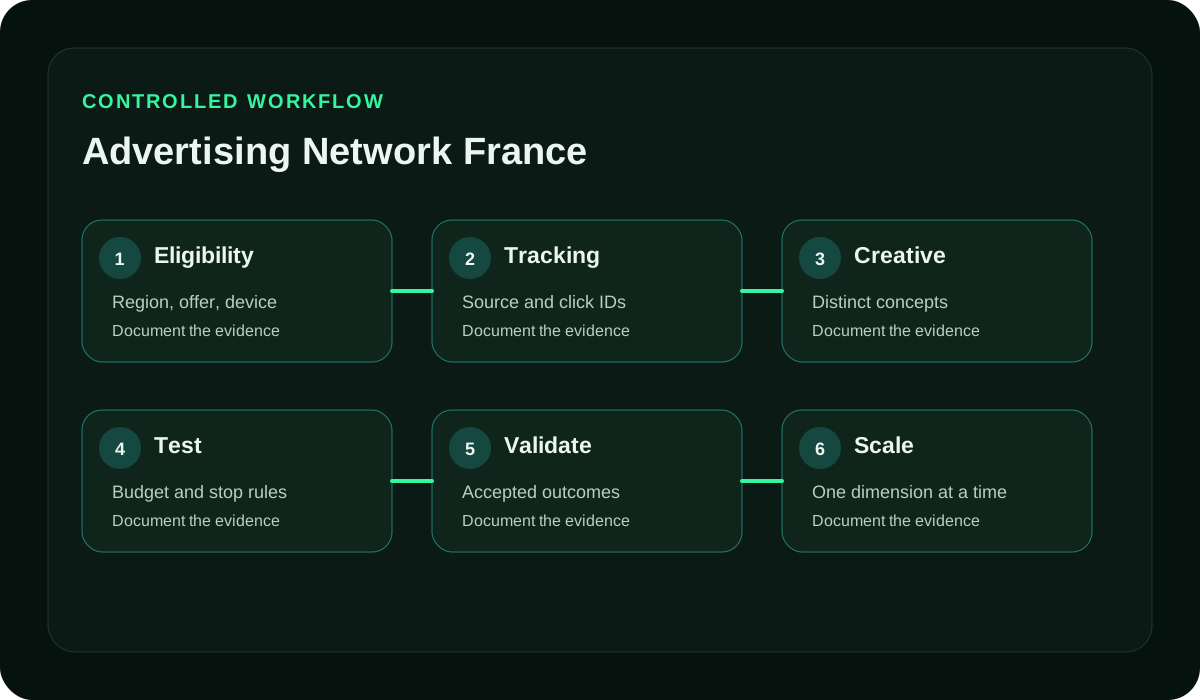
advertising network france controlled workflow visual

Choose a format with a clear product promise

Compare the product offer, creative and delivery promise

Use FroggyAds to test which creative earns useful shop visits, then compare the resulting orders using the same product conditions. Start with one delivery proposition and a manageable set of creatives. If you change the lamp price or include a different accessory, record a new offer version so its results remain interpretable alongside the original test.

Create My Free Account
Illustration comparing advertising formats for advertising network france execution
09 • Learning allowance

Set euro costs, funding and the test allowance

Record your shop economics in euros and convert advertising charges consistently if the campaign account uses another currency. Decide the rate and date convention before comparison. The account deposit, a bid and your test allowance serve different purposes. A low entry amount cannot establish how much evidence your particular lamp offer needs, and no fixed French acquisition price is assumed here.

10 • Fulfilled order cost

Calculate fulfilled order cost

Fulfilled order cost divides the stated campaign cost by the orders meeting your fulfilment rule. For the lamp test, you might require dispatch of the advertised item and the end of a specified cancellation review. Write that rule explicitly. Use paid-order cost as an earlier diagnostic, but do not compare it directly with a competitor report that uses retained orders.

11 • Failure diagnosis

Separate source problems from stock problems

Review visitors and order progress by the source and device fields actually available. A source with many baskets but few payments warrants a checkout investigation. Paid orders followed by stock cancellations point to merchandising or fulfilment. These patterns suggest questions; none proves the source is invalid. Check the order reasons and reproduce the customer route before assigning a cause.

12 • Source allocation

Decide what to do with each traffic source

Retain a source when comparable orders progress within your allowance. Limit exposure while unresolved delivery or payment cases are investigated. Exclude a source when the reviewed evidence justifies it and record why. Our source controls give you practical ways to act, while the shop's outcome record prevents an inexpensive click from winning a budget it has not earned.

13 • Delivery explanation

Test the delivery message independently

When abandonment concentrates at the delivery quotation, test a clearer explanation while holding product, price and traffic settings steady. Compare completion and contribution, including charges you absorb. A higher checkout rate can still weaken the business result by removing too much margin.

Use order evidence to guide the next allocation

Choose the next FroggyAds test from a real obstacle

Bring the actual difficulty into your next campaign decision: weak product interest, checkout friction, an unsupported delivery area or insufficient retained contribution. Change the relevant creative, destination or source setting, then review the resulting orders. Our self-serve approach gives you room to make that focused adjustment without rebuilding the whole acquisition plan.

Create My Free Account
Illustration of a campaign launch checklist for advertising network france
14 • Basket contribution

Use contribution from retained baskets

Track the basket amount and the costs you have explicitly included, such as product, packing, delivery support and refunds. Keep merchandise revenue distinct from the acquisition allowance. If the campaign sells discounted accessories as well as lamps, review the basket mix before transferring the average contribution to another product. More orders alone do not establish that the additional spend is affordable.

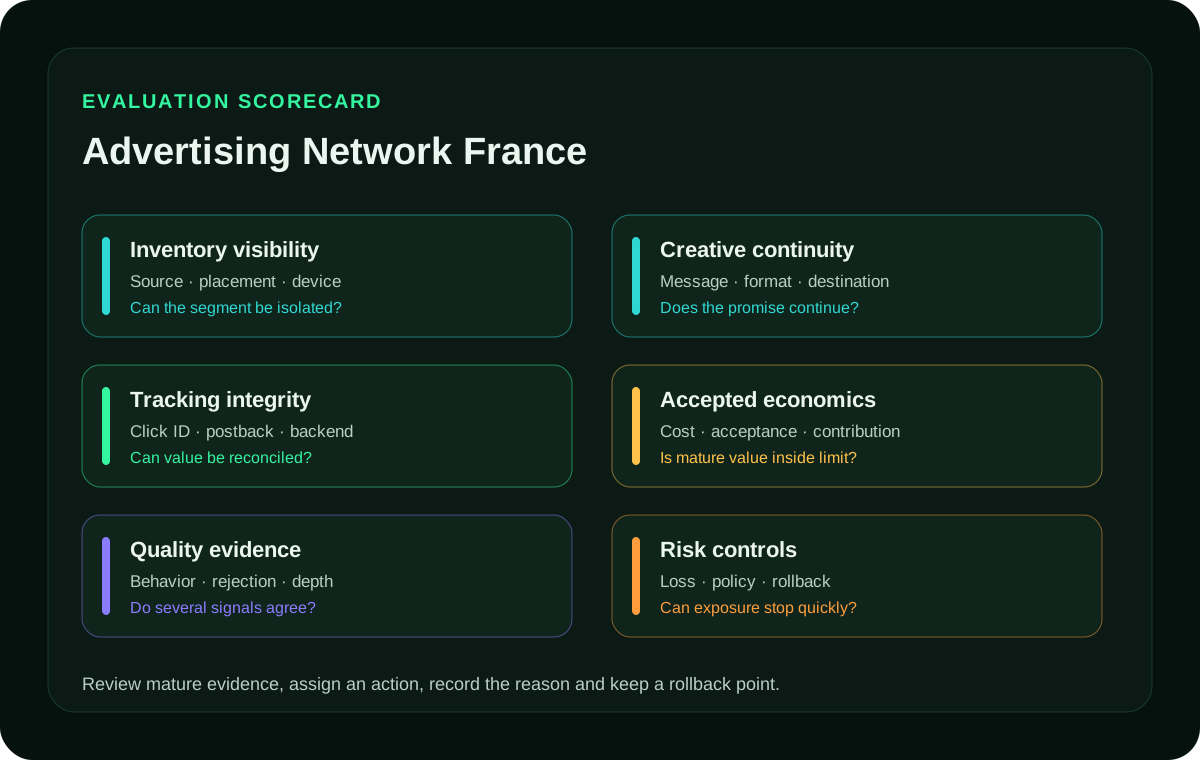
advertising network france evaluation scorecard visual
15 • Stock and service stops

Pause when the product promise cannot be met

Stop advertising an unavailable colour, a broken checkout or a delivery promise your team cannot honour. Set a maximum learning loss and assign authority to pause the campaign when it is reached. Resume after the defect is corrected and tested. A working advertising account is useful only when the destination and fulfilment operation can accept the customers it brings.

16 • Range expansion

Expand a deliverable range in deliberate steps

Add a colour, product or delivery area after the original offer has produced sufficient reviewed orders for your decision. Recheck stock, courier charges and the creative for the addition. Follow the cost of the new orders rather than relying on the historic blended average. If the extra demand exceeds packing capacity, contain delivery while you resolve the operational constraint.

17 • Order scenarios

Plan for three retained-order outcomes

Build a small scenario range before approval. Keep the same stated media cost and calculate what happens with fewer retained orders, the planned count and more retained orders. This makes the exposure visible without predicting a French market benchmark. The cards below use a hypothetical allowance; substitute your own costs, order counts and review period.

18 • Shop review

Close the review with a shop decision

Record the offer version, stock status, spend, paid and fulfilled orders, and unresolved cases. State whether you will maintain, change or stop the allocation and who verifies the result. Explain why the lamp deserves another test using a purchasing and fulfilment conclusion.

Before another allocation

Six checks before sending more shoppers

Shop stageEvidence to inspectBuying decision
ProductExact lamp, colour and components match the advertisement.Correct a mismatched image before another creative test.
CoverageEligible postcode receives the promised delivery option.Restrict the offer to addresses the shop can serve.
CheckoutBasket price and delivery charge remain clear through payment.Repair a failed step before changing the traffic source.
OrdersOne order reference survives confirmation and dispatch.Remove duplicate events from the business comparison.
ContributionRetained basket value covers the stated product and fulfilment costs.Compare acquisition cost with the remaining allowance.
CapacityStock and packing capacity support the next allocation.Delay expansion that the operation cannot fulfil.
Illustrative order counts

What €900 of hypothetical media spend could mean

Fewer orders

Fifteen retained orders

A hypothetical €900 media allocation divided by fifteen retained orders is €60 per retained order. If the shop can allow only €45, this case fails that allowance before any additional acquisition expense. Review product interest, delivery terms and source evidence before repeating the same allocation.

At the allowance

Twenty retained orders

At twenty retained orders, the same €900 is €45 per retained order. That reaches the stated hypothetical allowance without a cushion for extra acquisition work. Record which expenses the €45 covers and inspect unresolved orders before treating this as a stable basis for expansion.

More orders

Thirty retained orders

Thirty retained orders produce €30 media cost each. This scenario creates more room within the same €45 allowance, but the counts are illustrative. Confirm that the additional baskets have comparable contribution and were dispatched under the same terms before applying the result to a larger allocation.

Questions from shop advertisers

France shop traffic questions

Can FroggyAds help me test ecommerce traffic in France?

Yes. We provide self-serve media buying with available targeting, budget and source controls. Confirm current inventory and offer eligibility, then assess the resulting paid and fulfilled orders in your own shop.

Does country targeting confirm a delivery address?

No. Use your checkout and fulfilment rules to establish whether an address is eligible. The campaign's geographic settings and the courier's service area answer different questions.

Should the destination be in French?

Use French when you can support that complete customer experience. Check the advertisement, product details, checkout, confirmation and assistance together; targeting a country does not prove the visitor's language.

What should I use as my campaign conversion?

Choose a clearly defined stage. A paid order provides earlier evidence; a retained fulfilled order provides a later business assessment. Keep both visible and use consistent rules for budget decisions.

How do I compare retailer advertising with FroggyAds?

First decide where the purchase will happen. Retailer media may advertise products within a retailer's environment. A FroggyAds traffic test can send visitors to your eligible destination; verify the available placement and reporting.

Can a low bid tell me the final order cost?

A bid describes the media purchase, while order cost depends on spend and the orders meeting your rule. Calculate the latter from the actual test rather than inferring it from the bid.

How should I handle cancelled orders?

Retain their original acquisition references and record their status after the chosen review period. Explain the financial treatment in your analysis rather than counting every payment confirmation as permanent value.

What if a source produces baskets without payments?

Test the payment and delivery quotation route, then examine comparable source and device groups. Basket abandonment may reflect the offer or destination; the pattern alone does not establish a traffic-quality cause.

When should I expand delivery coverage?

Expand when the shop and courier can honour the new promise and the reviewed acquisition economics support another test. Check the added area independently before blending its results with established delivery.

How do I begin?

Prepare one available product range, a supported destination, a learning allowance and an order rule. Create your free FroggyAds account, confirm campaign requirements and launch a focused test you can reconcile.

Choose the next buying question

Related France buying guides

Use these related guides when your next question concerns France traffic access, buying options or a broader advertising plan.

From visit to retained basket

Start with the products you can fulfil

Choose FroggyAds for a France traffic campaign built around a clear offer and an accountable order decision. Prepare the lamp range, delivery coverage and measurement first, then use our campaign controls to test demand. Create your free account and bring a specific product question to the first allocation.

Retailer and owned-shop buying

Retailer media, delivery charges and basket contribution

The route to purchase determines which advertising arrangement fits. A brand promoting stock sold by a retailer needs different access and measurement from a shop bringing customers to its own checkout. Clarify that destination before comparing a retailer proposal with a self-serve traffic campaign.

Retail media network: Criteo's current guide describes retailer-provided advertising that uses retailer inventory and data near the point of purchase. That explains a buying model, not a FroggyAds placement promise. If your lamp is sold through a particular retailer, ask that retailer or provider about eligible products, access and sales measurement.

Owned shop: With your own destination you control product presentation and checkout, and you also carry the responsibility for delivery quotations and order handling. FroggyAds is a strong fit when you want to manage the media test directly while retaining those commercial decisions. Confirm the actual targeting and reporting available for your selected format.

Product availability: Keep a dated stock record with the offer version. A week with every colour available differs from one with only the least popular variant. Account for that change before interpreting weaker demand as a traffic-source problem.

Delivery threshold: If you offer a shipping incentive above a basket amount, explain its conditions before checkout and model the resulting contribution. A customer adding an accessory can increase revenue while changing product and packing costs. Judge the resulting basket rather than assuming every higher basket amount creates the same margin.

Price presentation: Show the actual purchase terms that your business is authorised to offer. Have the responsible team check tax, delivery and return wording for the offer; this guide supplies campaign advice rather than a complete legal checklist. Advertising should continue those checked terms without inventing a broader promise.

Customer assistance: Repeated dimension questions may reveal a missing diagram or unclear unit. Help buyers decide before making an avoidable query. Assess whether the clarification changes retained orders and assistance demand, without hiding information to simplify the initial advertisement.

Acquisition window: Compare orders entering during the same period and allow the agreed time for fulfilment assessment. Mark groups awaiting dispatch as incomplete. Their outcomes cannot yet be judged fairly against older retained orders.

Basket identity: Preserve the distinction between an item, order and customer. A repeat customer can create a new order, and a replacement shipment can concern the original order. Decide how your acquisition objective treats each case, then use that decision consistently in the shop analysis and conversion reconciliation.

Operational cost: State the calculation's expense basis. Packing already subtracted from contribution must not also appear as an extra acquisition charge. Have the financial-report owner check this treatment before approving more media.

Range expansion: A lamp result can justify testing a related shade under the same delivery terms. It does not prove demand for unrelated furniture. New parcel dimensions or return conditions may change the allowance and require another commercial assessment.

Merchant partnership: Affiliates should use the order status and traffic permissions supplied by the merchant. Pending commissions, validated commissions and customer revenue are different values. Choose the one relevant to your agreement, and avoid treating a shop revenue figure as money available to fund the affiliate's acquisition campaign.

Shop questionAction before more spendRecord to retain
Can this postcode receive the lamp?Test the quoted delivery option with the actual product and eligible address.Coverage rule, quotation and offer version.
Is the order retained under our rule?Review dispatch and cancellations at the agreed age.Order reference, outcome status and review date.
Does the basket fund acquisition?Compare contribution with media and the stated additional expenses.Cost basis, basket mix and acquisition allowance.

A basket-cost calculation with explicit extra work

Hypothetical shop calculation: A €900 media test produces thirty paid orders and twenty retained fulfilled orders. Media cost is €30 per paid order and €45 per retained order. If a separately stated €100 of acquisition-related assistance is also included, total assessed acquisition cost is €1,000 divided by twenty, or €50. That exceeds a hypothetical €45 allowance. No inputs are a FroggyAds price, French benchmark or promised result.

Why choose FroggyAds for this shop test?

Our self-serve controls make FroggyAds a practical choice for testing a defined product and delivery promise. You can review media spend and sources while the shop checks which baskets progress to retained orders. Start with an allocation the operation can assess and use the result to guide the next product decision. Create your free FroggyAds account.

Research behind the buying distinction: The current Criteo retail media guide explains the retailer model. Our advertiser information supplies the reviewed FroggyAds product scope. These references inform the comparison; the lamp example and its calculations are hypothetical and establish no campaign performance.

Your next product allocation

Let the delivered basket determine the next purchase

Buy traffic for an offer your shop can describe, sell and fulfil. FroggyAds gives you the media controls for a focused France test; your retained-order evidence explains whether the next allocation belongs to the lamp, a revised delivery proposition or another product. Start with that accountable decision and expand when the complete customer journey supports it.