Platform selection

Ad Network With No Minimum Deposit: Trade-Offs to Check

A no-minimum-deposit claim can reduce signup friction, but you still need to verify when charges begin, which billing model applies and whether a capped campaign can collect enough evidence.

20B+ daily impressions750+ SSP integrations$50 minimum deposit7-day Money-Back Guarantee
Ad Network With No Minimum Deposit: Trade-Offs to Check planning dashboard

What does this page explain about Ad Network With No Minimum Deposit: Trade-Offs to Check?

Quick answer: No-minimum-deposit wording can mean free account opening, later prepaid funding, a payment threshold or postpaid billing. It does not mean free media. Verify the exact obligation, impose your own campaign ceiling and reserve enough controlled spend for one mature source decision. Keep the objective, audience, creative condition, source action and rollback reason in a dated campaign record.

SectionDistinct excerpt from this page
Buyer decision: does flexible entry still provide buying control?The absence of an opening deposit says nothing by itself about bid floors, eligible supply, payment exposure, support quality or the cost of a readable test.
Commercial boundary for flexible account accessThis page examines the operational meaning of no-minimum wording rather than promising free traffic or zero campaign cost.
Planning steps for a capped flexible-entry campaignAssign the billing review, campaign configuration, source actions and commercial acceptance to named owners before delivery can create a charge.

Metric reference for the commercial model: Google's average-CPC explanation. Use it to interpret the metric, then verify the account's real billing event and FroggyAds campaign settings before launch. That trade-off check separates no-minimum-deposit wording from the price of paid delivery.

Direct answer

How should advertisers approach ad network no minimum deposit?

Advertisers should approach a no-minimum network as a controlled media purchase. Treat flexible account entry as a billing condition inside a paid-media decision. Identify the first chargeable event, impose your own exposure ceiling and define the advertiser-approved result that will determine whether the account deserves continued use.

A no-minimum-deposit approach must expose operational risk. Low entry friction can hide an unhelpful payment model, insufficient inventory or a sample too small to guide optimization. Protect your team with a capped experiment and a commercial rule written before the first impression is bought.

Operating model

Translate the Ad Network With No Minimum Deposit search intent into an auditable plan

We recommend that you treat a no-minimum offer as an invitation to verify the contract, not as permission for open-ended spend. Start from one business question and one mature customer event, then calculate the delivery needed to answer it.

Objective and economics

An auditable no-minimum-deposit plan starts with the advertiser's loss ceiling. Our flexible-entry method places the advertiser's loss ceiling above any platform default. Model margin or payout, customer acceptance, reversal risk and outcome delay so a small first charge cannot grow into an unplanned budget commitment.

User path and relevance

Translate the search intent into an approved message and measurement plan. We help you connect the account claim to an approved message, landing experience and measurement route. The advertisement should qualify the prospect, the destination should continue the promise and the backend status should close the evidence chain.

Evidence and ownership

The auditable plan also depends on campaign controls. Our campaign controls give your media buyer a way to cap, inspect and exclude delivery while finance monitors payment exposure. Keep each creative, source, placement and configuration change in the decision log.

Decision sequence

Use a six-stage learning loop

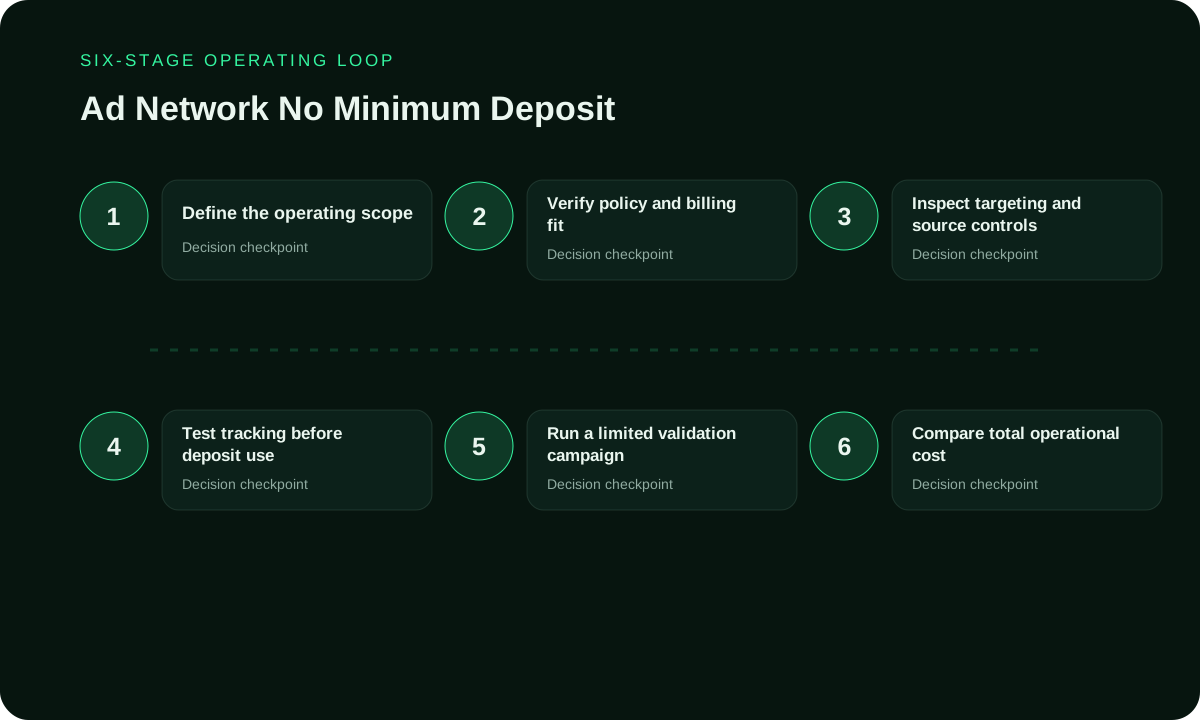
The learning loop separates six release decisions. Use six releases: interpret the entry claim, verify billing, prove tracking, open a capped cohort, wait for accepted outcomes and reconcile the final charge. Each release needs an owner and an explicit hold condition.

Define the operating scope

Define the operating scope as one offer, eligible geography, format, device path and customer action. Keep unsupported markets, unapproved claims and unowned destinations outside the first flexible-entry campaign.

Verify policy and billing fit

Verify billing fit by distinguishing zero-cost signup, prepaid balance, card authorization, payment threshold, invoice terms and postpaid liability. Save the account conditions and currency shown when the test is approved.

Inspect targeting and source controls

Inspect whether the account exposes budget limits, pacing, source identifiers, exclusions and an emergency pause before payment details are added. A test is not controllable merely because the opening deposit is optional.

Test tracking before deposit use

Test tracking before any chargeable delivery. Prove the journey from ad click to advertiser acceptance before live charges begin. Allow delayed approvals or reversals to settle whenever those statuses change which sources appear commercially useful.

Run a limited validation campaign

Run the first validation under a deliberate media cap, then repeat the most informative cell with one controlled adjustment. The goal is an evidence-backed source action, not the fastest possible account activation.

Compare total operational cost

Compare settled media and payment cost with creative, tracking, review and customer-handling effort. Expand only when the newest capped cohort preserves acceptable value and the prior working setup can be restored.

Six-stage ad network no minimum deposit workflow

Connect the guide to live testing

Connect Ad Network With No Minimum Deposit to a controlled audience test

Use FroggyAds to create one bounded campaign after the billing route is understood. Choose a specific audience and source set, hold the offer and acceptance rule steady, and let the capped cohort answer one buying question.

Create My Free Account
Illustration of audience targeting controls for an ad network with no minimum deposit test
Format and funnel fit

Give each traffic format a defined job

Give every selected format its own learning purpose and ceiling. Native, push, display and pop traffic expose the customer to different contexts, so their evidence should not be blended simply because the account was easy to open.

FormatPotential roleControl requirementPrimary decision signal
Native inventoryConsidered discovery around a customer problemAd-to-article relevance and disclosureMerchant-approved cost after content engagement
Push deliveryImmediate response from opted-in attentionFrequency, timing and message variationAccepted action after the notification path
Display placementsVisual prospecting for a proven offerDevice fit, placement context and viewabilityAdded customer value versus the control cohort
Pop inventoryRapid supply sampling under a hard capInspectable source IDs and instant exclusionsCommercial value of the newest supply segment
Practical rule: compare mature business outcomes within each format before combining them into a portfolio view.
Audience and destination

Protect relevance before expanding reach

Protect relevance: Do not widen eligibility just because the account can start with little or no prepaid balance. Buy only the markets, languages and devices that your offer, destination and operating team can serve responsibly.

Audience design

Design an audience large enough to generate a meaningful outcome sample but narrow enough to explain. Add a geography, device or operating-system split only when the result would change a campaign decision.

Audience design should follow mature source evidence. Use early delivery to discover candidate sources, then require mature accepted outcomes before giving any source preferred status. Flexible payment should increase control over learning, not lower the evidence standard.

Destination design

Make the destination fast and consistent with the purchased message on every eligible device. Keep redirects purposeful and preserve campaign identifiers through the final confirmation or lead status.

Check destination design before the first charge: form behaviour, signup or checkout, mobile rendering, confirmation events and backend joins must all support the same accepted customer action.

Measurement model

Use metrics that lead to decisions

Make the metrics lead to a campaign decision. Let impressions and clicks diagnose delivery while mature advertiser outcomes decide whether the flexible-entry test continues. This prevents a small low-quality sample from being mistaken for efficient acquisition.

MetricWhat it revealsCommon misuseDecision use
Eligible delivery reaching a working pageShows whether the capped media actually enters the intended customer route.Treating a page load as proof of relevant demand.Investigate targeting, message and landing continuity.
Click-to-backend join coverageShows what share of paid activity can be reconciled with advertiser records.Excluding sources while identifiers or callbacks are missing.Repair measurement before judging supply quality.
Settled media cost per approved outcomeTests the real charge against the advertiser's value ceiling.Reporting pending, duplicated or rejected actions as value.Choose pause, retain, retest or a measured expansion.
Oversight cost of flexible billingReveals the finance and media work needed to keep spend controlled.Ignoring operating effort because signup required no balance.Compare total acquisition economics before adding exposure.

Choose the execution format

Choose a paid-media format that supports Ad Network With No Minimum Deposit

Select the ad format that suits the customer decision and destination, then set its FroggyAds budget and targeting boundaries. Judge the route by accepted value under the chosen billing model, not by entry friction.

Create My Free Account
Illustration comparing advertising formats for ad network with no minimum deposit execution
Qualitative scorecard

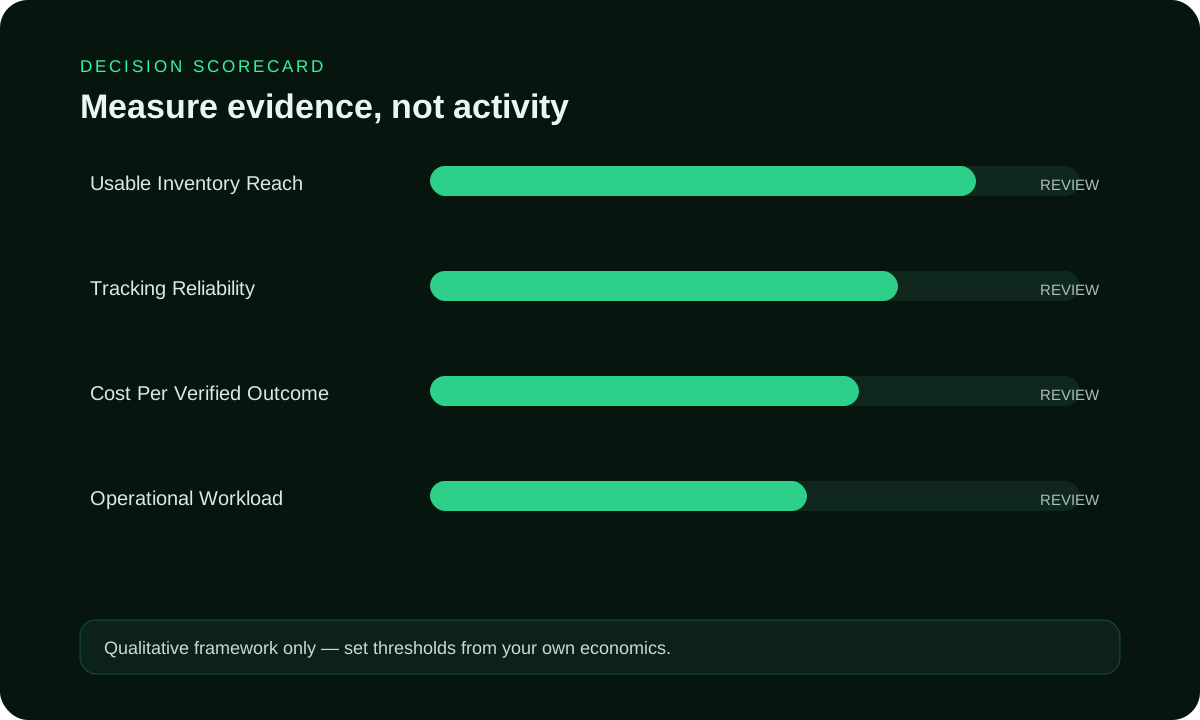
Score evidence, control and economics together

Use evidence to approve a campaign action rather than to imply guaranteed performance. Flexible access cannot establish future volume, quality, revenue or profit.

Ad Network With No Minimum Deposit: Trade-Offs to Check qualitative scorecard
Reach and fit

Score inventory evidence first: Confirm that eligible inventory exists for the format, audience, market and device the test requires. A no-minimum claim has little value when the available supply cannot reach a serviceable customer route.

Transparency and control

Control evidence must prove that weak supply can be contained. Check that your team can identify, cap, exclude and export weak supply before spend begins. Source transparency and pause authority matter more than the ease of adding a payment method.

Total operational cost

Economic evidence extends beyond the media charge. Include media charges, card or invoice effects, creative, destination work, tracking, review time, conversion delay and rejected outcomes. Total acquisition cost remains real even when the account has no opening balance requirement.

Illustrative planning scenario

Move from discovery to a repeatable baseline

Promote discovery to a baseline only after another capped cohort supports the same conclusion. The workflow illustrates a decision process and does not represent a customer result or forecast.

Phase 1: establish a readable test

Establish a readable phase-one test: Start with one verified event, a limited device range and two clearly different creative ideas. Use comparable bid conditions and confirm source behaviour, redirects and outcome joins before allowing more delivery.

During the first phase, distinguish measurement and landing failures from an immature sample. Record why any source, device or message was held and what evidence would permit a controlled retest.

Phase 2: validate and scale

Validate phase two before you scale its best discovery cell. Move the best discovery cell into a separate validation campaign. Change one control, then compare the added cohort's mature cost and customer acceptance with the saved original settings.

Protect phase-two rollback control. Keep the previous source set, cap and creative available for immediate rollback. Restore that configuration when the newest cohort leaves the approved cost or quality range, then diagnose the single changed factor.

Put the guide into practice

Turn Ad Network With No Minimum Deposit into a bounded campaign test

Turn no-minimum-deposit access into a bounded campaign test. After a repeatable pattern appears, authorize only the next reversible exposure step. FroggyAds source and audience controls should make the following decision depend on qualified outcomes rather than platform activity.

Create My Free Account
Illustration of a campaign launch checklist for ad network with no minimum deposit
Failure modes

Avoid the decisions that destroy learning

Avoid decisions that destroy learning: Convenient funding becomes waste when the buyer cannot explain billing, source identity, customer acceptance, exposure or decision ownership. Capture that context before the dashboard starts accumulating spend.

Comparing headline price only

Protect the learning record before you scale. Preserve a dated reason for every campaign action and a configuration that can be restored. Reversibility lets the media buyer learn from a weak increment without losing the evidence behind the last stable cohort.

Skipping policy review
No technical test
Undefined ownership
Opaque source reporting
Depositing without a loss limit
Frequently asked questions

Questions about ad network no minimum deposit

Use the answers for Ad Network With No Minimum Deposit to prepare a campaign brief covering objective, eligible audience, ad format, GEO, budget, tracking, source controls and the accepted conversion.

What does no minimum deposit mean for an ad network?

It generally means the provider does not require a stated opening balance at that moment, but media, fees, payment thresholds, and account rules still apply. Verify current terms because the absence of an entry minimum does not make traffic free or low risk.

How should a no-minimum network test be started?

A no-minimum-deposit campaign still needs a commercial question. Take advantage of the small funding flexibility by running one narrow campaign with a fixed spend cap, named sources, approved creative, and a clear outcome. A tiny controlled test is useful only when enough delivery can answer the planned question.

Which costs remain without an opening deposit requirement?

Even without an opening deposit, plan for delivered media, service and data charges, payment costs, original assets, destination work, measurement, fraud checks, campaign labour, and customer response. Compare the final settled expense with retained business value after the normal outcome window.

How can low-entry buying still reach a suitable audience?

A no-minimum network should provide inspectable buying controls. Choose a defined customer need and transparent placement group, then inspect qualified results source by source. Minimal funding can limit sample size, so avoid conclusions from a few clicks or aggregate delivery without customer evidence.

What message preparation is needed before a small test?

Deposit flexibility does not reduce creative responsibility. Use the same claim evidence, material conditions, advertiser identity, destination continuity, and approval required for a large campaign. Low financial entry does not reduce the responsibility to communicate accurately and protect customers.

What account controls should be checked on a no-minimum network?

Ask these network questions before activation: Test billing triggers, currency, caps, roles, source exclusions, creative review, reports, support, and emergency pause before adding payment details. Save current terms and reconcile a very small amount of live delivery.

How should a no-minimum campaign be evaluated?

Cost questions need reconciled evidence. Join spend and fees with viewable delivery, qualified visits, valid outcomes, rejection, later value, and the time required to operate the account. State sample limits clearly when the flexible entry produces too little evidence.

What explains poor results from a low-entry network test?

Review sample size, source quality, placement, device, bid competitiveness, creative, destination, and measurement before judging the network. A small budget may buy an unrepresentative mix, but that does not excuse unsafe or untraceable delivery.

Which warning signs outweigh the absence of a minimum?

A no-minimum network fails the buyer's questions when billing or supply cannot be verified. Walk away from unclear billing, invisible sources, unsafe placements, unverifiable quality, weak exclusions, missing exports, unresponsive support, or a broken pause. Easy account funding is not a substitute for buying control.

When can spending on a no-minimum network grow?

Network funding requires mature evidence. Add funds after controlled source cells show reliable reporting, suitable customer actions, viable mature economics, and manageable oversight. Increase one measured amount at a time rather than letting payment flexibility become open-ended spend.

Related playbooks

Continue the campaign workflow

Continue the campaign workflow from the billing record. Move from the capped trial to a source decision with the billing snapshot, measurement contract, mature outcome evidence and rollback point attached. This keeps flexible entry accountable through later scaling.

Launch with evidence

Turn ad network no minimum deposit into a controlled test

Convert no-minimum access into one measured acquisition experiment with a hard media ceiling, transparent tracking and a written expansion rule. Offer, creative, destination, auction and optimization choices still shape the observed result.

Decision guide

Separate account access from a usable test budget

Direct answer: A network may let you register without an opening deposit while still requiring prepaid funds before delivery, charging a card after spend, applying invoice terms or enforcing a payment threshold. Confirm signup cost, first billable event, credit conditions, payment timing and campaign caps separately. The useful comparison is the buyer's maximum exposure and control, not the presence of a deposit field. This comparison separates account access from a usable test budget.

Separate easy account creation from the money required for a mature sample. Search language answered here: ad network no minimum deposit is treated as one billing-and-campaign-control question rather than as a promise of cost-free traffic.

Write the measurement contract

Write the measurement contract before reporting results. Map each chargeable event to the advertiser's accepted business event. Define invalid-activity treatment, attribution, maturity and reversals so a flexible billing arrangement cannot turn platform totals into unsupported commercial value.

Constrain the first test

Constrain the first test with a buyer-owned loss limit. Set your own maximum loss when the platform sets no deposit floor. Keep the objective, audience and landing conditions stable long enough to understand actual payment exposure, source mix and accepted cost.

Preserve source-level control

Retain campaign, creative, source, placement, device and geography identifiers wherever available. Join bid, settled media cost, qualified behaviour and backend acceptance so one weak supply pocket can be contained.

Scale from marginal value

Scale from marginal value only after the stable cohort is saved. Raise exposure by one measured amount and compare it with the preceding stable cohort. Restore the earlier cap or source set when reconciliation, concentration or mature outcome cost leaves the approved range.

Decision layerEvidence to recordWhy it matters
AccessAccount eligibility, billing route and payment obligationClarifies whether free signup, prepaid funding or later invoicing governs live delivery.
Media eventNo required prepaid balance under the verified account termsKeeps CPC, CPM, CPA, CPV or install reporting anchored to the actual billing contract.
QualityQualified behaviour, activation and advertiser-approved outcomesSeparates low-friction account access from useful customer response.
EconomicsPayment exposure, campaign caps and the cost of a readable sampleConnects flexible funding with break-even value before expansion.
ControlSource exclusions, spend ceilings, bid limits and saved rollback settingsProtects the buyer when auctions, automation or the supply mix changes.

Seven-step operating workflow

  1. Name the mature customer result and its maximum acceptable acquisition cost.
  2. Verify the billable event, payment route and invalid-activity rules.
  3. Test analytics joins, click identifiers and advertiser callbacks end to end.
  4. Open only a few comparable cells under the first self-imposed spend cap.
  5. Wait for source-level customer quality before adjusting bids or messages.
  6. Allow approvals, reversals, activation or retention evidence to mature before declaring a flexible-entry winner.
  7. Expand, revise, retest or stop from marginal accepted value rather than early traffic volume.

Stop and rollback rule

Use a self-imposed rollback rule so payment flexibility cannot become uncontrolled spend. Freeze the newest increment when tracking diverges, qualified behaviour deteriorates, sources concentrate unexpectedly or settled cost exceeds the ceiling; restore the stable campaign and investigate one factor.

Evidence hierarchy

Build the evidence hierarchy before any source action. Prefer reconciled advertiser records to estimated conversions, source cohorts to blended totals and mature value to early engagement. Industry definitions can clarify metrics, but no published rate predicts your account's auction or customer response.

What this owner does not promise

Flexible entry does not promise a universal price, guaranteed traffic quality, fixed conversion result or automatic profitability. It becomes useful only when the buyer makes every charge measurable, attributable and reversible.

Flexible funding cannot guarantee better acquisition economics. Metric and planning references: consult Google's average-CPC definition, goal-based bidding guidance, Google's budget guidance, Meta's budget guidance and the IAB glossary for definitions, then inspect the active account. For flexible-entry network evaluation, apply those concepts to the verified payment route, audience, format and exposure limit in your campaign brief. The page owner therefore does not promise that billing flexibility will create a profitable campaign.

Search intent and buyer decision

Ad Network With No Minimum Deposit: Trade-Offs to Check — buyer decision

Treat this URL as the advertiser's decision about trading easy account entry for verified billing, source visibility and mature economics. Keep the first campaign narrow, retain every configuration change and leave the separate FroggyAds deposit page to explain platform-specific funding terms.

Evidence this page contributes: it distinguishes free signup from paid delivery, turns the billing claim into a capped campaign and connects source evidence with advertiser acceptance. The following decision fields preserve the payment obligation, customer path and rollback condition instead of repeating a generic network definition.

The buyer decision turns on these trade-off questions. Resolve these questions before expansion: When can the account first create a charge? Which settings limit the buyer's exposure? How much delivery is needed for a mature accepted-event read? What settled cost and source pattern would justify the next measured step?

CheckpointBudget test actionEvidence to keep
ScopeUse the direct-answer section to define what flexible entry includes, what can still trigger payment and which exposure remains outside the first campaign.Retain the verified billing statement together with campaign, source, audience and destination identifiers.
Quality checkUse the planning section to check whether the capped delivery creates the customer path expected in the campaign brief.Keep mature evidence that explains how the test began, what changed and why the strongest source cell earned validation.
AllocationUse the staged loop to choose one next variable and keep every other commercial condition stable for comparison.Record settled media and payment cost, advertiser-approved value and the exact condition that restores the prior cap.

Transparent decision example

Hypothetical calculation: assume a capped flexible-entry trial settles USD 175 of media and later produces five advertiser-approved outcomes. The observed media cost is USD 35 per approved outcome. Replace spend, approvals, rejection timing and operating cost with your own records; this example is not a FroggyAds price or result claim.

Why use FroggyAds for this step?

Choose FroggyAds when you want to turn flexible account access into a capped, source-aware acquisition test. We provide self-serve budget, targeting, conversion and source controls; you retain authority over accepted value, payment exposure and the next expansion. Create your free FroggyAds account. This step gives your team a clear route from flexible account access to a controlled media decision.

Direct answer

Ad Network With No Minimum Deposit: Trade-Offs to Check — what matters first

Evaluate no-minimum-deposit access as a billing-and-control decision: verify the payment obligation, impose a reversible campaign ceiling and let mature advertiser value determine any additional exposure.