Platform selection

Ad Network Minimum Deposit: Budgeting Beyond the Entry Price

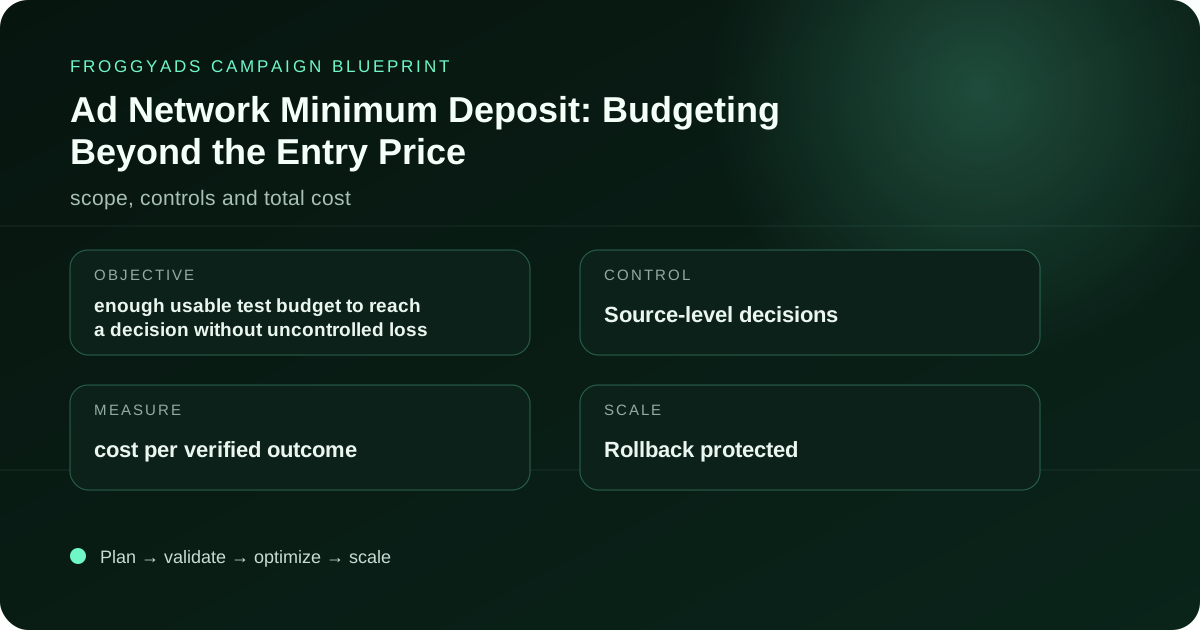
Evaluate an ad network minimum deposit as the first cash commitment in a measurable acquisition plan, not as proof that a useful campaign can run on the entry amount.

20B+ daily impressions750+ SSP integrations$50 minimum deposit7-day Money-Back Guarantee
Ad Network Minimum Deposit: Budgeting Beyond the Entry Price planning dashboard

What does this page explain about Ad Network Minimum Deposit: Budgeting Beyond the Entry Price?

Quick answer: A minimum deposit opens or funds an advertiser account; it does not establish the amount needed for a useful acquisition test. Compare the required payment with eligible inventory, bid floors, expected learning volume, balance conditions and your affordable loss. FroggyAds currently states a $50 minimum deposit. Build the first campaign around one advertiser-approved outcome and preserve campaign, creative, source, placement, device and geography identifiers for reconciliation.

SectionDistinct excerpt from this page
Buyer decision: can the opening payment support a useful test?The opening payment matters only after the buyer knows what traffic can be tested, how unused balance is handled and which accepted outcome will justify another allocation.
Translate the search intent into an auditable planTranslate the funding threshold into one offer, one serviceable audience, a fixed loss ceiling and a reconciliation date.
Ten funding questions for campaign approvalThis guide connects deposit terms with usable media capacity, full test cost, source evidence and the decision to fund a second tranche.

Planning reference for the cost model: Google's explanation of average CPC. Use it only to understand the metric; confirm FroggyAds funding and campaign conditions in the active account.

Direct answer

How should advertisers approach ad network minimum deposit?

Treat the minimum deposit as an account-access condition inside a wider acquisition decision. Before transferring funds, specify the customer action, campaign controls and evidence window that will tell you whether the balance produced useful learning.

A sound ad-network minimum-deposit approach begins by asking whether the chosen format, auction and market need more volume than the opening balance can support. Protect the first payment with an affordable loss limit and a test design that can reach a defensible conclusion.

Operating model

Translate the Ad Network Minimum Deposit search intent into an auditable plan

We recommend that you translate minimum-deposit search intent into a plan built backwards from the accepted business event. Confirm the provider's entry payment, then calculate whether the remaining usable balance can support the chosen market, format and normal conversion delay.

Objective and economics

Set the first cash ceiling from contribution, payout or qualified-lead value and the advertiser's maximum learning loss. Include likely rejection, refund and maturity effects before the deposit is approved, so a busy dashboard cannot redefine success later.

User path and relevance

We help you turn the minimum-deposit plan into a message and destination before funding the account. The ad should qualify the intended buyer, the landing page should continue the same promise, and the tracked action should be the one used in the commercial review.

Evidence and ownership

Our workflow gives you a clear ownership model: finance retains the deposit record, the media buyer owns campaign changes and the commercial owner authorizes further cash. Keep campaign, creative, source and placement identifiers with every funding decision.

Decision sequence

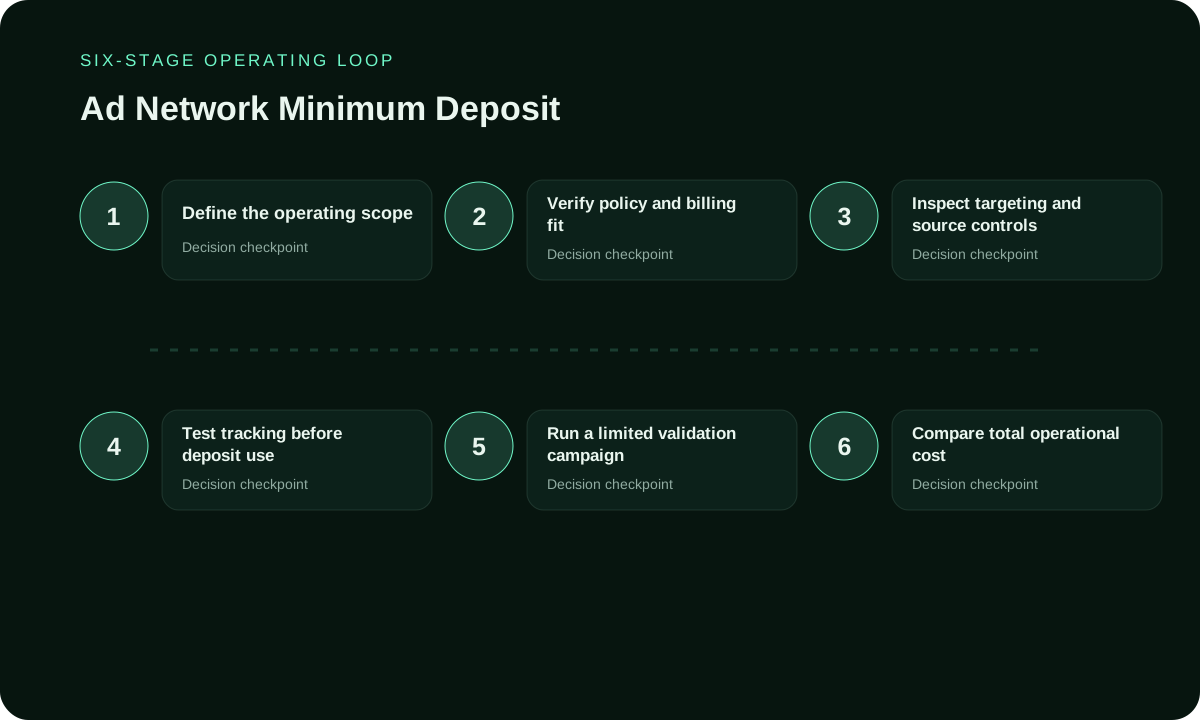
Use a six-stage learning loop

A useful funding loop moves from term verification to campaign setup, tracking proof, bounded delivery, mature acceptance and reconciliation. Each stage either releases the next action or holds the balance until a named gap is resolved.

Define the operating scope

Define the operating scope by recording the offer, geography, format, destination and accepted outcome covered by the first payment. Exclude unsupported markets and unapproved claims before the account balance becomes spendable.

Verify policy and billing fit

Verify policy and billing fit in the live account, including payment method, currency, fees, refunds, inactivity and balance rules. Save the terms used for approval so later reconciliation is based on the actual contract rather than a remembered headline.

Inspect targeting and source controls

Confirm that the campaign exposes the budget, pacing, source and exclusion controls needed for a reversible test. Limit the opening matrix to cells the buyer can compare without blending unrelated audiences.

Test tracking before deposit use

Complete a real click-to-accepted-event test before the deposited balance is released. Wait through the advertiser's normal approval or reversal window when that delay changes the commercial result.

Run a limited validation campaign

Spend the first tranche on a narrow validation question, then repeat the strongest cell with one declared change. A funded test should produce an explainable source decision before it produces a request for more money.

Compare total operational cost

Compare total operational cost by reconciling media charges with the work required to create, track, review and accept the outcome. Increase exposure only when the newest funded cohort stays inside the cash boundary and the last stable configuration remains recoverable.

Six-stage ad network minimum deposit workflow

Connect the guide to live testing

Connect Ad Network Minimum Deposit to a controlled audience test

With FroggyAds, you can turn the verified terms into one campaign with a named audience, capped budget and source set. Hold the offer and acceptance rule steady so the funded balance answers a buying question instead of mixing several experiments.

Create My Free Account
Illustration of audience targeting controls for an ad network minimum deposit test
Format and funnel fit

Give each traffic format a defined job

Assign each selected format a reason for consuming deposited funds. Native, push, display and pop placements create different attention and landing paths, so keep their budgets and accepted-cost evidence separate.

FormatPotential roleControl requirementPrimary decision signal
Native placementsEditorially aligned prospectingPromise-to-page continuityCost per merchant-approved action
Push notificationsTime-sensitive response testingFresh creative and frequency limitsVerified action after notification delivery
Display inventoryVisual reach for an established offerPlacement and device visibility checksIncremental accepted value beyond the baseline
Pop trafficBroad discovery with strict filteringSource exclusions and rapid spend capsAccepted cost of the newest traffic increment
Practical rule: compare mature business outcomes within each format before combining them into a portfolio view.
Audience and destination

Protect relevance before expanding reach

Use only markets, languages and devices that the offer, destination and operating team can serve. Expanding eligibility to consume the remaining balance creates volume, but it does not create a qualified customer path.

Audience design

Begin with a serviceable audience large enough for the accepted event to mature. Add device, operating-system or language splits only when each split represents a decision the campaign owner can act on.

Use audience-design evidence from the first readable cohort to locate where qualified response concentrates. A source earns preferred treatment after repeated mature outcomes, not because an early click-rate snapshot looks attractive.

Destination design

The destination should render on purchased devices, repeat the ad's material terms and make one primary action easy to complete. Preserve identifiers through redirects and confirmation so funded delivery can be reconciled.

Validate destination design across the complete route before launch, including forms, checkout or signup, confirmation events and advertiser-side status updates. The same accepted action must connect the media record to the final commercial review.

Measurement model

Use metrics that lead to decisions

Use delivery metrics to locate friction, then let advertiser-approved outcomes govern the next deposit. This keeps impressions, clicks and landing activity in diagnostic roles while cash follows verified customer value.

MetricWhat it revealsCommon misuseDecision use
Reach that survives technical filteringShows how much paid delivery reaches a functioning customer path.Calling every loaded visit a qualified prospect.Check audience, message and destination continuity.
Identifier reconciliation rateShows whether campaign clicks can be joined to advertiser outcomes.Judging supply before broken joins are repaired.Hold source decisions until tracking reconciles.
Media cost per accepted eventTests whether funded delivery stays under the declared value ceiling.Counting pending or rejected events as final value.Release, cap or stop the next cash tranche.
Operating effort per reviewed cohortReveals the labour needed to keep source evidence usable.Ignoring review time because the bid looks inexpensive.Compare full acquisition cost before scaling.

Choose the execution format

Choose a paid-media format that supports Ad Network Minimum Deposit

Choose a format from the buyer journey and destination rather than from the smallest visible rate. Configure the corresponding FroggyAds budget and targeting controls, then judge it by the funded test's accepted-event rule.

Create My Free Account
Illustration comparing advertising formats for ad network minimum deposit execution
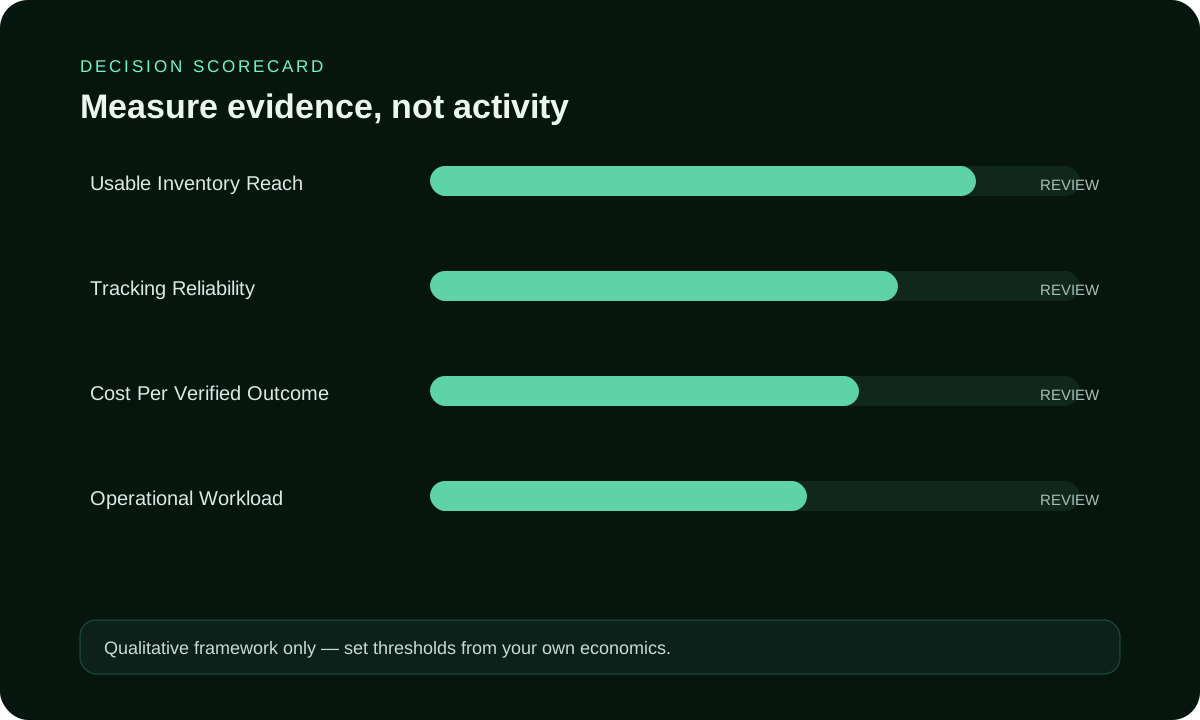
Qualitative scorecard

Score evidence, control and economics together

Score evidence as a release condition, not as a promise. A planning model can expose missing facts and cash risk, but it cannot certify future traffic volume, conversion quality or profitability.

Ad Network Minimum Deposit: Budgeting Beyond the Entry Price qualitative scorecard
Reach and fit

Score inventory evidence, campaign control and practical economics before treating the deposit as media capacity. Confirm that suitable supply exists for the required format, market and device and that the destination can lawfully serve the same audience.

Transparency and control

Require inspectable source identifiers, bid and budget limits, exclusions, exportable reporting and a clear pause owner. Those controls determine whether a weak cohort can be contained without abandoning the account.

Total operational cost

Calculate the acquisition decision with payment friction, creative, tracking, landing work, review labour, conversion delay and rejected outcomes included. The advertised entry amount is one cash-flow term, not the total experiment cost.

Illustrative planning scenario

Move from discovery to a repeatable baseline

Move from discovery only after another controlled cohort supports the same conclusion. This workflow is planning guidance rather than a customer result, forecast or guarantee.

Phase 1: establish a readable test

Open with one verified event, a limited device set and two materially different messages. Keep initial bids comparable while checking redirects, source behaviour and conversion joins before the balance is exposed further.

During discovery, separate tracking or destination failures from immature traffic. Every paused source, creative or device should have a recorded reason and a condition for a controlled retest.

Phase 2: validate and scale

Move a promising cell into its own validation campaign and change one control per cycle. Compare the added budget's mature cost and downstream acceptance with the preserved discovery baseline.

Keep the last working source mix, creative and cap available for rollback. If the newest cohort leaves the approved range, restore that version before diagnosing bid, audience, device or landing changes.

Put the guide into practice

Turn Ad Network Minimum Deposit into a bounded campaign test

Once a repeatable baseline exists, release only the next reversible cash increment. Use FroggyAds audience and source controls to make qualified outcomes, rather than raw activity, determine the following step.

Create My Free Account
Illustration of a campaign launch checklist for ad network minimum deposit
Failure modes

Avoid the decisions that destroy learning

The first balance is wasted when nobody can explain eligibility, source identity, accepted value, cash exposure or decision authority. Record those items before launch so apparent platform activity cannot substitute for a commercial answer.

Comparing headline price only

A reversible funding decision keeps the evidence behind cost and quality intact. Set the threshold, capture the reason for each action and preserve the configuration needed to undo a weak change.

Skipping policy review
No technical test
Undefined ownership
Opaque source reporting
Depositing without a loss limit
Frequently asked questions

Questions about ad network minimum deposit

Use the answers for Ad Network Minimum Deposit to prepare a campaign brief covering objective, eligible audience, ad format, GEO, budget, tracking, source controls and the accepted conversion.

What does an ad network minimum deposit actually mean?

It is the smallest account funding amount the provider currently accepts, not a guarantee of traffic quality, campaign cost, or refundability. Confirm currency, fees, spend rules, balance treatment, and current terms directly before payment.

How should an advertiser plan around a minimum deposit?

Define a campaign that can use the funded amount responsibly, including audience, sources, creative, limits, measurement, review dates, and a pause. Do not deposit until the complete test and its affordable downside are clear.

Which costs sit beyond the network's entry deposit?

Add transaction and currency charges, media fees, data, creative, page work, tracking, account operation, invalid traffic review, support, and customer handling. The deposit is a cash-flow threshold, while total campaign cost is broader.

How can audience fit affect the value of a deposit?

A small well-controlled source test can be more useful than spending the full balance across broad eligibility. Plan enough source detail and customer qualification to learn which delivery deserves funds before the deposit is consumed.

What should the campaign message establish before funding?

Prepare accurate creatives and a matching destination with current offer, advertiser identity, material conditions, and one working action. Funding should follow a publishable customer path, not precede the evidence and approvals needed to build it.

Which account checks matter before paying a minimum deposit?

Verify company identity, access roles, payment method, currency, invoices, refund and inactivity terms, caps, source controls, reporting, support, and pause behaviour. Save the current terms and complete account verification first.

How can an advertiser judge if the deposit was worthwhile?

Reconcile funded balance, charges, spend, visible delivery, qualified visits, accepted customer outcomes, remaining credit, and later value. Evaluate mature results and usable learning rather than treating account activation as success.

What should be investigated when the balance spends too quickly?

Check bids, pacing, caps, time zones, eligible sources, automation, invalid activity, and account access. Pause delivery before diagnosing, preserve logs, and ask the network to explain any difference between configured limits and billed traffic.

Which deposit terms should stop an advertiser?

Do not fund when fees, refunds, expiry, billing entity, traffic controls, or withdrawal rights are unclear, or the loss exceeds the approved test limit. Payment pressure should never replace due diligence on the campaign and provider.

When is a larger network deposit reasonable?

Increase funding after prior balances reconcile, sources produce suitable customers, complete economics are acceptable, support is responsive, and controls work. Deposit only the amount required for the next approved test or measured growth step.

Related playbooks

Continue the campaign workflow

Carry the funding record into a source action: retain the term snapshot, measurement rule, first-cohort evidence and rollback point. This creates a continuous decision trail from payment to marginal scaling.

Launch with evidence

Turn ad network minimum deposit into a controlled test

Use the required deposit for one controlled acquisition experiment with transparent tracking and a written stop-or-expand rule. Offer quality, creative, destination, auction conditions and ongoing optimization still determine the observed result.

Decision guide

Separate account access from a usable test budget

Direct answer: A low entry payment only makes account access easier; it cannot show whether the amount will buy enough eligible delivery for a readable outcome. FroggyAds currently uses a $50 minimum deposit rather than a $10 or zero-deposit offer. Before paying, compare that threshold with available formats, market supply, bid conditions, tracking needs, refund rules and the cash required to reach one mature advertiser decision.

Keep the access payment separate from spendable learning capacity. Related searches covered here: ad network minimum deposit, low-minimum ad network and $10-deposit comparisons are answered through one cost-and-control framework rather than three repeated definitions.

Write the measurement contract

Define funded balance, billable delivery and advertiser-accepted value as separate measures. Record invalid-event treatment, attribution, maturity and reversals so a platform conversion total is never mistaken for settled business value.

Constrain the first test

Cap the first test at an affordable learning loss. Keep the offer, creative condition and destination stable until fees, minimum bids and the normal outcome delay show whether the remaining balance can answer the chosen question.

Preserve source-level control

Retain campaign, creative, source, placement, device and geography identifiers wherever the account exposes them. Join configured bid and actual media cost to qualified behaviour and final acceptance before excluding supply.

Scale from marginal value

Increase spend by a measured cash increment and compare it with the preceding stable cohort. Roll back when tracking divergence, source concentration or mature accepted cost crosses the pre-launch ceiling.

Decision layerEvidence to recordWhy it matters
AccessCurrent account eligibility, currency and funding conditionsShows whether the buyer can enter the platform without confusing account access with a viable test.
Media eventConfirmed balance funding and contracted delivery unitKeeps CPC, CPM, CPA, CPV or install figures tied to the event the advertiser actually buys.
QualityQualified visits, activated users and advertiser-approved outcomesPrevents inexpensive delivery from being reported as useful customer acquisition.
EconomicsSpendable test capacity after fees, bid floors and maturity needsConnects the payment decision to break-even value before a weak average receives more cash.
ControlSource actions, pacing caps, bid ceilings and the saved rollback stateKeeps funded delivery reversible when auctions, automation or supply composition changes.

Seven-step operating workflow

  1. Name the advertiser-approved outcome and its maximum affordable media cost.
  2. Confirm the funding contract, purchased event and invalid-activity treatment.
  3. Prove analytics joins, click identifiers and advertiser callbacks end to end.
  4. Release the first balance across only a few comparable campaign cells.
  5. Review mature source quality before altering bids, messages or eligibility.
  6. Wait for the advertiser's approval, reversal, activation or retention window before naming a funded winner.
  7. Expand, revise, retest or stop from the newest source-level accepted value rather than early volume.

Stop and rollback rule

Write the rollback trigger before releasing another part of the balance. Pause the newest increment when tracking stops reconciling, qualified behaviour declines, supply concentrates unexpectedly or mature cost exceeds the ceiling; restore the saved source set and change one factor.

Evidence hierarchy

Rank reconciled advertiser outcomes above estimated platform conversions, source cohorts above blended totals and mature value above early engagement. Published rates and budget articles help plan the test, but they do not predict a particular auction or market.

What this owner does not promise

A minimum-deposit campaign does not promise a universal rate, guaranteed traffic quality, fixed conversion performance or profit. Its purpose is to make the first cash commitment measurable, attributable and reversible under changing inventory and response.

A modest entry amount cannot guarantee profitable acquisition. External metric references: use Google's average-CPC definition, goal-based bidding guidance, Google's budget guidance, Meta's budget guidance and the IAB glossary to check terminology, then verify live FroggyAds settings before launch. For minimum-deposit planning, apply those definitions to the actual audience, auction, format and funding contract under review.

Advertiser decision framework

Ad Network Minimum Deposit: Budgeting Beyond the Entry Price: what should the advertiser decide next?

Decide whether the entry payment leaves enough spendable capacity for a valid first read. Keep the funding event, media charge and cost per advertiser-approved outcome separate, because a minimum or suggested amount is never a performance forecast.

Use the funding threshold and balance terms to define cash exposure, the bounded campaign plan to define what the first payment must learn, and the reconciliation rule to determine whether another tranche is justified. The decision table below turns those three inputs into advertiser actions without repeating a general pricing guide.

DecisionWhat to verifyFroggyAds action
Funded-test objectiveName the settled customer event and the largest learning loss the advertiser will accept.Configure one FroggyAds objective and keep its conversion definition unchanged through the review window.
Serviceable audienceVerify that market, device, language, offer and destination can support the proposed paid route.Apply only the FroggyAds audience controls needed to test that real customer path.
Supply evidenceCompare mature source cells so a blended network average cannot hide concentration or poor fit.Keep, cap, exclude or retest inventory from documented source and acceptance evidence.
Cash economicsJoin media charges to accepted conversions, later value and the full work required to operate the test.Protect the deposited funds with a written loss ceiling and one consistent attribution window.
Next-tranche ruleSpecify the repeatable result that must mature before another part of the budget is released.Increase one source, audience or bid control at a time and compare its marginal value with the saved baseline.

A page-specific FroggyAds test sequence for Ad Network Minimum Deposit: Budgeting Beyond the Entry Price

  1. Accepted-value contract: name the advertiser-approved event, its maturity window and the maximum media loss allowed while the opening balance is learning.
  2. Funded customer path: verify serviceable market, device rendering, message continuity and end-to-end tracking before any of the deposited cash is exposed to delivery.
  3. Single learning question: open one capped FroggyAds campaign and nominate the bid, message, audience or destination as the variable; keep the other conditions fixed.
  4. Source reconciliation: compare qualified behaviour, mature advertiser acceptance, timing and full cost for each inspectable supply cell rather than reporting a network-wide average.
  5. Second-tranche condition: record the result that must reproduce, the source pattern that must remain stable and the cash ceiling that still applies before further funding is released.

Why FroggyAds is relevant to Ad Network Minimum Deposit: Budgeting Beyond the Entry Price

Choose FroggyAds when you want the campaign to remain controllable after the account is funded. Our self-serve workflow provides campaign budgets and available market, device, browser, carrier, category and source controls; SmartCPC and Adscore-supported signals can assist optimization while your tracker and backend decide commercial quality.

Use the completed funding loop as the release checkpoint. If the accepted result fails to reproduce at the next meaningful volume band, restore the prior configuration and investigate the single changed control.

Create your free FroggyAds account

Search intent and buyer decision

How should an advertiser judge an ad network minimum deposit?

This guide serves performance advertisers comparing account funding with usable source-level evidence and accepted economics. The linked FroggyAds minimum-deposit overview states the platform-specific entry information; this page owns the separate buyer task of deciding whether that cash commitment can support a controlled and commercially meaningful test.

Keep the audience, source, objective, market and accepted-event evidence in one funded-test record. Each item can change configuration or economics, so the next allocation should never rely on the deposit amount alone.

CheckpointPage-specific actionEvidence to keep
PriceSeparate the published threshold or bid floor from the amount actually charged to the campaign.Retain the dated deposit terms, currency and payment confirmation used for approval.
EconomicsValue the advertiser-approved outcome and set the maximum cash loss before delivery.Keep media charges, source identifiers and mature accepted outcomes in one ledger.
BudgetRelease a bounded learning amount before approving broader delivery.Archive the break-even rule, stable campaign state and evidence required for the next tranche.

Hypothetical calculation: suppose a campaign's mature accepted-action rate is 2% and the advertiser can afford USD 60 per accepted action. The implied break-even click value is 0.02 × USD 60, or USD 1.20. Replace the assumed rate, value, rejection pattern and full operating cost with your own evidence; the calculation is neither a FroggyAds price nor a performance forecast.

Choose FroggyAds as the controllable delivery layer once the funding case is ready: preserve the approved offer and outcome, apply the required budget, audience and source controls, and let advertiser-side accepted value govern the next cash decision. Create your free FroggyAds account.

Direct answer

Ad Network Minimum Deposit: Budgeting Beyond the Entry Price — what matters first

Judge an ad network minimum deposit as a cash-planning condition: verify what the payment unlocks, calculate the capacity needed for one accepted-event decision and fund only the first reversible campaign step.