South Africa regions and accepted value

Choose a South Africa Ad Network for Serviceable Regional Demand

By FroggyAds. Updated 21 October 2026.

Choose FroggyAds to test a South African offer with a defined region, clear ZAR terms and a customer journey your team can complete. Our available campaign settings help you manage the traffic purchase. Your retained orders, reached eligible leads or approved product actions show which delivery deserves another rand, with fulfilment and response capacity kept in view.

Operating briefStats SA boundaryRegional service map
ad network in south africa planning visual
South African buying brief

Start with a serviceable South African customer cell

Name the customer, problem, offer, covered province, metro or operating area, approved language route, ZAR amount or basis, eligibility, destination, response or fulfilment promise and final event. This is the unit the network comparison must support. Choose one first uncertainty. You may need to test delivery-ready ecommerce demand, reachable professional-service leads, a completed mobile application or a useful SaaS activation. A campaign that mixes all questions cannot tell finance or operations what to do next.

Campaign and household context

Check campaign availability and read Stats SA household measures carefully

We recommend FroggyAds when you want to configure a bounded campaign yourself and preserve the variables behind delivery. Check current South Africa supply, formats and controls in the account. Treat the live setup as observed evidence rather than a permanent catalogue claim.

Stats SA’s General Household Survey 2024 reported that 82.1 percent of households had at least one member who accessed or used the internet at one or more locations. Separately, 17.4 percent of households had fixed internet at home. The report shows metropolitan variation as well. These household measures do not count unique buyers or establish the connection used by a campaign visitor.

The figures do not disclose FroggyAds inventory, campaign geography, a visitor's connection, commercial intent or accepted results. They support testing production experiences under real conditions; they do not justify a reach, lead or sales forecast.

Regional service coverage

Use household context to plan real South African service coverage

Keep year, household unit and access definition beside the statistics. Use the live campaign for delivery information and the advertiser's orders, CRM or product system for value. A clean boundary prevents public context from becoming an unsupported sales claim.

List the areas where the business can ship, install, consult, book, activate or support customers under ordinary conditions. Include capacity, delivery timing, exclusions, return route and owner. Do not present national availability when the commercial promise has a smaller footprint.

Use geographic settings only at the precision confirmed in the account. When operational coverage is narrower, disclose it on the destination and classify unsupported actions. An enquiry outside the service area may inform expansion but is not an accepted lead.

Regional terms and language

Keep regional terms and language support commercially consistent

Separate areas when fulfilment cost, response capability or customer terms change. A regional scorecard lets the business expand deliberately instead of allowing a national average to hide places where the promise fails. South African campaigns may serve customers with different language needs, but language choice should follow a named audience and supported operation. Carry the approved meaning through creative, ZAR terms, eligibility, fields, errors, confirmation and follow-up.

Have a competent reviewer assess natural customer-facing meaning. Preserve the released versions. If a route changes audience, service area, qualification or sales ownership, treat it as a separate commercial cell rather than crediting or blaming language alone.

Choose FroggyAds when you want to test a clearly defined South African offer with campaign controls you can inspect. Explain the customer benefit, regional availability and next step in language the receiving team can support. A visitor should find the same ZAR terms and eligibility conditions on the destination, in the confirmation and during follow-up.

ZAR customer commitment

Show the ZAR offer before asking for a customer commitment

Show the approved rand amount or pricing basis, together with relevant payment, delivery, subscription, cancellation or eligibility conditions. The destination should preserve the offer that earned the visit instead of revealing a materially different condition late.

A country-wide audience estimate cannot tell you whether an order will be delivered, a lead will be reached or an account will activate. A useful South Africa campaign connects a defined region and accurate ZAR offer to a mature outcome in your own systems.

Keep changed offer versions attached to their outcomes

Create a new version when price, stock, promotion, service coverage or payment changes. Keep orders and leads with the version they saw. Pooling unlike offers can make a source appear responsible for a commercial or operational change.

Create My Free Account
Illustration of audience targeting controls for an ad network in south africa test
Currency and production journey

Record currency treatment and test the production customer journey

If media spend is billed elsewhere, retain the original amount and record the conversion method, reference date and decision currency. This lets finance reproduce accepted-cost calculations without treating a changing exchange display as historical evidence.

Inspect first render, asset weight, form behaviour, address or location selection, payment or booking handoff, confirmation and support on the production journey. Household access statistics cannot tell you which connection a visitor uses or whether the route will complete.

Customer-step diagnosis

Find the failed customer step before changing media allocation

Record route version and failing step. Strong ad response with weak completion may indicate an unclear service boundary, a heavy page, a field issue or payment friction. Repair the owned problem before making a durable source decision. Keep internal tests separate from customer outcomes. A successful technical transaction demonstrates capability. Retained orders, reached leads and approved activations require real eligible customers and the appropriate maturity period.

Format communication task

Give the selected format a clear communication job

Use short formats for a clear familiar need, visual formats for recognition, and context-bearing placements when the customer needs more explanation. Select only from live eligible options and name the communication job before launch.

Format and order evidence

Compare format meaning and the retained-order journey

State the understanding a suitable customer should have after the creative. Service area, price, qualification and response expectations should not be hidden to maximise clicks. A relevant visit is more valuable than curiosity that the business later rejects.

Compare formats under the same destination and mature denominator when possible. Attention metrics diagnose the message. Retained commercial outcomes determine allocation after comparable business windows close.

Trace product view, cart, checkout, payment, stock confirmation, dispatch, delivery, cancellation, return and retained order. Keep province or operating area where it affects the delivery promise. The advertising dashboard cannot observe every reversal.

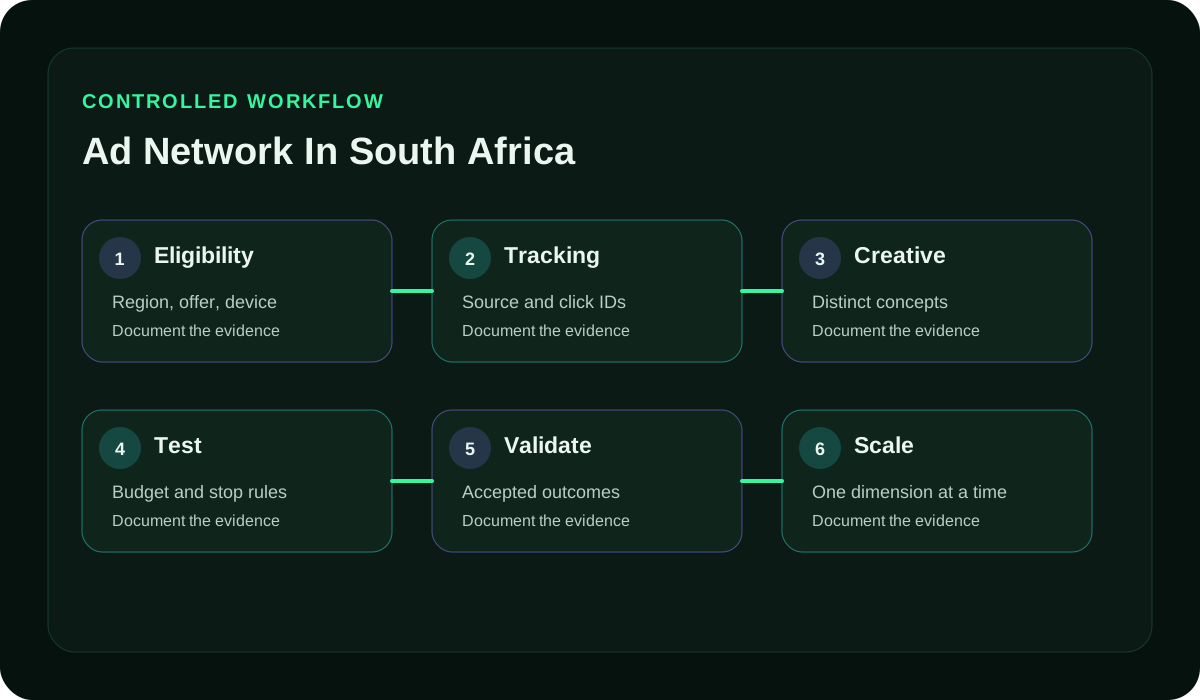
ad network in south africa controlled workflow visual

Separate order progress from retained value

Use fulfilment reasons to locate South African order loss

Preserve reasons such as unsupported address, payment failure, unavailable stock, late dispatch, cancellation and return. These reasons distinguish acquisition from fulfilment problems and assign the repair to the right team.

Create My Free Account
Illustration comparing advertising formats for ad network in south africa execution
Retained-order calculation

Calculate ZAR acquisition cost from retained delivered orders

For illustration, ZAR 240,000 divided by 120 retained delivered orders equals ZAR 2,000 per accepted order. This hypothetical calculation demonstrates the formula only and is not a FroggyAds price, result or recommended spend.

Service enquiry stages

Track service enquiries from submission to accepted opportunity

Explain what the form creates, who qualifies, where the service operates and when contact should occur. Record validation, assignment, first attempt, reached person, qualification, appointment and acceptance as separate timestamps. Use neutral reasons for invalid details, unsupported area, ineligible need, unreachable contact and late internal response. A source should not be rejected because the receiving team missed its own response standard.

Response capacity

Keep campaign delivery within staffed response capacity

Fit campaign scheduling and spending to staffed response capacity using the controls available in your setup. Monitor the receiving queue in your own process, and pause affected traffic when the promised response cannot be met. Keep the operational delay with the customer record and resume after the responsible manager confirms headroom. This does not assume an automatic CRM connection or queue-triggered campaign control.

Accepted product state

Define the product state that creates accepted business value

For finance, SaaS or apps, define the exact state the business accepts. Registration can indicate interest, while completed verification, approved account status, funded activity or a named product action may represent useful activation.

Activation review record

Keep product versions and review timestamps with activation

Keep campaign, source where available, creative, language, product version, device and stage timestamps. Exclude internal tests, duplicates and ineligible applications consistently. Mark pending reviews until the stated window closes.

Resolve the blocked product step

Diagnose application loss before judging its source

Diagnose loss by stage. A confusing field or document explanation belongs to the route. A mature cell that repeatedly fails the accepted-cost rule after the route works belongs in a cap or exclusion decision.

Create My Free Account
Illustration of a campaign launch checklist for ad network in south africa
Media and customer evidence

Retain South African media and customer evidence together

Retain campaign, format, source or placement, creative, destination, region, spend, delivery, meaningful action, accepted event, rejection reason, maturity and operational delay. Apply the same window to comparable cells.

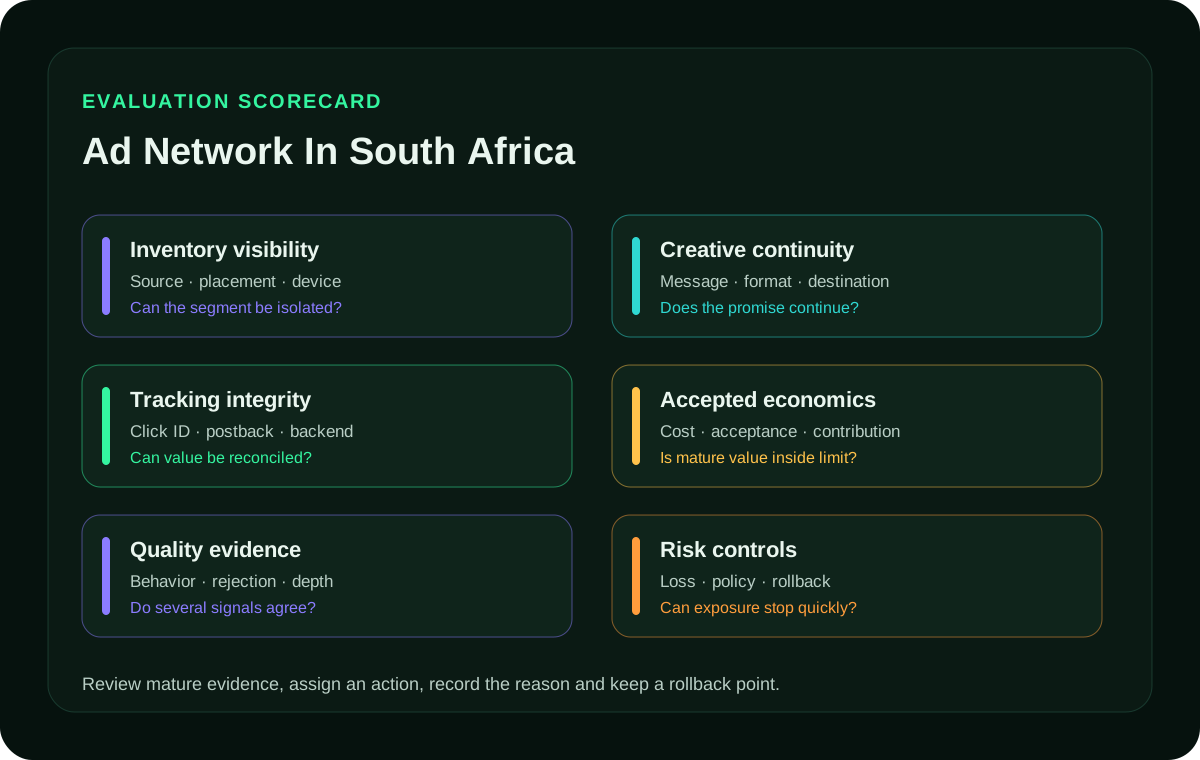
ad network in south africa evaluation scorecard visual
Source actions

Choose an accountable action for each inspected source

Use keep, cap, repair, exclude and retest. Keep after mature evidence passes; cap for capacity or uncertainty; repair when the page or operation owns the failure; exclude after repeated mature failure; retest after a documented material change.

Decision ownership and event proof

Assign the source decision and verify customer-event transport

Name the owner and reversal rule. This prevents a small early cohort from becoming a permanent winner and stops a source affected by a broken route from becoming a permanent loser. Map how campaign identifiers reach order, CRM, application or product records and where acceptance is decided. Use the minimum approved information. The advertiser remains responsible for its notices, consent choices and appropriate review.

Measurement verification

Test the measurement path before accepting its signal

Test event transport with authorised records and remove tests from results. A callback that arrives proves a signal moved; it does not prove qualification, delivery, approval or retention.

Attribution confidence

Keep partial attribution separate from verified customer value

Label delayed, partial or modelled attribution. Use it for diagnosis at the confidence it deserves. Do not convert an incomplete join into verified customer value merely to fill a source report.

Customer outcome worksheet

South African order, lead and application evidence by owner

Decision areaProduction questionAccepted evidence
Regional commerceCan the ZAR price, payment and delivery promise be completed?Retained delivered order after the return window
Commerce ownerWho confirms fulfilment and explains rejected deliveries?Commerce and fulfilment owner with dated order reasons
Service enquiryCan an eligible customer be reached within the promised time?Confirmed appointment or accepted opportunity
Response ownerWho owns assignment, response and qualification?Sales or service operations with stage timestamps
Product routeCan a suitable applicant finish the required product stages?Approved account or named useful activation
Activation ownerWho approves the final product state and its review window?Product and verification owner with the accepted-event rule
Capacity and release checks

Three checks before releasing more South African traffic

Operating headroom

Confirm dispatch, appointments and support headroom

Review inventory, dispatch, return handling, appointment capacity, verification, sales response, onboarding and support for the proposed increment. A profitable-looking media cell can still harm customers if the operation cannot keep up.

Controlled increment

Set a bounded regional increment

Set a maximum release, review time, accepted-event threshold and stop condition. Increase one variable at a time. Opening new regions, languages, formats and offers together produces volume without a usable explanation.

Campaign suitability

Use FroggyAds for the approved next traffic purchase

Choose FroggyAds when current self-serve controls match the bounded South Africa test your business can support. We help you configure and observe delivery; operations and finance authorise the next release.

Frequently asked questions

Questions about South Africa advertising campaigns

How should provinces guide a South Africa media plan?

Separate provinces or metros when service boundaries, fulfilment costs, customer terms or response ownership differ. Confirm the geographic precision available in your campaign and keep a business eligibility check. Compare equally mature accepted outcomes before merging allocations; a broad regional label cannot establish the visitor’s connection or commercial value.

Which language journeys can the campaign honestly support?

Release language versions that your business can continue through the destination, ZAR conditions, confirmation and customer response. Have a capable reviewer check meaning in context. If the language version also changes audience or service ownership, retain it as a distinct commercial test and compare its mature accepted outcome.

What device differences require independent testing?

Test supported phones and computers through first render, input, correction, address selection, payment or verification and confirmation. Record route version and failing step under representative connections. A household internet-access category does not reveal how the individual visitor connects, so use observed journey evidence when diagnosing completion.

How should publisher and format supply be logged?

Retain the source, environment, format and creative references your reporting supplies with spend and the agreed accepted event. Name a publisher or exact placement only when available. Keep missing or aggregated attribution visibly bounded, so a confident source decision does not depend on detail the campaign never recorded.

Which regional costs belong in budget planning?

Preserve attributable media spend in its original currency and record the approved ZAR conversion method and date where needed. Review delivery, returns, response, verification and other material business costs separately when setting the acceptable acquisition level. Account funding and available bid settings do not establish an economically sufficient regional test budget.

What connects platform clicks to backend records?

Keep supported campaign and click or source references with the later order, CRM, application or product record. Verify an authorised action through redirects, retries and delayed status updates. Reconcile unmatched and duplicate records before allocation, with technical transport kept distinct from eligibility, approval, delivery or retention.

How is accepted value stronger than engagement alone?

Engagement helps you locate interest and journey loss; the agreed accepted event shows whether the business obtained a usable customer outcome. Compare that value after equivalent review windows and explain rejected or pending events. An attractive click rate can coexist with unsupported addresses, late responses or unapproved applications.

Can destination and payment coverage vary by province?

Yes. State the actual payment, delivery or service coverage for the offer and test the customer route in each released area. Use the campaign’s confirmed geographic settings together with your own eligibility rule. Do not open an additional province until the destination and operating team can honour the advertised promise there.

How would a capped South African pilot start?

Begin with one supported province or metro, an approved ZAR offer, a complete language journey and a named accepted event. Verify current FroggyAds options and the event record, then set a manageable allocation, review date and pause conditions. Assign responsibility for response or fulfilment before buying the first sample.

Which verified cell should scale first?

Increase the cell with comparable mature accepted value inside the business limit and spare operating capacity. Keep the added budget, source group, region or language identifiable. Recheck the changed customer journey and review window, because the first cell’s economics do not forecast every additional provincial or metro audience.

Related regional resources

Continue the South African traffic-planning decision

Use the related South African guides for the next specific choice: network coverage, a push-format journey, provider comparison or source evidence. Carry the same regional service boundary, ZAR offer and accepted-event definition into that review, so your agency and operating team can explain the next traffic purchase together.

Measure accepted campaign value

Identify the failed campaign or customer stage

Low delivery points to availability, eligibility, format, schedule, budget or bid conditions. Strong clicks with weak progression point to message, page, connection tolerance or ZAR terms. Loss after submission points to payment, response, qualification or fulfilment.

Search intent and buyer decision

Give the next South African purchase an accountable business reason

Assign one repair and preserve its version: Choose one repair owner and version the change. A new audience cannot fix a broken address step, and a creative rewrite cannot add service capacity. Preserve the earlier route for a clean comparison. Stop under the written spend, customer, capacity or value rule. Record what must be true before restart. A controlled stop often creates more useful evidence than continuous optimisation without a boundary.

Confirm the customer, region, language, ZAR offer, working production route, mature accepted event, source decision and spare capacity. Attach the exact versions used by the cohort.

State the remaining decision uncertainty: Document remaining uncertainty and reversal conditions. Household internet access can frame planning, but it cannot authorise more media spend. The decision rests on campaign delivery and verified business outcomes.

Start a supported South African campaign: Start your next South Africa campaign with FroggyAds when this record is ready. Release one serviceable cell, learn from the full customer path and grow only where the promise remains commercially and operationally sound.

Make client and agency responsibilities explicit: For an agency-managed campaign, write who approves the proposition, ZAR terms, geographic boundary, creative, destination, event definition and next budget step. The client should retain access to the business evidence, while the media team retains a reproducible campaign record.

Prepare an urgent operating exception: Create an exception route for urgent stock, service or compliance changes. The operating owner should be able to pause the affected cell without waiting for a weekly media report. Record the time, reason and versions affected so the pause does not become unexplained missing delivery.

Agree on conversion vocabulary: Use one reporting vocabulary. A submission, reached lead, confirmed appointment, approved account and retained order must not be called the same conversion. When each team uses the stage name consistently, finance can reconcile cost without reinterpreting dashboard labels.

Show media cost and operational loss together: At review, show both media evidence and operational loss. A source with more expensive clicks can still create lower accepted cost if it produces serviceable customers, while apparently cheap traffic can create workload that never reaches acceptance. Compare the denominator the client approved. Close the handoff with the next action, owner, deadline and reversal condition. This keeps a South Africa campaign from drifting between agency optimisation, client response and fulfilment decisions without an accountable commercial conclusion.

Reconcile spend with accepted customer events: Create a reconciliation view that starts with attributable spend and ends with accepted events after response, approval, delivery or retention. Keep the intermediate counts so the team can locate loss without treating every stage as equal value.

Retain the relevant intermediate counts: For leads, show submissions, valid contacts, reached people, eligible opportunities and accepted outcomes. For commerce, show paid orders, fulfilled deliveries, cancellations, returns and retained orders. For products, show installs, registrations, verification and useful activation.

Calculate cost from the agreed final denominator: Calculate the accepted acquisition level from the final agreed denominator and document any other material business cost reviewed by the client. A source decision based only on dashboard conversions can move money toward a route that creates workload rather than customer value.

Ask the business owner to sign the definition: Have finance or the business owner sign the denominator before scaling. If the definition changes, version it and keep earlier cohorts under the rule used at the time. Historical evidence should not be rewritten to satisfy a new target.

Page checkpointHow to use itEvidence to retain
Regional offer readinessCheck the ZAR offer, destination and receiving team for the new area or language.Approved terms, service coverage, route version and available capacity.
Accepted value and ownershipKeep the mature outcome attached to its own version and acceptance rule.Customer-event evidence and the accountable commercial release owner.
Customer outcome definitionName the order, lead or product state the business accepts and who approves it. Keep its maturity window and offer version stable before comparing source economics.Document source quality, the decision taken and the rollback or retest condition.

Prepare a South African traffic purchase with a clear outcome

Your release decision: Create your free FroggyAds account, confirm current South Africa supply and release one serviceable customer route with an explicit maturity rule. We give you campaign controls; your order, CRM or product evidence decides what deserves the next rand.

Why use FroggyAds for a supported South African offer?

Choose FroggyAds for your next South Africa campaign when the region, language route, ZAR terms, destination and accepted outcome are ready. A bounded test gives you an actionable source decision without turning household internet context into a sales forecast. Create your free FroggyAds account.

Hypothetical service comparison and research scope: A business could separate regional ecommerce from professional-service leads. Commerce allocation could follow delivery and the return period; lead allocation could follow reached eligibility and confirmed appointments. Dispatch or response limits would pause the affected cell. This example promises no result. Stats SA’s General Household Survey 2024, Table 14.1, supplies the separate household access and fixed-home measures used here. General paid-advertising explanations from shopify.com and Google Display targeting context from support.google.com clarify terminology; they do not establish FroggyAds supply, ZAR prices or campaign performance.

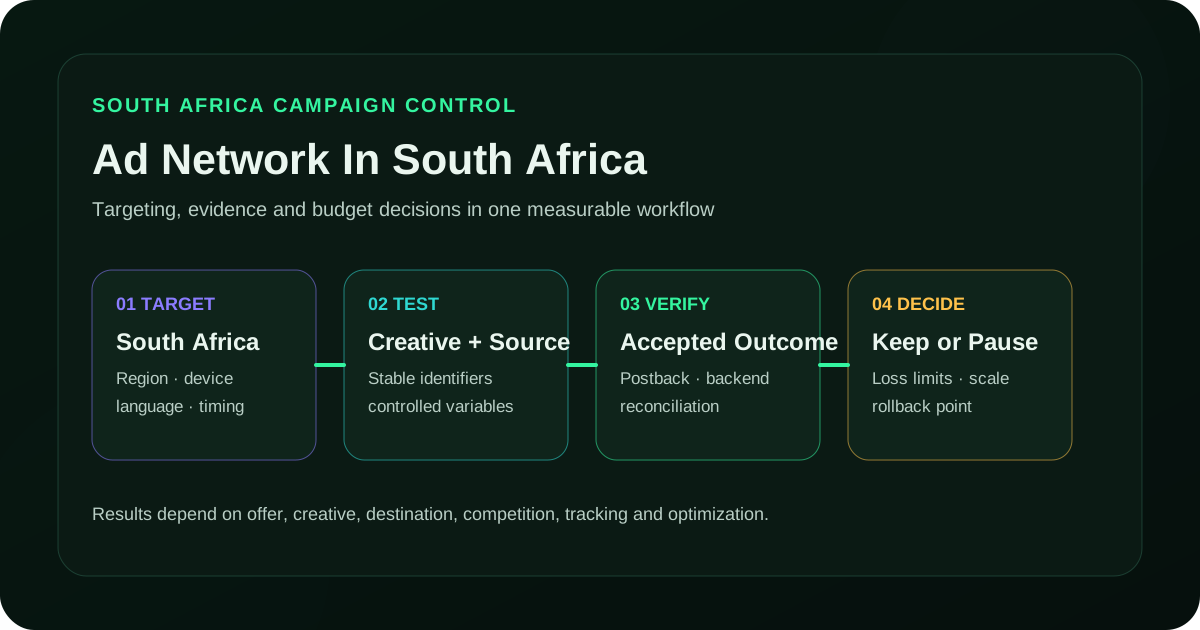
Direct answer

What should earn the next rand of South African ad spend?

Choose FroggyAds when the available campaign settings fit a region and customer journey your business can serve. Give the next rand to a cell with traceable mature value and enough dispatch, response or product capacity. Use household research to frame the test and your own accepted customer evidence to decide whether to repeat it.