Product activity and expansionKeep app activation and campaign evidence comparable
Connect activation with the campaign: Preserve the market cell, source, creative, device, app version and activation timestamp. Exclude internal tests, duplicates and ineligible accounts under written rules. Add a maturity period when later validation, subscription or cancellation can reverse an early action.
Diagnose permission, explanation, verification, plan choice and product error separately. Compare Bahasa and English routes only when each has a defined customer and support owner. A broken onboarding build should be repaired before the buyer judges media quality.
Hypothetical activation cost: Choose the event and window before spending. In a hypothetical serviceable cell, IDR 48,000,000 of attributable media spend divided by 1,200 accepted activations equals IDR 40,000 per accepted activation. The calculation demonstrates one method; it is not a FroggyAds price, benchmark or forecast.
Compare like outcomes: Keep spend in its original currency record and define any portfolio conversion method separately. Do not rank retained orders, qualified leads and activations through one unexplained regional score. Each outcome needs its own business value, workload and reversal logic.
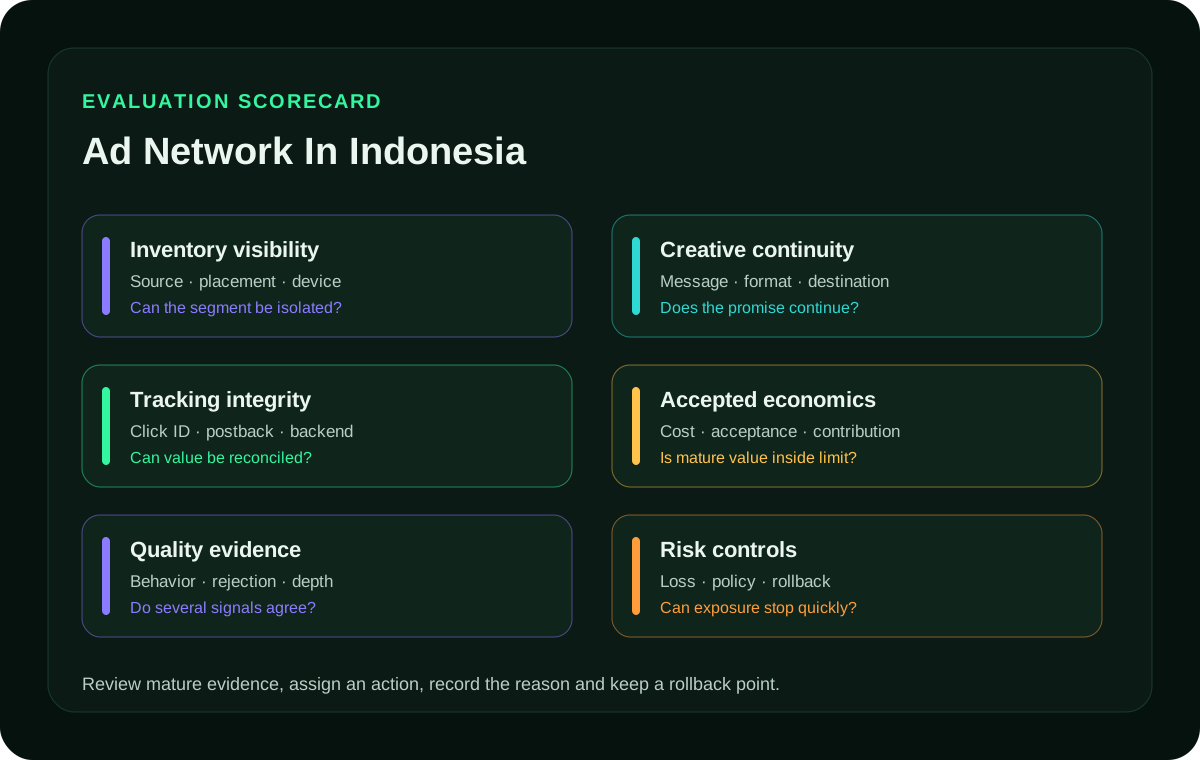
Decide what the test can support: Compare mature cost with value and ordinary capacity. A source can pass its cost threshold yet require a volume cap. Another can fail because the route was incomplete and deserve a repaired retest. State the resulting action and the evidence behind it.
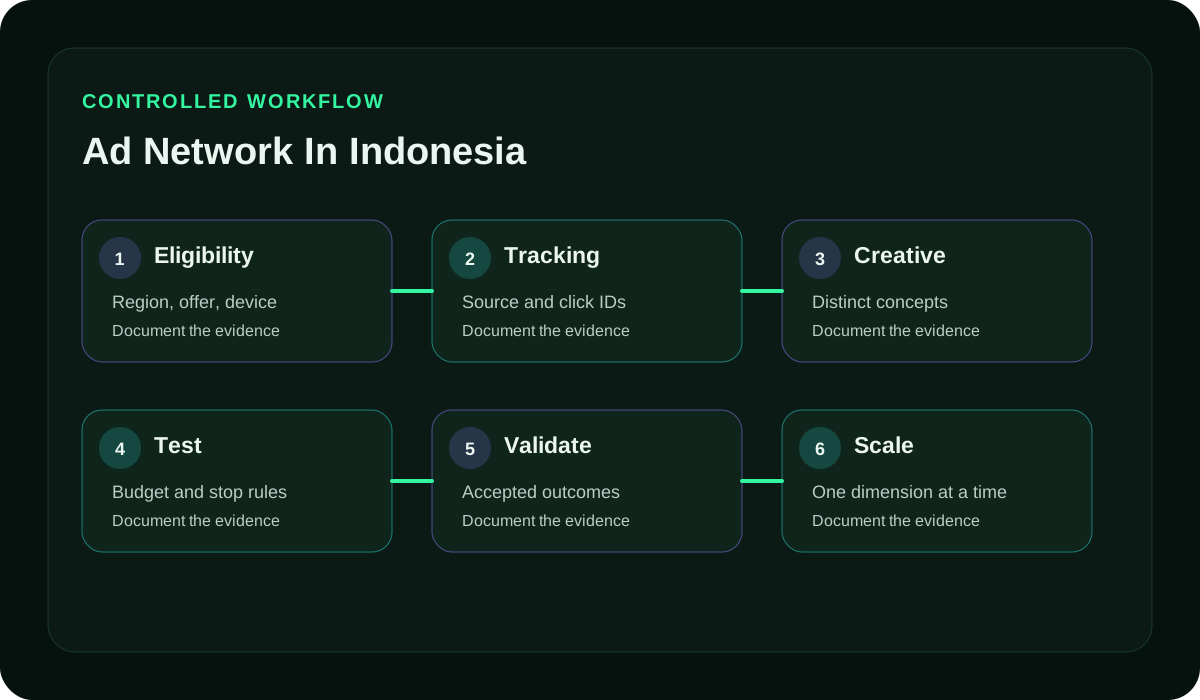
Locate the first failed stage: Limited delivery points to live availability, format, settings, schedule, bid and budget. Delivery without useful response points to creative and context. Response without completion points to language, proposition, page, verification or payment. Completed actions without acceptance point to eligibility, fulfilment or product use.
Give each repair an owner: Write the suspected break, evidence, responsible team, correction and rollback. Change one material condition when possible. A simultaneous geography, message, route and event change starts a new test without explaining the result that triggered it.
Keep unfinished outcomes provisional: Leave immature outcomes in review until their deadline. Pause inaccurate or unserviceable promises immediately. Continue other cells when they have a complete route and capacity. A blocked market segment should not stop independent work across the whole campaign.
Review the first allocation: Close the initial cell with current settings, source actions, mature value, workload, capacity and unresolved limits. Then choose one expansion dimension: budget, creative, format, source set, device route or serviceable geography. Name the decision the added sample should support.
Check the next service area: Preserve the passing cell as a control. Give a new area its own language, payment, fulfilment, service and acceptance review where those conditions differ. National BPS statistics remain background context and cannot approve a new cell's supply or customer economics.
Approve one controlled change: Write an approval record with the new boundary, owner, review date, stop condition and rollback. This keeps growth deliberate and gives each segment a real operating purpose while checking the real conditions in each added area.
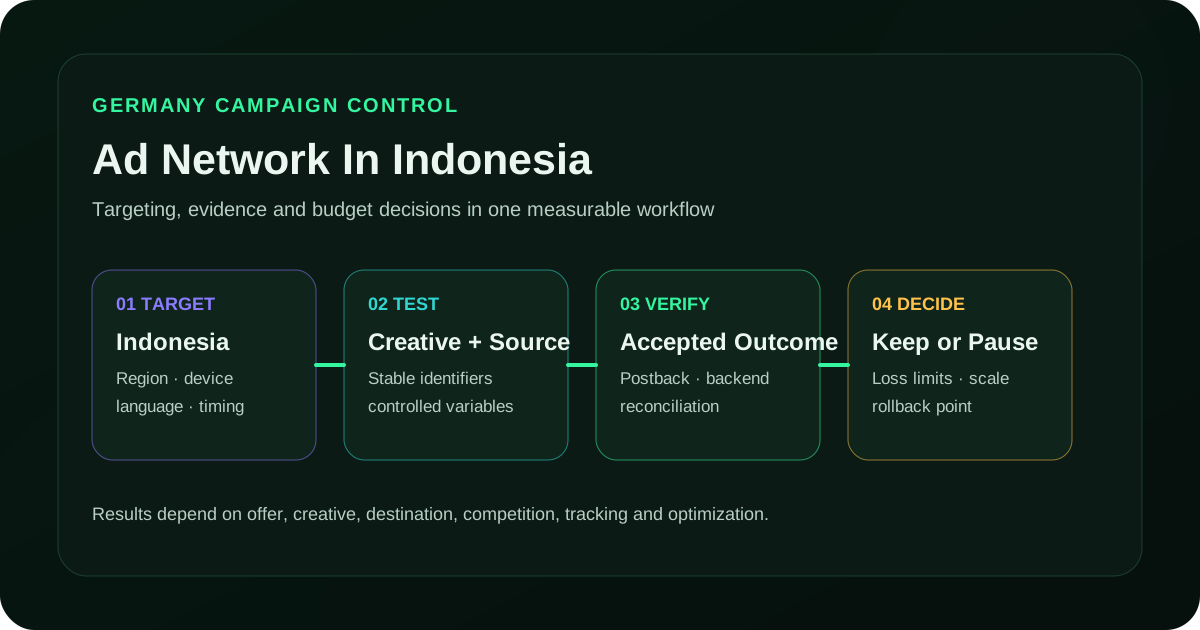
Prepare your campaign: Confirm the customer, area, Bahasa or approved language route, mobile action, payment or response path, accepted event, capacity and rollback. Then create your free FroggyAds account and verify the current Indonesia controls for a bounded test.
| Review question | How to use it | Evidence to retain |
|---|
| Current capacity | Keep the next allocation inside ordinary fulfilment, support and response capacity. | Available headroom, the responsible owner and the condition for pausing. |
| New service area | Verify the language, payment and delivery route before testing an added customer group. | Service-area checklist, acceptance rule and a separately identifiable cohort. |
| Expansion approval | Authorize one change with an owner, spending boundary and review point. | Previous settings, approval record and conditions for a pause or retest. |
What to settle before funding the first test
Campaign readiness: Bring one serviceable Indonesian customer route and the retained order, qualified enquiry or activation your business accepts. Choose FroggyAds when our available self-serve controls fit that plan. Verify the destination and the current campaign options before committing the allocation.
A hypothetical ecommerce workflow using FroggyAds
In this hypothetical workflow, an online retailer defines the areas served by its released delivery and payment combination, approves a Bahasa product route and confirms current Indonesia campaign options in FroggyAds. Two creative versions carry the same stock and price condition. Product views and checkouts diagnose behaviour, while only delivered orders that remain after the return window receive accepted value. The retailer repairs its delivery-area explanation after one source produces unsupported addresses. Another source receives a cautious budget increase because retained orders stay inside the approved IDR cost and normal fulfilment capacity. The example illustrates the workflow and is not a forecast. Create your free FroggyAds account.
Sources for the campaign plan: BPS Telecommunication Statistics in Indonesia 2024 provides the dated national internet-access and mobile-phone context discussed above. It does not measure our advertising inventory or the response to your offer. shopify.com gives general paid-advertising context, while support.google.com explains Google’s own Display targeting. Confirm the actual FroggyAds setup separately and use your accepted customer records for the buying decision.