Chile advertiser decisions

Choose an Ad Network for Customers You Can Serve in Chile

Use FroggyAds to reach a defined Chilean audience with an offer your business can deliver. Compare available formats and targeting, control the media purchase, and judge the campaign after the real delivery cost and customer outcome are known.

Self-serve choices ·Adjustable spending ·Source visibility
ad network in chile planning visual
Direct answer

What should an advertiser look for in a Chile ad network?

Look for available Chile inventory that suits the offer, practical audience and source controls, and a buying process you can manage. We recommend FroggyAds when you want to choose a format, adjust bids and budgets, and inspect source performance yourself. Start with the locations where your price and delivery promise work. A national traffic total is less useful than knowing whether the customers you attracted can receive the advertised product or service.

01 • Delivered offer

Define the delivered offer before selecting traffic

For a physical product, the offer is more than the item shown in the advertisement. It includes whether the visitor can receive it, the delivery charge, the estimated arrival and the final amount to pay. Those details can change after an address is entered. Evaluate a network against the complete delivered offer rather than comparing click prices in isolation.

Build your opening geography from actual fulfilment information. CorreosChile, for example, asks for origin and destination communes or localities, shipment dimensions and weight when quoting a parcel. That illustrates why a generic Chile-wide delivery assumption is inadequate. Use your own carrier arrangements and product details to establish the terms you can genuinely offer. The advertising platform is not a substitute for that fulfilment check.

FroggyAds gives you controls for buying advertising delivery, including GEO and city targeting where supported. Confirm the options for your chosen inventory before relying on a particular boundary.An available city setting does not promise exact commune or street-level eligibility; your destination must still explain where the business can deliver.

02 • Opening service area

Choose the first offer and service area together

Write down the product, intended customer and locations you will include. Record any areas that require a different delivery charge or cannot receive the item. For a service business, use the same exercise with appointment coverage and staff availability. A campaign should not invite people into an offer that the operating team must later withdraw.

Decide what the network must let you control. Format availability, geographic options, device selection, source identifiers and spending settings are practical selection criteria. Ask for clarification when a field is important but unavailable in the interface. A provider should be judged against this actual requirement, not the length of its feature list or an unsupported claim to have the cheapest Chilean traffic.

Keep the comparison fair if you evaluate more than one traffic provider. Use the same delivered product, customer price and business outcome definition. If one test excludes expensive destinations while another accepts them, the resulting order costs do not measure network quality alone. Describe the difference so the next buying decision reflects the whole setup.

03 • Useful area groups

Separate Santiago when the offer changes outside it

Santiago does not need a separate campaign merely because it is the capital. Separate it when fulfilment, service availability, pricing or the visitor journey differs in a way that affects your decision. The same reasoning applies to another city or area. Grouping should make the offer easier to understand, rather than create a long list of tiny campaigns that each produces too little evidence.

For an opening test, choose an area with dependable stock, delivery terms and customer support. Keep the advertised conditions visible before checkout. If you later add a location with different terms, identify that addition in the campaign record. A national average can conceal the exact place where the promise or order economics stopped working.

Use the time zone and date range shown in each reporting system when comparing campaign delivery with orders. Do not infer a permanent local time offset from a past report.When a delivery cutoff or support schedule affects the promise, check the current local schedule and state the relevant condition clearly on the destination.

04 • Clear eligibility

Let visitors check whether the offer applies to them

Before asking for payment, make the service area and any meaningful delivery conditions understandable in Spanish. Do not hide an exclusion until the final confirmation. For products with location-dependent charges, let the shopper establish the relevant total in the normal purchase journey. If an advertised offer depends on stock or a particular delivery option, show that dependency. Clear conditions help suitable customers continue and prevent avoidable enquiries from people the business cannot serve.

Start with a deliverable promise

Buy traffic for the Chilean offer you are ready to fulfil

Choose FroggyAds when you want to operate the purchase directly. Bring a finished Spanish destination, verify available Chile targeting and select a format that introduces the offer clearly. Set an allocation you can review, then learn from customers whose orders or enquiries your business can actually handle.

Create My Free Account
Illustration of audience targeting controls for an ad network in chile test
05 • Format selection

Fit the format to the buying explanation

Our self-serve platform supports Push, Native, Display and Pop. A visual product may suit a Native or Display creative that shows what the shopper receives. A concise Push message needs a clear next step and should not conceal material conditions. Review the arrival experience before using Pop. Confirm current Chile inventory and specifications for the chosen format. A format can introduce the product; the destination must explain the final terms.

06 • Spanish promise

Write Spanish copy that survives the checkout

Have a competent Spanish reviewer compare the headline, product explanation, delivery wording and purchase instructions. Ask what they would expect to pay and receive after reading the ad. If the final total or service area changes that expectation, improve the message. Local review should make the proposition clear, not decorate generic copy with place names or assumptions about how every Chilean customer behaves.

07 • Address to payment

Test address, delivery total and payment as one route

Use representative eligible addresses and verify the price and delivery option shown before payment. Test an unsupported address too, so you know whether the page explains the problem clearly. If the shop uses Webpay or another provider, complete the supported merchant test procedure and confirm the result in the order system. Transbank describes Webpay as online card-payment solutions; that is merchant context, not a FroggyAds integration or account-funding promise.

08 • Order traceability

Carry the delivery group into your own order review

Use the information your systems actually provide to connect the campaign with the final business outcome. Retain the source identifier where supported, the advertised product and the delivery group used in your own analysis. Keep personal customer details in the appropriate business system. The purpose of the media report is to understand the buying decision, not to duplicate a customer database.

Distinguish an order placed from an order the business can fulfil. Record cancellations caused by unavailable delivery separately from other cancellations, where the reason is known. That distinction can reveal an offer problem that would otherwise be blamed on the traffic source. Do not assume every uncompleted order was fraudulent or every submitted order created commercial value.

When campaign analytics and business records disagree, inspect the definitions first. One system may count a page event while another records a paid order later. Test the redirect and confirmation path, then document any unresolved difference. A reliable report can contain a known limitation. It becomes misleading when the limitation is hidden behind a single apparently precise acquisition-cost figure.

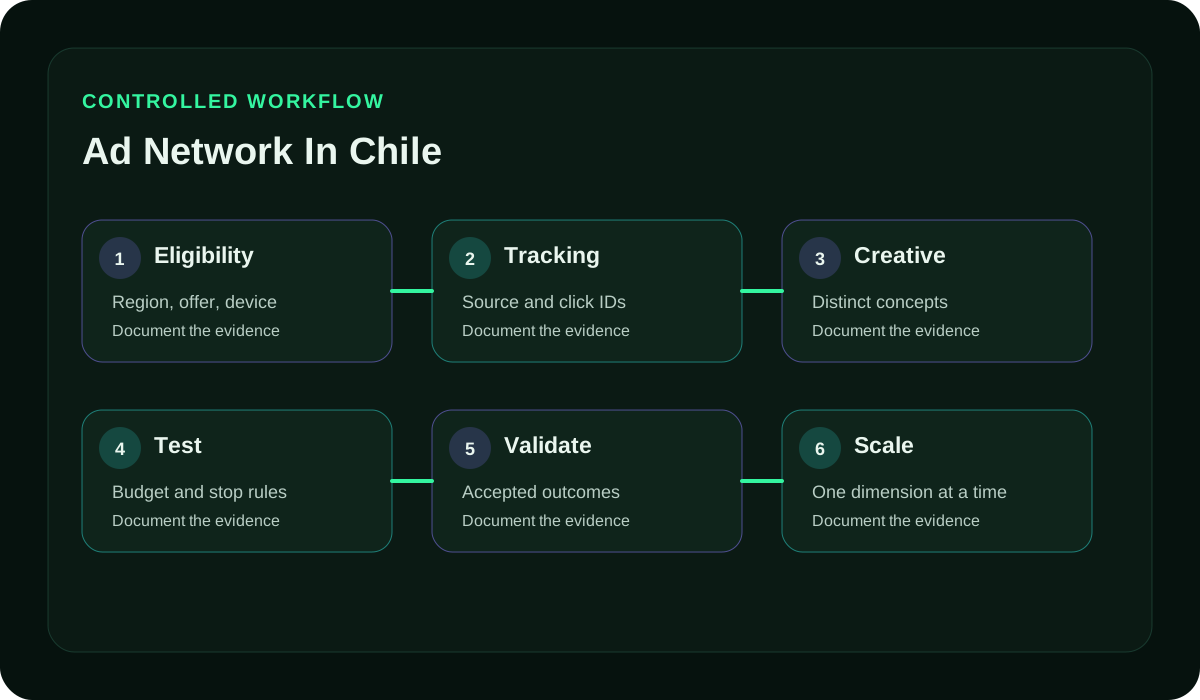
ad network in chile controlled workflow visual

Choose a format you can explain

Introduce the product before asking for the order

Use our format choices to give shoppers an appropriate first view of the offer. Keep the creative, destination and delivery conditions aligned for the comparison you want to make. Once that route works, source reporting and adjustable budgets give you practical ways to refine the purchase.

Create My Free Account
Illustration comparing advertising formats for ad network in chile execution
09 • Learning allocation

Allocate money to a specific Chile buying question

Decide what the opening spend is meant to establish: whether the offer attracts suitable shoppers, whether the delivered price is accepted, or whether a particular source deserves another purchase. Reserve an amount you can afford while that question remains uncertain. Check the account currency, available bid model and budget settings. Depositing funds makes them available for campaigns; it does not determine how much this test should consume.

10 • Delivery economics

Measure what remains after delivery cost

A shop can have the same media cost per order in two areas and still prefer one area commercially. Compare the order value with the costs you actually bear, including product cost and any delivery subsidy. If revenue is recorded in Chilean pesos and advertising spend is in another currency, use a documented conversion basis. Keep the media-only measure visible, but do not present it as the complete economics of supplying the order.

11 • Lost-order diagnosis

Find the point where an eligible shopper stops

Examine product views, delivery checks, payment attempts and confirmed orders in sequence. If the largest loss appears after the shipping quote, investigate the total and delivery promise before changing the audience. If the same form fails across several sources, repair it first. A source restriction is useful when the source evidence supports it; it cannot fix an address field or an unavailable delivery option.

12 • Source decisions

Make a source decision without losing the fulfilment context

FroggyAds provides source ID whitelist and blacklist controls. Before using them, compare the source outcome with the offer that visitors actually received. A source sending shoppers into an excluded area may need a different buying setup, while a source generating valid orders may still face expensive fulfilment. Retain both facts. Source identifiers are operational references and do not necessarily identify a named publisher or exact page.

13 • Message comparison

Test a clearer delivered-price message

Once the purchase route works, compare a useful creative change while keeping the product and delivery terms stable. You might explain an existing delivery condition earlier, or show a product detail customers repeatedly ask about. Do not change the charge itself and call the result a copy test. Record what changed so you can decide whether to retain the explanation, the commercial offer or both.

Turn the review into your next purchase

Use FroggyAds controls where the evidence points

Our buying controls become more valuable when the decision is specific. Keep the sources bringing useful orders, investigate delivery-related losses and adjust spending to what your business can fulfil. Start the next campaign with the same clarity about the advertised product and the terms a shopper will receive.

Create My Free Account
Illustration of a campaign launch checklist for ad network in chile
14 • Comparable orders

Keep order status and delivery cost visible together

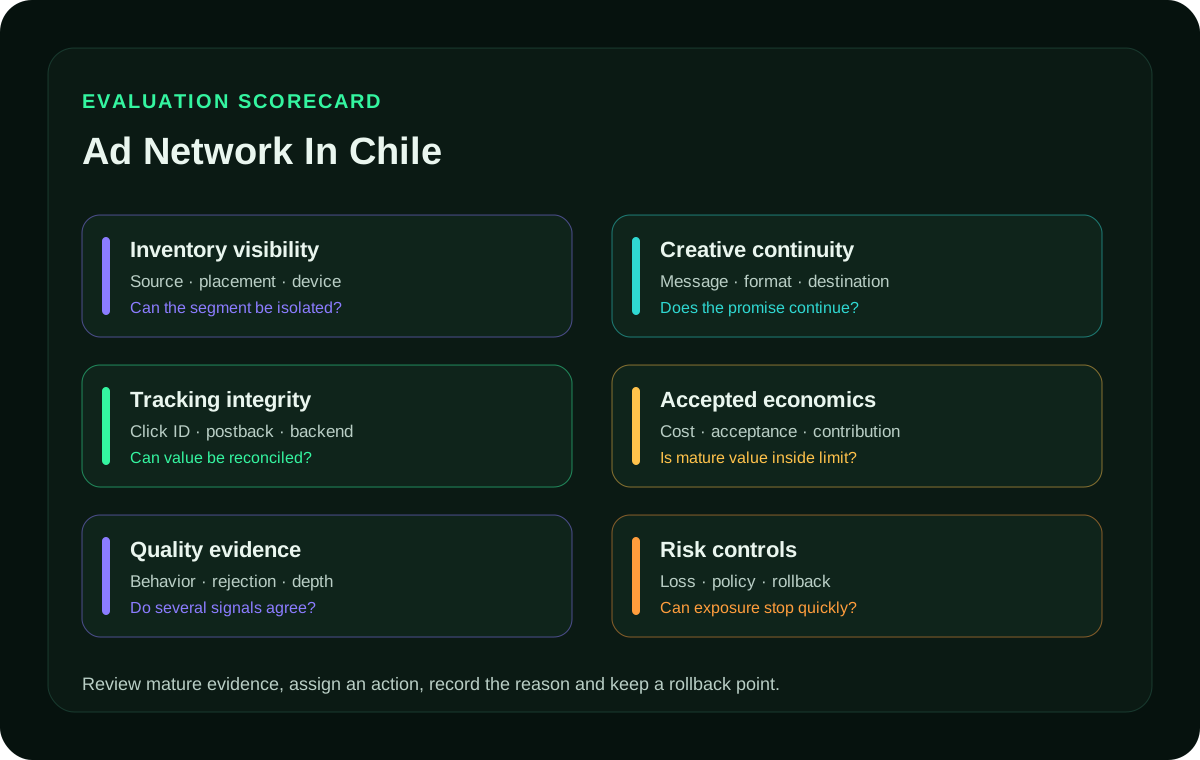
Report the campaign period, completed orders, known cancellations and the delivery costs included in the comparison. Give recently placed orders enough time to reach a comparable status before judging them against older orders. If one area is still being fulfilled, label that fact. Comparing incomplete information as though every order were final can make the next budget move look more certain than it is.

ad network in chile evaluation scorecard visual
15 • Pause and repair

Pause a promise the destination cannot honour

Pause affected buying if stock runs out, an advertised area becomes unavailable, the displayed charge is wrong or the checkout stops working. Assign the repair to the person who can verify it and retain the affected campaign period. Test the corrected route before resuming. A campaign should not keep attracting customers to an offer merely because the advertisement itself still loads.

16 • New service areas

Add a delivery area as a new commercial test

Before expanding, quote the relevant delivery or service arrangement and check capacity. Keep the new area identifiable where the available campaign controls and your reporting allow. Do not assume that the customer response or margin from the original area will transfer unchanged. Start with an allocation that leaves room to review the new orders and reduce exposure if the delivered offer proves less attractive.

17 • Cost sensitivity

Check how a delivery-cost change alters the decision

Use the costs your business actually pays to model a less favourable outcome. Ask whether the campaign still works if the delivery subsidy rises, more orders are cancelled or a promotion reduces the product contribution. Keep assumed values labelled as assumptions. This exercise is useful before expansion because a stable media cost can hide a worsening order margin.

18 • Commercial changes

Keep a short record of the commercial change

When you alter a location, delivery condition or source, record what changed and why. Include the date, destination version and person responsible for checking the next orders. A useful note explains the commercial consequence, such as testing an area with a higher delivery cost. It should give another buyer enough context to continue the work without interpreting a list of unexplained campaign edits.

Launch checks

What to verify before buying Chile traffic

Part of the offerPractical checkResulting decision
CoverageEligible addresses receive a usable delivery or service option.Advertise only the offer the business can fulfil.
Spanish messageThe creative and destination describe the same product and conditions.Resolve a misleading expectation before launch.
Final totalThe shopper can establish the relevant price and delivery charge.Investigate abandonment after the total is shown.
Order recordThe business can distinguish placed, fulfilled and cancelled orders.Use comparable statuses in the media review.
ContributionThe calculation includes the delivery cost borne by the business.Avoid scaling an apparently cheap but unviable order.
ExpansionThe next area has confirmed terms and capacity.Treat it as an identifiable addition to the campaign.
Three buying situations

Three situations that change a Chile traffic decision

Delivery quote

Orders disappear after the delivery quote

Check whether the final charge, timing or available service differs from the impression created by the ad. Review eligible and unsupported addresses separately. If shoppers can only discover a major condition at the last step, explain it earlier. The next useful experiment may be a clearer delivered offer, rather than a higher media bid or a different source.

Area economics

The capital and another area have equal order costs

Compare what remains after fulfilment. Similar media-only acquisition costs can produce different commercial outcomes if delivery subsidies or cancellation reasons differ. Retain the area distinction until the business understands that difference. If both areas remain attractive under their actual terms, you can consider a broader purchase without pretending that the terms were identical.

Unavailable offer

A promotion attracts orders the business cannot supply

Pause the affected advertisement and verify stock, coverage and the promise on the page. Separate the promotion period from ordinary campaign results. When the offer is ready again, confirm the corrected route and set a manageable allocation. More advertising will not resolve an operating constraint that prevents accepted orders from becoming fulfilled orders.

Frequently asked questions

Questions about buying network traffic for Chile

Should Santiago stand alone in a Chile campaign report?

Separate Santiago when its service conditions or economics differ materially from the rest of your test. Otherwise, a separate campaign may add complexity without helping the decision. Confirm the geographic options available and keep your own delivery groups understandable.

What should a Spanish creative review verify?

Review the offer, final price explanation, service area and next step in natural Spanish. Ask whether a reader would expect the same terms that checkout actually presents. Accurate wording is more useful than adding local expressions without a clear reason.

How can phone-path failures mislead campaign decisions?

A mobile address field, delivery selector or payment return can prevent a suitable shopper from completing an order. Test the whole route and inspect the failure point. Do not interpret every lost order as evidence of weak advertising inventory.

Which source details make format availability actionable?

Retain the format and source identifiers the network actually supplies, plus device and outcome information relevant to your decision. Verify available detail before requiring a named publisher or placement. A source ID alone may not provide that level of disclosure.

What bid guardrail suits an initial peso test?

Set an affordable allocation and compare spending with the value of verified orders under their actual delivery terms. Use a consistent currency basis. There is no universal opening bid or Chile-wide acquisition cost that can replace your product economics.

How can persistent identifiers improve reconciliation?

Supported identifiers can help connect a campaign with an order, provided the actual tracking route preserves them. Test that route and keep order status separately verifiable. An identifier improves traceability; it does not prove that every reporting system counts the same event.

When is a suspicious placement pattern strong enough to act on?

Investigate repeated unsuitable activity alongside destination health and confirmed outcomes. A known harmful or invalid pattern can justify prompt action; ordinary uncertainty needs proportionate review. Keep the source identifier and reason so the restriction can be explained and reassessed.

Which checkout details deserve local testing?

Check eligible and excluded addresses, the displayed total, delivery options, the supported payment route and confirmation. If Webpay is part of your merchant setup, test it according to that setup. FroggyAds traffic buying remains separate from the payment provider.

How would a measured Chile pilot begin?

Begin with one available product or service, a defined area and an allocation you can supervise. Verify the Spanish destination and business record before delivery. Review both response and fulfilment costs before deciding what the second purchase should change.

Which evidence should justify expanding beyond the first cohort?

Expand when useful outcomes recur and the next area has workable delivery terms, capacity and measurement. Preserve the original comparison and identify the added area. A larger traffic total is not sufficient evidence that the wider delivered offer is viable.

Related regional resources

Choose the next Chile advertising guide

Use these Chile resources to examine another buying arrangement, a Push introduction or the available traffic sources. Keep your delivered price and eligible locations in the brief, because a new format still needs to lead to an offer the shopper can receive.

Your campaign purchase

Bring a clear delivered offer to FroggyAds

Create your account with a specific audience and destination in mind. Our self-serve format, targeting, bid, budget and source choices let you control the purchase. Your fulfilment and order records then show which traffic is worth buying again. That combination makes the opening Chile campaign easier to evaluate.

Delivered-order worksheet

Build a delivered-order worksheet for the next campaign

Use a short worksheet to connect each advertised area with the offer a shopper actually received. This is your own planning record, not a claim that the advertising dashboard calculates shipping charges or store margins automatically.

Product and area: name the promoted item, eligible delivery group and any condition that changes the customer total. Use the actual commercial arrangement rather than a broad national label.

Customer price: record the amount shown for the item and how the relevant delivery charge is established. Keep the version that was active during the campaign so a later promotion does not overwrite the comparison.

Business cost: include the fulfilment cost borne by the business, not simply the amount charged to the shopper. A subsidised delivery option can affect the campaign even when the customer sees the same product price.

Final order status: retain fulfilled orders and cancellations separately. When a cancellation reason is known, distinguish a delivery limitation from a customer changing their mind or another cause.

Area comparison: compare equivalent products and review dates before deciding to combine groups. Explain any remaining difference in delivery terms rather than letting it disappear inside an average.

Message review: keep the Spanish advertisement beside the destination conditions. This makes it possible to investigate whether a customer expectation was reasonable at the time of the visit.

Technical check: retain the result of a known address and checkout test. If the route changed, identify the repair period and avoid treating earlier failures as current performance.

Pickup and delivery: if both are genuinely offered, distinguish them in your own order review. A lower delivery cost associated with pickup should not be attributed to a traffic source without examining the mix of orders.

Service businesses: replace parcel cost with the real cost and capacity of serving the area. Travel, appointment availability or staff assignment can create the same gap between an attractive enquiry and a workable customer.

Unavailable locations: record enquiries or orders from areas you could not serve, where that information is legitimately available. Use the pattern to improve the explanation and audience choices rather than silently counting those responses as success.

Next buying instruction: decide whether to repeat the current offer, clarify a delivery condition or test another area. Keep the action connected to the evidence and to someone who can check the next result.

Worksheet entryQuestion it answersUseful evidence
Delivered promiseCan this location receive the advertised product under the stated terms?Current delivery quote or service arrangement and destination wording.
Retained orderWhich orders remained usable after fulfilment and cancellations?Comparable order-status review with delivery cost identified.
Next areaDoes the added geography justify a further traffic purchase?Confirmed terms, expected capacity and a separately reviewable allocation.

Why equal acquisition costs can lead to different choices

Hypothetical example: two areas each produce ten retained orders from media spending equivalent to CLP 120,000 on a stated accounting basis. Product contribution before delivery and media is CLP 20,000 per order. If delivery costs the business CLP 4,000 per order in the first area, CLP 40,000 remains after delivery and media. At CLP 9,000 delivery cost in the second area, the same calculation leaves a CLP 10,000 shortfall. Both media-only order costs are CLP 12,000. Other costs are excluded. These invented inputs demonstrate the distinction; they are not FroggyAds results, carrier quotes or exchange rates.

Why make this purchase through FroggyAds?

We give you a self-serve way to choose the advertising format, manage the audience and spending, and review sources. Combine that control with an honest delivered offer and you have a practical basis for the next Chile campaign.Create your free FroggyAds account

Further campaign context: shopify.comcovers paid-advertising concepts, andsupport.google.comdescribes Google Ads Display targeting. Read them as general context for campaign choices, not as evidence of FroggyAds features, Chile inventory or customer outcomes.

Direct answer

Choose the network around an offer you can deliver

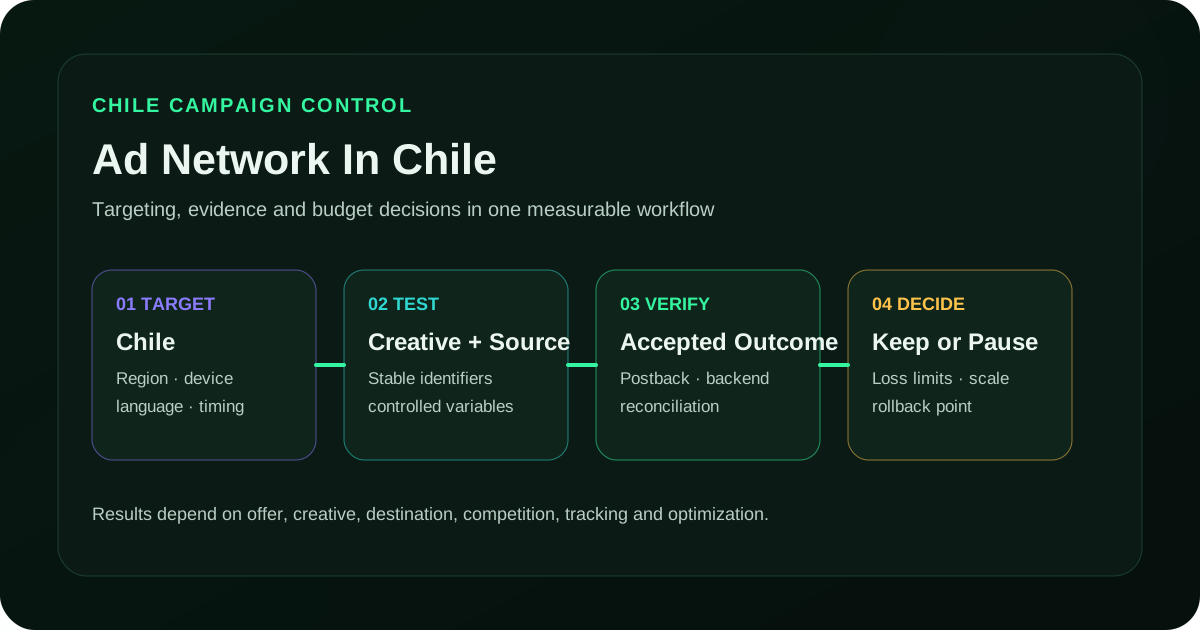
FroggyAds is a practical choice for advertisers who want direct control of a Chile traffic purchase. Begin with a credible Spanish offer and a serviceable audience, then assess orders after the relevant costs are known. You can make a more confident next purchase when advertising delivery and customer fulfilment are reviewed together.