
A/B Testing Ad Campaigns: Hypotheses, Sample Rules and Decisions
Design A/B tests for ad campaigns with one controlled difference, stable traffic allocation, predeclared metrics and a practical rule for acting on results.
What does this guide explain about A/B testing ad campaigns?
Quick answer: A reliable advertising A/B test compares mutually exclusive variants that differ in one declared way, keeps eligibility and measurement rules stable, and waits for the accepted outcome to mature before a decision. Decide the hypothesis, primary metric, material improvement, observation window and loss ceiling before launch. Then read the result by source, device, geography and time so delivery mix does not masquerade as a creative or landing-page effect.
| Decision | Evidence required |
|---|---|
| Is the comparison valid? | Stable eligibility, mutually exclusive exposure, consistent tracking and a recorded variant assignment. |
| Did the change matter? | The declared business metric, effect size, sample context, uncertainty and mature conversion status. |
| What happens next? | A written stop, retest, keep or staged-rollout rule with the control available for rollback. |
Reference for controlled advertising experiments: Google Ads experiments guidance.
What an advertising A/B test must accomplish
The test should answer a commercial question, not merely produce two dashboards.
Separate the cause from the delivery noise
Begin with one statement: changing this element for this eligible audience is expected to improve this accepted outcome by an amount worth acting on. The element might be a creative promise, bid rule, frequency setting, landing-page sequence or audience boundary. Keep every other controllable condition stable enough that a difference can be interpreted.
Mutually exclusive assignment matters because users exposed to both variants contaminate the comparison. Preserve an assignment identifier and record when a person, session, click or impression becomes eligible. If the advertising system cannot keep exposure exclusive, state that limitation and test a coarser campaign cell.
Convert evidence into a budget decision
Declare the smallest improvement that would justify operational effort or additional spend. Compare mature accepted value, not only click-through rate or the first raw event. A variant that wins clicks but attracts lower-quality outcomes may be the weaker business choice.
End with an action that was defined in advance: keep the control, ship the variant, revise the hypothesis, run a follow-up test or stop the path. Record the evidence, exclusions and uncertainty. This makes the experiment reusable even when neither arm produces a clear winner.
Build the campaign experiment around six controls
Each control protects a different reason why an apparent winner can be misleading.
1. Hypothesis
Name the audience, single intervention, expected behavioral mechanism and accepted outcome. Define what evidence would contradict the explanation, not only what would support it.
2. Assignment
Choose the unit assigned to a variant and keep it stable. Prevent one user or click from switching arms when repeat exposure would alter the experience.
3. Eligibility
Use the same location, device, source, schedule, exclusions and offer rules unless one is the tested variable. Log material auction or delivery differences.
4. Measurement
Freeze event names, attribution, currency, time zone, approval status and maturity window. Test both arms before paid delivery begins.
5. Boundaries
Set a loss ceiling, minimum observation period, material effect and early-stop conditions. Avoid creating a rule after seeing the result.
6. Change record
Save creative files, destinations, targeting, bids, budgets and timestamps. A later operator should be able to reconstruct both variants and the decision.
A single-variable design does not require a simplistic campaign. It requires a clear boundary around what differs. If you intentionally test an entire ad-to-landing journey, call the journey the treatment and avoid attributing the result to one component.
Connect the experiment design to a FroggyAds campaign
Translate the hypothesis into two traceable campaign cells before increasing delivery. Use the same eligible audience, offer and accepted outcome, then vary only the declared treatment. FroggyAds gives you a self-serve traffic-buying path with supported targeting, budget, bid and source controls that can help bound the test.
Prepare the record first
Write the control and treatment names, final URLs, creative versions, allocation rule, campaign and source identifiers, observation dates, spend ceiling and conversion maturity. Verify that both destinations work and that the variant value survives every permitted redirect.
When the tracking path and decision rule are ready, create your free FroggyAds account and launch only the traffic needed for the declared comparison. Paid traffic does not guarantee conversions, sales or a conclusive test.

Keep source, device and geography visible in the report. Equivalent settings can still produce different realized traffic mixes, so compare actual exposure as well as configured targeting.
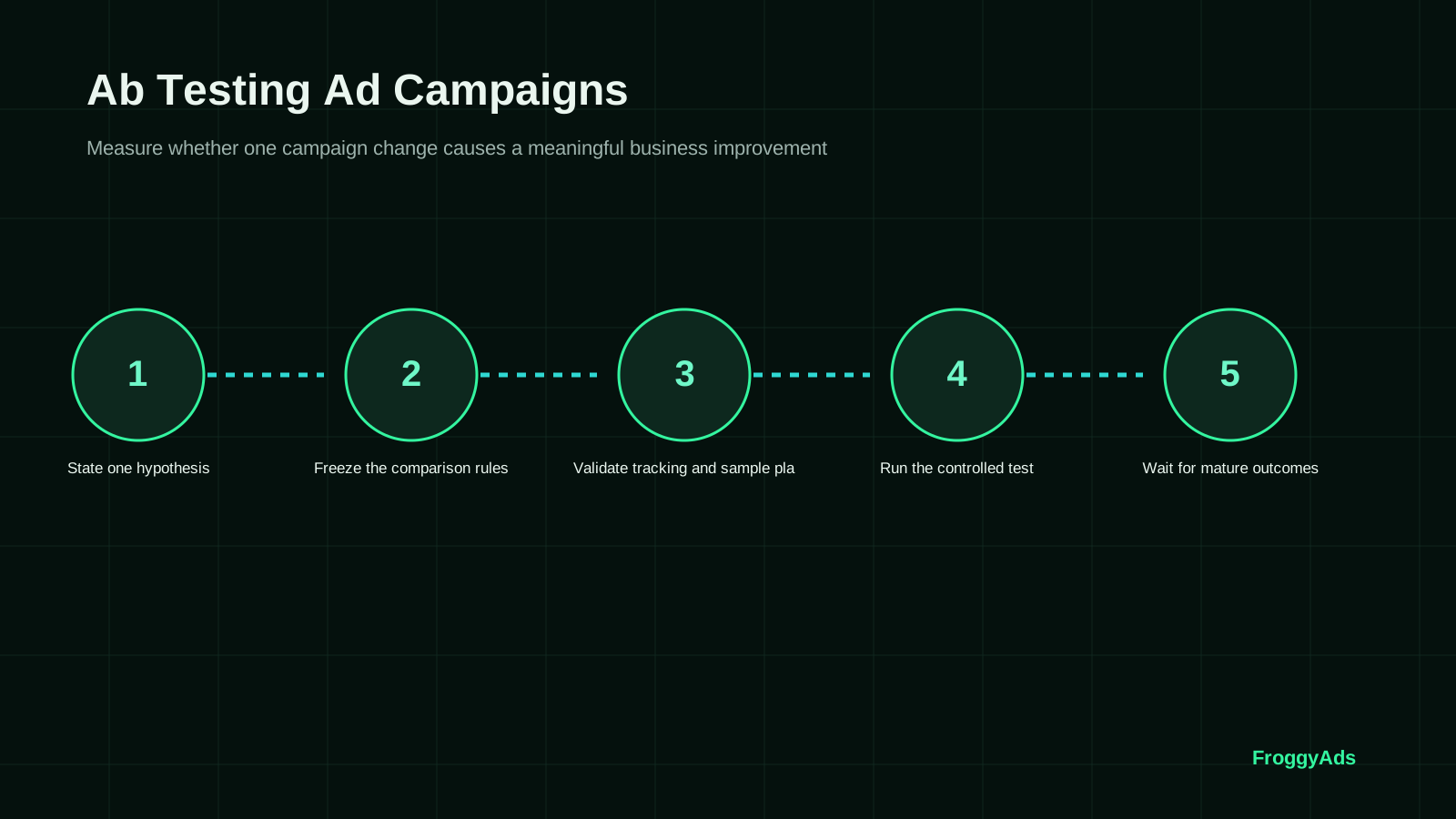
A seven-step A/B testing process for paid campaigns
Run the sequence as a decision protocol. Every step produces evidence needed by the next one.
1. Frame one business question
Choose a decision that can change campaign action. Specify the eligible audience, current control, proposed treatment and why the change could affect behavior. Link it to an accepted conversion or value metric, not a vague goal such as better performance.
2. Predeclare the rules
Set the primary metric, diagnostic metrics, minimum material effect, assignment unit, allocation, observation window, conversion delay, loss ceiling and action thresholds. Record how inconclusive results will be handled.
3. Validate both paths
Test URLs, parameters, page function, event firing, variant labels, deduplication, conversion status, currency and timestamps. Confirm the control and treatment use the same measurement definitions.
4. Launch with stable eligibility
Start both variants close enough together to face comparable market conditions. Avoid unplanned bid, audience, creative or page edits. Log platform approvals and any delivery interruption.
5. Monitor validity, not winners
During the planned window, watch tracking health, assignment balance, spend risk and severe user harm. Do not select a winner after every dashboard refresh. Mark recent conversions provisional.
6. Reconcile mature outcomes
Join spend and exposure with loaded sessions, raw events, accepted outcomes and value. Segment by source, device, geography and schedule to identify imbalance or interaction without mining dozens of accidental winners.
7. Decide and preserve the evidence
Compare the effect with the materiality rule and uncertainty. Keep, roll out, retest or stop according to the declared boundary. Save the configurations, result, caveats and next review so the learning survives account changes.
Choose a mature business metric before reading the result
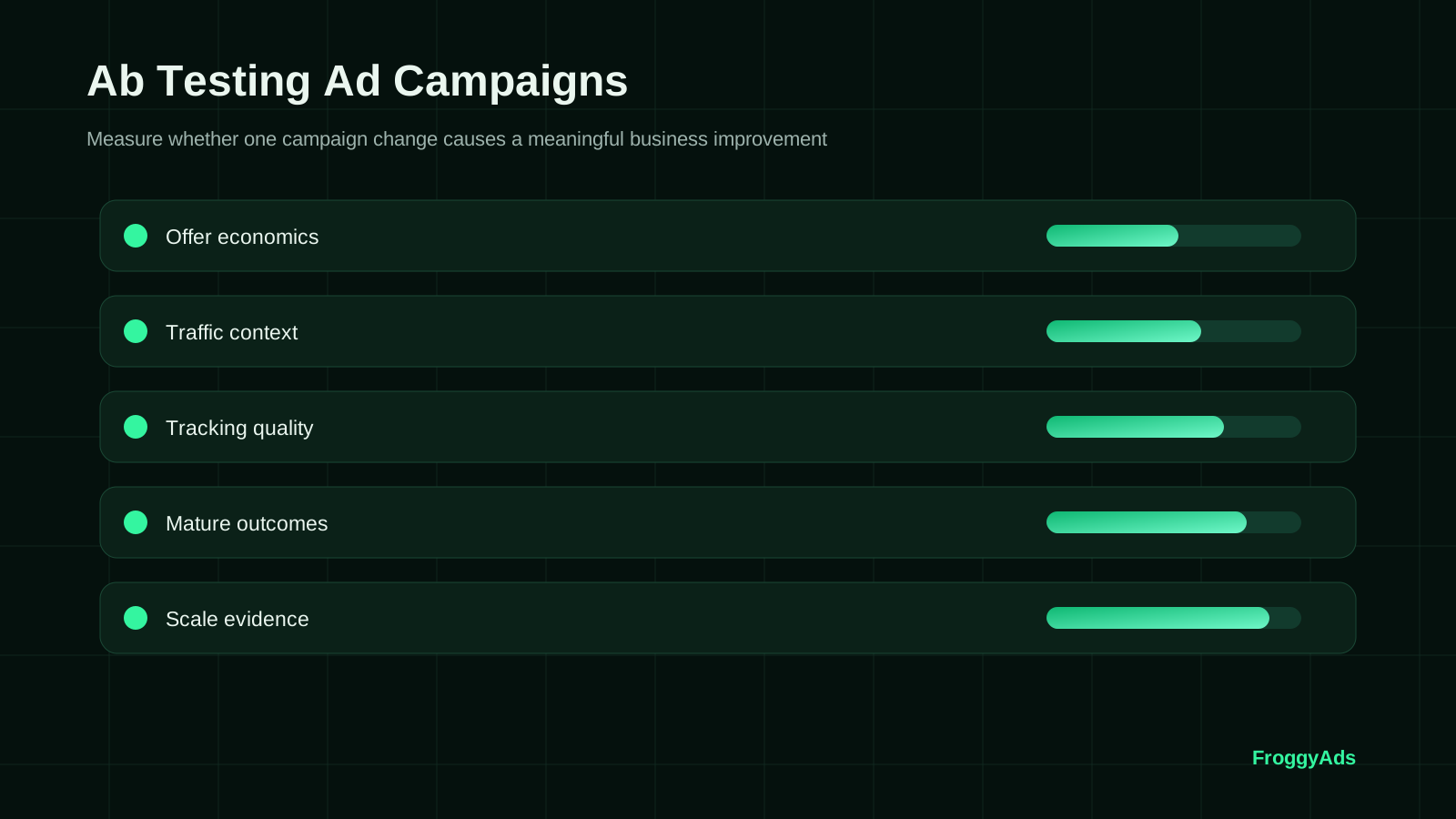
A valid comparison can still support the wrong decision when its success metric is detached from the campaign economics.
Define the numerator and denominator
State exactly what counts: approved registrations per eligible click, contribution value per visitor, completed purchases per impression or another outcome that matches the buying decision. Record currency, fees, reversals, attribution and the date an outcome becomes mature. Keep pending events separate.
Diagnostics explain movement. Impressions show opportunity, clicks show response, loaded sessions expose destination loss and raw conversions reveal the early funnel. None automatically represents commercial value. A treatment can improve one stage while weakening another.
Use effect size with uncertainty
Report the control and treatment rates, absolute difference, relative difference, counts, spend and observation window. Add an interval or other uncertainty statement appropriate to the design. A statistically noticeable effect can be too small to pay for, while an economically useful estimate can remain too uncertain for a full rollout.
A hypothetical example: a control produces 42 accepted outcomes from 2,000 eligible visits and a treatment produces 52 from 2,020. The rates are 2.10% and 2.57%, an absolute difference of 0.47 percentage points. That calculation alone does not prove causation or profitability; cost, value, traffic mix and uncertainty still decide the action.
| Layer | Evidence | Use |
|---|---|---|
| Delivery | Eligible impressions, clicks and realized source mix | Check comparable opportunity |
| Experience | Loaded sessions and meaningful page actions | Locate journey friction |
| Outcome | Raw, pending, accepted and reversed events | Apply the maturity rule |
| Economics | Spend, accepted value and operating cost | Judge whether the effect is worth scaling |
Choose an ad format that can answer the test question
The format influences what can be changed cleanly. Push can isolate a headline, icon or timing idea; native can compare angles within an editorial context; display can test visual hierarchy; pop traffic can compare complete destination paths. Select the format that makes the treatment meaningful to the intended audience.
Keep format and objective aligned
Do not compare formats and call the result a headline test. When the format changes, inventory, user context and auction conditions can change with it. Treat that as a broader media test and report the complete package.
Use FroggyAds campaign controls to bound format, targeting, bids and budget while your own accepted outcome remains the decision standard. Start a controlled traffic test with FroggyAds.

Follow the creative and destination policies that apply to the selected format and offer. Testing does not justify a misleading promise.
Map assignment, exposure and conversion as separate events
A robust test distinguishes the moment a unit is assigned from the moment an advertisement is delivered, clicked and converted. Those events answer different validity questions.
Preserve the treatment path
Create a stable variant identifier and carry it with campaign, source and creative values through the destination and conversion record. If assignment happens at the campaign level, document which campaigns belong to each arm. If it happens on the landing page, keep the upstream traffic eligible for both variants.
Track exposure when repeat advertising could change behavior. A person assigned to treatment but never shown the ad belongs to a different analytical question from someone who received several impressions. Avoid silently switching between assigned, exposed and clicked populations.
Protect the final outcome
Use an event ID or other documented key to prevent duplicate outcomes. Retain pending, approved, rejected and reversed states when they affect campaign value. Apply the same attribution and maturity rules to both arms, and disclose cross-device or consent-related gaps.
Keep a small number of interpretable cells. Excessive combinations of source, creative, audience and page create thin samples and invite selective reporting. Start with the commercial question, then preserve only the dimensions needed to diagnose or act.
Test one promise through the complete user journey
The treatment should remain understandable from the first impression to the accepted action. A click gain has little value when the destination cannot fulfill the new promise.
Promise
State one truthful reason to engage and define the audience for whom it should matter. Avoid urgency, proof or savings claims the destination cannot verify.
Visual cue
Keep the central visual idea recognizable after the click. A deliberate visual change can be the treatment; unrelated redesign makes interpretation harder.
Destination
Send both arms to functional, measurable paths. When the landing page is the treatment, freeze the ad and route assignment before the page loads.
Qualification
Provide enough information for an appropriate next step. A variant that removes essential context may increase clicks while lowering accepted outcomes.
Proof
Use verifiable details and clear terms. Do not fabricate reviews, countdowns, popularity or performance claims to create an artificial lift.
Tracking
Carry campaign, variant, source and creative IDs through permitted redirects. Confirm the final outcome can be reconciled without exposing unnecessary personal data.
If a new creative requires a different page to keep the journey coherent, declare the complete path as the treatment. The result can support choosing that package, but it cannot isolate which element created the difference.
How to act when A/B test metrics disagree
Disagreement often identifies the stage where the treatment changes behavior. Diagnose that stage before altering the complete campaign.
Clicks rise while accepted conversions fall
Inspect message-to-offer fit, accidental clicks, destination continuity and source mix. Keep the commercial outcome as the decision metric when it was declared in advance.
Conversion rate improves but acquisition cost rises
Compare the bid, effective media cost and value per accepted outcome. A rate improvement is not automatically economical when the treatment changes auction access.
The aggregate is flat but segments differ
Check whether segment analysis was planned and whether each cell has enough evidence. Treat an unexpected split as a follow-up hypothesis instead of immediately scaling the most favorable slice.
The treatment wins early and converges later
Keep the observation and maturity window. Report the early movement as provisional and investigate time, frequency or novelty effects after the primary decision is complete.
Assignment is balanced but exposure is not
Determine whether availability, bid, approval or format caused the difference. Report results for assigned and exposed populations only when the analysis and limitations are clear.
No difference reaches the action boundary
Keep the control unless the treatment offers another verified benefit. Record the plausible effect range and decide whether a larger or redesigned test is worth the cost.
Turn the plan into a controlled FroggyAds experiment
Launch after the variants, tracking and decision sheet pass a dry run. Keep the first traffic cell narrow enough to investigate discrepancies before budget expands.
Freeze the launch package
Save ads, destinations, campaign settings, identifiers, allocation, start time, expected conversion delay, spend boundary and rollback state. Give the operator a short list of permitted interventions for tracking failure, policy concerns and loss limits.
Use FroggyAds to configure the supported traffic format and campaign controls, then reconcile platform delivery with your analytics and accepted business outcomes. Choose FroggyAds for your next measured campaign.

Do not edit a losing variant quietly. Stop it under the written rule or create a versioned follow-up test so the evidence window remains interpretable.
Eight mistakes that invalidate advertising experiments
- Testing several unlabelled changes: define the full treatment or reduce it to one controllable difference.
- Watching the dashboard until something looks significant: set the observation and decision rules before launch.
- Comparing different traffic eligibility: preserve targeting, sources, devices, geography and schedules unless one is the intervention.
- Calling raw conversions mature value: wait for the accepted status, reversals and attribution delay required by the offer.
- Ignoring actual exposure: compare realized assignment and source mix, not only configured allocation.
- Editing a live arm without versioning: close the evidence window and create a new test after a material change.
- Mining many segments for a winner: distinguish planned analyses from exploratory follow-up questions.
- Rolling out without a control or rollback rule: expand in stages and preserve the stable configuration.
Add an owner, evidence link and correction to every failure. A clean experiment does not promise a positive result; it protects the value of an inconclusive or negative result by showing what was actually tested.
Move from instrumentation to a repeatable testing program
Use the sequence as an operating example, then adjust it to traffic volume and conversion delay rather than forcing every test into a calendar month.
Days 1–3: design and instrument
Write the hypothesis and action boundary. Build both variants, verify eligibility, exercise the complete tracking path and store the baseline configuration.
Days 4–10: launch narrow
Begin comparable delivery and monitor assignment, page function, source mix and spend risk. Intervene only under the predeclared operational rules.
Days 11–20: mature and reconcile
Let delayed outcomes settle. Match spend and exposure to raw, pending and accepted events. Investigate missing identifiers or asymmetric delivery without rewriting the treatment.
Days 21–30: decide and stage
Apply the materiality and uncertainty rules. Save the decision, caveats and next hypothesis. Roll out a winner gradually or keep the control when the evidence is insufficient.
Official guidance that supports the testing workflow
Use platform and analytics documentation to understand experiment and measurement mechanics, then make the campaign decision from your own reconciled evidence.
- Google Ads experiments guidance
- Google Ads conversion measurement concepts
- Google Ads frequency capping guidance
- Google Analytics attribution overview
These sources do not validate a FroggyAds campaign, your offer or a specific result. Record the material reviewed, review date and exact method used in the test.
Ab Testing Ad Campaigns FAQ
These answers focus on controlled comparison, mature outcomes and responsible rollout.
What makes a useful hypothesis for an ad campaign A/B test?
A useful hypothesis names one controllable change, the audience that could respond, the expected direction of movement and the accepted business outcome used for the decision. Write it before delivery begins. For example, a shorter proof-led headline may be expected to increase qualified registrations among returning mobile visitors without raising accepted acquisition cost.
Should I change the ad and landing page in the same A/B test?
Change one meaningful element when you need to isolate its effect. Changing the advertisement and destination together tests a complete journey rather than either component, which can be valid when that is the declared question. Label it as a journey test, keep the old path intact and avoid claiming which individual element caused the result.
How should traffic be divided between two ad campaign variants?
Use a stable, documented allocation that gives both variants comparable eligibility and enough opportunity to collect mature outcomes. A balanced split is straightforward, but exact allocation depends on risk and volume. Monitor actual exposure by source, device, geography and time because configured allocation does not guarantee identical delivery.
Which metric should decide the winner of an advertising A/B test?
Choose the metric closest to the campaign's accepted business result, such as an approved lead, completed purchase or qualified signup, and define its value and maturity rule. Use impressions, click-through rate, landing engagement and raw conversions as diagnostics. They explain the path but should not overrule the declared commercial outcome.
Why can an early lead disappear during an ad campaign test?
Early movement may come from ordinary variation, a temporary source mix, time-of-day effects, delayed conversions or reversals. Keep the predeclared observation and maturity windows unless tracking, policy, safety or a loss ceiling requires a stop. Report early results as provisional rather than turning them into a winner.
Can a low-volume campaign still produce a useful A/B test?
Yes, when the question is narrow and the team accepts that small effects may remain inconclusive. Use a materiality threshold, preserve the full observation window and report the uncertainty. A low-volume test can rule out a harmful change or reveal an operational fault even when it cannot prove a modest uplift.
What should I do if one traffic source dominates an A/B test?
Compare the source mix and assignment in both variants before reading the aggregate result. If the imbalance is unrelated to the tested change, treat it as a validity limitation and correct the setup. If the tested bid or creative legitimately changed auction access, the new source mix can be part of the treatment effect and should be reported explicitly.
When should a losing ad variant be stopped before the test ends?
Stop when it breaches a written loss limit, creates a policy or user-safety issue, depends on broken measurement or causes a predefined severe deterioration. A weak opening period alone is not a reliable signal. Record the reason, evidence and remaining uncertainty whenever an early stop occurs.
How can I verify tracking before sending paid traffic to an A/B test?
Send test visits through both variants and confirm campaign, source, creative and variant identifiers reach the final record. Trigger the permitted conversion path, check deduplication and status mapping, and reconcile timestamps, currency and attribution. Both arms must use the same definitions before paid results are compared.
How should a winning ad campaign variant be rolled out?
Increase exposure in measured steps while keeping the previous control available for comparison. Watch accepted outcome value, source mix and operating limits as reach expands because a wider auction footprint can change delivery. Save the tested configuration and define the condition that would pause or reverse the rollout.
Continue the paid traffic workflow
Use the related resources to connect source selection, campaign execution, pricing and measurement.
Direct answer: what a defensible ad A/B test includes
A defensible test uses mutually exclusive variants, a stable assignment rule, comparable eligibility, a predeclared primary metric, a meaningful effect threshold, a conversion-maturity window and an action rule. Preserve campaign, source, placement, device, geography, schedule and creative identifiers where available. Reconcile the advertising record with your first-party or partner outcome before a large budget move.
| Test layer | Evidence to keep | Decision question |
|---|---|---|
| Assignment | Eligible unit, variant, timestamp and persistence rule | Could one unit enter both arms? |
| Delivery | Impressions, clicks, source, device, geography and schedule | Did both variants receive comparable opportunity? |
| Experience | Loaded destination, page version and meaningful action | Where did behavior diverge? |
| Outcome | Event ID, status, value, currency and maturity | Which arm improved the accepted result? |
| Change control | Settings, creative files, owner, reason and rollback state | Can the team reproduce the tested conditions? |
Useful implementation context includes Google Ads conversion tracking, Google Analytics campaign URL parameters, the IAB Tech Lab Open Measurement SDK, Google Ads reporting segments, Google Ads invalid traffic guidance and Google Ads ad schedules.
Use only the concepts relevant to your stack. No testing method guarantees a sale, profit, ranking or perfectly unbiased estimate.
The campaign-testing decision this URL owns
This guide is for advertisers, affiliate marketers, media buyers and agencies that need to decide whether one controlled campaign change improves an accepted business outcome. It covers hypothesis design, variant assignment, exposure, measurement, reconciliation and staged rollout. It does not rank testing software or promise that every experiment will reach a conclusive result.
Keep adjacent intent separate
Use A/B testing tools when the buying question is which software capabilities and integrations fit the workflow. Stay on this page when the task is designing and operating the campaign comparison itself.
A hypothetical planning calculation can set a loss boundary: if a test can risk USD 240 and two arms are funded equally, the initial allocation is USD 120 per arm. That is arithmetic, not a recommended FroggyAds budget or a performance forecast. Replace every input with your own economics.
Why run the traffic test with FroggyAds?
We provide a self-serve way to buy targeted traffic using supported ad formats and campaign controls. You can bound the first cell, preserve source-level evidence and increase delivery only when your accepted outcome supports it. Create your free FroggyAds account.
Your offer, destination and measurement remain essential. We help you execute the traffic plan; we do not guarantee conversions or remove experiment uncertainty.
A/B testing ad campaigns — what matters first
Define one decision-changing hypothesis and the accepted outcome before creating variants. Keep assignment exclusive, eligibility comparable and measurement consistent. Let conversions mature, compare actual traffic mix and apply the action boundary you wrote before launch. When the evidence supports a rollout, expand gradually and keep the previous control available.