
Plan the offer, price, purchase route and promotion
4 Ps of Marketing: Product, Price, Place and Promotion
The 4 Ps of marketing are product, price, place and promotion, a planning model for aligning what is offered, what customers exchange, how value is delivered and how demand is created.
4 ps of marketing
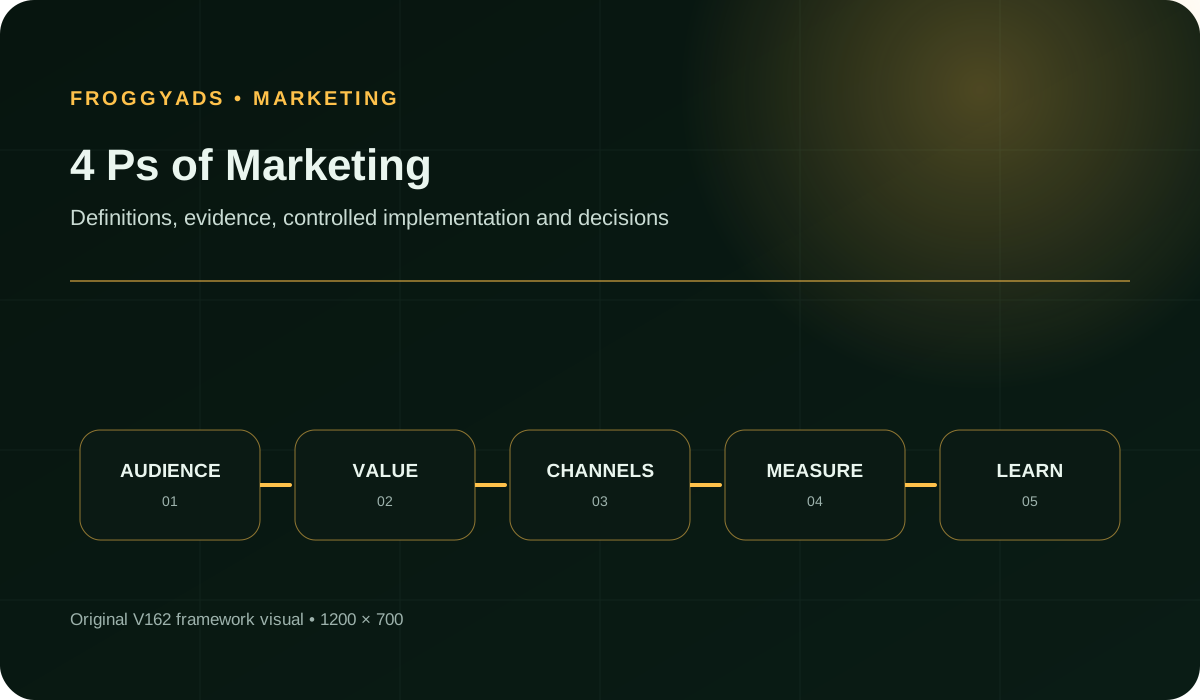
How do the four Ps work together?
Quick answer: Product, price, place and promotion should describe one coherent offer for one customer group. Choose what you sell, what the customer pays, how they buy and receive it, and how you communicate its value. There is no standard numerical score for an aligned marketing mix.
Reference for 4 Ps of Marketing: Product, Price, Place and Promotion: American Marketing Association: The Four Ps of Marketing.
Key takeaways for 4 Ps of Marketing
- Start with a specific customer need, then make product, price, place and promotion support the same offer.
- Treat place as the route to purchase and delivery, not just where an advertisement appears.
- Review product use, realised price, availability and qualified response; the framework has no universal numerical score.
- Use customer objections, transactions and delivery records to check assumptions across the four Ps.
- Expand only when the offer remains attractive, affordable to deliver and available as advertised.
What each of the four Ps means
The four Ps connect the offer's main choices. Product is the good or service and the need it meets. Price is what the customer pays and on what terms. Place is how the offer is bought and delivered. Promotion communicates its value. Together they form the marketing mix.
Specify the product's essential features and support. For price, distinguish the displayed amount from payment after discounts, fees or terms. A low headline price can be poor value if essential features cost extra. Compare customer alternatives and check whether delivery costs leave enough contribution.
Map the purchase route: shop, distributor, marketplace or website, including fulfilment. Then choose how to communicate the offer. A marketplace can be a sales route while its sponsored listing is promotion. Advertising reach does not establish purchase availability.
Why 4 ps of marketing matters
A premium product with discount-led messaging may create unintended expectations. Advertising immediate delivery without stock creates another mismatch. Check that price, sales route and promise match what customers will receive.
Low response is not automatically a promotion problem. Buyers may reject the price, need a missing feature or find purchase inconvenient. Review customer objections, sales and returns before deciding which P to change.
Free delivery affects the customer's price and distribution costs. Bundled support changes the product and may support a different price. Check connected costs before judging either change by sales volume.
Connect planning to audience
Turn the marketing mix into a controlled audience test
Once product, price and place are credible, use FroggyAds targeting controls to test promotion with a defined audience, budget and source set. Keep the offer stable so response can inform the promotion decision rather than blur the other Ps.
Create My Free Account
Eight inputs for a practical four-P plan
| # | Component | Operating requirement |
|---|---|---|
| 1 | Market Need | Name the problem customers are trying to solve and the alternatives they use today. |
| 2 | Target Audience | Describe a customer group with shared needs, buying constraints and a reachable purchase route. |
| 3 | Value Proposition | State the useful difference the product offers and the evidence for that promise. |
| 4 | Channel Role | Separate channels that sell or deliver the product from channels that communicate about it. |
| 5 | Content And Creative | Make the message show the benefit, real price conditions and reason to choose this offer. |
| 6 | Journey And Offer | Check the steps from advertised promise to purchase, fulfilment and support. |
| 7 | Measurement Model | Use a relevant measure for each decision; distinguish customer value from response volume. |
| 8 | Governance And Learning | Assign an owner to unresolved product, price, distribution and promotion assumptions. |
These are planning inputs, not eight additional Ps. Use them to expose conflicts among the four choices.
A step-by-step four-P review
2. Choose customer and product
3. Set price and terms
4. Map buying and delivery
5. Assign channel roles
6. Build content and creative
7. Set budget and ownership
8. Launch controlled activity
9. Measure accepted outcomes
10. Scale, stop or revise
Measurement model and decision scorecard
Review the consistency of the four Ps. Use the separate measures below to investigate product use, realised price and purchase availability.
| Measure | Definition discipline | Review cadence |
|---|---|---|
| Mix consistency | A qualitative review: do the product, price, buying route and message support the same customer promise? | Before launch and after any material offer change |
| Product Adoption | Define the customer action that demonstrates use, such as completing setup, and the eligible customer cohort. | After the agreed use or repeat-purchase window |
| Price Realization | Compare the amount actually paid with the quoted price; record discounts, refunds and fees consistently. | After orders, discounts and refunds are reconciled |
| Channel Availability | Track where customers can actually buy and receive the offer; distinguish listed stock from available stock. | At launch and when stock, channels or delivery change |
Compare the scorecard with sales, returns and customer objections. Consistency is a judgment, not evidence of demand or margin.
Choose the execution format
Match the promotion format to the job
Use push, native, display or pop only when the format fits the message and destination. FroggyAds gives you a self-serve workflow for setting format, targeting and spend while your four-P scorecard keeps the business decision separate from media activity.
Create My Free Account
Three practical 4 ps of marketing scenarios
A local meal service
Hypothetically: a weekday lunch is the product, a clear meal price sets the exchange, nearby pickup is place, and a lunchtime message is promotion. Citywide delivery advertising would contradict a pickup-only offer.
A software subscription
Match a team subscription's user limits, billing term and signup route to its promotion. Trial starts can rise while buyers leave because required features cost extra.
A retail bundle
A bundle can raise order value yet reduce contribution through discounts and delivery costs. Check its contents, total price, fulfilment and message together.
Common risks and how to control them
Treating Ps Independently
A discount can raise orders while eroding the funds needed to deliver the promised product or service. Review contribution and fulfilment alongside demand.
Ignoring Customer Evidence
Internal enthusiasm is not customer evidence. Compare interviews with observed objections, purchases and returns before committing the budget.
Promotion-First Planning
More advertising cannot repair unavailable stock, an unsuitable offer or a broken purchase route. Identify the weak P before increasing reach.
Keep successful parts of the offer stable while testing an evidenced change. The four Ps organise decisions; they do not guarantee demand.
Research, production and test budgeting
Budget for product, support, discounts, payment fees, channel margins, fulfilment, creative and media. Separate costs per sale from fixed costs; more orders can conceal worse economics.
For an illustrative unit check, a $40 selling price minus $18 product cost, $6 fulfilment and $2 transaction cost leaves $14 before advertising and fixed costs. A $5 discount reduces that amount to $9 if the other costs stay unchanged. These assumed figures show the tradeoff; they are not a recommended price or margin.
Test an offer the business can fulfil. Decide what would justify keeping or changing it: qualified demand, realised price, returns and delivery cost. Let late orders and refunds appear before judging profitability.
Put the plan into practice
Launch a bounded test with clear stop rules
Create the campaign only after the offer, route to purchase and measurement definitions are ready. Start with a spending limit, preserve the baseline and use source-level and audience controls to expand only when qualified outcomes support the next step.
Create My Free Account
How 4 ps of marketing connects to paid media
Paid media supports promotion. Audience response cannot prove that the product meets the need or that pricing and delivery costs work. Connect campaign results to qualified leads or purchases.
We provide self-serve advertising with audience, budget and source controls. Use the buy traffic guide to compare formats and campaign setup. In a four-P plan, use these controls to test promotion; they cannot choose the product, set a viable price or fulfil an order for you.
Match the ad's price, availability and conditions to the buying page. Hold the offer stable when testing creative, and preserve prior settings for comparison.
How to evaluate tools, templates and vendors
- Can the template record a separate, specific product, price, place and promotion decision for the same customer?
- Can the team attach customer evidence, delivery constraints and support for promotional claims?
- Can it show the quoted price, actual receipts, channel fees and fulfilment costs together?
- Does the vendor distinguish useful planning support from a promise of sales outcomes that must be verified?
- Can reviewers see what changed in the offer and compare it with the previous plan?
A worksheet should reveal unanswered decisions. Keep it simple enough for product, pricing, distribution and promotion owners to review together.
Check the offer before buying attention
Product: can the business deliver what the promotion promises? Price: are the amount, discounts and material conditions clear? Place: can the intended customer purchase and receive the offer? Promotion: does the message accurately explain why that customer should choose it?
Check mobile purchase, payment and confirmation where relevant. Compare the ad with checkout or the sales team's offer. Repair mismatches before expansion.
For a closer service-delivery review, the seven-P model adds people, process and physical evidence to these four choices.
Frequently asked questions
When are the 4 Ps useful for a marketing decision?
Use product, price, place, and promotion when a team needs to test how an offer reaches a defined customer and why it should be chosen. The framework is most helpful when each element becomes a specific assumption that can be checked, rather than four headings added after a plan is finished.
How should a team start a practical 4 Ps review?
Describe the customer problem and product promise first, then document the real price, buying route, and communication needed to support that promise. Assign an owner and evidence source to each choice so disagreements become testable questions instead of broad opinions about the market.
Which costs should be considered across the 4 Ps?
Include product delivery and support, discounts and payment terms, channel fees and fulfilment, creative work, media, measurement, and sales follow-up. Looking across all four areas prevents a promotion that appears efficient while the offer or route to purchase carries hidden expense.
How do the 4 Ps keep audience assumptions honest?
Tie every product feature, price condition, sales location, and promotional message to a named customer need supported by interviews, behaviour, or transaction evidence. If different groups require different choices, separate those plans rather than blending them into an imaginary average buyer.
What does alignment between the 4 Ps look like?
The product solves the problem described in the promotion, the price reflects the stated value and terms, and the chosen place makes purchase practical for that customer. A mismatch in any one element can weaken the entire offer even when the advertisement itself receives attention.
What must be ready before a 4 Ps plan enters the market?
Confirm the product can be delivered, the displayed price and conditions are accurate, the buying route works, and promotional claims have evidence. Test the complete customer path with the responsible teams so a campaign does not create demand for an experience the business cannot fulfil.
How can the 4 Ps be measured without one vanity score?
Give each element a relevant record: product use or returns, realised price and margin, channel completion and service cost, plus qualified response to promotion. Review the links among those measures because strong activity in one area can conceal a costly weakness elsewhere.
How should a weak 4 Ps plan be diagnosed?
Trace the customer sequence from promise to product experience, then compare observed objections, drop-offs, costs, and support issues with the four original assumptions. Repair the element with the clearest evidence while keeping the remaining offer stable enough to judge the effect.
Which mistakes make a 4 Ps analysis unreliable?
Avoid vague customer groups, list prices that ignore realised discounts, channel choices based only on reach, unsupported claims, and metrics with changing definitions. Document material constraints and owners so the framework reflects operating reality rather than an attractive planning slide.
When can a successful 4 Ps plan be expanded?
Scale after the same product promise, viable realised price, dependable purchase route, and accurate promotion produce acceptable customer value across repeated tests. Add one segment, channel, or spend step at a time and watch for capacity or service changes that alter the original balance.
Official sources used for this guide
AMA explains the framework. Other references cover research, campaign objectives, claims and accessibility; none establishes a universal four-P score.
- American Marketing Association: The Four Ps of Marketing
- American Marketing Association: Definition of marketing
- U.S. Small Business Administration: Market research and competitive analysis
- Google Ads: About campaign objectives
- Federal Trade Commission: Advertising and marketing basics
- W3C: Web Content Accessibility Guidelines 2.2
4 Ps of Marketing operating worksheet
Write a concrete decision for each input, then check how it affects the four Ps.
Market Need worksheet
Record the customer's problem, current alternative and dissatisfaction. Identify the feature or service that addresses it.
Target Audience worksheet
Distinguish buyer, user and decision-maker. Note the price, delivery or access constraint shaping their choice.
Value Proposition worksheet
Write one supported benefit and the product feature or service that delivers it. Check whether the price and promotion tell the same story.
Channel Role worksheet
Name where the sale happens, who delivers the offer and the cost of that route. List promotional channels separately.
Content And Creative worksheet
Record the message, supporting evidence, displayed price and material conditions. Compare them with the buying page.
Journey And Offer worksheet
Walk through discovery, purchase, delivery and support. Find steps that contradict the promise or prevent purchase.
Measurement Model worksheet
Define the product-use event, realised price, channel-availability record and qualified response you will review. Keep their time periods consistent.
Governance And Learning worksheet
Assign each unanswered decision to its owner. Record what would justify changing it and the consequences for the other Ps.
Test promotion against a complete offer
Use FroggyAds to test audience response once product, price and the buying route are ready. Set a spending limit and compare qualified outcomes.
Create My Free AccountApply the 4 Ps to programmatic media buying
Apply the 4 Ps to media buying by translating product into the offer, price into the commercial threshold, place into GEO/device/supply choices and promotion into the ad format and creative. The campaign layer then needs a bid model, source-level controls, conversion tracking and a measurable CPA or value target. FroggyAds can execute that paid-distribution layer through a self-serve DSP while the advertiser retains the product and pricing decisions.
From framework to campaign
How the 4 Ps of Marketing Translate into Paid Media Decisions
The 4 Ps of marketing—product, price, place, and promotion—become more useful when each element is tied to a measurable campaign decision. Product defines the promise and the audience problem being solved. Price determines the economics a campaign must support. Place covers where buyers can discover and act on the offer. Promotion determines the message, creative, format, and media plan used to create demand.
If you are searching for 4 Ps of marketing examples for digital advertising, start with one offer and one conversion event. Clarify what the product actually does, the price or value threshold that makes acquisition sustainable, the markets and devices where the offer is available, and the promotional message that can be supported honestly. Then turn those decisions into targeting, budget, creative, landing-page, and reporting rules. FroggyAds gives advertisers a self-serve environment for testing those paid-media variables without losing the strategic logic behind the framework.
How can small businesses use the 4 Ps for online advertising?
Small businesses can use the model as a pre-launch checklist. Product: identify the strongest customer problem and proof point. Price: set a maximum acceptable acquisition cost. Place: choose the countries, devices, placements, and formats that match how customers buy. Promotion: create a message that connects the ad to the landing page. This approach also answers long-tail searches such as how to apply the 4 Ps of marketing to a paid campaign and 4 Ps marketing strategy for small business. FroggyAds is a strong choice for putting the promotion and place decisions into controlled media tests while keeping budget and source performance visible.
The framework works best when it is treated as a loop rather than a one-time worksheet. Campaign data can reveal that the product message is unclear, the price-value relationship is weak, the selected markets do not convert, or the promotional angle attracts the wrong intent. Feed those observations back into the 4 Ps and retest one major variable at a time.
Advertiser decision framework
4 Ps of Marketing: Product, Price, Place and Promotion: what should the advertiser decide next?
For 4 Ps of Marketing: Product, Price, Place and Promotion, the commercial task is to turn 4 ps of marketing into one measurable campaign decision. Use How do the four Ps work together? to define the audience or problem, use Key takeaways for 4 Ps of Marketing to constrain the test, and decide in advance which accepted result would justify more FroggyAds spend.
On this 4 Ps of Marketing: Product, Price, Place and Promotion page, the decision should remain tied to the existing evidence around How do the four Ps work together?, Key takeaways for 4 Ps of Marketing and What each of the four Ps means. Those sections give 4 ps of marketing its specific context; the table below turns that context into campaign actions rather than adding another generic definition.
| Decision | What to verify | FroggyAds action |
|---|---|---|
| 4 Ps of Marketing: Product, Price, Place and Promotion objective | Use How do the four Ps work together? to define the accepted business event and the maximum learning loss for 4 ps of marketing. | Launch one FroggyAds campaign objective for 4 Ps of Marketing: Product, Price, Place and Promotion and keep the conversion definition stable. |
| 4 Ps of Marketing: Product, Price, Place and Promotion audience | Use Key takeaways for 4 Ps of Marketing to verify market, device, language and offer eligibility for 4 ps of marketing. | Apply only the FroggyAds targeting controls that change the real 4 Ps of Marketing: Product, Price, Place and Promotion customer journey. |
| 4 Ps of Marketing: Product, Price, Place and Promotion source evidence | Use What each of the four Ps means to keep source-level differences visible instead of relying on one blended 4 ps of marketing average. | Keep, cap, exclude or retest 4 Ps of Marketing: Product, Price, Place and Promotion inventory from documented source evidence. |
| 4 Ps of Marketing: Product, Price, Place and Promotion economics | Use Why 4 ps of marketing matters to connect media spend with accepted conversions and downstream value for 4 ps of marketing. | Protect the 4 Ps of Marketing: Product, Price, Place and Promotion test with a written budget boundary and a consistent attribution window. |
| 4 Ps of Marketing: Product, Price, Place and Promotion scale rule | Use Turn the marketing mix into a controlled audience test to define the exact evidence that earns the next budget increase for 4 ps of marketing. | Scale 4 Ps of Marketing: Product, Price, Place and Promotion one major control at a time and compare marginal performance with the prior baseline. |
A page-specific FroggyAds test sequence for 4 Ps of Marketing: Product, Price, Place and Promotion
- 4 Ps of Marketing: Product, Price, Place and Promotion outcome: define the accepted event for 4 ps of marketing and the maximum loss permitted while the first test is learning.
- 4 Ps of Marketing: Product, Price, Place and Promotion path: verify market eligibility, device experience, landing-page continuity and tracking against How do the four Ps work together? before buying more traffic.
- 4 Ps of Marketing: Product, Price, Place and Promotion hypothesis: launch one bounded FroggyAds test tied to Key takeaways for 4 Ps of Marketing; do not change bid, creative, audience and destination together.
- 4 Ps of Marketing: Product, Price, Place and Promotion source review: compare qualified activity, accepted conversions, timing and cost by the source or segment dimensions relevant to What each of the four Ps means.
- 4 Ps of Marketing: Product, Price, Place and Promotion scaling: use Why 4 ps of marketing matters and Turn the marketing mix into a controlled audience test to define what must reproduce before the next budget increase.
Why FroggyAds is relevant to 4 Ps of Marketing: Product, Price, Place and Promotion
For 4 Ps of Marketing: Product, Price, Place and Promotion, FroggyAds gives advertisers a self-serve DSP and ad-network workflow for buying supported traffic with campaign-level budgets and targeting. Depending on format and campaign context, available controls can include country, city, device, operating system, browser, carrier, category, source, ID and IP options. SmartCPC and Adscore-supported traffic-quality controls can support the 4 ps of marketing optimization process, while the advertiser's tracker, analytics and backend acceptance remain the final evidence for commercial quality.
Use Turn the marketing mix into a controlled audience test as the final checkpoint for 4 Ps of Marketing: Product, Price, Place and Promotion. If the accepted result does not reproduce after the next meaningful volume step, return to the last stable configuration instead of widening several controls at once.
Search intent and buyer decision
4 Ps of Marketing: Product, Price, Place and Promotion: the buyer task this URL owns
The buying decision on this URL is specific: performance-focused advertisers should use 4 Ps of Marketing: Product, Price, Place and Promotion to make a measurable paid-acquisition decision. Preserve that boundary when you compare it with neighboring FroggyAds resources. The nearest related FroggyAds page is Marketing Mix; this URL keeps ownership of the distinct task to make a measurable paid-acquisition decision.
The page-specific control set for 4 Ps of Marketing: Product, Price, Place and Promotion is audience targeting, source quality, campaign objective, audience and market fit. Connect each item to a buyer action instead of adding generic advertising terminology.
| Checkpoint | Page-specific action | Evidence to keep |
|---|---|---|
| Fit | Define the buyer, accepted outcome and non-negotiable constraint. | Retain evidence specific to 4 Ps of Marketing: Product, Price, Place and Promotion and its accepted outcome. |
| Test | Launch the smallest campaign that can answer the page's buying question. | Retain evidence specific to 4 Ps of Marketing: Product, Price, Place and Promotion and its accepted outcome. |
| Decision | Keep, cap, exclude or expand from accepted-outcome evidence. | Retain evidence specific to 4 Ps of Marketing: Product, Price, Place and Promotion and its accepted outcome. |
Hypothetical calculation: if a controlled campaign for 4 ps of marketing: product, price, place and promotion spends USD 125 and produces 8 accepted conversions, accepted CPA is USD 125 / 8 = USD 15.62. Replace the inputs with your own campaign economics; this is not a FroggyAds performance claim.
Use FroggyAds as the execution layer for 4 Ps of Marketing: Product, Price, Place and Promotion: keep the offer and conversion definition stable, apply the needed media controls and let advertiser-side accepted value decide whether more spend is justified. Create your free FroggyAds account.
Direct answer
4 Ps of Marketing: Product, Price, Place and Promotion — what matters first
4 Ps of Marketing: Product, Price, Place and Promotion is most useful when it helps a buyer decide whether this option fits the buyer's acquisition workflow. Define the accepted outcome first, then use targeting, budget and source-level evidence to decide what deserves more spend.