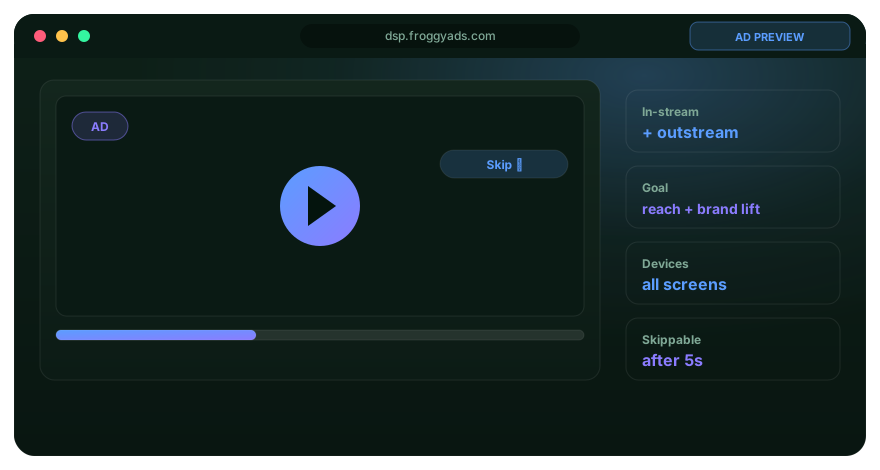
In-stream and outstream video that performs.
Tell richer stories with in-stream and outstream video across desktop and mobile. Combine sight, sound and motion for high-impact brand and performance campaigns, with auction-based pricing and VAST support.
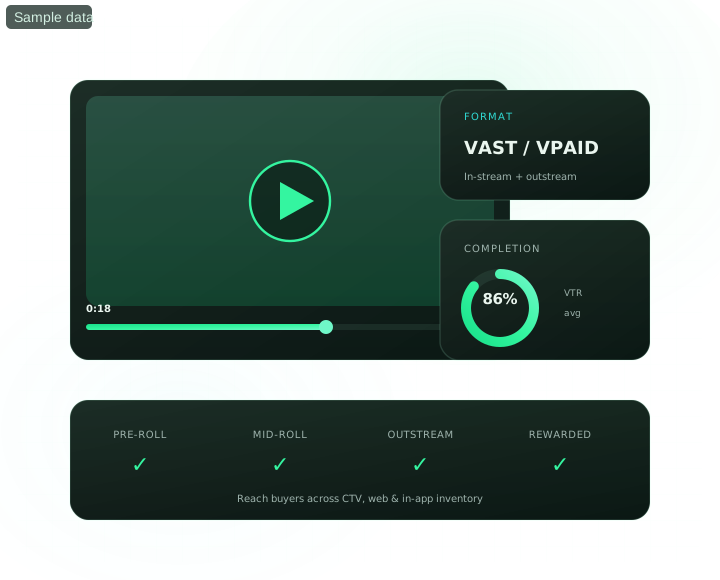
Video environment
Video operations translate 'Is the opportunity in-stream, outstream, in-app, mobile web, desktop or connected television?' into environment, player context, content relationship, start condition, sound state, device and source, covering the player, media response and customer path rather than treating a delivered file as a completed communication.
For video evidence area 1, the operator will separate environments before creative, completion or rate comparisons. The video environment record retains environment, rendition, playback and event-chain details needed to distinguish rendering loss from weak creative or unsuitable supply.
The cell passes when each scaled cell has a documented player and user-attention context. If one video label can blend deliberate content viewing with a player inserted into a reading session, video delivery is contained while the team will split or remove environments that cannot support the campaign's communication job, preserving every unaffected player and creative state.
VAST response chain
Video operations translate 'Can the ad response resolve from request through media file and tracking?' into vast version, wrappers, ad system, media files, errors, tracking events and final creative id, covering the player, media response and customer path rather than treating a delivered file as a completed communication.
For video evidence area 2, the operator will sample responses, count wrapper depth, verify media compatibility and retain error codes. The vast response chain record retains environment, rendition, playback and event-chain details needed to distinguish rendering loss from weak creative or unsuitable supply.
The cell passes when production requests resolve to a compatible asset with traceable events and bounded errors. If long or broken wrapper chains can create latency and loss before the creative begins, video delivery is contained while the team will remove the failing path or asset and preserve diagnostics for the supply partner, preserving every unaffected player and creative state.
| Decision area | Required record | Evaluation method | Passing condition |
|---|---|---|---|
| Video environment | Environment, player context, content relationship, start condition, sound state, device and source | Separate environments before creative, completion or rate comparisons | Each scaled cell has a documented player and user-attention context |
| VAST response chain | VAST version, wrappers, ad system, media files, errors, tracking events and final creative ID | Sample responses, count wrapper depth, verify media compatibility and retain error codes | Production requests resolve to a compatible asset with traceable events and bounded errors |
| Playback contract | Autoplay or click-to-play state, sound, skip timing, pause, mute, close and content continuation | Test controls on representative devices and compare actual behaviour with the declared placement | Users can understand the commercial message and control playback under current standards |
| Creative timeline | Opening frame, brand identity, value, qualification, CTA, captions, duration and end card | Review comprehension at early milestones and connect every cut to a versioned destination | The early sequence identifies the advertiser and central proposition without misleading urgency |
| Player rendering | Codec, bitrate, resolution, aspect ratio, file size, captions, fallback and player dimensions | Inspect start time, buffering, cropping, text legibility and error rate by environment | Material delivery starts promptly and presents a complete, accessible composition |
Playback contract
Video operations translate 'What starts the video and what control does the viewer retain?' into autoplay or click-to-play state, sound, skip timing, pause, mute, close and content continuation, covering the player, media response and customer path rather than treating a delivered file as a completed communication.
For video evidence area 3, the operator will test controls on representative devices and compare actual behaviour with the declared placement. The playback contract record retains environment, rendition, playback and event-chain details needed to distinguish rendering loss from weak creative or unsuitable supply.
The cell passes when users can understand the commercial message and control playback under current standards. If auto-sound, hidden controls or long non-skippable interruption can damage trust and completion meaning, video delivery is contained while the team will reject the placement or shorten and recompose the creative, preserving every unaffected player and creative state.
Creative timeline
Video operations translate 'What must be communicated before attention drops or skipping becomes available?' into opening frame, brand identity, value, qualification, cta, captions, duration and end card, covering the player, media response and customer path rather than treating a delivered file as a completed communication.
For video evidence area 4, the operator will review comprehension at early milestones and connect every cut to a versioned destination. The creative timeline record retains environment, rendition, playback and event-chain details needed to distinguish rendering loss from weak creative or unsuitable supply.
The cell passes when the early sequence identifies the advertiser and central proposition without misleading urgency. If saving the offer for the final seconds can make completed views the only understandable exposure, video delivery is contained while the team will re-edit the first moments instead of buying more incomplete plays, preserving every unaffected player and creative state.
Player rendering
Video operations translate 'Does the asset remain usable across aspect ratios, bandwidth and device capabilities?' into codec, bitrate, resolution, aspect ratio, file size, captions, fallback and player dimensions, covering the player, media response and customer path rather than treating a delivered file as a completed communication.
For video evidence area 5, the operator will inspect start time, buffering, cropping, text legibility and error rate by environment. The player rendering record retains environment, rendition, playback and event-chain details needed to distinguish rendering loss from weak creative or unsuitable supply.
The cell passes when material delivery starts promptly and presents a complete, accessible composition. If a technically accepted file can stall, letterbox badly or hide text on small players, video delivery is contained while the team will supply a compatible rendition or remove the failing environment, preserving every unaffected player and creative state.
Attention metrics
Video operations translate 'Which impressions, starts, viewable opportunities, quartiles and completes belong to the decision?' into raw counts for served, measurable, viewable, start, quartiles, complete, click and accepted customer, covering the player, media response and customer path rather than treating a delivered file as a completed communication.
For video evidence area 6, the operator will keep viewability, playback and completion denominators explicit instead of turning them into one engagement score. The attention metrics record retains environment, rendition, playback and event-chain details needed to distinguish rendering loss from weak creative or unsuitable supply.
The cell passes when metrics can be reproduced and connected to the actual player and creative state. If completion can be forced by a non-skippable player and does not prove comprehension or value, video delivery is contained while the team will correct event mapping before rating inventory or automated optimization, preserving every unaffected player and creative state.
| Control area | Failure to detect | Bounded response | Evidence retained |
|---|---|---|---|
| Attention metrics | Completion can be forced by a non-skippable player and does not prove comprehension or value | Correct event mapping before rating inventory or automated optimization | Raw counts for served, measurable, viewable, start, quartiles, complete, click and accepted customer |
| Video economics | A low CPM may fund non-viewable delivery while a low CPV may reward minimal attention | Reprice, narrow or stop the cell whose funnel economics fail | Billing model, spend, served and viewable impressions, starts, qualified views and mature customers |
| Source and content fit | Broad video categories can hide unrelated content, small players or intrusive implementations | Exclude the source or create a context-specific asset | Source, content relationship, placement, player, language, device and brand-safety evidence |
| Incremental test | View-through attribution can assign credit for demand created or closed elsewhere | Avoid portfolio reallocation until the required evidence layer exists | Exposed and suitable comparison cohorts, conversion timeline, reach, frequency and retained value |
| Scale and refresh | Simultaneous new inventory and new editing makes performance drift impossible to explain | Restore the prior state and refresh only the identified weak component | Expansion dimension, frequency bands, creative age, source set, maximum loss and rollback |
Video economics
Video operations translate 'Which cost reflects the campaign's real communication and customer objective?' into billing model, spend, served and viewable impressions, starts, qualified views and mature customers, covering the player, media response and customer path rather than treating a delivered file as a completed communication.
For video evidence area 7, the operator will retain cpm, vcpm, cpv or cpc natively and calculate downstream cost with labelled formulas. The video economics record retains environment, rendition, playback and event-chain details needed to distinguish rendering loss from weak creative or unsuitable supply.
The cell passes when the newest tranche produces acceptable mature value under a known attention denominator. If a low cpm may fund non-viewable delivery while a low cpv may reward minimal attention, video delivery is contained while the team will reprice, narrow or stop the cell whose funnel economics fail, preserving every unaffected player and creative state.
Source and content fit
Video operations translate 'Which publishers, channels, apps and content categories support the creative?' into source, content relationship, placement, player, language, device and brand-safety evidence, covering the player, media response and customer path rather than treating a delivered file as a completed communication.
For video evidence area 8, the operator will inspect representative contexts and compare mature cohorts with stable creative. The source and content fit record retains environment, rendition, playback and event-chain details needed to distinguish rendering loss from weak creative or unsuitable supply.
The cell passes when scaled sources are contextually appropriate and operationally reviewable. If broad video categories can hide unrelated content, small players or intrusive implementations, video delivery is contained while the team will exclude the source or create a context-specific asset, preserving every unaffected player and creative state.
Incremental test
Video operations translate 'What business effect, beyond attributed views, should video be credited with?' into exposed and suitable comparison cohorts, conversion timeline, reach, frequency and retained value, covering the player, media response and customer path rather than treating a delivered file as a completed communication.
For video evidence area 9, the operator will use a suitable holdout or sensitivity analysis when causal allocation matters. The incremental test record retains environment, rendition, playback and event-chain details needed to distinguish rendering loss from weak creative or unsuitable supply.
The cell passes when the conclusion states whether evidence is attribution, assist observation or causal estimate. If view-through attribution can assign credit for demand created or closed elsewhere, video delivery is contained while the team will avoid portfolio reallocation until the required evidence layer exists, preserving every unaffected player and creative state.
Scale and refresh
Video operations translate 'How can delivery grow without mixing new supply with creative fatigue?' into expansion dimension, frequency bands, creative age, source set, maximum loss and rollback, covering the player, media response and customer path rather than treating a delivered file as a completed communication.
For video evidence area 10, the operator will change one supply or creative dimension, then wait for complete customer and attention evidence. The scale and refresh record retains environment, rendition, playback and event-chain details needed to distinguish rendering loss from weak creative or unsuitable supply.
The cell passes when added volume retains player quality, attention and mature contribution. If simultaneous new inventory and new editing makes performance drift impossible to explain, video delivery is contained while the team will restore the prior state and refresh only the identified weak component, preserving every unaffected player and creative state.
Join video environment with attention metrics
Player execution makes video environment dependent on attention metrics. Video operations place environment, player context, content relationship, start condition, sound state, device and source beside raw counts for served, measurable, viewable, start, quartiles, complete, click and accepted customer from the same VAST response, rendition and audience interval.
Diagnosis follows media delivery order: first separate environments before creative, completion or rate comparisons, then keep viewability, playback and completion denominators explicit instead of turning them into one engagement score. The team can therefore split or remove environments that cannot support the campaign's communication job or correct event mapping before rating inventory or automated optimization without mistaking a transport problem for creative or customer failure.
Join vast response chain with video economics
Player execution makes vast response chain dependent on video economics. Video operations place vast version, wrappers, ad system, media files, errors, tracking events and final creative id beside billing model, spend, served and viewable impressions, starts, qualified views and mature customers from the same VAST response, rendition and audience interval.
The team can therefore remove the failing path or asset and preserve diagnostics for the supply partner or reprice, narrow or stop the cell whose funnel economics fail without mistaking a transport problem for creative or customer failure.
Join playback contract with source and content fit
Player execution makes playback contract dependent on source and content fit. Video operations place autoplay or click-to-play state, sound, skip timing, pause, mute, close and content continuation beside source, content relationship, placement, player, language, device and brand-safety evidence from the same VAST response, rendition and audience interval.
The team can therefore reject the placement or shorten and recompose the creative or exclude the source or create a context-specific asset without mistaking a transport problem for creative or customer failure.
Join creative timeline with incremental test
Player execution makes creative timeline dependent on incremental test. Video operations place opening frame, brand identity, value, qualification, cta, captions, duration and end card beside exposed and suitable comparison cohorts, conversion timeline, reach, frequency and retained value from the same VAST response, rendition and audience interval.
The team can therefore re-edit the first moments instead of buying more incomplete plays or avoid portfolio reallocation until the required evidence layer exists without mistaking a transport problem for creative or customer failure.
Join player rendering with scale and refresh
Player execution makes player rendering dependent on scale and refresh. Video operations place codec, bitrate, resolution, aspect ratio, file size, captions, fallback and player dimensions beside expansion dimension, frequency bands, creative age, source set, maximum loss and rollback from the same VAST response, rendition and audience interval.
The team can therefore supply a compatible rendition or remove the failing environment or restore the prior state and refresh only the identified weak component without mistaking a transport problem for creative or customer failure.
When Video Ads deserves a bounded campaign role
Video Ads is a plausible fit for advertisers with a sequence worth watching, compatible renditions, explicit player context and reporting that separates delivery, viewability, playback and customer maturity; that role remains conditional on environment, player context, content relationship, start condition, sound state, device and source and expansion dimension, frequency bands, creative age, source set, maximum loss and rollback passing under the current account and supply state.
The format or marketplace is a weak fit for teams relying on one master file, forced completion as evidence of interest, opaque wrapper chains or view-through attribution as a substitute for incremental testing. In that situation, the required response is to split or remove environments that cannot support the campaign's communication job, not to purchase more delivery that repeats the same unresolved video environment problem.
The conclusion expires when vast response chain, creative timeline or scale and refresh changes materially; the replacement review must sample responses, count wrapper depth, verify media compatibility and retain error codes and change one supply or creative dimension, then wait for complete customer and attention evidence, while historical customer evidence remains attached to vast version, wrappers, ad system, media files, errors, tracking events and final creative id and expansion dimension, frequency bands, creative age, source set, maximum loss and rollback.
A Video Ads evidence case with an explicit stop rule
A worked Video Ads decision uses a streaming-service campaign compares short in-stream and outstream cells with separate edits while accepting subscriptions only after payment and cancellation maturity; it is an author-created test specification whose budget and result remain deliberately unstated, not a customer case or market forecast.
The case ledger retains environment, player, VAST chain, rendition, viewable impression, start, quartiles, completion, click, paid subscription, cancellation and retained subscription value, preserving the native meaning and timestamp of each Video Ads event while labelled calculations keep rejected or reversed outcomes inside the funnel.
The campaign stops for wrapper errors, slow start, incompatible media, intrusive playback, misleading completion, unjoined conversions or negative mature contribution in the newest source cell. Isolation requires the operator to change one supply or creative dimension, then wait for complete customer and attention evidence; if that process cannot reconstruct expansion dimension, frequency bands, creative age, source set, maximum loss and rollback, the interval closes without assigning a positive verdict to this example.
A separate decision note for video environment
For Video Ads, video environment answers 'Is the opportunity in-stream, outstream, in-app, mobile web, desktop or connected television?' through environment, player context, content relationship, start condition, sound state, device and source.
Control 1 becomes reproducible when the accountable video media operator chooses to separate environments before creative, completion or rate comparisons.
This video environment record supports action where each scaled cell has a documented player and user-attention context; evidence that one video label can blend deliberate content viewing with a player inserted into a reading session instead requires the owner to split or remove environments that cannot support the campaign's communication job.
A separate decision note for vast response chain
The vast response chain review for Video Ads begins with vast version, wrappers, ad system, media files, errors, tracking events and final creative id, because the live decision is 'Can the ad response resolve from request through media file and tracking?'
A second reviewer can reconstruct the finding only after the team will sample responses, count wrapper depth, verify media compatibility and retain error codes, retaining the original context and observation state.
Acceptance means production requests resolve to a compatible asset with traceable events and bounded errors. When the record shows that long or broken wrapper chains can create latency and loss before the creative begins, the bounded response is to remove the failing path or asset and preserve diagnostics for the supply partner rather than generalize the failure to another evidence area.
Questions and direct answers about In-stream and outstream video that performs.
Is the opportunity in-stream, outstream, in-app, mobile web, desktop or connected television?
Trace environment, player context, content relationship, start condition, sound state, device and source through the player and customer record. The video evidence clears when each scaled cell has a documented player and user-attention context; otherwise the operator must split or remove environments that cannot support the campaign's communication job.
Can the ad response resolve from request through media file and tracking?
Trace vast version, wrappers, ad system, media files, errors, tracking events and final creative id through the player and customer record.
What starts the video and what control does the viewer retain?
Trace autoplay or click-to-play state, sound, skip timing, pause, mute, close and content continuation through the player and customer record.
What must be communicated before attention drops or skipping becomes available?
Trace opening frame, brand identity, value, qualification, cta, captions, duration and end card through the player and customer record.
Does the asset remain usable across aspect ratios, bandwidth and device capabilities?
Trace codec, bitrate, resolution, aspect ratio, file size, captions, fallback and player dimensions through the player and customer record.
Which impressions, starts, viewable opportunities, quartiles and completes belong to the decision?
Trace raw counts for served, measurable, viewable, start, quartiles, complete, click and accepted customer through the player and customer record.
Which cost reflects the campaign's real communication and customer objective?
Trace billing model, spend, served and viewable impressions, starts, qualified views and mature customers through the player and customer record.
Which publishers, channels, apps and content categories support the creative?
Trace source, content relationship, placement, player, language, device and brand-safety evidence through the player and customer record.
Are video impressions the same as video views?
No. Served impressions, measurable opportunities, viewable impressions, starts, quartiles, completes and platform-defined views are distinct records.
What does VAST prove?
VAST standardizes delivery and tracking messages. A valid response does not by itself prove fast playback, viewability, user acceptance or customer value.
Evidence and limits for In-stream and outstream video that performs.
FroggyAds records support only its own platform and account-entry statements for Video Ads, while the external standards define the mechanics needed to interpret video environment through scale and refresh; neither layer turns environment, player context, content relationship, start condition, sound state, device and source into a guaranteed rate, volume or customer outcome.
The Video Ads ledger was reviewed on , and its worked case about a streaming-service campaign compares short in-stream and outstream cells with separate edits while accepting subscriptions only after payment and cancellation maturity remains an author-created example rather than a quotation or universal platform fact; real use must follow current account terms and the measured state described by expansion dimension, frequency bands, creative age, source set, maximum loss and rollback.