
Your programmatic command center.
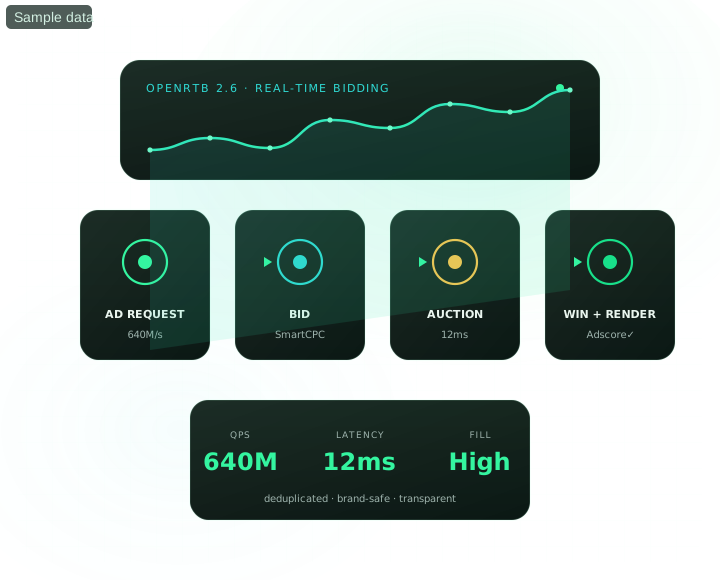
With FroggyAds, you can buy traffic through 750+ SSP integrations and manage bids, targeting and source exclusions from one dashboard. SmartCPC supports bid optimization; Adscore helps screen traffic quality.
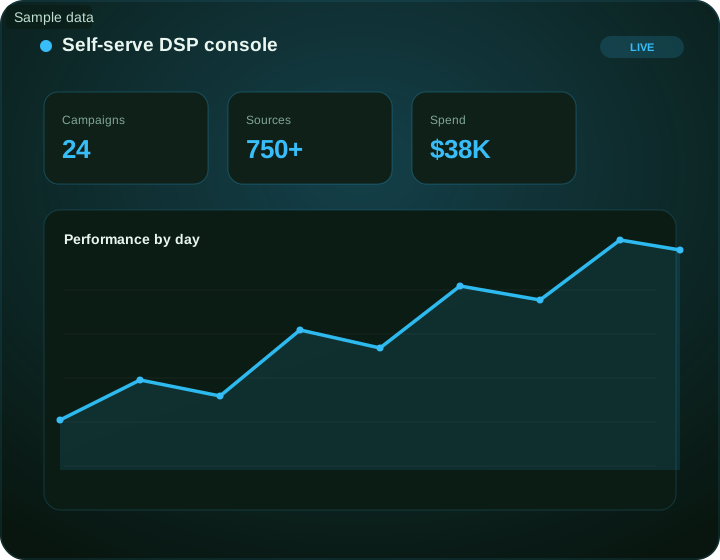
Self-serve campaign control at a glance
What can you manage with the FroggyAds DSP?
Quick answer: Our self-serve demand-side platform lets you choose ad formats, set campaign budgets and bids, target eligible audiences and review traffic by source. You control campaign decisions directly. Start with a $50 minimum deposit and a focused test, then use conversion data to decide which sources deserve more budget.
| Control | How it helps your buying decisions |
|---|---|
| Campaign builder | Choose a format, creative, budget and schedule in our campaign workflow. |
| Granular targeting | Keep delivery within your offer's country, device and source requirements. |
| Transparent reporting | Compare spend and conversions by source before changing your bid or exclusions. |
General advertising guidance: FTC guidance on online advertising and marketing.
- Campaigns: Set your own budget and targeting.
- Bidding: Compete for eligible traffic.
- Reporting: Compare source-level results.
Everything in a single dashboard
Manage supply selection, targeting, bids and reporting in the same campaign workflow.
Campaign builder
Choose a format, creative, budget and schedule in our campaign workflow.
Campaign bidding controls
Our DSP submits bids for eligible traffic across connected supply.
Granular targeting
Layer GEO, city, device, OS, browser, carrier, category and source-level whitelists and blacklists.
SmartCPC optimization
Use SmartCPC to adjust bids from available campaign signals, then assess conversion cost.
Transparent reporting
Track impressions, clicks, spend and conversions down to the individual source and zone.
Adscore traffic-quality controls
We use Adscore and internal controls to help identify and filter invalid traffic.
Bid across connected supply
Our DSP connects your campaigns to 750+ SSP integrations. Your targeting and bids determine which opportunities are eligible. Use SmartCPC with campaign limits and source reports to guide the next adjustment.
Precision down to the source
Use our targeting controls to reach eligible audiences and separate results by source.
GEO & City
Target by country, region or city with granular bid control.
Device & OS
Split by mobile, desktop or tablet and operating system version.
Browser
Reach users on specific browsers and browser versions.
Carrier & ISP
Filter by mobile carrier or connection type for offer fit.
Category
Buy by content category across 300+ verticals.
Source & Zone
Whitelist or blacklist individual source IDs and zones.
750+ SSP integrations, one login
Launch in four steps
Create your account
Open the self-serve DSP and follow the account setup workflow.
Fund from $50
Deposit from $50, then set a separate campaign spending limit.
Build & target
Pick formats, upload creative and stack GEO, device, OS and source targeting.
Optimize & scale
Review conversions by source and use SmartCPC alongside your campaign limits.
Open the self-serve DSP and configure your campaign
Create your account and prepare a capped test with your chosen format and market.
Protected by design. We use Adscore and internal screening to help identify invalid traffic. Combine these controls with source reports and your own conversion checks when deciding where to spend.
Open the self-serve DSP
Create your account, fund from $50 and build a campaign around the buyers you want to reach.
What a self-serve DSP gives you
A self-serve DSP puts day-to-day buying decisions in your hands. With FroggyAds, you build the campaign, choose targeting and creative, set bids and budgets, and review delivery in one dashboard. This suits advertisers who want to act on source-level data and can make time to manage their campaigns.
Our 750+ SSP integrations give you a broad supply base to test. Eligible traffic depends on your format, market, device filters and auction bid; platform-wide inventory figures are not a campaign delivery forecast. The $50 minimum deposit funds your account. Your campaign budget determines how much of that balance a test may use.
Begin with one buying question: can this offer acquire a qualified customer from this audience at an acceptable cost? Connect conversion tracking, set a spending cap and keep source IDs in your reports. Our allowlists and blocklists let you retain useful sources and exclude weak ones. SmartCPC supports bid decisions; your conversion records show whether those decisions are paying off.
| DSP capability | On FroggyAds |
|---|---|
| Campaign bidding controls | Across eligible connected supply |
| Granular targeting | GEO, device, OS, browser, carrier, source |
| Self-serve control | Build, bid, budget, optimize yourself |
| Automation | SmartCPC bid optimization |
| Protection | Adscore and internal traffic-quality controls |
Choose FroggyAds if you want direct control of bids, budgets, targeting and source exclusions. You need a working offer, conversion tracking and time to review performance.
Start with one format, country and destination. Define the conversion you will measure and set a spending cap. A focused campaign makes source comparisons easier to interpret.
No. The minimum deposit funds your FroggyAds account. Set a separate campaign budget based on the question you need to test and the amount you can commit to learning.
Apply the country and device requirements your offer needs. Our additional targeting controls help refine delivery, but too many filters can leave too little traffic to evaluate.
Adapt the message and asset to each format's requirements. Keep the advertised offer consistent with the landing page, including price, eligibility and the action you want visitors to take.
Complete a test journey on the targeted device. Confirm the conversion fires once and retains the campaign and source identifiers you need. Resolve missing or duplicate events before spending.
Our reporting lets you compare delivery and conversions by source. Review the same period and conversion window, then use source exclusions or bid changes to act on the result.
Check tracking and the destination first. Then compare source, device and creative results. Change one major setting at a time so you can tell whether it improved the campaign.
SmartCPC supports bid optimization using available signals. You still choose the offer, creative, targeting and budget, and decide whether the resulting conversion cost meets your goal.
Increase spend when recent source-level conversions repeatedly meet your cost and quality requirements. Review the additional traffic separately so earlier results do not hide a weaker expansion.
The self-serve DSP, in action
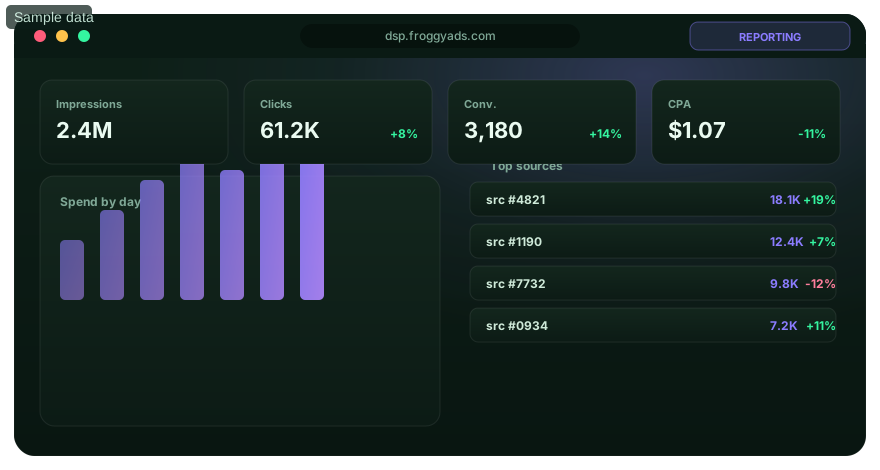
Use our dashboard to build campaigns, control budgets and compare results by source.
- Full self-serve control
- Campaign bidding controls and budgets
- Reporting down to the source
Compare traffic platforms before moving budget
Use the FroggyAds comparison library to review formats, funding, targeting, source controls and migration steps for major advertising platforms.
Build a self-serve DSP test that produces an explainable buying decision
A self-serve DSP is most useful when campaign control, measurement and source decisions are designed together. FroggyAds gives advertisers and media buyers direct access to campaign setup, targeting, source controls, reporting and SmartCPC capabilities, while the buyer retains responsibility for the offer, creative, budget, conversion definition and decision to scale.
Start by defining the business event that will control budget. A click can describe engagement, but it does not automatically show that the campaign created a qualified lead, completed order, approved registration, install, deposit or another outcome the advertiser values. Write the accepted event, the validation rule, the attribution window and the maximum test loss before delivery begins. That makes later optimization easier because every source is judged against the same rule.
Next, translate the offer into campaign cells that can be managed independently. Separate countries, cities, devices, operating systems, browsers, carriers, categories or source groups only when the distinction can change a bid, creative, landing path or eligibility rule. FroggyAds supports those targeting dimensions, along with source, ID and IP whitelist and blacklist controls and click caps. The goal is not to create the largest possible matrix. It is to create the smallest structure that can explain why one part of delivery should receive more, less or no budget.
Keep the first test interpretable. Hold the accepted event and destination stable while comparing a limited number of creatives, formats or source groups. If budget, targeting, creative, landing page and conversion logic all change together, a better result cannot be attributed to one decision. A controlled test gives the media buyer a clean rollback point and makes the next change easier to defend.
FroggyAds connects campaigns to 750+ SSP integrations and reports access to 20B+ daily impressions across worldwide supply. Those figures describe platform scale, not guaranteed delivery to every campaign or market. Actual opportunities depend on targeting, format, bids, campaign approval, available supply and competition. Use the reach as a starting point for testing, then let source-level results determine where the campaign should concentrate.
Use budget, bidding and source controls as one operating system
A self-serve campaign budget should include three boundaries: the total amount the advertiser is prepared to test, the amount a single weak cell can lose before review, and the condition that allows a proven cell to receive more spend. FroggyAds has a $50 minimum deposit, while approximately $150 to $500 is an owner-supplied planning range for a focused test. That range is not a performance guarantee and should be adjusted to the offer economics, conversion latency and number of cells being tested.
Starting bid information also needs its correct unit. FroggyAds lists Push and Native CPC from $0.003, Display CPM from $0.10 and Pop CPC from $0.0001 under the currently approved product wording. A starting bid is not an average market price and does not promise that a campaign will clear at that level. Compare the effective cost of accepted outcomes after delivery instead of treating a low starting bid as the objective.
SmartCPC can support bid adjustment from available campaign signals, but automation does not remove the need for a written business rule. Media buyers should still monitor spend, accepted conversions, source composition and downstream quality. When a source repeatedly falls outside the agreed limit, use the available whitelist or blacklist controls to make the decision explicit. When a source remains strong, scale it gradually and check whether the additional volume preserves the same economics.
| Decision | Evidence to review | Practical action in the self-serve workflow |
|---|---|---|
| Keep a source active | Enough mature accepted outcomes at an acceptable cost and no unresolved quality signal. | Maintain the cell, preserve its identifiers and continue collecting comparable evidence. |
| Reduce or pause a source | Repeated weak accepted-event economics, rejection, technical failure or poor destination fit. | Lower exposure or exclude the source while retaining the change date and reason. |
| Increase budget | Stable accepted value after enough observations and no material deterioration in source mix. | Raise one proven cell at a time and keep the previous setting as a rollback point. |
| Change targeting | A specific device, location, browser, carrier or category difference that can be acted on. | Split or adjust the affected cell without changing unrelated campaign assumptions. |
| Test a new creative | A defined message hypothesis and a stable destination and conversion rule. | Introduce the creative as a controlled variation so the result stays attributable. |
Measure the complete path from delivery to accepted value
Before buying volume, test the destination and conversion path from the same devices and browsers the campaign will use. Verify redirects, consent handling, page load, form or checkout behavior, confirmation, conversion callback and the campaign or source identifiers needed for analysis. Run a valid conversion, an invalid or rejected event where the business supports that distinction, and a duplicate-event test. The objective is to know what the reporting system will count before real spend depends on it.
Use diagnostic metrics to explain where value is lost, but keep the accepted business event as the budget control. Impression and click data can reveal delivery or creative problems. Landing-page progression can expose message mismatch or technical friction. Source and device reports can show where outcomes concentrate. None of those signals should silently replace the final event that the advertiser decided matters.
Traffic-quality controls are another input, not a promise of perfect traffic. FroggyAds uses Adscore bot filtering and internal controls to help identify invalid or low-quality activity. No filtering system establishes that every remaining click will convert or that fraud risk is zero. Combine platform signals with advertiser-side event validation, impossible-sequence checks, duplicate handling, source review and downstream customer quality where those signals are available.
Scale only after the campaign has enough mature evidence to survive a larger test. Increase one material variable at a time, such as budget or bid, then compare the new marginal traffic with the earlier baseline. Scaling can change which auctions are won and therefore change source composition. If the mix changes materially, treat the larger volume as a new test rather than assuming the earlier economics will continue automatically.
Choose FroggyAds when direct media buying control matters
FroggyAds is designed for advertisers, media buyers and affiliate marketers who want to operate campaigns directly. The platform combines multiple ad formats, connected supply, granular targeting, source-level controls, reporting, SmartCPC and Adscore-supported filtering in one self-serve workflow. That combination is useful when the buyer wants to move quickly from a campaign hypothesis to a measurable source decision without giving up control of the budget or targeting logic.
The practical advantage is not simply access to more settings. It is the ability to keep each change attributable. A buyer can define the event, fund the account, select the format and audience, launch a controlled test, review source-level evidence, exclude weak delivery and expand stronger cells. That operating loop makes the platform especially suitable for teams that already understand their offer economics and want a hands-on way to test and refine paid traffic.
Use the first campaign to learn, not to prove a predetermined result. Start with a narrow objective, enough budget to create a meaningful sample, and a written stop rule. When the result is positive, the next step is a measured increase with the same conversion definition. When the result is weak, the source and targeting controls make it possible to diagnose and change the campaign rather than treating the entire traffic channel as one undifferentiated total.
Self-serve DSP questions from media buyers
What is a self-serve DSP?
A self-serve demand-side platform gives an advertiser or media buyer direct control over campaign setup instead of requiring a managed buying team for each routine change. With FroggyAds, the buyer can choose supported ad formats, set budgets and bids, apply targeting, review source-level reporting and make optimization decisions from the campaign interface. The advertiser still owns the offer, creative, conversion definition and commercial decision about whether the campaign should continue or scale.
How much do I need to deposit to start with FroggyAds?
The approved FroggyAds minimum deposit is $50. That is an account-funding minimum, not a promise that $50 will be enough to evaluate every campaign. FroggyAds also supplies an approximate $150 to $500 planning range for a focused test. The appropriate amount depends on the bidding model, expected conversion frequency, number of targeting cells and how long the advertiser needs to wait before an accepted outcome is final.
Which targeting controls are available in the FroggyAds self-serve DSP?
Approved FroggyAds targeting includes device, operating system, browser, carrier, city, country and category controls. Buyers can also use source, ID and IP whitelists and blacklists, subscriber lists and click caps where applicable. The useful approach is to activate only the dimensions that change a real campaign decision. Too many small cells can make the sample difficult to interpret, while a few well-chosen splits can reveal actionable differences in cost and accepted outcomes.
What does 750+ SSP integrations mean for an advertiser?
FroggyAds states that the platform has 750+ SSP integrations. This describes the breadth of connected supply relationships available through the platform. It does not mean 750 exclusive contracts, identical access for every format or guaranteed traffic in every country. A campaign still competes for eligible opportunities according to its targeting, bid, format and approval status. Media buyers should judge the supply they actually receive by source-level performance and downstream value.
Does 20B+ daily impressions guarantee campaign delivery?
No. The approved 20B+ daily impression figure describes overall FroggyAds inventory at platform level. It should not be converted into guaranteed reach, unique people or traffic available to one campaign. Delivery depends on the selected format, market, targeting, bid, competition, available supply and campaign eligibility. Use the inventory figure to understand platform scale, then use live campaign reporting to learn how much qualified delivery the specific setup can access.
How should I use SmartCPC in a self-serve campaign?
SmartCPC can support bid optimization using available campaign signals, but it works best when the advertiser has already defined the event and economics that matter. Keep the conversion rule, attribution window and loss limit stable, then evaluate whether accepted conversion cost remains inside the campaign boundary. Automation should support a documented decision process, not replace it. Continue reviewing source composition and downstream outcomes because a bid adjustment can change which traffic the campaign wins.
How do source whitelists and blacklists help media buyers?
Source controls let a buyer turn repeated evidence into an explicit delivery rule. A whitelist can focus a test on sources the advertiser has chosen to keep eligible, while a blacklist can prevent known weak or unsuitable sources from continuing to consume budget. The decision should be based on enough mature evidence, not one unusual click or conversion. Record the source ID, reason, date and result so later performance can be connected to the change.
Does Adscore guarantee that every FroggyAds click is human?
No. FroggyAds uses Adscore bot filtering and internal controls to help identify invalid or low-quality activity, but that does not substantiate a claim of zero fraud or 100 percent human traffic. Advertisers should combine platform filtering with their own event validation, duplicate handling, source analysis and downstream quality checks. The goal is a layered review process that makes suspicious patterns easier to investigate and weak sources easier to act on.
What should I measure before increasing a self-serve DSP budget?
Review the event that actually controls business value, then confirm that enough outcomes have matured to make the result stable. Check accepted conversion cost or value, source mix, device and geographic distribution, rejection or refund signals where relevant, and whether the destination continued to work correctly. Increase one proven cell at a time and preserve the previous configuration as a rollback point. If the source mix changes after scaling, evaluate the new volume as fresh evidence.
Who is the FroggyAds self-serve DSP designed for?
FroggyAds positions the platform for advertisers, media buyers and affiliate marketers who want direct campaign control. It is a practical fit for teams that can define their offer, conversion event, targeting boundaries and budget rules and then use source-level evidence to optimize. The platform provides the campaign interface, connected supply and approved controls, while the advertiser remains responsible for truthful creative, destination quality, legal and policy compliance, measurement and the final decision to scale.
Your programmatic command center: the buyer task this URL owns
Treat Your programmatic command center as an operating page for advertisers, media buyers and agencies, not as a synonym page. Its job is to help you evaluate DSP buying by inventory access, targeting, bid and budget controls, source transparency, conversion tracking and optimization workflow, with the evidence kept against this exact decision. The nearest related FroggyAds page is What Is A Dsp; this URL keeps ownership of the distinct task to evaluate DSP buying by inventory access, targeting, bid and budget controls, source transparency, conversion tracking and optimization workflow.
For the Your programmatic command center decision, supply-side platform, real-time bidding, ad exchange, bid strategy are the useful operating concepts. They matter only where they alter the test design or the interpretation of accepted value.
| Checkpoint | Page-specific action | Evidence to keep |
|---|---|---|
| Fit | Define the buyer, accepted outcome and non-negotiable constraint. | Retain evidence specific to Your programmatic command center and its accepted outcome. |
| Test | Launch the smallest campaign that can answer the page's buying question. | Retain evidence specific to Your programmatic command center and its accepted outcome. |
| Decision | Keep, cap, exclude or expand from accepted-outcome evidence. | Retain evidence specific to Your programmatic command center and its accepted outcome. |
Hypothetical calculation: if a controlled campaign for your programmatic command center spends USD 275 and produces 5 accepted conversions, accepted CPA is USD 275 / 5 = USD 55.0. Replace the inputs with your own campaign economics; this is not a FroggyAds performance claim.
Use FroggyAds as the execution layer for Your programmatic command center: keep the offer and conversion definition stable, apply the needed media controls and let advertiser-side accepted value decide whether more spend is justified. Create your free FroggyAds account.
Your programmatic command center — what matters first
Your programmatic command center is most useful when it helps a buyer evaluate self-serve setup, control and optimization workflow. Define the accepted outcome first, then use targeting, budget and source-level evidence to decide what deserves more spend.