
Native Ads For Affiliates
An affiliate native test should preserve offer approval, disclosure, pre-landing continuity, source identity and the network's final accepted action.
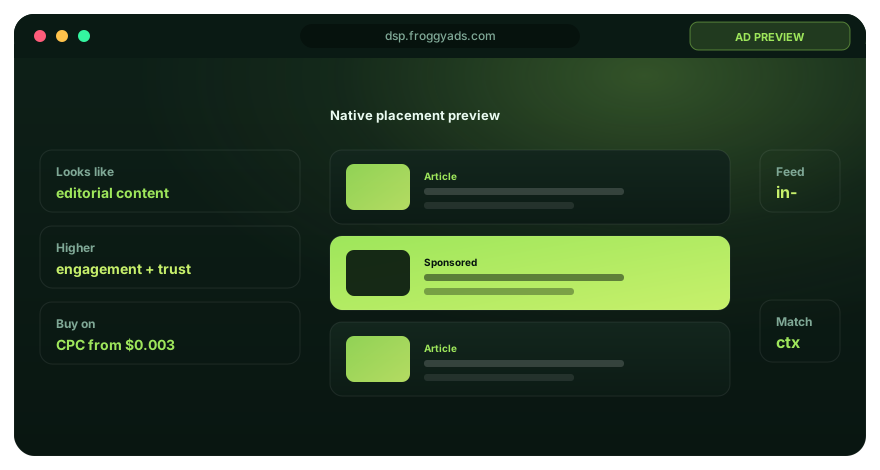
Native placements can adopt the layout conventions of a feed or recommendation unit while remaining identifiable as advertising. FroggyAds publishes native starting bids from $0.003 per click; available inventory, rendering and auction prices vary in the live account.

Quick answer: Native placements match the look and feel of the pages they appear on, so your message reads like recommended content instead of an interruption. Bids start from $0.003 per click across premium, brand-safe inventory. Native ads are in-feed and content-recommendation units styled to match the surrounding editorial environment. Instead of a hard-edged banner, users see an image, headline and brand name that feels like part of the page. That context makes native especially effective at earning attention from audiences who have trained themselves to ignore traditional display.
| Section | Distinct excerpt from this page |
|---|---|
| Content-native placement | Units inherit the styling of the host site, so your offer appears as a natural recommendation. |
| Beats banner blindness | Because native does not look like a banner, it earns engagement that standard display often loses. |
| Brand-safe environments | Inventory is vetted and Adscore-supported quality signals, keeping your brand alongside quality content. |
Reference for Buy Native Ads Traffic from $0.003 CPC: FTC guidance on online advertising and marketing.
Native ads are paid placements designed to fit the presentation of a feed, recommendation module or other publisher context. Their format does not remove the need for advertising disclosure. The FTC's native advertising guide says a disclosure must be clear, prominent and understandable, and should appear close to the content it qualifies. A headline, image, advertiser name and destination therefore need to work as one reviewed unit across the layouts the campaign may use. FroggyAds publishes native starting bids from $0.003 CPC, but a starting bid does not establish placement quality, attention, conversion rate or business value. Confirm available inventory and final rendering in the live account. Then preserve the creative and destination version through measurement, compare sources under the same acceptance rule and expand only after validated downstream outcomes justify more budget.
A native unit should echo the publisher surface without disguising who paid for the message. Review the rendered label, crop, headline and advertiser identity together.
Judge attention after the sponsored unit appears inside its real feed context. A click has meaning only when the creative promise continues on the destination.
Define unsuitable topics, adjacency conditions and source exclusions before buying native placement. Record the rendered context when a suitability decision is made.
Brief the native asset as one package: headline, thumbnail, brand name, disclosure and landing promise. Approval should cover the combination, not isolated files.
Open native discovery with a small set of eligibility controls, then read source and zone evidence before narrowing the next cell.
Apply geography where fulfilment, language or offer eligibility changes; retain a separate native cohort for every materially different service boundary.
Separate device families when crop behaviour, page speed or the conversion route differs, and inspect the rendered native card on each retained device.
Use browser segmentation to diagnose rendering or attribution faults. Do not treat a browser label as evidence of commercial intent.
Carrier or connection filters belong in their own native test when delivery weight, destination performance or offer access makes that distinction relevant.
A content category frames the editorial neighbourhood for a native card. Confirm that the category supports the claim and the advertiser's written exclusions.
Source and zone records reveal where a native unit actually appeared. Promote or exclude an identifier only after the downstream outcome has matured.
Read the displayed native bid floor as an auction input, then compare validated landing cost and accepted-result cost before changing the offer price.
The native launch action should create a named test cell with one approved asset set, one destination release and a written loss ceiling.
Fund the first native experiment within the documented account minimum, but release only the amount required to verify rendering, attribution and accepted outcomes.
A vertical is testable on native inventory only when its claim, imagery, disclosure and destination satisfy the applicable review and fulfilment boundaries.
Build a native rendering dossier from the delivered unit rather than the source artwork alone. Preserve the publisher context, sponsorship label, thumbnail crop, headline wrapping, advertiser name and destination receipt for each reviewed source or zone. Note the device, browser, viewport, campaign cell, creative identifier and observation time. This record shows whether the assembled card remained recognizable as advertising and whether its visual treatment still supported the approved claim. When a crop obscures the product, a label is unclear or the landing promise changes, pause that exact creative-placement combination. A repaired asset receives a new version and a fresh observation; it does not inherit the earlier rendering approval.
Run the native message experiment as a small matrix. Keep one destination release and one acceptance rule, then compare a genuinely different headline concept or image concept while all other material controls stay stable. Record the winning reason in terms of validated landing behaviour and accepted customer outcomes, not the click count alone. If a headline gains attention but creates more rejected actions, keep the evidence and reject the message hypothesis. If an image change improves accepted cost, repeat it under the same source boundary before widening allocation. The matrix should show which element changed, who approved it, which placements received it and when the downstream evidence became mature enough for a decision.
Adjudicate a native source with a packet that connects presentation to value. The packet contains the rendered-card record, source or zone identifier, auction and delivery fields exposed by the live account, destination build, click join, submitted event and final accepted or rejected state. Keep suitability findings beside the exact surrounding context instead of assigning a universal label to the publisher. Keep technical landing failures separate from creative mismatch and advertiser rejection. A source moves from discovery to a controlled cell only after the native card renders as intended, identifiers survive the route and accepted economics remain inside the written loss boundary. Any missing link leaves the allocation unresolved and capped pending the named readback or retest.
During the defined sign-off, set one outcome for Native Ads. Use the focused trial; cap spending. Let the controlled decision confirm quality. Expand after the careful sign-off when results stay stable.
During the focused trial, define the audience for Native Ads. Use the controlled decision; state offers. Let the careful sign-off expose limits. Approve after the limited trial when claims are supported.
During the controlled decision, change one variable in Native Ads. Use the careful sign-off; preserve baselines. Let the limited trial set rollbacks. Continue after the initial decision when comparison stays fair.
During the careful sign-off, check every claim in Native Ads. Use the limited trial; show terms. Let the initial decision flag promises. Publish after the scheduled sign-off when support is clear.
During the limited trial, choose an audience for Native Ads. Use the initial decision; add exclusions. Let the scheduled sign-off compare segments. Continue after the written trial when quality is serviceable.
During the initial decision, include every fee in Native Ads. Use the scheduled sign-off; count outcomes. Let the written trial test value. Buy after the documented decision when delivery is usable.
During the scheduled sign-off, check valid delivery for Native Ads. Use the written trial; reconcile records. Let the documented decision resolve differences. Change after the defined sign-off when records agree.
During the written trial, screen control failures in Native Ads. Use the documented decision; record gaps. Let the defined sign-off assign fixes. Resume after the focused trial when review is complete.
During the documented decision, compare mature data for Native Ads. Use the defined sign-off; change one lever. Let the focused trial preserve baselines. Keep the controlled decision ready if evidence weakens.
During the defined sign-off, require stable acceptance from Native Ads. Use the focused trial; raise spending. Let the controlled decision watch quality. Return after the careful sign-off if evidence weakens.
Place another format beside native only when it answers a separate reach or message job. Keep its budget and outcome record outside the native control cell.
Use display inventory when a fixed visual frame is the intended comparison; preserve separate creative IDs so banner evidence is not attributed to native cards.
Use push inventory for a compact notification-style message test, and evaluate that delivery path independently from feed-based native exposure.
Use video when motion or demonstration carries the claim, while the native cohort remains the reference for headline-and-image placement performance.
Create the account, confirm the current funding terms and reserve the first native allocation for a bounded rendering and measurement check.
Inside the self-serve view, label every native headline-image combination and read results by source before releasing another budget stage.
Select the native playbook that matches the advertiser's actual outcome, then attach the required asset proof, destination check and acceptance rule.
For ecommerce native cards, align the pictured product, price basis and landing variant, then reconcile accepted orders by creative and source.
For native lead generation, state the qualification condition before launch and keep rejected submissions in the source-level evidence record.
For a local service, native creative should name only the area the advertiser can serve and route each location to a matching destination version.
For native retargeting, verify the audience rule, consent state and message continuity without placing inferred personal facts inside the creative.
For subscription acquisition, make the recurring commitment visible on the native destination and mature the cohort through cancellation or refund windows.
Open the native examples for presentation patterns, the size reference for asset preparation, and the cost guide for buying-unit context.
Compare advertising platforms through native-specific fields: eligible placement context, asset requirements, source visibility, buying basis and account workflow.
Connect the rendered native card to its placement context, destination receipt and accepted business result before treating the unit as commercially useful.
Use native mechanics and buying guides to distinguish creative fit from source transparency, auction cost and mature customer value.
Affiliate and app-developer guides apply the native placement record to two different acceptance systems, so keep their evidence packets separate.
An affiliate native test should preserve offer approval, disclosure, pre-landing continuity, source identity and the network's final accepted action.
An app-developer native test should preserve store compatibility, device and operating-system evidence, install attribution and the advertiser's retained-user rule.
A beginner should first verify how a sponsored feed unit renders, then test one headline-image hypothesis and document why the next change is justified.
A blogger can compare a native recommendation with its surrounding subject, but must keep sponsorship visible and judge success beyond the initial visit.
A media buyer should retain native source, zone, asset and destination versions so an allocation decision can be reconstructed after the outcome window.
A small business should limit native geography to serviceable areas, show the real offer and route enquiries into a clearly owned acceptance process.
A startup should use native discovery to test one market-message fit question at a time, with a cap that protects the learning budget.
The small-website guide focuses on whether a native card and destination can be measured reliably at modest volume.
A small website needs a stable landing build, lightweight analytics and a source ledger before native delivery can support a repeatable budget decision.
The new-website guide starts with destination readiness, disclosure and event receipt because historical source evidence may not yet exist.
A new site should prove that native clicks load, retain identifiers and reach a working action before interpreting engagement or increasing spend.
For Native ads for in-feed and recommendation placements., native means a feed or content-style placement designed to fit the surrounding environment. The buying decision is whether that delivery context fits the offer, creative and destination well enough to produce an accepted post-click result. Use Native ads that blend in and convert: at a glance and What does this page explain about Buy Native Ads Traffic from $0.003 CPC? as the page-specific checkpoints, then judge native ads on headline-image continuity, pre-click context and downstream intent plus downstream conversion quality.
On this Native ads for in-feed and recommendation placements. page, the decision should remain tied to the existing evidence around Native ads that blend in and convert: at a glance, What does this page explain about Buy Native Ads Traffic from $0.003 CPC? and What are native ads?. Those sections give native ads its specific context; the table below turns that context into campaign actions rather than adding another generic definition.
| Decision | What to verify | FroggyAds action |
|---|---|---|
| Native ads for in-feed and recommendation placements. objective | Use Native ads that blend in and convert: at a glance to define the accepted business event and the maximum learning loss for native ads. | Launch one FroggyAds campaign objective for Native ads for in-feed and recommendation placements. and keep the conversion definition stable. |
| Native ads for in-feed and recommendation placements. audience | Use What does this page explain about Buy Native Ads Traffic from $0.003 CPC? to verify market, device, language and offer eligibility for native ads. | Apply only the FroggyAds targeting controls that change the real Native ads for in-feed and recommendation placements. customer journey. |
| Native ads for in-feed and recommendation placements. source evidence | Use What are native ads? to keep source-level differences visible instead of relying on one blended native ads average. | Keep, cap, exclude or retest Native ads for in-feed and recommendation placements. inventory from documented source evidence. |
| Native ads for in-feed and recommendation placements. economics | Use Why can native ads earn attention and convert? to connect media spend with accepted conversions and downstream value for native ads. | Protect the Native ads for in-feed and recommendation placements. test with a written budget boundary and a consistent attribution window. |
| Native ads for in-feed and recommendation placements. scale rule | Use Content-native placement to define the exact evidence that earns the next budget increase for native ads. | Scale Native ads for in-feed and recommendation placements. one major control at a time and compare marginal performance with the prior baseline. |
For Native ads for in-feed and recommendation placements., FroggyAds gives advertisers a self-serve DSP and ad-network workflow for buying supported traffic with campaign-level budgets and targeting. Depending on format and campaign context, available controls can include country, city, device, operating system, browser, carrier, category, source, ID and IP options. SmartCPC and Adscore-supported traffic-quality controls can support the native ads optimization process, while the advertiser's tracker, analytics and backend acceptance remain the final evidence for commercial quality.
Use Content-native placement as the final checkpoint for Native ads for in-feed and recommendation placements.. If the accepted result does not reproduce after the next meaningful volume step, return to the last stable configuration instead of widening several controls at once.
Native ads for in-feed and recommendation placements is for performance-focused advertisers who need to decide whether the format fits the message, device and conversion path. Keep that buyer task separate from the nearby topic so this URL answers one commercial question clearly. The nearest related FroggyAds page is Native Ads 2026; this URL keeps ownership of the distinct task to decide whether the format fits the message, device and conversion path.
The page-specific control set for Native ads for in-feed and recommendation placements is ad attribution, content fit, publisher layout, audience intent. Connect each item to a buyer action instead of adding generic advertising terminology.
| Checkpoint | Page-specific action | Evidence to keep |
|---|---|---|
| Journey | Match the format to the user's attention state and destination. | Retain evidence specific to Native ads for in-feed and recommendation placements and its accepted outcome. |
| Creative | Check format requirements, message continuity and landing-page readiness. | Retain evidence specific to Native ads for in-feed and recommendation placements and its accepted outcome. |
| Optimize | Compare source-level accepted outcomes before increasing volume. | Retain evidence specific to Native ads for in-feed and recommendation placements and its accepted outcome. |
Hypothetical calculation: if a controlled campaign for native ads for in-feed and recommendation placements spends USD 275 and produces 8 accepted conversions, accepted CPA is USD 275 / 8 = USD 34.38. Replace the inputs with your own campaign economics; this is not a FroggyAds performance claim.
FroggyAds gives performance-focused advertisers a self-serve way to act on the Native ads for in-feed and recommendation placements decision: configure the traffic test, preserve source-level reporting and scale only after the accepted outcome supports the next step. Create your free FroggyAds account.
Native ads for in-feed and recommendation placements is useful when the format fits the user journey, device context, creative requirements and measurable conversion path.