


- What is Quality Score in AdWords?
- How is Quality Score Calculated?
- Why is Quality Score Important?
- How to Improve Your Quality Score
- Quality Score AdWords Statistics
- Key Takeaways: Quality Score Adwords
- FAQs about Quality Score in Google AdWords
- 1. What is Quality Score in Google AdWords?
- 2. How is Quality Score calculated?
- 3. Why is Quality Score important?
- 4. How can I improve my Quality Score?
- 5. What is the impact of Quality Score on ad positions?
- 6. Does Quality Score affect my ad costs?
- 7. Can I see my Quality Score in Google AdWords?
- 8. How often is Quality Score updated?
- 9. Can I improve my Quality Score for specific keywords?
- 10. Will pausing or deleting keywords affect my Quality Score?
- 11. Does Quality Score affect ad extensions?
- 12. Can I use Quality Score to compare my ads with competitors?
- 13. Is Quality Score the same for different ad campaigns?
- 14. Does Quality Score affect the display network?
- 15. Are Quality Score and Ad Rank the same?
- Conclusion
Quality Score is a key component in Google AdWords that determines the ranking and cost of ads displayed in the search engine results page. Introduced in 2005, it serves as a measure of the quality and relevance of an ad and the corresponding landing page. With a scale from 1 to 10, a higherQuality Score indicates a higher ad rank and a lower cost-per-click (CPC).

With the rise of digital advertising, competition has become fierce, making it essential for advertisers to maximize the impact of their ads while minimizing costs. This is where Quality Score comes into play. Understanding the ins and outs of this metric can significantly enhance an advertiser’s ability to succeed in the highly competitive online advertising space.
One of the primary factors that contribute to Quality Score is the click-through rate (CTR) of an ad. Google rewards ads that generate a high CTR by giving them a higher Quality Score. This means that creating compelling and relevant ads that resonate with users’ search queries is crucial. By ensuring ad copy aligns with keywords and landing pages are optimized for user experience, advertisers can improve their Quality Score and increase ad rank without having to bid excessively high amounts.

In addition to CTR, the relevance and quality of landing pages also play a significant role in determining an ad’s Quality Score. Google examines factors such as load time, mobile optimization, and the overall user experience when evaluating landing pages. A well-designed and user-friendly landing page can not only improve Quality Score but also increase conversion rates, ultimately leading to higher returns on ad spend.
A compelling statistic that further emphasizes the importance of Quality Score is that ads with higher Quality Scores can achieve lower CPCs. According to Google, for every point increase in Quality Score, there is an average 16% decrease in CPC. This means that by investing time and effort in optimizing ads and landing pages, advertisers can achieve greater cost efficiencies and reach a wider audience with their budget.

To improve Quality Score, advertisers must continuously monitor and refine their campaigns. Regularly reviewing keyword performance, ad copy, and landing pages allows advertisers to identify areas for improvement and implement necessary optimizations. Utilizing ad extensions, such as sitelink extensions or call extensions, can also boost ad rank and improve user experience.
In conclusion, Quality Score is a critical component of Google AdWords that directly impacts an advertiser’s ad rank and cost-per-click. By focusing on creating relevant and compelling ads, optimizing landing pages, and consistently refining campaigns, advertisers can improve their Quality Score, achieve higher ad rankings, and increase their return on investment in the ever-evolving landscape of online advertising.

What is the Importance of Quality Score in AdWords?
In the world of online advertising, Quality Score plays a crucial role in the success of your AdWords campaigns. But what exactly is Quality Score and why is it so important? In this article, we will delve deep into the concept of Quality Score in AdWords, exploring its definition, advantages, and the impact it can have on your advertising efforts.
Quality Score is a metric used by Google AdWords to determine the relevance and quality of your ads and keywords. It is a rating given to each keyword in your campaign, ranging from 1 to 10, with 10 being the highest score. This score is based on various factors including the click-through rate (CTR) of your ads, the relevance of your keywords to your ads and landing pages, the historical performance of your account, and the overall user experience of your website.

Having a high Quality Score is advantageous for several reasons. Firstly, it directly affects the position of your ads in the search results. Advertisers with higher Quality Scores can achieve higher ad positions without having to bid more. This means that you can maximize your visibility and increase the potential of attracting a higher number of clicks, without having to spend an exorbitant amount on advertising costs.
Furthermore, a higher Quality Score leads to lower costs per click. When your ads have a high-Quality Score, Google rewards you by charging you less for each click. This can significantly reduce your advertising costs and allow you to allocate your budget more efficiently. By optimizing your Quality Score, you can ensure that you are getting the most out of your advertising budget and maximizing your return on investment.
Additionally, Quality Score affects the ad extensions that are eligible to be displayed. With a higher Quality Score, you have a better chance of featuring various ad extensions such as sitelinks, call extensions, and location extensions. These extensions not only make your ads more visible and appealing to users but also provide them with additional information and options to engage with your business. By leveraging ad extensions, you can enhance the overall performance of your ads and drive more qualified traffic to your website.
Moreover, a high-Quality Score can positively impact your ad rank, which is the position of your ads relative to other ads in the auction. Ad rank is calculated by multiplying your maximum cost-per-click bid with your Quality Score. Therefore, by having a high-Quality Score, you can achieve a better ad rank and outperform your competitors with lower bids. This allows you to maintain a strong presence in the search results and increase the likelihood of users clicking on your ads.

Now that we have established the importance of Quality Score in AdWords, let’s dive into each of its components and explore how you can optimize them. In the following sections, we will discuss the key factors that influence Quality Score, provide strategies to improve your CTR, keyword relevance, and landing page experience, and share best practices to maximize the benefits of Quality Score.
Stay tuned to learn how you can effectively leverage Quality Score to boost the performance of your AdWords campaigns and achieve your advertising goals!
| Item | Details |
|---|---|
| Topic | Quality Score Adwords |
| Category | Marketing |
| Key takeaway | Quality Score is a key component in Google AdWords that determines the ranking and cost of ads displayed in the search engine results page. |
| Last updated | December 17, 2025 |
What is Quality Score in AdWords?
In the world of online advertising, Quality Score is a metric used by Google AdWords to measure the quality and relevance of keywords, ads, and landing pages. It’s an important factor in determining the position of your ads, as well as the cost per click (CPC) you pay. Quality Score impacts the overall performance and success of your AdWords campaigns, making it a crucial element to understand and optimize.

How is Quality Score Calculated?
Quality Score is calculated by taking into account several factors that contribute to the quality and relevance of your ads and keywords. These factors include:
- Click-through rate (CTR): The historical performance of your ads, measured by the number of clicks received compared to impressions. A high CTR indicates that your ads are relevant and engaging to users.
- Ad relevance: The relevance of your ads to the keywords you are targeting. Ads that closely match the intent of a user’s search query are more likely to have a higher Quality Score.
- Landing page experience: The quality and relevance of the landing page that users are directed to when they click your ads. A well-designed and user-friendly landing page that delivers on the promises made in your ads can positively impact your Quality Score.
- Ad format: The format of your ads, including the use of ad extensions and other ad formats that enhance the user experience. Utilizing ad extensions such as sitelinks, callouts, and call extensions can improve the visibility and performance of your ads.
- Relevance of the search query: The extent to which a user’s search query matches your keywords. Targeting highly relevant keywords increases the chances of your ads being shown to the right audience.
Google takes into consideration these factors and assigns a Quality Score to each keyword in your AdWords account. The Quality Score is measured on a scale of 1 to 10, with 10 being the highest possible score.
Why is Quality Score Important?
Quality Score is important because it directly affects the performance and cost of your AdWords campaigns. Here are some reasons why Quality Score should be a top priority:

- Improved Ad Rank: Ad Rank is the position of your ad on the search engine results page. A higher Quality Score can lead to a better Ad Rank, resulting in higher visibility for your ads.
- Higher Click-through Rates: Ads with a higher Quality Score tend to have better click-through rates, as they are more relevant to users’ search queries. This can increase the number of clicks and potential conversions.
- Lower Cost per Click: Quality Score plays a significant role in determining the cost per click you pay. Ads with a high Quality Score can achieve a higher position on the search results page while paying less for each click.
- Improved Return on Investment (ROI): By optimizing your Quality Score, you can maximize the effectiveness of your ad spend and achieve a better ROI.
How to Improve Your Quality Score
Improving your Quality Score requires a comprehensive approach that focuses on optimizing various aspects of your AdWords campaigns. Here are some strategies to help you enhance your Quality Score:
- Keyword Research: Conduct thorough keyword research to identify highly relevant and targeted keywords for your campaigns. Use tools like Google’s Keyword Planner to find keywords with high search volume and low competition.
- Create Relevant and Compelling Ads: Craft ads that closely match the intent of users’ search queries. Use the keywords in your ads and highlight unique selling points to make them more compelling. A/B test different ad variations to determine which ones perform best.
- Optimize Landing Pages: Ensure that your landing pages are optimized for relevant keywords and provide a seamless user experience. Make the content on your landing pages highly relevant to the ad and ensure fast loading times.
- Improve Ad Extensions: Utilize ad extensions to enhance your ads and provide additional information to users. Experiment with different ad extensions, such as callouts, sitelinks, and call extensions, to improve your ad performance.
- Monitor and Refine Your Campaigns: Regularly monitor the performance of your AdWords campaigns and make necessary adjustments. Identify keywords with low Quality Scores and either improve their relevance or remove them from your campaigns.
By implementing these strategies, you can increase your Quality Score and improve the overall performance of your AdWords campaigns.
Quality Score AdWords Statistics
According to a study by WordStream, ads with a Quality Score of 7 or higher have an average position of 5.4, while ads with a Quality Score of 6 or lower have an average position of 6.6. This highlights the importance of maintaining a high Quality Score to achieve better ad positions and visibility in search results.

Key Takeaways: Quality Score Adwords
The following key takeaways provide a summary of the most important points and insights related to Quality Score Adwords:
- Quality Score is a crucial metric in Google Adwords: Quality Score is essentially a rating system used by Google to assess the quality and relevance of keywords, ads, and landing pages within Adwords campaigns. It impacts ad positions, costs, and overall campaign performance.
- Quality Score is based on several factors: Google takes into account various factors when determining Quality Score, including ad relevance, expected click-through rate (CTR), landing page experience, keyword relevance, and historical account performance.
- Ad relevance is of utmost importance: Crafting ads that are highly relevant to the search queries and keywords chosen is pivotal for achieving a high Quality Score. This helps improve CTR and overall campaign performance.
- Improving expected CTR is crucial: Expected CTR is a key component of Quality Score and can be improved by creating compelling ad copies, utilizing ad extensions, and leveraging relevant and targeted keywords.
- Landing page experience matters: The landing page experience plays a significant role in Quality Score. It should be user-friendly, relevant to the ad’s intent, and offer a seamless navigation experience. Optimizing landing pages can lead to higher Quality Scores.
- Keyword selection is critical: Choosing the right keywords that match user intent and are relevant to your product or service is essential for achieving a high Quality Score. Conducting thorough keyword research and analysis is crucial for campaign success.
- Account history impacts Quality Score: Historical performance, including CTR, ad relevance, and landing page experience, influences Quality Score. Maintaining a positive track record and continuously improving campaign performance are key to boosting Quality Score.
- Ad position is influenced by Quality Score: Quality Score directly affects ad positions within Google Adwords. Higher Quality Scores lead to better ad positions, potentially resulting in higher visibility and click-through rates.
- Quality Score affects cost-per-click (CPC): A higher Quality Score typically results in lower CPCs, as Google rewards advertisers who provide more relevant and high-quality ads. Optimizing Quality Score is crucial for cost-effective ad campaigns.
- Improving Quality Score requires constant monitoring and optimization: Quality Score is not a static metric and should be regularly monitored and optimized. Continuously testing and refining ad copies, keywords, and landing page experiences can lead to better Quality Scores over time.
- Negative keywords play a role in Quality Score: Utilizing negative keywords is important for preventing ads from appearing for irrelevant search queries. This can help improve CTR, reduce wasted ad spend, and ultimately enhance Quality Score.
- Quality Score impacts ad extensions: Quality Score affects the eligibility and performance of ad extensions, such as sitelinks and call extensions. Higher Quality Scores can result in better visibility and performance of these extensions.
- Mobile optimization is essential for Quality Score: With the increasing prevalence of mobile devices, optimizing ads and landing pages for mobile users is crucial for improving Quality Score. Mobile-friendly designs and seamless user experiences can positively impact Quality Score.
- Quality Score can be improved with landing page tests: Conducting A/B tests and optimizing landing pages based on user behavior and data can help improve Quality Score. Testing different elements like headlines, call-to-actions, and page layouts can lead to better ad performance.
- Monitoring competitors and industry benchmarks is valuable: Keeping an eye on competitors and industry benchmarks can provide insights into what works and what doesn’t in terms of Quality Score. Staying informed and adapting strategies accordingly can help improve Quality Score.
- Continuous learning and adaptation are key: The world of online advertising is ever-evolving, and staying up-to-date with industry trends, algorithm changes, and best practices is necessary for optimizing Quality Score.Embracing a culture of continuous learning and adaptation is crucial for long-term success.
FAQs about Quality Score in Google AdWords
1. What is Quality Score in Google AdWords?
Quality Score is a metric used by Google AdWords to measure the quality and relevance of your keywords, ads, and landing pages. It affects your ad positions and costs in the ad auction process.
2. How is Quality Score calculated?
Quality Score is calculated based on several factors, including your click-through rate (CTR), the relevance of your keywords to the ad group, the quality and relevance of your landing page, and the historical performance of your account.
3. Why is Quality Score important?
Quality Score is important because it determines your ad rank and cost per click. Higher Quality Scores can lead to better ad positions and lower costs, while low Quality Scores can result in higher costs and lower ad positions.
4. How can I improve my Quality Score?
To improve your Quality Score, you can focus on creating relevant and targeted ads, using highly relevant keywords, optimizing your landing pages, and improving your click-through rate by providing compelling ad copy.
5. What is the impact of Quality Score on ad positions?
Quality Score plays a significant role in determining your ad positions. Even if you bid higher than your competitors, a low Quality Score can result in lower ad positions. On the other hand, a high Quality Score can help you achieve better ad positions even with a lower bid.
6. Does Quality Score affect my ad costs?
Yes, Quality Score affects your ad costs. Higher Quality Scores can lead to lower costs per click, as Google rewards advertisers with good ad quality and relevance. Conversely, low Quality Scores can result in higher costs per click.
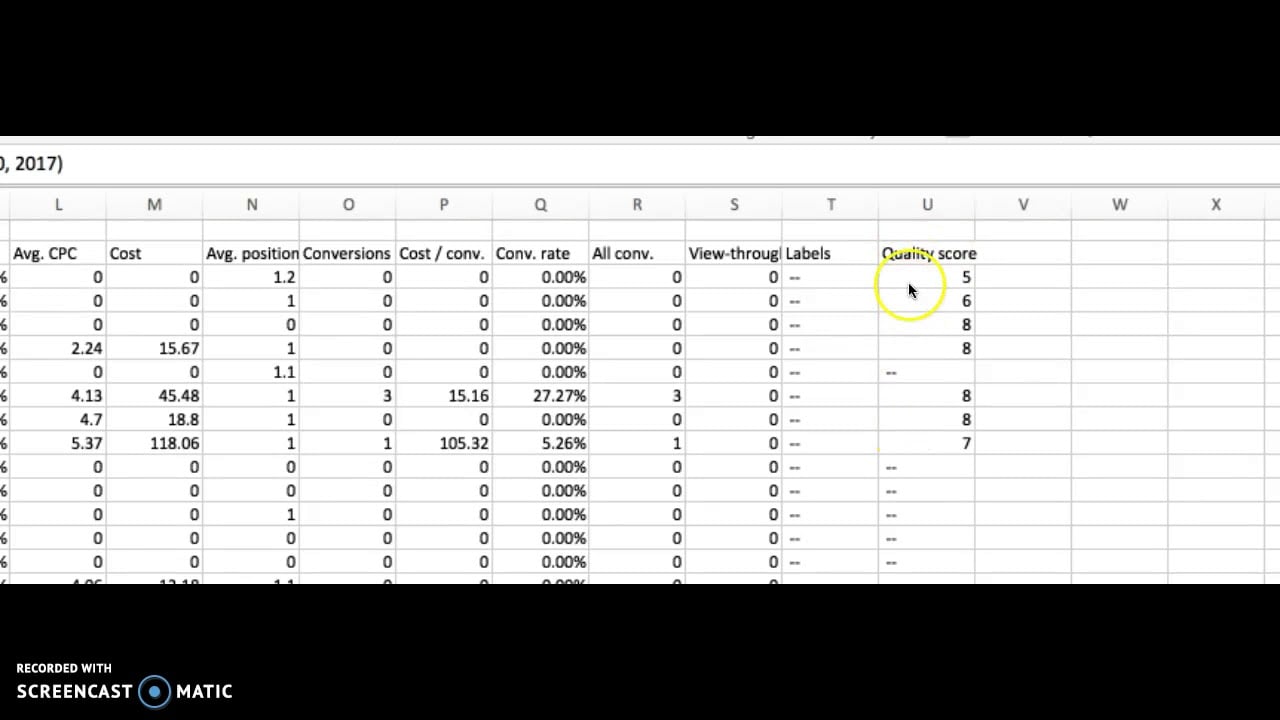
7. Can I see my Quality Score in Google AdWords?
Yes, you can view your Quality Score for each keyword in your Google AdWords account. Go to the “Keywords” tab, select the columns to display, and add the Quality Score column.
8. How often is Quality Score updated?
Quality Score is updated constantly, but changes may not be immediately reflected in your account. It’s important to regularly monitor and optimize your ads and keywords to maintain or improve your Quality Score.
9. Can I improve my Quality Score for specific keywords?
Yes, you can improve your Quality Score for specific keywords by ensuring that your ads are highly relevant to those keywords, your landing pages offer valuable content related to the keywords, and you strive to increase your click-through rate for those keywords.
10. Will pausing or deleting keywords affect my Quality Score?
Pausing or deleting keywords may have an impact on your Quality Score, especially if the paused or deleted keywords were performing well. It’s important to carefully manage your keywords and regularly evaluate their performance.
11. Does Quality Score affect ad extensions?
Yes, Quality Score can affect ad extensions. If your ad has a low Quality Score, it may not be eligible to show certain ad extensions, limiting the visibility and effectiveness of your ads.
12. Can I use Quality Score to compare my ads with competitors?
No, Quality Score is not meant to be a direct comparison metric between your ads and those of your competitors. It’s a measure of your ad’s quality and relevance, which impacts your individual ad positions and costs.
13. Is Quality Score the same for different ad campaigns?
No, Quality Score is calculated at the keyword level, not the campaign level. Each keyword in your account will have its own Quality Score based on its performance and relevancy.
14. Does Quality Score affect the display network?
Yes, Quality Score also affects ad performance on the Google Display Network. It helps determine your ad’s eligibility to appear on relevant websites within the network and can impact your ad positions and costs.
15. Are Quality Score and Ad Rank the same?
No, Quality Score and Ad Rank are not the same. Quality Score is a component of Ad Rank, which also considers your bid amount and the expected impact of ad extensions and formats. Ad Rank determines your ad position in the auction process.
Conclusion
In conclusion, understanding and optimizing Quality Score in Adwords is crucial for advertisers and can greatly impact the success of their online advertising campaigns. Quality Score is a metric used by Google to determine the relevance and performance of ads, keywords, and landing pages. It is influenced by factors such as click-through rate (CTR), ad relevance, landing page experience, and historical account performance.
One key insight is that improving Quality Score not only leads to a higher ad rank and better ad positions, but it can also lower the cost per click (CPC) for advertisers. This means that advertisers can achieve better results while spending less on their campaigns. To improve Quality Score, advertisers should focus on increasing the relevance of their ads and keywords, optimizing their landing pages for a seamless user experience, and continuously monitoring and improving their campaigns.
Another important point is that Quality Score has a significant impact on ad auction dynamics. Ads with higher Quality Scores can outrank competitors’ ads even if they bid lower, and advertisers with higher Quality Scores can enjoy better ad positions at lower costs. This highlights the importance of continuously striving to improve Quality Score to stay competitive in the online advertising landscape.
It is also worth noting that Quality Score is not a static metric and can change over time. Advertisers should regularly analyze and optimize their campaigns to maintain and improve their Quality Scores. Additionally, Google provides resources and tools to help advertisers track and improve their Quality Scores, such as the Quality Score column in Adwords reporting and the Adwords Keyword Planner.
Overall, understanding and managing Quality Score in Adwords is essential for advertisers looking to maximize the performance and efficiency of their online advertising campaigns. By focusing on improving ad relevance, optimizing landing pages, and continuously monitoring and optimizing their campaigns, advertisers can achieve higher ad positions, lower CPCs, and ultimately, better results for their advertising efforts.