
Display banners across premium web inventory.
Buy display banner placements across desktop and mobile web with FroggyAds. Keep your creative, targeting, budget and source decisions together, with a published entry bid from $0.10 CPM per thousand impressions. Actual campaign cost and customer response depend on the inventory, offer and setup.
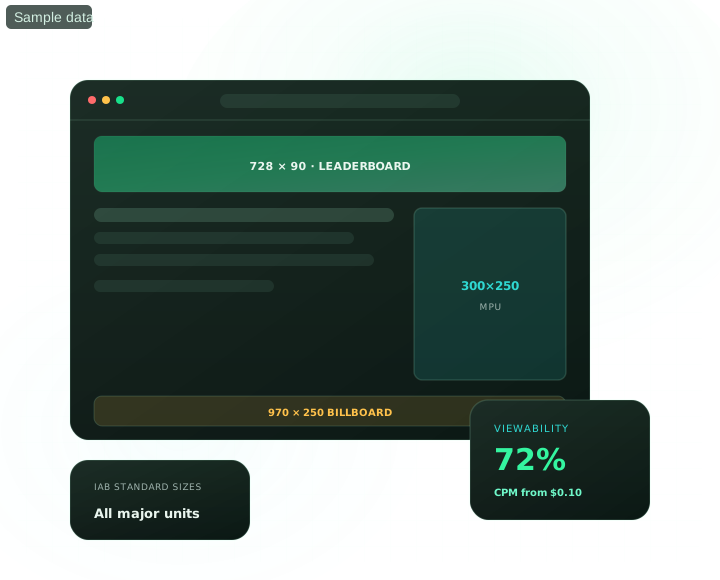
Display banners across premium web inventory: at a glance
What does this page explain about Buy Display Ads from $0.10 CPM?
Quick answer: Choose FroggyAds for display campaigns when your offer needs a designed banner and you want control over targeting, budget and traffic sources. Our published Display entry bid is $0.10 CPM, not a fixed campaign price or a price per customer. Prepare the supported banner sizes, test the destination and judge source performance using the customer action you actually accept.
| Section | Distinct excerpt from this page |
|---|---|
| Measure the opportunity to see | Viewability helps display buyers distinguish served impressions from inventory that met a defined screen-visibility threshold. |
| Recognisable brand creative | Give your offer a consistent visual identity across supported banner placements; evaluate visibility and response separately. |
| Standard creative workflow | Reuse suitable brand assets, then adapt each export to the dimensions and upload requirements of your selected campaign. |
Reference for Buy Display Ads from $0.10 CPM: FTC guidance on online advertising and marketing.
- Planning: Measure the opportunity to see.
- Control: What are display ads?
- Decision: Built to earn attention and convert.
Measure the opportunity to see
Viewability helps display buyers distinguish served impressions from inventory that met a defined screen-visibility threshold.
What are display ads?
Display ads are the standard banner formats that power the open web - leaderboards, medium rectangles, skyscrapers and mobile banners. They are quick to launch with creative you may already have, and they excel at building awareness and keeping your brand visible across a wide pool of vetted inventory.
Built to earn attention and convert
Recognisable brand creative
Give your offer a consistent visual identity across supported banner placements; evaluate visibility and response separately.
Standard creative workflow
Reuse suitable brand assets, then adapt each export to the dimensions and upload requirements of your selected campaign.
Wide inventory
Tap a large, vetted pool of desktop and mobile web placements across 300+ verticals.
Format specs at a glance
Everything you need to brief creative and launch your first display ads campaign on FroggyAds.
Stack targeting to find profitable traffic
Combine these dimensions to narrow in on the audiences that convert, then scale them.
GEO & City
Target by country, region or city with granular bid control.
Device & OS
Split by mobile, desktop or tablet and operating system version.
Browser
Reach users on specific browsers and browser versions.
Carrier & ISP
Filter by mobile carrier or connection type for offer fit.
Category
Buy by content category across 300+ verticals.
Source & Zone
Whitelist or blacklist individual source IDs and zones.
Start small, scale what performs
Transparent floor pricing for display ads - bid up only once a source proves it converts. SmartCPC can assist with bid adjustments based on available campaign signals automatically.
Start running display ads on FroggyAds
Open your account, deposit from $50 and Build your first display ads campaign through the self-serve workflow.
Display ads works across 300+ verticals
A starting point - most verticals can be tested on this format.
Display ads, answered
Why buy display advertising through FroggyAds?
Choose FroggyAds when you want to run banner campaigns with direct control over targeting, bids, budgets and traffic sources. Display gives you a recognisable space for your brand and offer across desktop and mobile web placements. Our self-serve workflow lets you compare those placements against your own sales or lead goals, rather than treating a large impression count as the whole result.
Which banner sizes can I use for FroggyAds display campaigns?
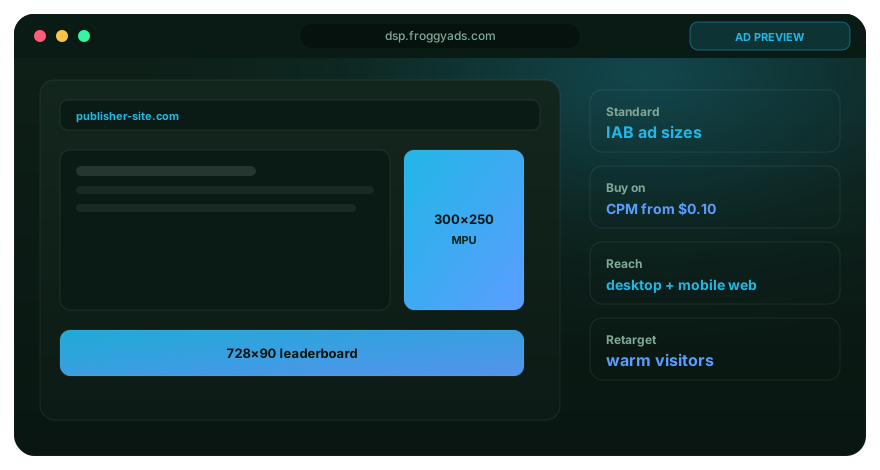
Our published common display sizes are 300x250, 728x90, 320x50, 160x600 and 300x600 pixels. Prepare layouts that use each shape properly instead of shrinking a desktop design into a mobile banner. Keep the offer and call to action readable at the actual size, and confirm the dimensions and asset requirements accepted by your selected campaign before upload.
How much do display ads cost, and what does CPM mean?
Our published Display starting bid is $0.10 CPM: $0.10 per 1,000 impressions at that entry rate, not per click or customer. Actual buying costs depend on the campaign and available inventory. The $50 minimum deposit funds your account; choose a separate display campaign budget. Compare spend with the leads or orders generated before deciding that a low CPM is good value.
Can I run static, animated or HTML5 banner ads?
FroggyAds lists JPG, PNG, GIF and HTML5 among its display creative types, with static and animated options. Check the current upload requirements for your campaign, including any file-size or animation limits. Make the message understandable without waiting through a long sequence. An animated banner still needs a clear offer, readable text and a destination that delivers what the ad promises.
How are display ads different from native ads?
Display typically uses a designed banner in a defined placement. Native advertising adapts a headline and image to the surrounding recommendation or feed layout. Choose display when a recognisable branded visual is central to your message; test native when the headline and surrounding content context may help introduce the offer. Compare the formats on the same business goal rather than assuming one always converts better.
Does a recorded banner impression mean somebody saw my ad?
Not necessarily. A served impression and an impression meeting a defined viewability condition are different measurements. Viewability is useful context when available, but even a viewable banner does not prove attention or buying intent. Keep the measurement definition clear when comparing placements, and connect display spend with subsequent visits and customer actions before expanding a campaign.
What should I put in a display banner to attract relevant clicks?
Present one useful benefit, an identifiable brand and a clear next step. Show the product or service accurately and avoid text that only becomes readable when the banner is enlarged. For a sale, the destination should show the advertised offer; for a trial, explain what the visitor can try. Test a different benefit or visual without changing everything else in the campaign.
Should display clicks go to my homepage or a dedicated landing page?
Send visitors to the page that fulfils the banner's specific promise with the least confusion. A product banner usually needs the relevant product or offer page, while a broader brand message may suit an overview. Test the complete mobile journey, including forms and checkout. Our targeting can bring eligible visitors to your site; the destination must make their next action straightforward.
Why do my banner ads get clicks but few sales or leads?
First compare the banner's promise with what the visitor actually finds. Check loading, form errors, product availability and whether completed actions are recorded. Then separate results by creative, device and source. A high click-through rate can reflect curiosity rather than purchase interest, so judge each variant by qualified results as well as its ability to attract a click.
How should I optimize a display campaign after the first test?
Keep the banners and placements producing useful results identifiable, and investigate weak combinations before raising spend across the board. Our source reports and inclusion or exclusion lists help you direct the next budget toward suitable inventory. Review new traffic separately when you expand. Start a display campaign with FroggyAds and build the next test around what your customers actually do.
Pair it with another format
Choose another format when it serves a different audience or message; compare it against the same accepted business outcome.
Launch your first display ads campaign
Create a FroggyAds account, fund it from the $50 minimum deposit and launch a display test for your selected audience. Campaign delivery depends on available inventory and your settings; conditional 7-day refund eligibility follows the published terms.
See it inside the platform
Everything runs from one self-serve dashboard - launch, target precisely, then watch results by source and optimize in real time.
- Launch and target in one workflow
- Read performance by source ID
- SmartCPC and Adscore in the background
Display Ads execution guides
Choose the examples, sizes, best-practices or cost guide for display ads.
Compare traffic platforms before moving budget
Use the FroggyAds comparison library to review formats, funding, targeting, source controls and migration steps for major advertising platforms.
Display and banner format decisions
Compare display and banner delivery, viewability, buying controls, profitability and creative fit.
Display and Banner buying guides
Compare Display and Banner platform controls, viewability, cost, creative and advertiser use cases.
Display Traffic Evaluation and Research Guides
How do you turn a banner set into a controlled FroggyAds campaign?
Choose FroggyAds when you want to buy display placements while keeping the banner, audience, budget and source decisions in your hands. Our self-serve workflow is a practical fit for a media buyer who already has an offer and needs to test how it performs beyond a single traffic source. Start with one customer action and the creative sizes that your selected inventory accepts. Expand from that working combination rather than uploading every available asset and hoping a blended report explains the result.
1. Match the banner promise to the landing page
Write the action you want a visitor to take before briefing the designer. A product banner should lead to the relevant product or offer, not an unrelated homepage. A software trial banner should explain the actual trial and take the visitor to a usable registration path. An affiliate banner needs a destination and promotion method that the offer owner permits. Keep price, availability and any important condition consistent between the banner and the destination.
For example, a banner advertising a specific subscription plan should not land on a page that shows a different plan by default. That mismatch can create clicks without qualified interest. Save the destination URL and page version with the creative record so you can identify which promise a visitor saw. We recommend testing this handoff on the same device type you intend to buy, including the form, checkout or registration step after the landing page.
2. Design for the actual rectangle, not just the brand template
Our published common display sizes include 300x250, 728x90, 320x50, 160x600 and 300x600 pixels. A 320x50 mobile banner cannot carry the same explanation as a 300x600 layout. Use the smaller space for one benefit and a clear action; use a larger layout to make the product and supporting detail easier to understand. Preview each export at its real display size rather than judging readability from an enlarged design canvas.
Our format specification lists JPG, PNG, GIF and HTML5, but your selected campaign's current upload requirements decide what to deliver. Confirm accepted dimensions, file weight, animation rules and any HTML5 packaging requirements before commissioning a full set. A format accepted by another advertising platform is not automatically accepted here. Keep a static version available for comparison where the selected inventory supports it, and make the first animation frame understandable without waiting for the final frame.
IAB Tech Lab's New Ad Portfolio distinguishes flexible, aspect-ratio-based guidance from fixed-size specifications and emphasizes lightweight, non-disruptive creative. Use that guidance when briefing design, not as a claim that every FroggyAds placement resizes an uploaded banner automatically. For the detailed export checklist, use our display sizes and specifications guide.
3. Keep size, message and traffic source distinguishable
Name each asset so you can connect its size and message to the report. A label such as trial-benefit-a-300x250-v1 is an illustrative naming convention, not a required FroggyAds parameter. Keep your campaign and creative identifiers beside that label. Two assets with the same filename but different promises make later source decisions difficult to explain.
Compare messages within the same size and delivery context first. A 300x250 banner and a 320x50 banner may access different placements; a difference between their results does not isolate the effect of the wording. Once a message has useful evidence, test its adaptation to another supported size. Our source-level reporting and source inclusion or exclusion controls help you keep the placement decision separate from the creative decision.
4. Separate the entry bid, account deposit and campaign budget
Our published Display entry bid starts at $0.10 CPM. CPM means cost per thousand impressions; it is not a price per click, unique person or accepted customer. The live auction can require a different bid. The $50 minimum deposit funds the account and is separate from the amount you choose to allocate to this particular display test. Refund eligibility is governed by our published terms, not by whether a campaign produces the result you hoped for.
Write a campaign spending limit that your business can afford to use for learning. Decide which outcome will justify continuing before delivery begins. A low CPM alone cannot answer that question: you also need the banner's destination to work and the chosen customer action to be measured. Our display cost and budgeting guide develops the pricing decision; this format page helps you assemble a launch-ready banner campaign.
5. Check the measurement handoff before interpreting clicks
Send a known test visit through the destination and confirm that the identifiers you need remain available. Then trigger a permitted test conversion and reconcile it with the system that owns the sale, lead or signup. Record test activity separately from real campaign results. A tracking receipt shows that a message arrived; it does not by itself prove that the advertiser accepted a new customer.
Keep the report's time zone, attribution window and outcome definition consistent. For a lead campaign, distinguish submitted forms from leads your business accepts. For an online store, distinguish an initial order event from an order after the relevant cancellation or refund review. FroggyAds supplies the media-buying controls; your customer records explain what that delivery was worth. This separation helps you diagnose a reporting fault before it becomes a bid or source exclusion.
6. Decide whether to repair the banner, destination or source
If delivery is limited, first confirm campaign approval, compatible sizes, targeting and bid conditions. If delivery is present but response is weak, inspect the message at its served size and review placement context where available. If clicks arrive but the intended action does not, test page loading, product availability and form completion before assigning the entire problem to the traffic source.
When a source produces useful accepted results, keep its identity and the working creative version visible during the next budget change. Add one meaningful variable at a time. Introducing a new size, audience and destination together may increase volume, but it will not tell you which change helped. Choose FroggyAds for this controlled buying workflow: you can act on source evidence while retaining a clear record of the offer and creative that produced it.
Which impression count should drive your display decision?
An impression records a delivery event; it is not a customer, an attention measurement or proof that the banner was noticed. We recommend deciding what you need to learn from a display test before choosing the headline metric. For direct response, connect spend with accepted orders or leads. For a visibility objective, establish the measurement method and coverage available to the campaign instead of relabelling every delivered impression as a view.
Google's Active View documentation separates total, measurable and viewable impressions. Its measurable rate uses total impressions as the denominator; its viewable rate uses measurable impressions. Unmeasured impressions are not automatically non-viewable, and viewability does not establish that a person looked at the ad. Those are useful measurement distinctions, not evidence that FroggyAds provides Active View, identical reporting columns or viewable-only billing.
A worked example: the denominator changes the answer
Hypothetical display report, not FroggyAds campaign results: suppose an advertiser spends USD 60 for 120,000 served impressions. A separate compatible measurement report covers 75,000 of those impressions and identifies 45,000 as viewable under its stated method. The figures below illustrate how to reconcile reports that cover the same campaign and period. They are not recommended targets or a forecast of inventory quality.
| Metric | Calculation | Interpretation |
|---|---|---|
| Served CPM | USD 60 / 120,000 x 1,000 = USD 0.50 | Cost per thousand served impressions in this example. |
| Measurable share | 75,000 / 120,000 = 62.5% | The part of delivered inventory covered by the measurement method. |
| Measured viewability | 45,000 / 75,000 = 60% | The viewable share of measurable impressions, not all served impressions. |
| Known viewable share | 45,000 / 120,000 = 37.5% | The share of all delivered impressions confirmed viewable by this report. |
| Unmeasured share | 45,000 / 120,000 = 37.5% | The remaining measurement gap; do not automatically classify it as failed visibility. |
| Spend per 1,000 known viewable impressions | USD 60 / 45,000 x 1,000 = USD 1.33, rounded | An analytical ratio using all spend, not a viewable-impression invoice rate. |
On a narrow screen, scroll the table horizontally to read the calculation and interpretation together.
The same hypothetical campaign therefore has a served CPM of USD 0.50 and measured viewability of 60%. Reporting only one figure hides either cost or coverage. Reporting 60% as the share of all served impressions would use the wrong denominator. The USD 1.33 ratio is not Google's reported average viewable CPM and does not establish a FroggyAds vCPM buying option; it is the advertiser's own calculation across these assumed reports.
Connect visibility to the customer action you actually need
Continue the hypothetical example with 240 clicks and six accepted orders. The served-impression CTR is 240 / 120,000 = 0.20%, while cost per accepted order is USD 60 / 6 = USD 10. Those numbers describe different stages. They cannot establish profitability without order value, non-media costs and the relevant reversals. They also do not show that all sales were caused by the banner or that all clicks came from the measurable subset.
Use this distinction in your next FroggyAds source review. A placement can attract clicks yet produce weak accepted value. Another can have lower click response but a more useful customer journey. Keep the creative, device and source context with the outcome before deciding whether to change the banner or restrict the source. When compatible viewability data is unavailable, record that limitation and evaluate the measurements you genuinely have; do not manufacture a visibility score.
Give each display test one clear next action
For a new banner, the next action might be to retain the message and test another supported size. For a placement with unreliable measurement, it may be to investigate the reporting gap before increasing spend. For a campaign with accepted orders inside your own cost limit, it may be to expand the validated source group while keeping a comparison period. Our source controls make these media decisions actionable, while your own acceptance rules keep the result connected to customers rather than raw traffic.
Use our ad viewability measurement guide for the measurement question and our native-versus-display comparison when you are still choosing the format. For a campaign that needs a designed banner, supported dimensions, clear budget boundaries and source-level decisions, start with FroggyAds and test the complete banner-to-customer path.
Display banners across premium web inventory — what matters first
Display banners across premium web inventory is useful when the format fits the user journey, device context, creative requirements and measurable conversion path.